The Ultimate Footwear Sourcing Guide for Bangladesh
Footwear sourcing guide for Bangladesh: leather and non-leather products, EPB market data, supplier verification, MOQ and pricing drivers, quality checks and duties.
Short answer
Bangladesh is a large footwear producer and a growing exporter, and this footwear sourcing guide shows buyers how to use that base in a controlled way. Source by product family, leather or non-leather, verify the factory and its ERC, material chain and export record, fix specification, MOQ drivers, price split and lead time in writing, require destination chemical tests and AQL inspection, and confirm the Chapter 64 code and duty before shipping.
On this page
Key takeaways
Bangladesh ranked seventh in world footwear production in 2025 with around 554 million pairs, while exports remain a smaller share of output, so export-ready factories must be selected individually.
EPB-based research put footwear exports at approximately US$1.19 billion in fiscal year 2024-25, with leather footwear at approximately US$672 million.
There is no single typical footwear MOQ: minimums are set per style and per colour by material lots, sole and mould economics, component minimums and line setup.
Footwear is classified in HS Chapter 64 by upper and sole material, and the heading drives the duty line in the EU, the UK, the US and the UAE.
For EU sales, chromium VI in skin-contact leather must stay below 3 mg/kg under REACH, and tannery LWG evidence covers the tannery, not the shoe factory.
This footwear sourcing guide is for importers, brands, retailers and sourcing agents in the United States, the United Kingdom, the European Union and the United Arab Emirates who want to buy finished footwear from Bangladesh in a controlled way. A shoe is not one item but a build, made of an upper, a lining, an insole, an outsole, adhesives, eyelets, laces and packing, and each part can come from a different supplier. Your control over the order depends on naming every part, fixing the specification in writing, and checking the factory against that specification before production starts.
Bangladesh gives you two distinct supply routes. Leather footwear is built on a domestic hide base and a tannery sector concentrated at the Savar tannery estate, while non-leather footwear, including sneakers, sandals and synthetic shoes, depends far more on imported materials such as EVA and PU compounds, rubber soles and adhesives.1 The checks, cost drivers and compliance evidence differ between the two routes, so decide which route your product takes before you compare quotations. Exportain lists footwear inside its Leather, Footwear and Travel Goods category, one of 20 export categories on the marketplace.2
Market overview with latest data
Read the export figures at the level the Export Promotion Bureau (EPB) reports them, and keep each statistical series separate. The EPB reports leather as one sector with three lines, leather itself, leather products and leather footwear, and reports footwear other than leather as a separate line again, so do not treat the headline leather sector total as a footwear figure.
On the EPB shipment series reported by The Financial Express, leather and footwear exports together reached US$591.5 million in the period to October of fiscal year 2025-26, up 9.7 percent from US$539.4 million a year earlier.3 That total covers the whole leather sector, not footwear alone. For the footwear line itself, EPB data reported by The Financial Express put leather footwear export receipts at US$545.35 million in the first ten months of fiscal year 2024-25, a rise of 26.08 percent, inside total leather exports of US$1,057.82 million for July 2024 to May 2025, up 12.55 percent.4
Research that compiles the same official series for a full year gives a wider frame. LightCastle Partners, compiling EPB-based figures for fiscal year 2024-25, put total leather goods and footwear exports at US$1.67 billion, with footwear alone at approximately US$1.19 billion, or 72 percent of the sector, and leather footwear at approximately US$672 million.1 The Daily Star, also reporting EPB figures, recorded leather footwear at US$672 million in fiscal year 2023-24 and US$544 million by June of fiscal year 2024-25.5 The two publications attach the US$672 million figure to different fiscal years, which is why this guide names the publication, the series and the period beside every figure instead of merging them into one headline number.
Production volume tells a different story from export value, and the gap between them is the central sourcing fact in this market. The World Footwear Yearbook 2026, published under the initiative of the Portuguese Footwear, Components and Leather Goods Manufacturers Association (APICCAPS) and reported by Prothom Alo, ranked Bangladesh as the seventh-largest footwear manufacturer in the world, producing around 554 million pairs in 2025, or 2.3 percent of global production of 24.6 billion pairs, while noting that Bangladesh did not appear in the list of the ten largest footwear exporters.6 LightCastle Partners put annual production at approximately 423 million pairs across more than 3,600 production units, with roughly 90 large export-oriented factories, and estimated exports at approximately 85 million pairs a year, about 20 percent of production.1 The two compilations cover different periods, so read them as a range for capacity, not as one count.
Main products and production clusters
Which footwear products does Bangladesh export?
Buyers source four product families from Bangladesh:
Product family | Typical constructions | What to specify first |
|---|---|---|
Leather footwear | Dress shoes, casual shoes, boots, sandals and loafers with leather uppers | Leather type and thickness, tannery source, lining, sole material |
Non-leather and synthetic footwear | Shoes with synthetic or textile uppers, including sneakers and sports-style shoes | Upper composition, sole compound, bonding method, colourfastness |
Rubber and plastic footwear | Sandals, slippers and waterproof footwear of rubber or plastics | Mould ownership, compound, size grading, assembly strength |
Children's footwear | Smaller size runs across the families above | Size grading, skin-contact materials, destination labelling rules |
Classification follows the same material logic. Footwear sits in Chapter 64 of the Harmonized System, and the United States Harmonized Tariff Schedule (HTS) Chapter 64, 2026 Revision 15, sets the headings by upper and sole material: heading 6401 covers waterproof footwear with outer soles and uppers of rubber or plastics whose uppers are neither fixed to the sole nor assembled by stitching or similar processes, heading 6402 covers other footwear with outer soles and uppers of rubber or plastics, heading 6403 covers footwear with uppers of leather, heading 6404 covers footwear with uppers of textile materials, heading 6405 covers other footwear, and heading 6406 covers parts of footwear.7 Chapter 64 note 4 states that the material of the upper is the constituent material with the greatest external surface area, ignoring accessories and reinforcements, and that the material of the outer sole is the material with the greatest surface area in contact with the ground.7 Confirm the heading for your exact construction before you cost the order, because the heading drives the duty line in every destination.
Where are the production clusters?
Tanning is concentrated at the BSCIC Tannery Industrial Estate in Savar, where tanneries were relocated from Hazaribagh, and The Financial Express counted 200 tanneries and 3,500 small and medium enterprises producing wet blue, crust and finished leather across the country.4 Footwear making clusters around the Dhaka industrial belt, including Gazipur, Savar and Ashulia, with further production around Narayanganj, Cumilla and Chattogram, close to the port. Treat cluster names as a starting point for a search, not as evidence about any one factory. What matters is the individual factory's product family, its export history for your destination, and the origin of its upper material: a factory that buys finished leather from a Savar tannery carries one evidence chain, and a factory that imports finished leather or synthetic uppers carries another.1
How to find and verify suppliers
Where do you find footwear suppliers in Bangladesh?
Work from three channels and merge the results into one long list. First, search supplier directories and marketplaces by product family, not by the word footwear alone: a sneaker factory and a leather dress shoe factory rarely overlap. On Exportain, supplier profiles sit inside the Leather, Footwear and Travel Goods category and carry review badges that state what Exportain checked.2 Second, use the trade association route: the Leathergoods and Footwear Manufacturers and Exporters Association of Bangladesh (LFMEAB) represents leather goods and footwear makers, and its member records help you confirm that a company operates in the sector. Third, use the structured search in finding suppliers in Bangladesh to size the sector before you spend time on individual factories.
What should you check before you request a quotation?
Verify the company before you discuss price:
Legal identity and export status. Ask for the trade licence, business registration and Export Registration Certificate (ERC), and check that the names match across documents and match the bank account you will pay. On Exportain, the Exportain Verified badge means Exportain has checked the seller's identity, phone, email and business registration, and the Export Verified badge means it has checked the seller's ERC.2
Maker status. Confirm whether the company is the factory, a trading company working with named factories, or an agent. Each model can work, but the contract, the inspection access and the party responsible for defects differ. The Factory Verified badge on Exportain means Exportain has reviewed photos of the manufacturer's factory, and the Trading Company Verified badge means it has reviewed photos of the trading company's office or warehouse.2 Photo review is not a factory inspection: Exportain states its document review is a review by the Exportain team, not an inspection.2
Product fit. Ask which product families the factory produces for export, which constructions it runs, and which destinations it already ships to.
Material chain. For leather footwear, ask which tannery supplies the leather, whether that leather is finished in Bangladesh or imported, and what audit or test evidence the tannery holds, because environmental performance at the Savar estate affects whether tanneries can obtain Leather Working Group certification.4 For synthetic footwear, ask where uppers, soles and adhesives come from, since imported inputs drive both price and timing.1
Capacity and size range. Ask for daily output on your construction, the size range the factory grades, and its current order load for your delivery window.
Compliance file. Request the test reports and certificates your destination requires, and check the holder name, site address, scope and expiry date on each one. Reject any certificate that names a different company or a different site.
Shortlist two or three suppliers that pass these checks, then move to samples. The general ordering sequence in how to import from Bangladesh applies to footwear as it does to other categories.
MOQ, pricing and lead times
What sets the minimum order quantity for footwear?
There is no single typical MOQ for footwear from Bangladesh, and any supplier or guide that quotes one number for the whole category is describing its own factory, not the market. Minimums are set per style, per colour and often per size run, and they are driven by material lots rather than by the shoe itself:
Upper material lots. Leather is bought by area and cut for a style, so a small run wastes a larger share of each hide. Synthetic and textile uppers are bought in rolls or batches with their own minimums, and a dyed-to-order colour raises the minimum for that colour.
Sole and mould economics. An existing outsole in a standard size range is cheaper to run than a new mould. A private mould, a new last or an unusual size range adds tooling that the factory recovers across quantity.
Component minimums. Eyelets, buckles, zips, laces, insoles, labels, printed boxes and cartons each carry supplier minimums, and the highest component minimum often sets the order minimum.
Production line setup. Lasting, stitching and finishing lines are set per style, and short runs spread that setup over fewer pairs.
How is a footwear price built?
A footwear quotation is a stack of material, making and export costs. Ask the supplier to split it into upper material, lining and insole, outsole and midsole, components and trims, making labour, testing and inspection, packing, and delivery under the agreed Incoterms rule. Two quotations that look far apart often differ in only one layer of the stack, most commonly the upper material grade or the sole compound. Compare quotations only at the same specification, the same Incoterm and the same destination point.
Example figures: a buyer receives a quotation of 8.40 per pair for 3,000 pairs of a synthetic-upper shoe on FOB Chattogram terms, freight and insurance to the destination port of 0.90 per pair, and duty, clearance and local delivery estimated by the buyer's broker at 1.10 per pair. The landed cost per pair is 8.40 plus 0.90 plus 1.10, which equals 10.40 per pair before the buyer's own warehousing and distribution. Replace every line with your own quotation, freight quote and broker estimate. The method is set out in landed cost for imports from Bangladesh.
What drives lead time?
Lead time is product- and input-specific, and it runs from sample approval, not from first contact. It covers material purchase, including tanning and finishing time for leather or import time for synthetic uppers, soles and adhesives, then cutting, stitching, lasting, finishing, testing, inspection, packing and transport to the port. Imported inputs are the usual constraint on non-leather footwear, and dyed-to-order leather is the usual constraint on leather footwear.1 Require a written lead time for your product and delivery month, split into material time and production time, and confirm the production slot in the purchase order. Treat a lead time quoted without a material breakdown as unconfirmed.
Quality, certifications and compliance
Which chemical rules apply to footwear sold in the EU?
Chemical compliance is set by your destination, not by the factory's home market. For leather sold into the European Union, Commission Regulation (EU) No 301/2014 amended Annex XVII to the REACH Regulation so that leather articles coming into contact with the skin must not be placed on the market where they contain chromium VI in concentrations equal to or greater than 3 mg/kg, which is 0.0003 percent by weight of the total dry weight of the leather, and the same limit applies to any leather part of an article that comes into contact with the skin.8 The regulation names EN ISO 17075 as the internationally recognised analytical method for detecting chromium VI in leather.8 In practice: for every leather style, require a chromium VI test report on the finished leather that names the material, the colour and the tannery batch, and repeat the test when the tannery or the leather source changes. Research on this sector notes that EU market participation is increasingly conditioned on REACH chemical compliance and on tannery environmental certification.1
What does Leather Working Group certification cover?
The Leather Working Group (LWG) has designed standards since 2005 to certify actors across the leather supply chain, from rawhide to finished leather, and a leather manufacturer, leather trader, commissioning manufacturer or subcontractor may be audited against the applicable LWG audit standard.9 LWG states that audits and the assurance process against its standards are carried out by LWG Assurance Services, which it describes as the only officially recognised assurance body for the Leather Working Group.9 An LWG certificate answers a question about the tannery, not about the shoe factory. Ask the shoe factory which tannery supplies your leather, then check that tannery's certificate for holder, site, scope and expiry. The gap matters in Bangladesh: The Financial Express reported that tanneries are unable to obtain the LWG certificate where the central effluent treatment plant at Savar is not fully functional, and that major global brands stipulate products made with leather from LWG-certified companies.4 Where your standard requires LWG leather and the factory's tannery cannot evidence it, the factory may import certified finished leather instead, so settle that route before sampling, not after.
How should you inspect a footwear order?
Inspection decides whether the specification you agreed is the product you receive. Define the inspection in the purchase order: the checkpoints, the sampling plan, the defect classification and the party who inspects. For sampling, ISO 2859-1:2026 specifies sampling schemes indexed by acceptance quality limit (AQL) for lot-by-lot inspection by attributes, and defines single, double and multiple sampling schemes.10 ISO describes AQL as the maximum average percentage of defective items considered acceptable during random sampling, used to determine sample sizes and acceptance and rejection thresholds.10 Agree the AQL level for critical, major and minor defects in writing, and name the standard in the contract so both sides read the same tables. Footwear-specific checks at final inspection include pair matching and colour consistency across the size run, upper material and stitching quality, sole bonding and flexing, size and fitting against the graded size set, insole and lining finish, labelling and country-of-origin marks, and carton count and packing against the packing list. The process in pre-shipment inspection and the sampling method in AQL acceptance quality limit apply directly to footwear lots.
Shipping, Incoterms and duties
Which Incoterms rule should a footwear buyer use?
Incoterms rules are the standard trade terms published by the International Chamber of Commerce (ICC). First published by the ICC in 1936, the Incoterms rules are a set of eleven three-letter trade terms for contracts for the sale and purchase of goods, and they clarify the tasks, costs and risks involved in the delivery of goods from sellers to buyers.11 The current edition, Incoterms 2020, entered into force on 1 January 2020.11 Name the exact place beside the rule, for example FOB Chattogram or CIF Rotterdam, because the named place fixes where delivery and risk transfer happen.
For containerised footwear from Bangladesh, three patterns cover most orders:
Rule | What the seller handles | What the buyer handles | When it fits |
|---|---|---|---|
EXW (Ex Works) | Makes the goods available at the named place, usually the factory | Export handling, freight, insurance, import clearance and duty | Only where the buyer has its own export handling in Bangladesh |
FOB (Free On Board) | Delivers the goods on board the vessel at the named port of loading and handles export clearance | Main freight, insurance, import clearance and duty | The common pattern where the buyer controls freight and consolidation |
CIF (Cost, Insurance and Freight) | Delivers on board, pays freight and minimum insurance to the named destination port | Import clearance, duty and onward delivery | Where the buyer wants the seller to arrange freight and accepts minimum-cover insurance |
Risk and cost do not move together under every rule: under CIF the seller pays freight to the destination port while risk passes at loading. Read the full comparison in Incoterms for shipments from Bangladesh.
How are duties set for footwear from Bangladesh?
Duty is set by the destination tariff on your confirmed Chapter 64 heading and subheading, by the origin of the goods and by the preference scheme in force on the entry date.7
European Union. The Everything But Arms (EBA) scheme is the special arrangement for least developed countries, granting full duty-free and quota-free access to the EU Single Market for all products except arms and ammunition.12 The European Commission describes EBA in the same terms.13 A preference is a claim, not an automatic rate: the goods must meet the scheme's rules of origin and travel with the required proof of origin, so confirm both with your broker for your heading before you price the order. Research on this sector flags potential most-favoured-nation tariff exposure in the EU after graduation from least developed country status if no replacement preference applies,1 so price long contracts with that change in view and re-check the rate at each shipment.
United Kingdom. The UK runs its own preference arrangements and its own tariff. Take the rate from the UK Trade Tariff for your commodity code and entry date, and do not reuse an EU rate for a UK entry.
United States. The United States applies its HTS rates to Bangladeshi footwear, and Chapter 64 rates vary widely by heading, material and value line, as the HTS Chapter 64 schedule shows line by line.7 No general scheme removes footwear duty for Bangladesh in the way EBA does in the EU, so build duty into the landed cost from the start, using the full ten-digit line for the exact construction.
United Arab Emirates. UAE entries follow the Gulf Cooperation Council common external tariff and UAE customs rules for the specific heading. Confirm the applied rate and any re-export documentation with a local broker, since footwear is often imported into the UAE for onward distribution.
This guide states no duty rate for any heading: confirm the rate beside your confirmed code, for your origin and your entry date, before you commit to a selling price.
Step-by-step buying process
The diagram below summarises the sequence.
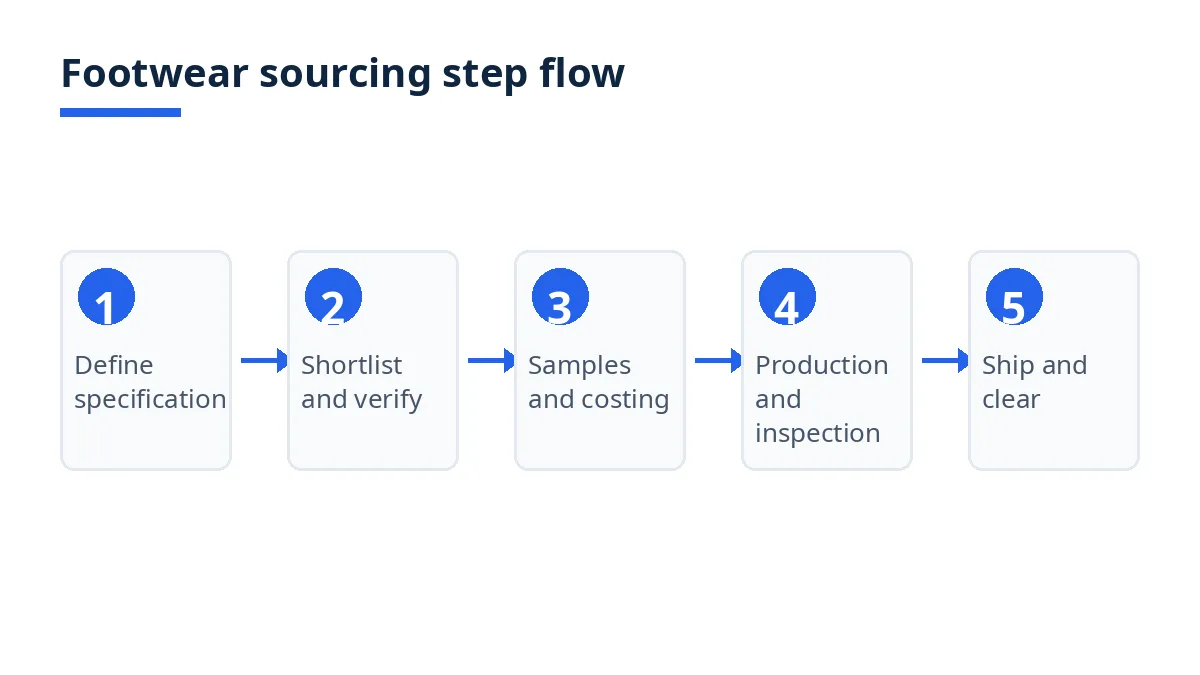
Define the specification. Write the tech pack for each style: upper material and thickness or composition, lining, insole, outsole compound and attachment method, size range and grading, colours, labelling, packing and carton specification. Add the destination compliance file, including the chemical limits and test reports you will require.8
Shortlist and verify suppliers. Build the long list from directories, the trade association and marketplace profiles, then run the six verification checks in this guide, including ERC, maker status and material chain.2
Request quotations on one specification. Send the same tech pack, quantity, destination and Incoterms rule to each shortlisted supplier, and require the price split and the MOQ by style and colour.
Sample and test. Order pre-production samples, check fit across the size set, and send the upper material for the destination tests, including chromium VI testing for leather under EN ISO 17075 where the EU is the destination.8 Approve or correct the sample in writing.
Agree the contract and payment terms. Fix specification, quantity, price, Incoterm and named place, lead time, inspection plan with AQL levels under ISO 2859-1,10 packing, documents and payment stages in one purchase order or contract.
Monitor production. Confirm material arrival and hold a mid-production check on the first finished pairs against the approved sample.
Inspect before shipment. Run the final inspection on the agreed sampling plan and release shipment only on a passed or formally accepted report.
Ship, clear and review. Receive the export documents, including the commercial invoice, packing list, bill of lading and proof of origin where a preference is claimed,13 12 clear the goods on the confirmed Chapter 64 code,7 and record defects, timing and communication quality against the supplier for the next order.
Related guides
Leather goods sourcing guide for bags, belts, wallets and other leather products made by the adjoining factory base.
Leather goods industry in Bangladesh for the tannery and leather sector background behind leather footwear.
How to import from Bangladesh for the general ordering, documents and payment sequence.
Bangladesh export data for the EPB series behind the market figures in this guide.
FAQs
Is Bangladesh a good place to source footwear?
Bangladesh can be a good place to source footwear when the product family and the factory are matched and the material chain is named. The country produced around 554 million pairs in 2025 and ranked seventh in world production in the World Footwear Yearbook 2026,6 and footwear exports were approximately US$1.19 billion in fiscal year 2024-25 on EPB-based research figures.1 The outcome depends on factory verification, material evidence and inspection, not on the country label.
What is the typical MOQ?
There is no single typical MOQ for footwear. Minimums are set per style and per colour by upper material lots, sole and mould economics, component minimums and line setup. Ask each supplier to state its MOQ against your exact specification and to name the driver that sets it.
How long is the lead time?
Lead time is product- and input-specific and runs from sample approval. It covers material purchase or import, production, testing, inspection, packing and transport to the port. Require a written lead time split into material time and production time for your delivery month, and confirm the slot in the purchase order.
Which certifications matter?
The certifications that matter are set by your destination and your buyer standard. For leather sold into the EU, chromium VI in skin-contact leather must stay below 3 mg/kg of the total dry weight of the leather under the REACH restriction.8 Where tannery environmental performance matters, an LWG audit covers the tannery against the applicable LWG standard.9 For inspection, AQL sampling under ISO 2859-1 gives both sides one agreed method.10 Check the holder, site, scope and expiry date on every certificate.
Next steps on Exportain
Check the current market picture on Exportain Trade Intelligence, then browse Bangladeshi suppliers in the footwear categories against your specification and run the verification checks in this guide on each profile. When the specification is ready, post a free RFQ on the Exportain RFQ board with style, quantity, destination and delivery term, so suppliers quote against the same specification. Exportain is a B2B marketplace: it is not a party to the goods contract, and it does not inspect goods, book freight or clear customs.2
Sources
- Leather & Footwear as The Next Export Frontier of Bangladesh. LightCastle Partners (accessed )
- Exportain | Bangladesh B2B Export Marketplace. Exportain (accessed )
- Leather industry poised to reach full potential. The Financial Express (accessed )
- Bangladesh needs to accelerate green transformation of the leather industry. The Financial Express, (accessed )
- Turning leather into lasting growth. The Daily Star, (accessed )
- Bangladesh ranks 7th globally in footwear manufacturing, China on top. Prothom Alo, (accessed )
- Harmonized Tariff Schedule of the United States, Chapter 64 (2026 Revision 15). U.S. International Trade Commission (accessed )
- Commission Regulation (EU) No 301/2014 amending Annex XVII to Regulation (EC) No 1907/2006 (REACH) as regards chromium VI compounds. European Union, (accessed )
- Understanding certification. Leather Working Group (accessed )
- ISO 2859-1:2026 - Sampling procedures for inspection by attributes — Part 1: Sampling schemes indexed by acceptance quality limit (AQL) for lot-by-lot inspection. ISO (accessed )
- Incoterms® rules. International Chamber of Commerce (ICC) (accessed )
- Trade arrangements. European Commission, Access2Markets (accessed )
- Generalised Scheme of Preferences. European Commission (accessed )
About the author
Sourcing from Bangladesh?
Post a request for quotation and suppliers on Exportain can send you their quotes directly.
Post an RFQ