The Ultimate Leather & Leather Goods Sourcing Guide for Bangladesh
Leather and leather products exports were USD 366.88 million in Q1 fiscal 2027 on EPB data. This guide covers products, clusters, supplier checks, MOQ, quality and duties.
Short answer
This leather goods sourcing guide shows buyers how to source handbags, wallets, belts, gloves and other leather goods from Bangladesh. It uses EPB data for leather, leather products and leather footwear, explains product families and the Savar tannery cluster, and sets out supplier and tannery checks, MOQ, price and lead time drivers, chemical and audit rules, classification and duties, and a step-by-step buying process.
On this page
Key takeaways
EPB data put leather and leather products exports at USD 366.88 million in the first quarter of fiscal 2027, with leather products at USD 119.59 million, up 16.42 percent.
Provisional EPB data put fiscal 2025-26 leather and leather products exports at USD 1.23 billion, a separate series from Bangladesh Bank receipts of USD 1,197.5 million for 2024-25.
Heading 4202 covers handbags, wallets, purses, briefcases and travel bags, and the exact line follows the product type and the material of the outer surface.
There is no single typical MOQ, price or lead time in this category; each is quoted per supplier, per product, per colour and per leather against a written specification.
Skin-contact leather at or above 3 mg/kg chromium VI must not be placed on the UK market, and an LWG tannery audit covers 17 sections with medal thresholds of 85, 75 and 65 percent.
If you buy handbags, wallets, belts, gloves or other leather goods, this guide shows how to source them from Bangladesh in a controlled way. Leather goods sit at the end of a chain that starts with raw hides, passes through tanning and finishing, and ends with cutting, stitching, edge finishing and hardware fitting. Each stage uses different skills and checks, so match each product to a factory equipped for that construction, confirm where its leather comes from and how it was made, and fix specification, quantity, price and timing in writing before production starts. It states no single typical price, minimum quantity or lead time, because none exists across a range from a card wallet to a structured handbag.
Market overview with latest data
Read the export figures at the level the Export Promotion Bureau (EPB) reports them. The EPB reports leather as one sector with three lines: leather itself, leather products and leather footwear. A buyer of leather goods should read the leather products line most closely: leather footwear is a separate line made by different factories, and finished leather is an input, not a finished product.
For the first quarter of fiscal year 2027, July to September, EPB data reported by BizBD Review put leather and leather products exports at USD 366.88 million, up 14.74 percent from USD 319.74 million a year earlier.1 Within the sector, leather footwear earned USD 208.72 million, up 12.45 percent, leather products grew 16.42 percent to USD 119.59 million, and leather exports rose 22.80 percent to USD 38.57 million.1 The Financial Express, reporting the same EPB release, recorded the same 14.74 percent cumulative growth and 20.19 percent growth in September alone.2
For the full fiscal year 2025-26, provisional EPB data reported by United News of Bangladesh (UNB) put leather and leather products exports at USD 1.23 billion, up 7.09 percent.3 Total merchandise exports were USD 48,001.91 million on the same data, so leather remains a small, specialised sector beside garments.3
Bangladesh Bank records the same trade through the banking channel, on a different basis. Its annual publication for 2024-25 records total export receipts for goods of USD 43,559.3 million, of which leather and leather manufactures were USD 1,197.5 million, up 9.4 percent.4 Bangladesh Bank states that its receipts figures can differ from the figures compiled by the Bangladesh Bureau of Statistics and the EPB because of differences in valuation, timing and coverage, since receipts are recorded when proceeds are received through banks.4 Use the EPB series for shipment momentum and the Bangladesh Bank series for money actually received, and keep the two series separate: they cover different years on different bases, so do not add or average them.
For sourcing, the figures point to three conclusions. First, leather products are a growth line inside the sector, which supports a serious search for goods factories rather than only footwear factories. Second, the finished leather line is small beside the products and footwear lines, so confirm the origin and finish of the leather in your product: a goods factory may buy finished leather from a Bangladeshi tannery or import it, and each route carries different evidence. Third, environmental performance in tanning affects market access. A Daily Star sector review reported that the Central Effluent Treatment Plant (CETP) at the Savar tannery estate has struggled to operate at the required standard, and that when the CETP is underperforming, tanneries cannot meet buyer environmental checks.5 Ask where the leather was tanned and what evidence covers that site, rather than accepting a general statement about the sector.
Main products and production clusters
Fix your product family before you look for factories. Each family uses different patterns, machines and checks, and a factory set up for one family does not automatically produce another well.
Bags and travel goods. Handbags, shopping bags, briefcases, backpacks, travel bags and similar containers, specified by leather type and thickness, lining, structure, edge finish, stitch density, handles and straps, zips and hardware, and dimensions. Handles, strap attachments and base structure decide whether a bag keeps its shape and carries weight, so specify reinforcement and test loaded handles on the sample.
Small leather goods. Wallets, purses, card cases, key cases and similar articles normally carried in the pocket or handbag, specified by leather, lining, card-slot dimensions, edge painting or folding, and stitching. Panel selection and colour matching across a set decide the visible quality.
Belts, gloves and clothing accessories. Belts specified by strap width and thickness, buckle finish, hole spacing and edge finish. Gloves specified by leather thickness, sizing, lining, stitch type and fit. These products come into prolonged contact with the skin, so the chemical limits in the compliance section apply directly.
Where the clusters are
Tanning is centred on the tannery estate at Savar, where the CETP discussed above serves the estate.5 Goods making is a separate stage: cutting, stitching and finishing can sit in a different factory from the tannery that produced the leather, so record both sites for every order and confirm the leather in your product can be traced between them.
The sector trade body is the Leathergoods and Footwear Manufacturers and Exporters Association of Bangladesh (LFMEAB). Its president's message states that LFMEAB is a trade body that represents manufacturers and exporters of leather products, footwear, synthetic and allied factories located in Bangladesh, and that its objective is a healthy business environment between local manufacturers and exporters and their buyers.6 Use association membership as a starting point for a long list and as one identity check, not as evidence that a specific factory can make your product.
Classification decides the duty line
Classify each product before you negotiate the final price, because the code follows the product type and its outer surface, not the marketing name. The Harmonized System maintained by the World Customs Organization (WCO) comprises more than 5,000 commodity groups, each identified by a six-digit code, and it is used by more than 200 countries and economies as the basis for their customs tariffs, with over 98 percent of merchandise in international trade classified in its terms.7 Heading 4202 covers trunks, suitcases, briefcases, travelling bags, handbags, shopping bags, wallets, purses, tool bags, sports bags and similar containers, of leather or of composition leather, of plastic sheeting, of textile materials or of other materials named in the heading, and the United Kingdom tariff notes that for heading 4202 subheadings the term outer surface means the material visible to the naked eye.8
Product family | Indicative heading | What decides the exact line |
|---|---|---|
Handbags, wallets, purses, briefcases, travel and sports bags | 4202 | Product type and the material of the outer surface |
Gloves, belts and other articles of apparel and clothing accessories of leather | 4203 | The article type, as the chapter notes apply heading 4203 to gloves, mittens and mitts, aprons and other protective clothing, braces, belts, bandoliers and wrist straps |
Read the table as indicative only. In the United Kingdom tariff, the third-country duty on commodity line 4202 9900 90, an other line under heading 4202, is 2.00 percent, which shows that rates differ by the exact line even inside one heading.8 Confirm the full national code in the destination tariff for your exact product before you price the order.
How to find and verify suppliers
Start from your specification, not from a supplier list. For bags, it states leather type, origin and thickness, lining, structure, dimensions, hardware, stitching, edge finish, labelling, packing and test evidence. For small goods, it states leather, panel selection, dimensions, slot and fold construction and edge treatment. For gloves and belts, it adds sizing, fit or hole spacing and the chemical test evidence for skin contact. See how to write an RFQ and finding suppliers in Bangladesh.
Build a shortlist from the Exportain category directory, association membership, trade data and referrals, then run the same sequence on every candidate:
Identity. Match the legal name, trade licence details and factory address across the supplier documents and its online presence. Resolve any inconsistency in writing before you discuss price.
Producing sites, plural. Record which site tans or supplies the leather and which site cuts, stitches and finishes your product, and which stages are bought in: hardware, lining, zips and edge paint where used. A bought-in stage is workable when it is named.
Leather evidence for the exact product. Ask which tannery made the leather in your sample, what finish and thickness it carries, and what audit or test evidence names that tannery and that leather. Evidence for a different leather or site is background only.
Capability. Ask which cutting, skiving, stitching, edge-finishing and hardware-setting equipment will produce your order, and who checks handles, straps and closures. Ask to see finished edges on a sample in your leather.
Sample in your specification. Order a pre-production sample in your leather, colour, lining and hardware, then check dimensions, stitching, edge finish, colour consistency across panels, and function of zips, snaps and buckles. Seal a counter-sample once approved.
Export readiness. Ask which markets the supplier ships this family to, which documents it prepares as a routine, and its export registration and association position. If a supplier claims LFMEAB membership, confirm the claim with the association.6
Capacity in your window. Ask how much of the line is already booked, where leather for your order will come from, and what happens if approvals slip.
Independent checks. For larger programmes, use an independent inspection company for a factory audit or a pre-shipment inspection.
Payment discipline. Agree payment terms that match the risk of a new relationship. Confirm bank details through a second channel before paying, and treat any late change of bank details as a reason to pause and re-verify.
Warning signs include a quote far below comparable offers, refusal to sample in your leather, pressure to pay quickly to a personal account, reluctance to identify the tannery or the producing factory, and certificates naming a different company, site or product.
Sourcing through Exportain. On Exportain, read each badge for what it records. Supplier verification is a document review by Exportain staff, and it is not a factory inspection and not a check against a government database.9 Exportain Verified means Exportain has checked identity, phone, email and business registration, Export Verified means it has checked the Export Registration Certificate (ERC), Factory Verified means it has reviewed photos of the manufacturer factory, and Trading Company Verified means it has reviewed photos of the trading company office or warehouse.9 A badge is not a guarantee of production capacity, product quality or delivery, verification is free, and membership plans never grant a trust badge.9 Every submission is reviewed by Exportain staff before a badge is approved.10 When you accept a quotation, Exportain creates one order and issues one proforma invoice from the accepted terms.9 The guide to how supplier verification works on Exportain sets out each check.
MOQ, pricing and lead times
Buyers routinely ask for one typical minimum order quantity (MOQ), one typical price and one typical lead time. None exists as a single figure here. Each is quoted per supplier, per product, per colour and per leather, against a written specification, so name the drivers in your enquiry.
What sets the minimum order quantity?
MOQ is driven by the smallest workable lot at each stage: hide and finished-leather lots, dye and finish lots where leather is coloured to order, and lining, hardware, label and carton print runs for private-label goods. A wallet in a running leather and standard colour will normally carry a lower minimum than the same wallet in a dyed-to-order colour with your label and hardware finish, because the second version is a separate leather and trim commitment. Expect minimums per style and per colour, not only per order. The minimum order quantity definition explains how minimums are set.
What does the price consist of?
Pricing is built from leather, lining and reinforcement, hardware, making, edge finishing, testing, packing, inland transport and margin, then expressed on the agreed delivery term. Leather is a major cost element, so a quote that does not state leather type, origin and thickness cannot be compared with another quote. Compare quotations only on an identical specification: a cheaper quote in thinner leather or a different finish is a different product, not a saving.
Delivery terms decide who pays for which leg, so quotations on different terms are not comparable until you adjust them. Example figures: two suppliers quote for the same handbag, one at USD 18.40 per piece EXW and one at USD 19.10 per piece FOB. Adding inland transport, export handling and loading of USD 0.55 per piece to the EXW quote gives a like-for-like FOB cost of USD 18.95 per piece, so the real gap is USD 0.15 per piece, not USD 0.70. Use the same adjustment with the landed cost for imports from Bangladesh method.
How long does an order take?
Lead times cover leather purchase or tanning and finishing, hardware and lining purchase, production, testing, packing and transport to port, after sample approval. Dyed-to-order leather and imported hardware are the usual long poles. Plan backwards from your delivery date and confirm the slot and the leather position in the purchase order.
Quality, certifications and compliance
Leather goods fail in predictable ways: colour that varies from panel to panel, stitching that opens at a handle or strap attachment, edges that crack, hardware that pulls out, and, for skin-contact products, a chemical failure that only a laboratory test will find. A quality plan names each risk and its check, and attaches the specification to the purchase order.
Specify measurable quality. For bags, define leather type and thickness, panel colour tolerance, stitch density, seam strength at load-bearing points, hardware function and dimensions with tolerances. For small goods, define dimensions, slot fit, edge treatment and colour matching. For gloves, define sizing, fit and stitch type. Words such as soft or premium cannot be inspected. Numbers and an approved sample can.
Chemical limits for skin-contact leather are law in the UK and the EU. United Kingdom guidance on leather goods, summarising the REACH-derived rules that apply in England, Scotland and Wales, states that leather articles or articles containing leather parts coming into contact with the skin must not be placed on the market where they contain chromium VI in concentrations equal to or greater than 3 mg/kg of the total dry weight of the leather.11 The same guidance states that azo dyes which may release listed aromatic amines above 30 mg/kg must not be used in articles that may come into direct and prolonged contact with the skin, a list that names handbags, purses, wallets and briefcases, and that leather products containing dimethyl fumarate above 0.1 mg/kg must not be placed on the market.11 Give the factory your restricted substances list at enquiry stage, require test reports that name your product and its leather, and retest when the leather, tannery or colour changes.
Tannery environmental audit: read the scope. The Leather Working Group (LWG) Audit Standard, first launched in 2005, is an international certification standard for environmentally and socially accountable leather manufacturing, and the audit assesses how a tannery measures, controls and reports the impact of its operations.12 The audit includes 17 separate sections, including water and energy usage, chemical management, waste management and effluent treatment, and health and safety.12 Manufacturers are rated in each section against a minimum threshold of 85 percent for Gold, 75 percent for Silver, 65 percent for Bronze and 50 percent for Audited, and the final medal rating is the lowest category achieved across all sections.12 Certification is valid for 24 months for leather manufacturing facilities.12 Two limits matter to a buyer. LWG states that certification does not guarantee that there will be no restricted substance failures in a final product, and that the quality of the final effluent is assessed as part of the audit, which means the efficiency of a common effluent treatment plant could affect a facility's scores, with third-party evidence of CETP performance required.12 An LWG rating therefore covers the tannery named on the certificate, for the period stated, and supports, but does not replace, product testing on your own goods. The Daily Star review reported that many Bangladeshi tanneries are not LWG certified, with the CETP position and weak technical records given as the main reasons, so treat a current certificate as a factual check on the specific tannery, not as a judgement on the whole sector.5
Social compliance is buyer-specific. State your audit requirement at enquiry stage, ask which audits both producing sites have passed and when, and do not treat a product certificate or a tannery audit as evidence of social compliance at the goods factory.
Test at the right stages. Approve a pre-production sample, check bulk leather colour and thickness before cutting, then inspect before shipment against the sealed counter-sample. Agree the sampling method in the order. ISO 2859-1:2026 defines a system of acceptance sampling plans for inspection by attributes, indexed by acceptance quality limit (AQL), for lot-by-lot inspection, and the AQL is the maximum average percentage of defective items considered acceptable during random sampling.13 See AQL acceptance quality limit and pre-shipment inspection.
Shipping, Incoterms and duties
Leather goods ship mainly in cartons by sea, with samples by air. Bags can be crushed if cartons are overfilled, and light-coloured leather marks in transit, so agree pieces per carton, internal protection, carton dimensions and gross weights before the price is fixed, because carton volume decides the freight basis.
Duties and market access must be checked, not assumed. Duty depends on the HS classification, your destination tariff and any preferential scheme that applies to Bangladesh at the time of import. For the European Union, the Access2Markets guidance describes Everything But Arms (EBA) as a special arrangement for least developed countries, granting full duty-free and quota-free access to the EU Single Market for all products except arms and ammunition.14 That preference depends on origin rules and on the scheme in force at shipment, so confirm eligibility and the origin evidence required with your broker before you price the order. Arrangements differ between the EU, the UK, the USA and the UAE, and the third-country rate on one line under heading 4202 in the UK tariff, 2.00 percent on line 4202 9900 90,8 shows why the exact line and the preference both matter to landed cost. Check both in Exportain trade intelligence before you fix the retail price.
Choose the delivery term deliberately. Under EXW, you arrange and pay for almost everything from the factory gate. Under FOB, the supplier delivers the goods on board the vessel at the named Bangladeshi port and you control the main freight. Under CIF, the supplier arranges and pays freight and minimum insurance to your named destination port, while risk still passes when the goods are loaded. Under DAP, the goods are brought to a named place in your country without import clearance, and under DDP, duties and clearance sit with the seller as well. The Incoterms rules published by the International Chamber of Commerce are eleven three-letter trade terms used in contracts for the sale and purchase of goods, and they clarify the tasks, costs and risks involved in delivering goods from sellers to buyers.15 Incoterms 2020 entered into force on 1 January 2020.15 Name the port or place precisely in the purchase order, and read Incoterms for shipments from Bangladesh.
Documents decide whether goods move. Bangladesh Customs requires an export declaration, known as a Bill of Export or Shipping Bill, to be submitted and approved before goods are loaded for export, with documents enclosed that include the export letter of credit or, where there is none, the export contract or purchase order, a commercial invoice, a packing list, an EXP form certified by an authorised dealer bank, a certificate of origin issued by the EPB or a chamber of commerce, a VAT registration certificate and a taxpayer identification number.16 Check style names, HS codes, quantities, carton counts and weights across every document as soon as drafts arrive.
Step-by-step buying process
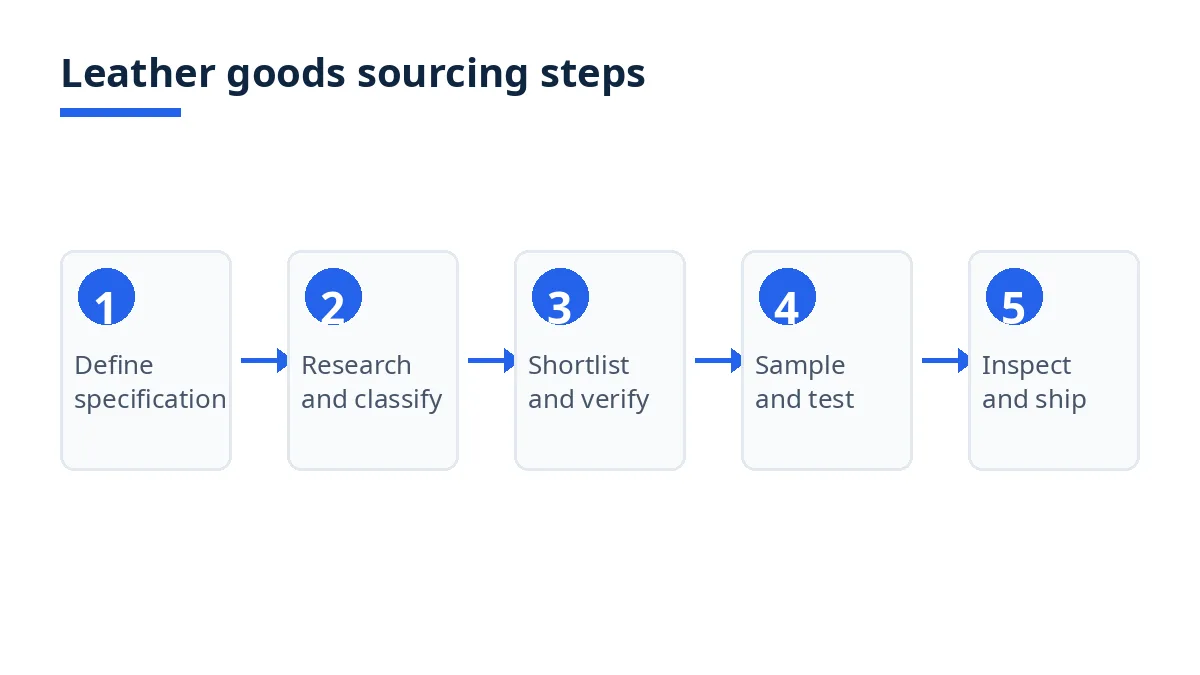
Define the range. Fix product families, leather type and origin, colours, sizes, labelling, packing and destination.
Research the market. Check current EPB and Bangladesh Bank data before you negotiate, and keep the two series separate.
Classify each product. Confirm the indicative heading by product type and outer surface, then the full national code and duty line in your destination tariff.
Shortlist and check suppliers. Run the identity, producing-site, tannery evidence, capability and registration checks in this guide.
Request comparable quotations. Send the identical specification to each supplier, and require delivery term, currency, validity, MOQ and lead time.
Sample and test. Approve pre-production samples in your leather and colour, check dimensions, stitching, edges and hardware, complete the chemical tests your market requires, and seal a counter-sample.
Agree the contract. Issue a purchase order with the full specification, tolerances, label wording, test and document list, inspection rights, payment terms and delivery term.
Control production. Confirm leather and hardware arrival and the production slot, and resolve any substitution request in writing first.
Inspect before shipment. Commission an independent inspection against the sealed sample across styles and colours, and release shipment only on a pass or an agreed corrective action.
Ship, clear and review. Check document drafts early, clear customs with your broker using the confirmed classification and preference position, then review the delivered goods against the counter-sample.
Related guides
Use how to import from Bangladesh for the general import sequence behind this category guide, and finding suppliers in Bangladesh to widen the long list before you apply the checks in this guide.
FAQs
Is Bangladesh a good place to source leather & leather goods?
It can be, when the product and the factory are matched and the leather chain is named. EPB data reported for the first quarter of fiscal 2027 put leather products exports at USD 119.59 million, up 16.42 percent, inside a total of USD 366.88 million.1 The checks that decide the outcome are the tannery evidence for your leather, including its effluent and audit position,5 12 and the goods factory capability for your product family.
What is the typical MOQ?
There is no single typical MOQ. Minimums are set by leather lots and dye or finish lots, and by lining, hardware, label and carton print runs, and are normally quoted per style and per colour. Ask each supplier to state its MOQ against your exact specification.
How long is the lead time?
Lead time is product- and input-specific. It covers leather purchase or tanning and finishing, hardware and lining purchase, production, testing, packing and transport to the port, after sample approval. Dyed-to-order leather and imported hardware are the usual constraints. Require a written lead time for your product and delivery month, and confirm the slot in the purchase order.
Which certifications matter?
It depends on your market and your product. For skin-contact leather sold in the UK, chromium VI at or above 3 mg/kg of the total dry weight of the leather must not be placed on the market, and limits also apply to listed azo dyes and to dimethyl fumarate.11 Where tannery environmental performance matters, an LWG audit covers 17 sections with medal thresholds of 85 percent for Gold, 75 percent for Silver and 65 percent for Bronze, and certification is valid for 24 months for a leather manufacturing facility.12 Check the holder, site, coverage and expiry date on every certificate, and state any factory audit requirement separately.
Next steps on Exportain
Start with how to import from Bangladesh, then browse suppliers in the leather goods categories against your specification. When the specification is ready, post a free RFQ on the RFQ board with quantity, destination and delivery term, so suppliers quote against the same specification.
Sources
- Bangladesh exports grow 6.34pc in Q1, led by RMG. BizBD Review (accessed )
- Merchandise exports rise 6.34pc to $13.09b in Q1 FY27: EPB. The Financial Express, (accessed )
- June exports surge by 25.91%, FY26 earnings hold steady at $48 billion: EPB. United News of Bangladesh (accessed )
- Annual Export Receipts of Goods and Services 2024-25. Bangladesh Bank (accessed )
- Turning leather into lasting growth. The Daily Star, (accessed )
- President's Message - LFMEAB. Leathergoods and Footwear Manufacturers and Exporters Association of Bangladesh (LFMEAB) (accessed )
- What is the Harmonized System (HS)?. World Customs Organization (accessed )
- Commodity code 4202990090: Other - UK Integrated Online Tariff. GOV.UK (accessed )
- Trust & Safety Center. Exportain (accessed )
- Supplier verification: Earn trust badges buyers can see. Exportain (accessed )
- Leather goods | Business Companion. Business Companion (accessed )
- Certification - Leather Working Group. Leather Working Group (accessed )
- ISO 2859-1:2026 - Sampling procedures for inspection by attributes — Part 1: Sampling schemes indexed by acceptance quality limit (AQL) for lot-by-lot inspection. ISO (accessed )
- Trade arrangements. European Commission, Access2Markets (accessed )
- Incoterms® rules. International Chamber of Commerce (ICC) (accessed )
- Customs Clearance Procedures for Export. Bangladesh Customs, National Board of Revenue (accessed )
About the author
Sourcing from Bangladesh?
Post a request for quotation and suppliers on Exportain can send you their quotes directly.
Post an RFQ