Minimum Order Quantity Definition: Practical Guide
What minimum order quantity means in practice: how suppliers set MOQs, how the basis changes the real minimum, and how to negotiate quantity terms when sourcing from Bangladesh.
Short answer
Minimum order quantity (MOQ) is the smallest quantity of a product that a supplier will produce or sell in a single order. Each supplier sets its own MOQ per product, based on setup costs and the minimum quantities it must buy materials in. An MOQ is only complete with its unit and basis: per order, per style, per color, or per size.
On this page
Key takeaways
MOQ is the smallest quantity a supplier will accept for one order, set by the supplier per product, not by regulation.
A quoted MOQ is incomplete without its unit and basis: per order, per style, per color, per size, or per SKU.
Setup costs and material minimums from mills and dye houses are the main drivers behind a factory MOQ.
Below-MOQ orders may be rejected, repriced, or accepted with a surcharge, so agree any exception in writing.
The minimum order quantity definition is short, but the number behind it decides whether a sourcing plan works at all. Minimum order quantity, usually shortened to MOQ, is the minimum number of units of an item that a seller requires a buyer to purchase in a single order.1 This guide explains the minimum order quantity definition in full for buyers sourcing from Bangladesh: what the number covers, how suppliers set it, how it affects price and lead time, and how to state your requirement in a request for quotation (RFQ).
An MOQ is a commercial condition set by each supplier for each product. It is not a law, a customs rule, or a standard set by a trade body. Two factories making a similar product can set very different MOQs, and the same factory can set different MOQs for different styles, materials, or colors. The MOQ is the lowest quantity of a product, component, material, or order value that a supplier is willing to accept for a single transaction, production run, or shipment.2
Why this matters for buyers and sellers
For a buyer, the MOQ decides whether a product is reachable at all. A small brand testing a new design may need a short first run to learn what sells. A factory MOQ above that test quantity forces a choice between committing more cash to unproven stock, redesigning the product to fit a lower-MOQ process, or finding another supplier. MOQ also shapes the unit cost discussion, because a quoted price normally assumes production at or above the MOQ.
For a seller or factory, the MOQ protects the economics of production. Setting up a line, preparing patterns, sourcing fabric and trims, and running quality checks all take time and money before the first finished unit appears. Spread across a very small order, those fixed costs make each unit expensive to produce. Suppliers set MOQs to cover setup cost, handling effort, production efficiency, and distribution economics.2 Materials add a second constraint: mills, dye houses, and trim suppliers sell in their own minimum quantities, so a factory may have to buy far more material than a tiny order uses.
For both sides, a clearly stated MOQ prevents wasted negotiation. When the basis and unit are written into the first exchange, both sides can judge fit immediately. For a closer look at how MOQs appear in quotations, see our explainer on MOQ — minimum order quantity.
What does an MOQ number actually cover?
An MOQ quoted without its basis is incomplete. The threshold may be expressed in units, cases, weight, volume, or monetary value, depending on the product and the supplier's operating model.2 It may also apply at different levels:
MOQ basis | What it means | What to confirm |
|---|---|---|
Per order | One minimum for the whole order | Whether styles and colors can be mixed |
Per style | Each design must meet the minimum | Whether shared fabric counts together |
Per color | Each color must meet the minimum | How your quantity splits across colors |
Per size | Each size must meet the minimum | Whether a size ratio is allowed |
Per SKU | Each variant counts separately | Which features create a new variant |
Typically, if any feature of an item changes, it becomes a unique stock keeping unit (SKU) and carries its own MOQ.1 A simple MOQ is a single limit on any single order, while a complex MOQ applies at least two requirements, such as the item, fabric type, color, and length, before the minimum is set.1 Always confirm the basis and unit before you compare two suppliers.
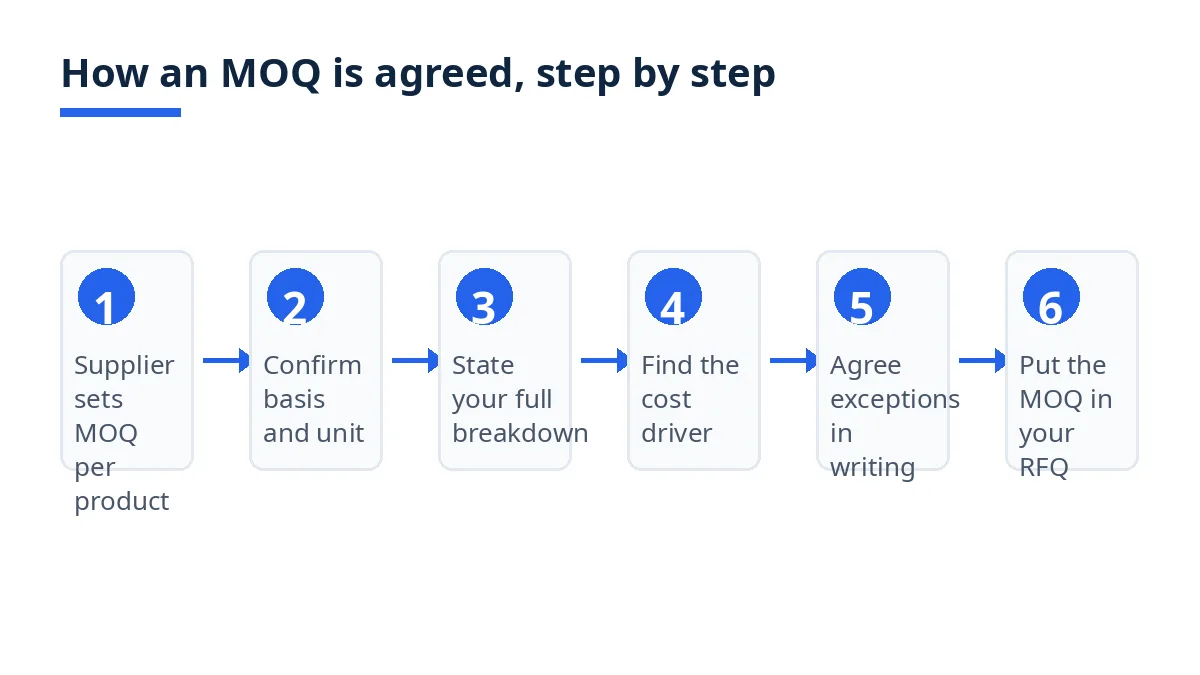
Step-by-step: how it works
Step 1 — The supplier sets the MOQ per product. The factory calculates the smallest run that covers its setup costs and its own material minimums, then states the MOQ for that product, in pieces, pairs, sets, kilograms, cartons, or a minimum order value. There is no set formula for MOQ; suppliers work from production costs, their own suppliers' requirements, demand, and a break-even point, then set the MOQ above that point.1
Step 2 — Confirm the basis of the MOQ. The same headline number can mean very different things. An MOQ per color is stricter than an MOQ per style split across colors, and an MOQ per size is stricter again. Ask whether the MOQ is per order, per style, per color, per size, or per print or design, and get the answer in writing.
Step 3 — State your real requirement. Give the supplier your target quantity with its full breakdown: total units, colors, sizes, and any customization such as private labels, printed logos, or special packaging. A supplier can only judge flexibility against a concrete breakdown.
Step 4 — Ask what drives the MOQ for this product. If the driver is a fabric minimum, stock fabric or a shared fabric program may help. If the driver is machine setup or print screens, fewer colors or a simpler print may help. If the driver is the factory's own policy, a trial order followed by a larger repeat may be the route. Procurement can also manage MOQ by consolidating demand, standardizing specifications, or qualifying suppliers whose batch economics support smaller runs.2 Identify the real constraint first, because the right question depends on it.
Step 5 — Agree any exception in writing. When a buyer requests less than the MOQ, the supplier may reject the order, raise the price, combine the demand with another run, or propose an alternative product or packaging configuration.2 If the supplier accepts a below-MOQ order, record the agreed quantity, unit price, any surcharge, and delivery terms in the proforma invoice or purchase documents.
Step 6 — Put the MOQ in your RFQ. State your quantity and breakdown up front, and ask each supplier to confirm its MOQ basis in the reply. Our guide on how to write an RFQ shows how to structure that request.
Costs, timelines and documents
How does MOQ affect cost?
An MOQ itself is not a charge, but it interacts with cost in three ways. First, unit price: a higher MOQ can reduce unit price because the supplier spreads fixed cost over a larger quantity and runs production more efficiently.2 Second, surcharges: some suppliers accept a below-MOQ order only with a setup or small-order surcharge, which is the supplier's commercial decision, so ask for it in writing. Third, material waste: if your order forces the factory to buy a full material minimum, the cost of unused material may be reflected in your price.
The apparent price benefit of a higher MOQ may be offset by higher holding cost, obsolescence risk, or slower inventory turnover, so judge MOQ on total cost rather than unit price alone.2 That total includes freight, duty, and handling, which our guide to landed cost for imports from Bangladesh works through in detail.
Example figures — the same total quantity under two different MOQ bases:
Supplier A | Supplier B | |
|---|---|---|
Quoted MOQ | 1,000 pieces per order | 1,000 pieces per color |
Your order | 1,000 pieces in 4 colors | 1,000 pieces in 4 colors |
Pieces per color | 250 | 250 |
Meets the MOQ as stated? | Yes, the total reaches 1,000 | No, each color is 750 short |
Practical result | Quoted unit price can apply | Higher quantity, surcharge, or fewer colors |
The example shows why the basis matters more than the headline number. Supplier B is not offering the same terms as Supplier A, even though both quote 1,000.
How does MOQ affect timelines?
A below-MOQ or highly customized small order may wait for a production slot, because factories schedule lines around efficient run lengths. Material minimums can also affect timing: a custom-dyed fabric or special trim takes longer to source than a stock material. No universal timetable follows from this, so ask the supplier to quote MOQ, price, and lead time together for your breakdown, and confirm all three before payment.
Which documents carry the MOQ?
The documents that carry the MOQ are ordinary trade documents, used carefully. The RFQ states your required quantity and asks for the supplier's MOQ basis. The quotation or proforma invoice should restate the agreed quantity, unit, and price. Check that the quantity on it is the quantity you agreed, not the standard MOQ substituted back in. The purchase order confirms the breakdown by color and size. The commercial invoice and packing list later record what was produced and shipped. Our overview of export documents from Bangladesh explains each document.
Bangladesh-specific rules and tips
Bangladesh's export trade is built around volume production, especially ready-made garments. Ready-made garment exports reached $10.58 billion in the first quarter of FY2026-27 (July to September 2026), with knitwear at $5.96 billion and woven garments at $4.61 billion, according to data released by the Export Promotion Bureau (EPB).3 Large factories organized around substantial runs sit behind those figures, so MOQs from large exporters can be high for a small buyer, while smaller factories, buying houses, and specialized workshops may work with shorter runs for simpler products. The question is fit between your order and the supplier's production model.
Practical tips for sourcing from Bangladesh:
Separate the factory MOQ from the material MOQ. In garments, fabric and dyeing minimums frequently drive the final number. Flexibility on fabric — a stock fabric, a standard color, or a fabric shared across two styles — can change the conversation more than asking for a lower quantity.
Keep the size and color breakdown realistic. Many colors and sizes inside a small total quantity multiply setup work, so a tighter breakdown often makes a modest order acceptable.
Treat customization as an MOQ factor. Private labels, custom prints, and special packaging each carry their own setup. Simplifying one element can lower the practical minimum.
Check the supplier before committing to a larger first order just to meet an MOQ. Review the business and its documents, and use a sample stage to confirm quality and communication first. Our explainer on how supplier verification works on Exportain sets out what each badge covers.
Ask how your quantity will be packed and shipped. Packing, consolidation, and freight choices differ for a small trial shipment and a full run, and they change the landed cost per unit.
Mistakes and red flags
Comparing MOQs without the basis. A supplier quoting 500 per order and another quoting 500 per color are not offering the same thing. Normalize the basis and unit first.
Assuming the MOQ is the price quantity. A low MOQ does not mean the quoted display price applies at that quantity. Confirm the unit price at your quantity.
Hiding your real quantity. Opening with an inflated quantity to attract attention, then revealing a small order later, damages trust and usually ends the negotiation.
Accepting a verbal exception. If a supplier agrees to a smaller run, get the quantity, price, and any surcharge in the written quotation.
Ignoring material minimums. Agreeing a small quantity while specifying a custom fabric or dye color can be a contradiction, because the material minimum may set a higher floor than the factory MOQ.
Red flags on the supplier side. Treat with caution any supplier who will not explain what its MOQ is based on, who changes the MOQ after sampling without a reason, or who accepts any quantity at the same price with no discussion of setup or materials. That pattern can signal a trader without control of production, or a quote that will change later.
Checklist
Before you confirm an order where MOQ is a factor, work through this list:
The supplier's MOQ is stated in writing, with its unit (pieces, weight, value, or another measure).
The basis is confirmed: per order, per style, per color, per size, or per design.
Your breakdown — total, colors, sizes, customization — has been sent to the supplier in full.
The unit price at your quantity is confirmed, including any small-order or setup surcharge.
The driver behind the MOQ (setup, materials, policy) is identified.
Material minimums for custom fabric, dyeing, print, or trims are checked against your quantity.
Lead time is quoted for your quantity, not only for a standard run.
The agreed quantity and price appear correctly on the quotation or proforma invoice.
Samples have been approved before the main quantity is produced.
Packing and shipping for your quantity are discussed, so the landed cost per unit is understood.
Frequently asked questions
What should I know first about Minimum Order Quantity Definition?
Know first that the minimum order quantity is a supplier-set commercial condition, not a legal standard. Confirm three things: the quantity itself, the unit it is counted in, and its basis — per order, style, color, size, or design. Then ask what drives it, because setup costs and material minimums are negotiated differently. With those facts, you can meet the MOQ, adjust your breakdown, negotiate an exception, or choose a supplier whose model fits your order size.
What are the typical costs and timelines?
There is no universal MOQ price or timetable, because both depend on the product, materials, customization, and the individual factory. On cost, expect the quoted unit price to assume production at or above the MOQ. A smaller accepted order usually carries a higher unit price or a stated surcharge, and material bought to a mill minimum can add cost. On timelines, small or customized orders may wait for a suitable production slot and for materials to be sourced, so have the supplier quote MOQ, price, and lead time together for your exact breakdown, in writing.
Which documents are needed?
No special MOQ document exists. The requirement travels through the normal trade documents. Your RFQ should state your quantity and breakdown and request the supplier's MOQ basis. The quotation or proforma invoice should restate the agreed quantity, unit, and price, and your purchase order should confirm the breakdown by color and size. Before payment, check that the quantity on the proforma matches what you agreed.
What are the most common mistakes?
The most common mistakes are comparing MOQs without checking whether they apply per order, per color, or per size; assuming the displayed price applies at the minimum quantity; opening with an inflated quantity and revealing a smaller real order later; accepting a verbal below-MOQ exception without the quantity, price, and surcharge in writing; and specifying custom fabric, dyeing, or print on a small order without checking material minimums, which can set a higher floor than the factory MOQ.
Next steps on Exportain
On Exportain, product listings carry the seller's MOQ and tiered unit prices where the seller has set them, and quotations are priced on quantity, specification, and Incoterm.4 Sellers add specifications, MOQ, price tiers, and HS code to each listing, so the quantity terms are visible before you start a conversation.5 Browse suppliers by category, read how to buy for the full buyer workflow, or post an RFQ stating your quantity and breakdown once, then compare quotations that state unit price, MOQ, lead time, and Incoterm in a single thread.4
Sources
- Minimum Order Quantity: What Is It and Why Does It Matter. Paramount Global (accessed )
- Minimum Order Quantity (MOQ) Explained: A Complete Guide. Simfoni (accessed )
- RMG exports rise 6.10pc to US$10.58b in July-Sept of FY27. The Financial Express, (accessed )
- Exportain | Bangladesh B2B Export Marketplace. Exportain (accessed )
- Sell Bangladeshi Products to Global Buyers | Exportain. Exportain (accessed )
About the author
Sourcing from Bangladesh?
Post a request for quotation and suppliers on Exportain can send you their quotes directly.
Post an RFQ