

The Sweaters, Jackets & Outerwear Industry in Bangladesh: Capacity, Clusters and Key Players
Knitwear was USD 5.96 billion in Q1 fiscal 2027 on EPB data, while outerwear is only 3.83 percent of apparel exports. This pillar covers sweaters, jackets, clusters, supplier checks, MOQ and quality.
Short answer
Sweaters sit inside knitwear and jackets span knit and woven production in Bangladesh. EPB data put knitwear at USD 5.96 billion and woven garments at USD 4.61 billion in the first quarter of fiscal 2027. Buyers source this category by fixing fibre, gauge or construction and size ratio first, checking the producing factory and its test evidence, and agreeing minimum quantity, price and lead time per style in writing.
On this page
Key takeaways
EPB data put knitwear at USD 5,963.76 million and woven garments at USD 4,614.80 million in the first quarter of fiscal 2027, framing a category the EPB does not report as one line.
BGMEA member factories account for more than 95 percent of sweater shipments, while outerwear is only 3.83 percent of Bangladesh apparel exports against 13.45 percent globally.
Heading 6110 covers knitted jerseys, pullovers and cardigans and splits by fibre and wearer, so a jacket is classified by construction and fibre, not by its marketing name.
There is no single typical MOQ, price or lead time in this category; all three are quoted per supplier, per style, per colour and per size ratio against a written tech pack.
If you buy sweaters, knitted jackets, woven jackets or coats, Bangladesh belongs on your sourcing map for a specific reason. Sweaters are a long-established knitwear line, while jackets sit across both the knit and woven halves of the garment industry. Those halves use different machines, fabrics and skills, so a supplier strong in one is not automatically equipped for the other. This guide explains how the industry is organised, what the export data shows, where production is clustered, and how to find and check suppliers. It gives no single typical price, minimum quantity or lead time, because none exists from a fine-gauge cardigan to a padded woven jacket.
Market overview with latest data
Start with the export figures at the level the Export Promotion Bureau (EPB) reports them. The EPB publishes no single combined line for sweaters, jackets and outerwear: sweaters sit inside knitwear, and jackets inside knitwear or woven garments depending on construction. The knit and woven totals frame the category, but do not measure it alone.
For the first quarter of fiscal year 2027, July to September, EPB data put ready-made garment exports at USD 10,578.56 million, up 6.10 percent year on year, with knitwear at USD 5,963.76 million, up 6.88 percent, and woven garments at USD 4,614.80 million, up 5.11 percent.1 In the same quarter the European Union took USD 4,904.02 million of Bangladeshi apparel and held a 46.36 percent share, the United States took USD 2,220.86 million as the largest single-country market, and the United Kingdom took USD 1,292.13 million.1 Among the non-traditional markets named in the same release, the United Arab Emirates took USD 74.34 million, up 18.67 percent.1 See Bangladesh export data for how to read EPB releases without mixing series.
Bangladesh Bank tells a complementary story through the banking channel. Its annual publication for 2024-25 records total export receipts for goods of USD 43,559.3 million, of which ready-made garments were USD 37,218.0 million, or 85.4 percent.2 Bangladesh Bank states that its receipts figures can differ from customs-based and EPB figures because of differences in valuation, timing and coverage, since receipts are recorded when proceeds are received through banks.2 Read the EPB series for shipment momentum and the Bangladesh Bank series for money actually received, and do not add the two together.
A third view, on a different basis and for a different period, shows where this category sits inside the wider basket. An analysis by Bangladesh Apparel Voice based on EPB and International Trade Centre Trade Map data put total garment exports at about USD 38.83 billion in calendar year 2025, with basic products, a group that includes sweaters, accounting for more than 76 percent of apparel exports.3 The same analysis put advanced products, including outerwear, dresses, technical garments, sportswear and suits, at only 9.35 percent of Bangladesh apparel exports against 30.46 percent globally, and outerwear such as jackets and coats at only 3.83 percent of Bangladesh exports against 13.45 percent globally.3 It also recorded that Bangladesh exported about USD 3.63 billion of advanced products in 2025, and that nearly three-quarters of Bangladesh apparel exports remain cotton-based while most global garment trade involves fibres other than cotton.3
Read together, with each figure keeping its own period and definition, sweaters are part of a large, established basic knitwear trade, while jackets and coats are a smaller line where global demand exceeds the Bangladesh share. A complex padded or man-made fibre jacket needs a factory selected for that construction, not a general factory willing to attempt it.
Two points sit behind the numbers. First, fibre matters: a sweater is specified by fibre, yarn count and gauge, and a jacket by shell fabric, filling and closure hardware, so quotations depend on yarn and fabric arriving. Ask which inputs a supplier holds, buys domestically and imports. Second, demand is seasonal, because sweaters and heavier jackets are winter goods in the main northern markets. Confirm the production slot for your delivery window in writing.
Main products and production clusters
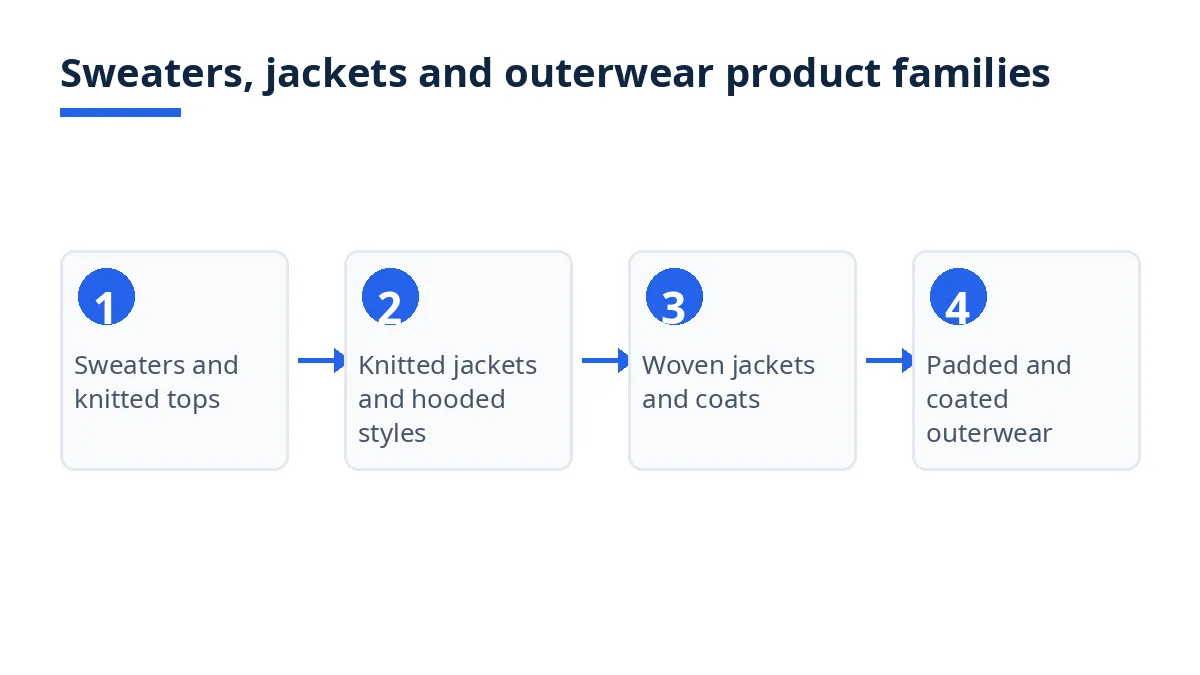
The offer groups into product families. Each family uses different machinery and different checks, so fix your family first, then look for factories.
Sweaters and knitted tops. Pullovers, cardigans, waistcoats and similar knitted articles, specified by fibre composition, gauge, ply, stitch structure, measurements and finishing. Gauge decides how fine the knit looks and how the garment drapes, and two sweaters with the same fibre label can differ in weight, hand feel and cost because the gauge and ply differ. Buy this family on an approved sample measured flat against a measurement chart, not on a photograph.
Knitted jackets and hooded styles. Jackets, blazers and hooded tops made from knitted fabric, specified by fabric weight, construction, closure and lining where fitted. The factory must handle heavier knitted fabric, structured panels and hardware as well as garment making.
Woven jackets and coats. Overcoats, anoraks, wind jackets and padded jackets made from woven fabric, specified by shell composition, coating where required, filling weight, lining, zips, snaps and seam construction. Seam strength, padding distribution and closure function decide whether the garment performs.
Where the clusters are
According to BGMEA figures reported by The Financial Express, BGMEA has around 4,500 member factories, of which about 40 percent are knitwear and sweater manufacturers and 60 percent woven garment manufacturers.4 The same report records that member factories account for 100 percent of woven garment exports, more than 95 percent of sweater shipments and around half of light knitwear exports, and that Bangladesh earned USD 39.34 billion from ready-made garment exports in fiscal 2025 on official data, on a different basis from the Bangladesh Bank receipts figure above.4 Formal sweater and woven exports therefore run mainly through member factories, while part of light knitwear sits outside that tier.
The Bangladesh Knitwear Manufacturers and Exporters Association (BKMEA) and Swisscontact partnership for the knitwear sector operates across key manufacturing hubs including Dhaka, Narayanganj, Gazipur and Chattogram, with work on upskilling, environmental and social standards and renewable energy adoption.5 Record where a factory makes your goods, because distance to the port and to fabric suppliers affects lead time and carton transport cost.
How to read key players
Key players are best read through the sector bodies, not a ranking. Under BGMEA criteria reported in December 2025, a woven or knit garment factory must have at least 100 machines, a sweater factory a minimum of 60 machines, and a factory a minimum floor space of 15,000 square feet to qualify for membership.4 Use those thresholds as a scale screen. This guide names no companies as recommended suppliers, because ranges and machinery change by season. Verify each name against your tech pack: a good basic pullover does not prove a factory can make your padded jacket.
Classification decides the duty line
Classify each style before you negotiate the final price, because the code follows construction and fibre, not the marketing name. Heading 6110 covers jerseys, pullovers, cardigans, waistcoats and similar articles, knitted or crocheted, and the United Kingdom tariff splits it by fibre, including wool, cotton and man-made fibres, then by wearer and construction.6
Product family | Indicative heading | What decides the exact line |
|---|---|---|
Sweaters, pullovers and cardigans, knitted | 6110 | Fibre, wearer, and whether the article is a lightweight fine knit roll, polo or turtleneck style |
Knitted overcoats, anoraks and ski jackets | 6101 and 6102 | Wearer, and the garment type within knitted outerwear |
Woven overcoats, anoraks and wind jackets | 6201 and 6202 | Wearer, fibre and garment type within woven outerwear |
Woven jackets and blazers in suits and ensembles | 6203 and 6204 | Wearer, and whether the item is sold as a suit, ensemble or separate jacket |
Garments made up from coated or special fabrics | 6210 | The fabric type the garment is made up from |
Read the table as indicative only. Confirm the full national code in the destination tariff for your exact style, fibre and wearer, and read the knitwear industry guide alongside the woven garments industry guide when a range spans both constructions.
How to find and verify suppliers
Start from your tech pack, not from a supplier list. For sweaters, the tech pack states fibre composition, yarn and gauge, stitch, colour, size ratio, measurements with tolerances, labelling, packing and the test evidence you require. For jackets, it states shell and lining composition, filling weight where padded, hardware, seam and closure requirements, measurements, labelling, packing and test evidence. A precise enquiry gets comparable quotes. See how to write an RFQ and finding suppliers in Bangladesh.
Build a shortlist from the Exportain category directory, association membership, trade data and referrals, then run the same verification sequence:
Identity. Match the legal name, trade licence details and factory address across the supplier documents and its online presence. Resolve any inconsistency in writing before you discuss price.
Producing site. Record which plant knits, links, sews and finishes your style, and which stages are bought in: yarn dyeing for sweaters, shell fabric and filling for jackets, embroidery or printing where used. A bought-in stage is workable when it is named. An unexplained chain is the problem.
Machine capability. For sweaters, ask which gauges the site runs and how linking and finishing are handled. For woven jackets, ask which sewing, fusing, quilting and press equipment will produce your order.4
Evidence for the exact style family. Ask for export history and test reports that name a comparable style, fibre and market. A report for a cotton T-shirt is background only for an acrylic sweater or a polyester padded jacket.
Sample in your specification. Order a pre-production sample in your fibre, gauge or fabric, colour and size, then measure it, wash-test it where required, and check closures and seams. Seal a counter-sample once approved.
Export readiness. Ask which markets the supplier ships this family to, which documents it prepares as a routine, and its export registration and association position.
Capacity in your window. Ask how much of the line is already booked for your window and what happens if approvals slip. A clear answer names dates and quantities.
Independent checks. For larger programmes, use an independent inspection company for a factory audit or a pre-shipment inspection. Use a video walk-through as a first screen only.
Payment discipline. Agree payment terms that match the risk of a new relationship. Confirm bank details through a second channel before paying, and treat any late change of bank details as a reason to pause and re-verify.
Warning signs include a quote far below comparable offers for the same tech pack, refusal to sample in your fibre or fabric, pressure to pay quickly to a personal account, reluctance to identify the producing factory, and certificates naming a different company, site or product. A factory that agrees to any gauge, filling weight and delivery date without asking about yarn or fabric availability has not costed your style.
MOQ, pricing and lead times
Buyers routinely ask for one typical minimum order quantity (MOQ), one typical price and one typical lead time. None of the three exists as a single figure for this category. Each is quoted per supplier, per style, per colour and per size ratio against a written tech pack. See the knitwear sourcing guide for the knitwear side of the same method.
MOQ is driven by the smallest workable lot at each stage: yarn lots and dye lots for sweaters, fabric roll and filling lots for jackets, and trim, label and carton print runs for private-label goods. A stock-yarn pullover in a running colour will normally carry a lower minimum than the same pullover in a dyed-to-order colour with your label, because the second version is a separate yarn and dye commitment. Expect minimums per style, per colour and per size ratio, not only per order, and ask whether a minimum can be split across colours or must sit in one colour.
Pricing is built from yarn or fabric, making, dyeing and finishing, trims, testing, packing, inland transport and margin, then expressed on the agreed delivery term. Compare quotations only on an identical tech pack, and ask what the price includes, the currency and the validity date. State gauge and ply for sweaters and filling weight for padded jackets: a cheaper quote at a lighter specification is a different product, not a saving.
Delivery terms decide who pays for which leg, so quotations on different terms are not comparable until you adjust them. For method only, consider this comparison. Example figures: two suppliers quote for the same sweater style, one at USD 6.20 per piece EXW and one at USD 6.55 per piece FOB. Adding inland transport, export handling and loading of USD 0.28 per piece to the EXW quote gives a like-for-like FOB cost of USD 6.48 per piece, so the real gap is USD 0.07 per piece, not USD 0.35. Use the same adjustment with the landed cost for imports from Bangladesh method, and read the best Incoterm for importing knitwear before you choose the term for a knit order.
Lead times cover yarn or fabric purchase and dyeing, production, finishing, testing, packing and transport to port, after sample approval. Imported or dyed-to-order inputs are the usual long pole, and orders compete for the same seasonal window, so a lead time for one month may not hold in the peak month. Plan backwards from your delivery date and confirm the slot and input position in the purchase order.
Quality, certifications and compliance
Sweaters and jackets fail in predictable ways: a sweater that stretches after washing, pills early or misses the approved shade; a jacket with uneven padding, weak seams or a failing zip. A quality plan names each risk and its check, and attaches the tech pack to the purchase order so the standard becomes part of the contract.
Specify measurable quality. For sweaters, define fibre, gauge, finished weight, measurements with tolerances, shrinkage, colourfastness, pilling and appearance after washing. For jackets, define shell and lining, filling weight where padded, seam strength, zip and snap function, measurements and any water resistance test your claim depends on. Words such as warm or premium cannot be inspected. Numbers, a test method and an approved sample can.
Fibre labelling is a legal duty in the EU. Regulation (EU) No 1007/2011 requires that, when a textile product is made available on the market, its fibre composition descriptions be indicated in catalogues and trade literature, on packaging, labels and markings in a manner that is easily legible, visible and clear, and clearly visible to the consumer before purchase, including for electronic sales.7 The labelling or marking must be provided in the official language or languages of the member state where the product is made available to the consumer, unless that member state provides otherwise.7 Give the factory your exact label wording, fibre order and percentages, care instructions and size marking in the tech pack, and check the bulk labels against that wording before sewing begins. A correct garment with a wrong composition label is still a non-compliant garment in that market.
Chemical safety certification: read the scope. Where a buyer requires OEKO-TEX STANDARD 100, the Hohenstein guidance states that the certificate and label are only awarded if all components of an item meet the required criteria without exception, including, for finished garments, the outer fabric, all sewing threads, the lining, dyes, finishes and prints, and non-textile accessories such as buttons, rivets or zips.8 The same guidance places jackets and coats in Product Class III, for textiles whose surface comes into direct contact with the skin only to a limited extent, and states that a STANDARD 100 certificate is valid for 12 months.8 Check the certificate number, the holder, the product class, the articles covered and the expiry date. A certificate for a fabric alone does not certify the finished jacket, and a certificate held by a yarn supplier does not transfer to your garment.
Social compliance is buyer-specific. State your audit requirement at enquiry stage, ask which audits the producing site has passed and when, and do not treat a product certificate as evidence of factory social compliance.
Test at the right stages. Approve a pre-production sample, check bulk yarn or fabric and lab dips before production, then inspect before shipment against the sealed counter-sample. Agree the sampling method in the order. ISO 2859-1:2026 defines a system of acceptance sampling plans for inspection by attributes, indexed by acceptance quality limit (AQL), for lot-by-lot inspection, and the AQL is the maximum average percentage of defective items considered acceptable during random sampling.9 See AQL acceptance quality limit and pre-shipment inspection. Measure sweaters flat after relaxation, check jacket zips and snaps in the sample, and open cartons across sizes and colours.
Shipping, Incoterms and duties
Sweaters and jackets ship mainly in cartons by sea, with samples by air. Sweaters are bulky for their weight and padded jackets compress if packed too tightly, so agree folding, pieces per carton, carton dimensions and gross weights before the price is fixed, because carton volume decides the freight basis. Mark cartons with style, colour and size information that matches the packing list and invoice.
Duties and market access must be checked, not assumed. Duty depends on the HS classification, your destination tariff and any preferential scheme that applies to Bangladesh at the time of import. For the European Union, the Access2Markets guidance describes Everything But Arms (EBA) as a special arrangement for least developed countries, granting full duty-free and quota-free access to the EU Single Market for all products except arms and ammunition.10 That preference depends on origin rules and on the scheme in force at shipment, so confirm eligibility and the origin evidence required with your broker before you price the order. Arrangements differ between the EU, the UK, the USA and the UAE, and the standard third-country rates in the tariff, such as the mainly 12.00 percent lines under heading 6110 in the UK tariff,6 show why the preference and the classification both matter to landed cost.
Choose the delivery term deliberately. Under EXW, you arrange and pay for almost everything from the factory gate. Under FOB, the supplier delivers the goods on board the vessel at the named Bangladeshi port and you control the main freight. Under CIF, the supplier arranges and pays freight and minimum insurance to your named destination port, while risk still passes when the goods are loaded. Under DAP, the goods are brought to a named place in your country without import clearance, and under DDP, duties and clearance sit with the seller as well. The Incoterms rules published by the International Chamber of Commerce are eleven three-letter trade terms used in contracts for the sale and purchase of goods, and they clarify the tasks, costs and risks involved in delivering goods from sellers to buyers.11 Incoterms 2020, the current version, entered into force on 1 January 2020.11 Name the port or place precisely in the purchase order and the invoice, and read Incoterms for shipments from Bangladesh.
Documents decide whether goods move. Bangladesh Customs requires an export declaration, known as a Bill of Export or Shipping Bill, to be submitted and approved before goods are loaded for export, with documents enclosed that include the export letter of credit or, where there is none, the export contract or purchase order, a commercial invoice with a detailed description of the goods, a packing list with quantity, weight and packing information, an EXP form certified by an authorised dealer bank, a certificate of origin issued by the EPB or a chamber of commerce, a VAT registration certificate and a taxpayer identification number.12 For garment exports under bonded warehouse, a utilisation declaration is also listed among the product-wise additional documents.12 Require a consistent set for every shipment, and check style names, HS codes, quantities, carton counts and weights across every document as soon as drafts arrive.
Step-by-step buying process
Define the range. Fix product families, fibre or fabric, gauge or construction, colours, size ratios, labelling, packing and destination.
Research the market. Check current EPB and Bangladesh Bank data before you negotiate, and record which series each figure came from.
Classify each style. Confirm the indicative heading by construction and fibre, then the full national code and duty line in your destination tariff.
Shortlist and check suppliers. Run the identity, producing-site, machine capability, style evidence and registration checks in this guide.
Request comparable quotations. Send the identical tech pack to each supplier, and require delivery term, currency, validity, MOQ and lead time.
Sample and test. Approve pre-production samples in your fibre or fabric and colour, measure them, wash or function-test as the style requires, and seal a counter-sample.
Agree the contract. Issue a purchase order with the full tech pack, tolerances, label wording, test and document list, inspection rights, payment terms and delivery term.
Control production. Confirm yarn or fabric arrival, lab dip and bulk approvals, and the production slot, and resolve any substitution request in writing before it happens.
Inspect before shipment. Commission an independent inspection against the sealed sample, including measurement, appearance and closure checks across sizes and colours, and release shipment only on a pass or an agreed corrective action.
Ship, clear and review. Check document drafts early, clear customs with your broker using the confirmed classification and preference position, then review the delivered goods against the counter-sample.
Related guides
Use the knitwear industry guide for knit only enquiries and the woven garments industry guide for woven only enquiries. Use how to import hoodies and sweatshirts from Bangladesh for the closest knitted outerwear sequence, and clothing manufacturers in Bangladesh to widen the long list.
FAQs
Is Bangladesh a good place to source sweaters, jackets & outerwear?
It can be, when the style and the factory are matched. Sweaters sit inside a knitwear trade that reached USD 5,963.76 million in the first quarter of fiscal 2027 on EPB data,1 BGMEA member factories account for more than 95 percent of sweater shipments,4 and outerwear remains a smaller line at 3.83 percent of apparel exports against 13.45 percent globally, so complex jackets need a factory chosen for that construction.3
What is the typical MOQ?
There is no single typical MOQ for this category. Minimums are set by yarn and dye lots for sweaters, by fabric, filling and trim lots for jackets, and by label and carton print runs, and are normally quoted per style, per colour and per size ratio. Ask each supplier to state its MOQ against your exact tech pack, and whether the minimum can be split across colours.
How long is the lead time?
Lead time is style- and input-specific. It covers yarn or fabric purchase and dyeing, production, finishing, testing, packing and transport to the port, after sample approval. Dyed-to-order yarn, imported shell fabric, filling and hardware are the usual constraints, and the seasonal window for winter goods tightens capacity further. Require a written lead time for your style and delivery month, and confirm the production slot in the purchase order.
Which certifications matter?
It depends on your market and your product. For the European Union, fibre composition labelling under Regulation (EU) No 1007/2011 must be legible, visible and clear on packaging, labels and markings, and visible to the consumer before purchase.7 Where chemical safety certification is required, an OEKO-TEX STANDARD 100 certificate covers an item only when all of its components meet the criteria, jackets and coats fall in Product Class III, and the certificate is valid for 12 months.8 Check the holder, site, product class, articles covered and expiry date on every certificate a supplier sends, and state any factory audit requirement separately.
Next steps on Exportain
Start with how to import from Bangladesh, then use finding suppliers in Bangladesh to build a shortlist against your tech pack.
Sources
- RMG exports rise 6.10pc to US$10.58b in July-Sept of FY27. The Financial Express, (accessed )
- Annual Export Receipts of Goods and Services 2024-25. Bangladesh Bank (accessed )
- Bangladesh trails in advanced apparel. TOB News, (accessed )
- BGMEA sets new membership criteria to ensure factory safety, operational standards. The Financial Express, (accessed )
- Swisscontact, BKMEA to drive growth in knitting sector. New Age, (accessed )
- Jerseys, pullovers, cardigans, waistcoats and similar articles, knitted or crocheted - Northern Ireland Online Tariff. GOV.UK, UK Trade Tariff (accessed )
- Regulation (EU) No 1007/2011 on textile fibre names and related labelling and marking of the fibre composition of textile products, Article 16. European Union, (accessed )
- OEKO-TEX STANDARD 100 for textiles tested for harmful substances. Hohenstein (accessed )
- ISO 2859-1:2026 - Sampling procedures for inspection by attributes — Part 1: Sampling schemes indexed by acceptance quality limit (AQL) for lot-by-lot inspection. ISO (accessed )
- Trade arrangements. European Commission, Access2Markets (accessed )
- Incoterms® rules. International Chamber of Commerce (ICC) (accessed )
- Customs Clearance Procedures for Export. Bangladesh Customs, National Board of Revenue (accessed )
About the author
Sourcing from Bangladesh?
Post a request for quotation and suppliers on Exportain can send you their quotes directly.
Post an RFQ


