Home Textiles and Towels Sourcing Guide for Bangladesh
A sourcing guide to home textiles from Bangladesh: read the EPB and Bangladesh Bank figures separately, verify suppliers and certificates, and buy on a written specification.
Short answer
To source home textiles from Bangladesh, write a product specification first, then shortlist mills, verify legal documents and certificates in the scheme registers, compare itemised quotes on identical terms, approve samples, inspect against AQL terms before shipment, and confirm classification, delivery term and current duty with your broker before pricing.
On this page
Key takeaways
Keep the EPB shipment series and the Bangladesh Bank receipts series separate: home textiles were USD 871.57 million on the EPB series and USD 453.8 million on the receipts series in 2024-25.
There is no single MOQ, price or lead time for home textiles: all three follow your written specification, so compare suppliers only on identical terms.
Verify every certificate by number, site, scope and expiry in the scheme owner register: OEKO-TEX Standard 100 covers harmful substance testing, and GOTS covers an organic claim through scope and transaction certificates.
Confirm classification under HS heading 6302, the delivery term and the current duty and preference position with your broker before you fix selling prices.
This home textiles sourcing guide is for buyers who plan to source towels, bed linen and other household textiles from Bangladesh and want a process they can repeat order after order. It covers what Bangladesh makes in this category, how to read the published trade figures, how to find and check suppliers, how minimum order quantities, prices and lead times are set, which quality tests and certificates matter, and how shipping, delivery terms and duties fit together.
This guide is deliberately narrow. It is a sourcing guide, not an industry history. For the wider picture, read the companion overview of the home textiles industry in Bangladesh first, then return here for the buying method. Sustainability claims are covered separately in the sustainable home textiles guide in this series. Everything that follows rests on one discipline: work from a written specification, check every claim against a document or a register, and compare suppliers only on identical terms.
Market overview with latest data
Home textiles are a separately tracked line in Bangladesh export statistics, distinct from woven and knit garments. Two official series describe the category, and they measure different things, so keep them apart and cite each one under its own name.
The first series follows shipments. The Export Promotion Bureau (EPB) figures reported for fiscal year 2024-25 put home textile exports at USD 871.57 million, up 2.42 percent on the previous year, within total merchandise exports of USD 48.28 billion.1
The second series follows money received. Bangladesh Bank publishes export receipts recorded through the banking channel, and in that series home textile receipts were USD 453.8 million in 2024-25, up 3.2 percent, with terry towel receipts recorded separately at USD 18.7 million.2 Bangladesh Bank itself explains why the two series differ: receipts are recorded when proceeds arrive through authorised dealer banks, while shipment figures are recorded when goods leave, so valuation, timing and coverage differ.2 Neither series is wrong. They answer different questions, and merging them would misstate both.
For a sourcing decision, the figures show a category large enough to support established export departments and repeat programmes, growing modestly in 2024-25 after weaker years. They say nothing about an individual mill. That judgement comes from the verification work below.
Demand usually comes from two directions. Retail buyers buy on colour, hand feel, shelf ready packaging and price across a range. Hospitality and institutional buyers buy on durability, wash performance, sizing consistency after laundering and continuity of supply. State your channel in your first enquiry.
Main products and production clusters
Home textiles is an umbrella term. Treat each product family separately, because the machinery, the skills and the quality risks differ.
Terry towels and towelling. Bath towels, hand towels, face towels, bath sheets, bath mats, pool and beach towels, and institutional towels for hotels, hospitals, gyms and salons. The specification that matters most is weight, expressed as GSM, or grams per square metre, together with finished size, pile height, yarn type, border style, colourfastness and absorbency after washing. A higher GSM generally means a heavier towel, but yarn quality and construction decide how it performs after repeated laundering, so GSM alone is never a complete specification.
Bed linen. Flat and fitted sheets, pillowcases, duvet covers, sheet sets and bedspreads. Buyers specify fibre, weave, percale or sateen where relevant, finished size including a shrinkage allowance, hemming, and packaging, from simple polybags to retail ready boxed sets.
Filled and quilted products. Quilts, comforters, pillows and mattress protectors. The specification adds filling type and weight and stitching pattern, and buyers need to check destination market rules on filling labelling and flammability before sampling rather than after.
Kitchen, table and other household textiles. Tea towels, aprons, tablecloths, napkins, curtains and throws, together with bathrobes and blankets. These lines often suit smaller, varied assortments, which can make them a practical entry point for a new importer testing a supplier.
Classification ties these families to the tariff. In the Harmonized System, heading 6302 covers bed linen, table linen, toilet linen and kitchen linen, with subheadings that split bed linen by fibre and by whether it is printed or knitted or crocheted, table linen by fibre, and toilet and kitchen linen of terry towelling or similar terry fabrics of cotton under subheading 630260.3 Give your customs broker the full specification rather than a product nickname, because fibre composition can move an item between subheadings with different duty rates. Exportain explains the method in its guide to HS codes and how to classify your product.
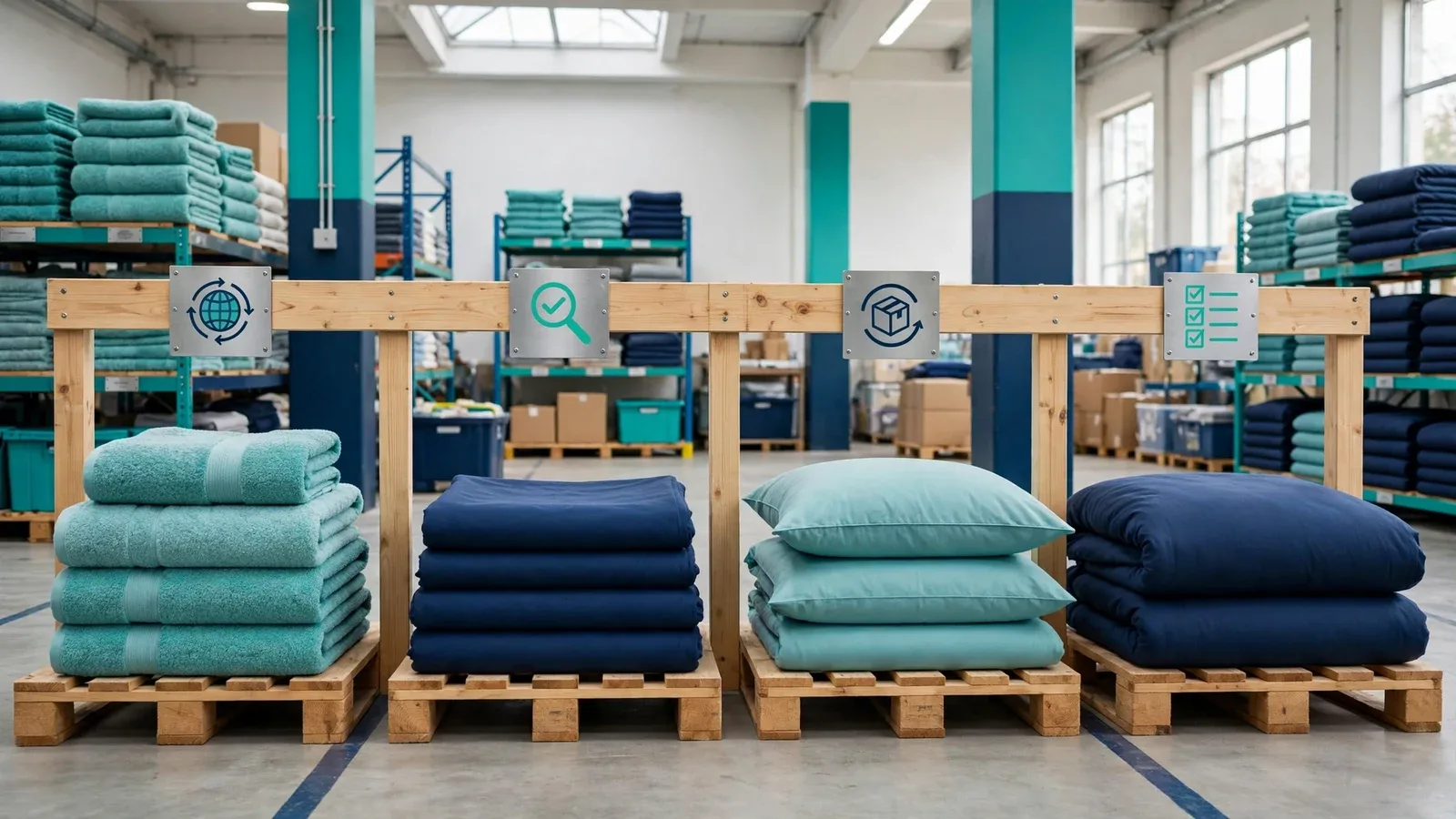
Production sits inside the wider Bangladeshi textile base. Individual mills may run spinning, weaving, dyeing, finishing and stitching at one integrated site, or spread those stages across sister units and subcontractors. Ask where each process for your order actually happens, and record the answer in the order file. An integrated mill, a stitching unit buying in dyed fabric, and a trading office offer different control and different minimums, and the answer decides which factory address your certificates and inspection need to cover.
How to find and verify suppliers
Finding names in this category is easy. Directories, association listings, trade fair lists, referrals and B2B marketplaces all produce names quickly. Exportain maintains a starting point for finding suppliers in Bangladesh. Verification is the slower and more valuable work. Run every candidate through the same sequence, so you compare evidence rather than marketing.
Legal identity. Ask for the trade licence, company registration, export registration and tax identification, and check that the legal name matches across all documents. Payment should only ever go to an account in that legal company name. A request to pay a personal account or a differently named company is a reason to stop until it is resolved in writing.
Production reality. Ask which processes are in house and which are subcontracted, request recent production photographs or a live video walk through, and confirm the factory address. For a significant programme, commission an independent audit or visit in person.
Export history for your product. A mill strong in bed linen is not automatically strong in high GSM terry towels. Ask which product groups and destination markets the factory serves, and ask for references you can contact.
Certificates and audits. Request certificates and audit summaries, then check them in the issuing scheme register, as set out in the compliance section below. The site address on each certificate must cover the factory that will make your goods.
Quality system. Ask how in line and final checks are run, which tests are done in house and which go to an external laboratory, and how shade, size and weight tolerances are recorded.
Communication and documentation. Judge the export team on responsiveness and precision during sampling. The same team will handle your production updates, packing lists and shipping documents during bulk production.
On Exportain, checks behind a supplier profile are document and photo reviews against the information the supplier submits. They are a useful screening step. They are not factory inspections, and they are not a guarantee of any individual order. The platform sets out its process in its guide to how supplier verification works on Exportain.
Red flags include reluctance to share registration documents, a price quoted without any specification, certificates that cannot be found in the scheme register, and refusal of written inspection rights. Any one flag is a reason to pause. Several together are a reason to remove the supplier from the shortlist.
MOQ, pricing and lead times
Buyers often ask for a standard minimum order quantity, a standard price and a standard lead time. None of the three exists as a single figure, and any source that offers one without asking about your specification is guessing. What follows is how each figure is determined, so you can obtain comparable quotes.
Minimum order quantity is set by the most constrained stage of production. For towels and bed linen that stage is usually dyeing, because a dye lot has a practical minimum. Minimums are therefore often expressed per colour, per design or per size rather than per order. Plain white institutional towels in standard sizes will generally carry lower minimums than a multi colour private label programme with custom borders, embroidered logos, jacquard weaving or retail packaging in several sizes. Ask each supplier for the minimum per SKU and per colour against your exact specification, and consolidate colours and sizes where your market allows it. Exportain explains the concept in its guide to minimum order quantity.
Pricing follows the specification line by line: fibre and yarn cost, fabric weight, size and cutting efficiency, dyeing and finishing, embroidery or branding, testing, packaging, and the delivery term you buy on. Two quotes for a 500 GSM bath towel can legitimately differ because one assumes combed ring spun yarn, double stitched hems and individual retail packaging, while the other assumes a simpler construction and bulk packing. Issue one written specification sheet and require every quote against it, itemised so you can see what is included. Agree also how long each quote stays valid, because prices linked to cotton move with that market.
Lead times have two parts. Sampling, developing the correct weight, shade, hand feel and packaging, takes its own time and should never be folded into the bulk timeline. Bulk lead time then depends on yarn and fabric availability, dyeing capacity, factory loading in peak seasons, and the number of colours and sizes. Confirm seasonal programmes well ahead of the delivery window and agree a milestone schedule in writing: fabric ready, dyeing complete, stitching complete, packing complete, inspection date and shipment date. Build contingency for port and vessel variability into the final leg, and treat any lead time promised without reference to the current order book as provisional until confirmed on the proforma invoice. Record payment terms in the same document, with inspection rights and tolerances.
Quality, certifications and compliance
Quality in home textiles is measurable. Most disputes in this category come from specifications that were never written down, not from products that cannot be tested. Define, in the order documents, the tests and tolerances that matter for your product and your market, and hold the approved pre production sample as the reference standard for bulk.
For towels, buyers typically specify GSM with a tolerance, finished size with a tolerance, absorbency, colourfastness, shrinkage after washing, pile appearance, and hem quality. For bed linen, the equivalent list covers fibre composition, weave and construction, finished dimensions including shrinkage allowance, colourfastness, shrinkage, pilling resistance and seam strength. For filled products, add filling weight and composition, stitching integrity and any destination market flammability requirements. Agree who tests, where, and against which standard before production starts.
Certifications and audits answer different questions, and keeping them separate is the core verification skill in this category.
OEKO-TEX Standard 100, for product safety testing. Standard 100 is a label for textiles tested for harmful substances, covering the article from yarn to finished product, with every thread, button and other accessory tested against a list of more than 1,000 harmful substances.4 Requirements become stricter as skin contact becomes more intensive: the scheme places products for babies in the strictest class, products with direct skin contact such as bed linens in the next class, and home textiles and decoration materials such as curtains in their own class.4 Certificates are issued for one year, and validity can be checked through the OEKO-TEX Label Check using the certificate number.4 It supports a claim about harmful substance testing for the certified article. It does not, by itself, support a claim about organic fibre content or factory energy use.
GOTS, for an organic claim. The Global Organic Textile Standard can support an organic claim about a textile product, and it works as a chain of custody system rather than a single product test. A company permitted to market products as GOTS certified holds a scope certificate showing the site and the products it may process or trade, and a specific shipment is evidenced by a transaction certificate issued by the supplier certifier, listing the products and shipment details including the buyer name and address.5 Certification rests on annual on site inspection, tracing of the fibre product flow, and assessment of the inputs used.5 A product needs a minimum of 70 percent certified organic fibre to achieve GOTS certification, with the label grade organic requiring a minimum of 95 percent.5 Ask for the scope certificate for capability, and make the transaction certificate for your shipment a condition in the order documents. One without the other leaves a gap.
Management systems and social audits, for the factory rather than the article. Quality and environmental management system certificates and social audit reports evidence that a factory operates a documented system, or that conditions at a site were reviewed at audit time. They do not certify that a specific towel or sheet has a specific property. File them as evidence about the factory rather than as product evidence. For sustainability evidence in depth, use the sustainable home textiles guide in this series.
Inspection, using a sampling standard. Many buyers close the quality loop with an independent final random inspection against the approved sample, covering quantity, workmanship, measurements, weight, labelling and packaging, before authorising shipment. ISO 2859-1 specifies an acceptance sampling system for inspection by attributes, with sampling schemes indexed by acceptance quality limit, known as AQL, for lot by lot inspection.6 Lot size and inspection level set the sample size, and the AQL sets the acceptance and rejection numbers your inspector works to. Write the inspection level, the AQL values for critical, major and minor defects, and the pass and fail consequences into the purchase order. Exportain explains the method in its guides to AQL testing and pre-shipment inspection.
Destination market law always applies. Certification does not replace the law of the market where the goods will be sold. In the European Union, Regulation (EU) No 1007/2011 governs textile fibre names and the related labelling and marking of fibre composition, with the aim of harmonising fibre names and the indications on labels, markings and accompanying documents across production, processing and distribution.7 A multi fibre product sold in the EU must be labelled with the name and percentage by weight of all constituent fibres in descending order.7 In the United States, the Federal Trade Commission states that labels on covered textile and wool products must accurately reflect fibre content and show the country of origin and either the name or the registered identification number of the manufacturer or marketer.8 Confirm your labelling specification with your broker or compliance adviser for each destination before you approve the pre production sample, because relabelling after shipment is expensive and sometimes impossible.
For every certificate, follow the same four checks: record the certificate number, the certified site, the product scope and the expiry date, and check them in the scheme owner register before you place the order, and again before a repeat order. A certificate for a different site, a different product group or an expired period does not cover your shipment.
Shipping, Incoterms and duties
Most home textile exports from Bangladesh move by sea in full or shared containers, with air freight reserved for samples and urgent or small high value lots. Towels and bed linen are bulky relative to their weight, so freight economics reward good packing. Confirm carton dimensions, gross weights and total cubic metres on the packing list before booking space, and align the shipment plan with your inspection date. Exportain sets out the full cost build up in its guide to landed cost for imports from Bangladesh.
Delivery terms. The Incoterms rules published by the International Chamber of Commerce are eleven three letter trade terms for contracts for the sale and purchase of goods, and they clarify the tasks, costs and risks involved in delivering goods from sellers to buyers.9 Incoterms 2020, the current edition, entered into force on 1 January 2020.9 Home textile trade commonly uses FOB, where the supplier delivers the goods on board the vessel at the named load port and the buyer controls the main freight, CFR or CIF, where the supplier arranges freight, and for CIF also insurance, to the destination port, and EXW, where the buyer manages collection from the factory. Choose based on your freight rates, your forwarder network and how much control you want over the main leg, and state the term, the named place and the version explicitly in the order. Under CIF the seller insurance obligation is minimum cover, so a buyer who needs wider cover should agree it expressly or arrange additional cover. Exportain compares the main terms in its guide to Incoterms for shipments from Bangladesh.
Export documents. Bangladesh Customs states that goods may not be loaded for export unless an export declaration, known as a Bill of Export or Shipping Bill, is submitted and approved, and that the documents enclosed for all export consignments include the export letter of credit or, where there is none, the export contract, purchase order or export guarantee approved by the negotiating bank, a commercial invoice with a detailed description of the goods, a packing list, an EXP form certified by an authorised dealer bank, a certificate of origin issued by the Export Promotion Bureau or a chamber of commerce, a VAT registration certificate and a taxpayer identification number.10 Agree who prepares each document, check drafts before the vessel sails, and keep test and inspection records with the shipment file. Exportain lists the full set in its guide to export documents from Bangladesh.
Duties and market access depend on how your product is classified, where it originates, and the preference arrangements between Bangladesh and your market at the time of import. Preferences depend on rules of origin: the product must meet the scheme origin criteria and travel with the correct origin documentation. Bangladesh graduation from least developed country status will also change its preference position over time, and transition arrangements differ by market. Confirm the current duty, origin rules and documentation for your exact classification with your customs broker and the official tariff of your destination market before you fix your selling prices.
The official tariffs show why that check matters. In the UK Integrated Online Tariff, the third country duty for most heading 6302 lines is shown at 12.00 percent, with lower rates of 6.00 percent on some man made fibre nonwoven lines.11 Against that standard rate, preference schemes change the landed cost. The European Union Everything But Arms arrangement grants duty free and quota free access for almost all products, except arms and ammunition, to least developed countries.12 In the United Kingdom, the Developing Countries Trading Scheme gives exporters in Comprehensive Preferences countries a 0 percent import tariff on 99.8 percent of products, while exporters in Enhanced Preferences countries receive 0 percent tariffs on 92 percent of product lines.13 Whether either preference applies depends on Bangladesh status on the import date and on your goods meeting the origin rules, which is the point to settle with your broker before you price the programme.
Step-by-step buying process
The sequence below is the process experienced importers follow for a first order. Do not skip the sampling, approval and inspection steps, because each one moves a risk to the point where it is cheapest to fix.
Write the specification. One page per product: fibre, construction, size, weight, colours, finishing, labelling, packaging, quantities per SKU and delivery window. If you are new to importing from the country generally, read how to import from Bangladesh alongside this step.
Shortlist and check suppliers. Build the shortlist from more than one source, run the verification sequence in this guide, and remove any supplier whose documents, certificates or references do not check out.
Request comparable quotations. Send the identical specification to each shortlisted supplier and ask for the minimum per colour and size, an itemised price, sampling time, bulk lead time, and the delivery term and port. Use how to write an RFQ to structure the request.
Develop samples. Order samples made to your specification, wash test towels and linen as your customers will, and check size, weight, shade and hand feel against the specification. Keep one approved sample sealed as the production reference.
Approve the pre production sample and the paperwork. Confirm the final sample, artwork, labels, barcodes and carton markings in writing, and agree the proforma invoice or purchase order covering price, tolerances, inspection rights, documents, payment terms and shipment schedule.
Monitor production by milestones. Agree milestone dates in advance and ask for dated updates and photographs at each stage, so a delay becomes visible weeks before the shipment date rather than on it.
Inspect before shipment. Carry out or commission a final random inspection against the approved sample and specification, using the sampling and AQL terms written into the order, resolve failures by rework or re inspection, and authorise shipment only on a pass.
Control the documents and the shipment. Check the invoice, packing list, bill of lading and origin documents as drafts, confirm the vessel and arrival plan with your forwarder, and arrange insurance where the delivery term leaves it with you.
Clear, receive and review. Clear customs with your broker using the confirmed classification, check the received goods against the packing list and the retained sample, record any claim promptly with evidence, and review supplier performance before reordering.
Related guides
See the companion overview of the home textiles industry in Bangladesh, Bangladesh export data for the data layer, HS codes and how to classify your product for classification work, and Incoterms for shipments from Bangladesh for delivery term choices.
FAQs
Is Bangladesh a good place to source home textiles and towels?
Bangladesh can be a strong sourcing base for buyers who verify carefully. The category is separately tracked in national export statistics, and mills work inside a wider textile base covering spinning, weaving, dyeing, finishing and stitching. Those strengths belong to individual mills rather than to the country in the abstract. Choose the supplier whose specialisation, checked certificates and references match your specification.
What is the typical MOQ?
There is no single typical minimum, because the minimum is set by production economics, most often the dye lot per colour, plus any weaving, printing, embroidery or packaging set up for your design. Plain white towels and bed linen in standard sizes generally start lower. Multi colour private label programmes with custom sizes, borders, logos and retail packaging start higher, usually expressed per colour, per design or per size. Ask each supplier for the minimum against your exact written specification.
How long is the lead time?
Lead time has two parts. Sampling develops and approves the correct weight, shade, hand feel and packaging. Bulk production then depends on yarn and fabric availability, dyeing capacity, the number of colours and sizes, and the factory current order book, followed by sea freight to your destination port. Agree a written milestone schedule on the proforma invoice, covering fabric ready, dyeing, stitching, packing, inspection and shipment, and build contingency into the final delivery date.
Which certifications matter?
The certifications that matter are the ones your market and your customers require, checked in the scheme owner register for the factory and product you are buying. For product safety, OEKO-TEX Standard 100 is widely requested for textiles in contact with skin. For an organic claim, GOTS certification with the scope certificate for the site and a transaction certificate for your shipment is the recognised route. Management system certificates and social audits support your view of the factory, but they do not certify an individual product, and none of these replaces destination market law on fibre labelling and product safety.
Next steps on Exportain
Start by building a shortlist with finding suppliers in Bangladesh, then send one specification to every supplier using how to write an RFQ. Before you commit, read how supplier verification works on Exportain so you know which checks sit behind a profile and which checks remain yours.
Sources
- Exports fetch $48.28b in FY25. The Financial Express (accessed )
- Annual Export Receipts of Goods and Services 2024-25. Bangladesh Bank (accessed )
- HS 2017 - Code 6302: Bed linen, table linen, toilet linen and kitchen linen. United Nations Statistics Division (accessed )
- OEKO-TEX Standard 100. OEKO-TEX (accessed )
- Frequently Asked Questions on GOTS Certification. Global Organic Textile Standard (accessed )
- ISO 2859-1:2026 - Sampling procedures for inspection by attributes — Part 1: Sampling schemes indexed by acceptance quality limit (AQL) for lot-by-lot inspection. ISO (accessed )
- Regulation (EU) No 1007/2011 on textile fibre names and related labelling and marking of the fibre composition of textile products. European Union, (accessed )
- Cachet of Cashmere: Complying with the Wool Products Labeling Act. Federal Trade Commission (accessed )
- Incoterms® rules. International Chamber of Commerce (accessed )
- Customs Clearance Procedures for Export. Bangladesh Customs, National Board of Revenue (accessed )
- Bed linen, table linen, toilet linen and kitchen linen - UK Integrated Online Tariff, Heading 6302. GOV.UK (accessed )
- Everything but arms. European Commission, Access2Markets (accessed )
- Identify tariffs by product under the Developing Countries Trading Scheme (DCTS). UK Government, Department for Business and Trade (accessed )
About the author
Sourcing from Bangladesh?
Post a request for quotation and suppliers on Exportain can send you their quotes directly.
Post an RFQ