AQL Testing vs Lab Testing: What Each One Proves
Definition
AQL testing is a sampling inspection of finished goods: an inspector checks a random sample against agreed defect limits and accepts or rejects the whole lot. Lab testing measures material specimens in a laboratory for properties such as fiber composition, colorfastness and shrinkage under a named method. AQL testing proves lot workmanship within the agreed limit. Lab testing proves material performance of the specimen. Neither replaces the other.
Published 7 min read
On this page
Key takeaways
AQL testing judges a lot from a random sample of finished, packed units, not from material specimens.
Lab testing proves composition and measured performance of a specimen under a named method, not workmanship across the lot.
Common garment settings are 0 for critical defects, AQL 2.5 for major defects and AQL 4.0 for minor defects, agreed in the order.
A lot can pass AQL and fail a lab test, or the reverse, because the checks prove different things.
Write the standard, inspection level, AQL values, defect list and lab methods into the purchase order before production ends.
Buyers often treat aql testing and lab testing as the same check. They are not. AQL testing is a sampling inspection of finished goods, where the goods are packed. Lab testing measures material specimens in a laboratory. One judges lot workmanship, the other measures material properties, and a shipment can pass one and fail the other.
Quick answer
AQL testing checks a random sample of finished, packed units against agreed defect limits and accepts or rejects the whole lot. Lab testing analyzes specimens for properties such as fiber composition, colorfastness and shrinkage under a named test method. Use AQL testing to control workmanship across a lot, and lab testing to control properties you cannot judge by eye.
What AQL means in plain English
AQL stands for Acceptance Quality Limit. ISO 2859-1 defines a system of acceptance sampling plans for inspection by attributes, indexed by AQL, for lot-by-lot inspection.1 Under that system, AQL is the maximum average percentage of defective items considered acceptable during random sampling.1 It is the worst tolerable process average when a continuing series of lots is submitted for acceptance sampling. It is a decision rule, not a promise that every unit is perfect, and not permission to ship defective goods.
You set an AQL value for each defect class. A critical defect could harm users and is entirely unacceptable, with an AQL set at 0 percent. A major defect is usually not acceptable to end users because it will likely result in failure, and the AQL for major defects is typically set at 2.5 percent. A minor defect does not significantly affect usability but departs from the specified standard, and its AQL is usually set at 4 percent.2
For the full sampling tables and defect classes, see the AQL acceptance quality limit guide. For the abbreviation itself, see AQL full form.
Lab testing answers a different question. A laboratory measures specimens, such as fabric or a garment, under controlled conditions. Textile laboratory tests include physical tests for dimensional stability, including shrinkage, as well as fiber identification, restricted substances screening, banned azo dyes, formaldehyde testing and colorfastness checks.3 A lab report proves what the specimen contained and how it performed under the stated method. It says nothing about stitching or packing across the lot.
How aql testing works step by step
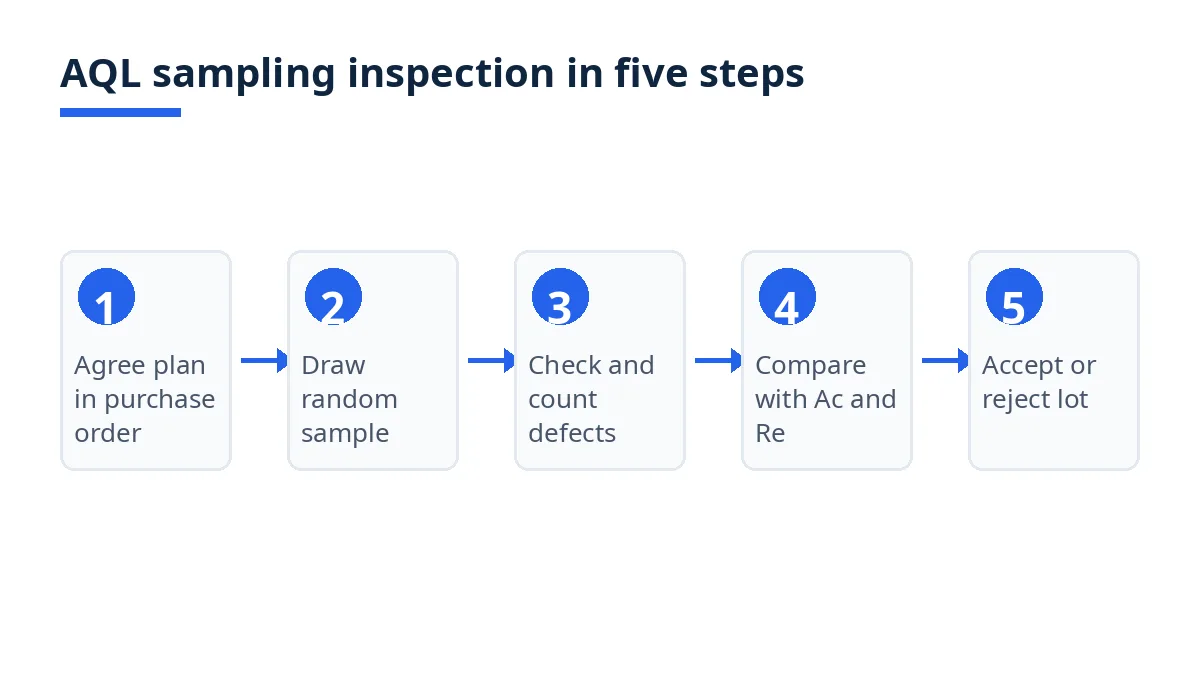
Agree the plan before production ends. Write the standard, inspection level, AQL value for each defect class, defect list and timing into the purchase order.
Draw a random sample. When goods are finished and mostly packed, the inspector selects cartons at random and pulls the sample size the table requires. A sample chosen by the seller is not random.
Check each unit in the sample. The inspector examines workmanship, measurements, function, labeling and packing against your specification, and classifies defects as critical, major or minor.
Compare the counts with the table. Each class is judged on its own. At or below the acceptance number, Ac, the lot passes for that class. At or above the rejection number, Re, it fails.
Send lab specimens separately, if ordered. Where material performance matters, specimens go to a laboratory in parallel. Read both results together before you release the shipment.
Most AQL checks happen as part of a pre-shipment inspection, once production is complete and goods are packed.
Who is responsible for what
Task | Buyer | Seller | Inspector or laboratory |
|---|---|---|---|
Set AQL levels and defect list | Yes | Agrees | Advises if asked |
Produce goods to specification | No | Yes | No |
Make packed goods available | No | Yes | No |
Draw sample and inspect it | No | No | Inspector |
Test specimens to a named method | No | No | Laboratory |
Pay for inspection and testing | As agreed | As agreed | No |
Rework or sort a failed lot | No | Yes | Re-inspects if ordered |
Accept, reject or waive a result | Yes | No | No |
Who pays is a contract point, so record it in the order.
Worked example with numbers (Bangladesh shipment)
Example figures. The numbers below follow the published sampling table. The defect counts are illustrative.
A buyer orders 10,000 polo shirts from Bangladesh. The order specifies General Inspection Level II under ISO 2859-1, AQL 2.5 major, AQL 4.0 minor, and zero acceptance for critical defects.
For a lot of 3,201 to 10,000 units at General Inspection Level II, the table gives a sample size of 200, with acceptance and rejection numbers of 10 and 11 at AQL 2.5, and 14 and 15 at AQL 4.0.4 A lot of exactly 10,000 units falls in that band, so the inspector draws 200 shirts at random.
The inspector finds no critical defects, 7 major defects, including open seams and misaligned plackets, and 11 minor defects, mostly loose threads. Both counts are at or below the acceptance numbers, so the lot passes. If 11 shirts had carried a major defect, the lot would have failed.
In parallel, the buyer sends fabric specimens from the same production to a laboratory. Laboratory testing of textiles can cover dimensional stability and appearance after laundering, fiber identification and colorfastness, among other properties.3 The lab reports composition, shrinkage and colorfastness against the methods named in the order. Those results prove the material behaves as specified. They do not prove that the other shirts were sewn, labeled and packed correctly.
A purchase order clause joining the two checks reads, in plain form: Shipment is subject to pre-shipment inspection to ISO 2859-1, General Level II, AQL 2.5 major, 4.0 minor and 0 critical, and to laboratory testing of production fabric for composition, shrinkage and colorfastness to the methods in the specification.
AQL vs related terms
Check | What is checked | Where | What it proves | Limits |
|---|---|---|---|---|
AQL testing (sampling inspection) | Random sample of finished, packed units: workmanship, measurements, function, labeling, packing | Factory or packing site, before shipment | Whether the sample defect rate sits within the agreed limit for each class | Cannot prove material properties; uninspected units are not individually checked |
Lab testing | Specimens measured for composition, colorfastness, shrinkage, strength and restricted substances | Laboratory, using a named test method | What the specimen contained and how it performed under that method | Cannot prove every unit is well made, sized, labeled or packed |
Pre-shipment inspection | Finished goods, quantity, packing and shipping marks, often including AQL sampling | Packing site, after production | That the shipment matched the order at inspection | Cannot prove durability or hidden material properties |
100 percent inspection | Every unit in the lot | Packing site | Condition of each unit checked | Cannot prove material properties; slow, costly and subject to human error |
Use the checks together, not as substitutes. Sampling controls workmanship at practical cost. Lab testing controls risks you cannot see, such as a restricted substance no visual check can confirm.
Common mistakes to avoid
Treating AQL as a guarantee. A passed lot can still contain defective units up to the acceptance number.
Ordering AQL 2.5 with no standard or level. Without the standard, level and defect definitions, two inspectors can reach opposite results on the same lot.
Letting the seller pick the sample. Hand-picked cartons defeat random sampling. The inspector must select cartons independently.
Using an inspection to test the material. An inspector cannot confirm fiber content or colorfastness by eye. If a property matters, name a lab test and method.
Using a lab report to release the shipment. A report on one specimen says nothing about sizing, stitching, labels or packing in the full lot.
Agreeing limits after production. Setting levels only once goods are finished turns inspection into negotiation. Fix the plan in the order.
FAQs
What is AQL?
AQL is the Acceptance Quality Limit. It is the worst tolerable process average under a sampling system such as ISO 2859-1, expressed as a percentage of defective items.1 An inspector checks a random sample, classifies defects as critical, major or minor, and accepts or rejects the lot by comparing counts with the table.
How does AQL work in practice?
You agree the standard, inspection level and an AQL value for each defect class in the purchase order. The inspector draws the sample size the table sets for your lot, checks each unit and counts defects. The lot passes at or below the acceptance number and fails at the rejection number.
Is AQL used for shipments from Bangladesh?
Yes. AQL sampling is used for garment and other shipments from Bangladesh, usually within a pre-shipment inspection once goods are packed. Buyers pair it with lab testing when composition, shrinkage or colorfastness need proof visual inspection cannot give.
What are common mistakes with AQL?
Treating a pass as a guarantee of zero defects, naming an AQL value with no standard or level, letting the seller choose the sample, expecting visual inspection to prove material properties, and agreeing limits only after production.
Next steps on Exportain
Exportain is a marketplace where buyers find Bangladeshi suppliers and state quality requirements in their enquiry. Exportain does not inspect or test goods, so arrange inspection and lab testing separately and write both into your order. Browse suppliers, post your requirement at post an RFQ, or read how to buy.
Sources
- ISO 2859-1:2026 - Sampling procedures for inspection by attributes — Part 1: Sampling schemes indexed by acceptance quality limit (AQL) for lot-by-lot inspection. ISO (accessed )
- Understanding Acceptable Quality Level (AQL) in Quality Control. Investopedia (accessed )
- Textile & Fabric Testing for Quality Control. QIMA (accessed )
- AQL Table Explained: Sample Size and Accept/Reject. Westwood Sourcing, (accessed )
Reviewed by Naim Islam
About the author
Sourcing from Bangladesh?
Post a request for quotation and suppliers on Exportain can send you their quotes directly.
Post an RFQ