AQL Full Form and Origin of the Standard
Definition
AQL stands for Acceptance Quality Limit. It is the worst tolerable process average, expressed as a percentage of nonconforming units, when a continuing series of lots is submitted for acceptance sampling under ISO 2859-1. Inspectors draw a random sample, classify defects as critical, major or minor, and accept or reject the lot by comparing each count with the acceptance and rejection numbers for the agreed AQL.
By Naim Islam
Published 7 min read

On this page
Key takeaways
AQL stands for Acceptance Quality Limit, defined in ISO 2859-1 and ANSI/ASQ Z1.4.
AQL is a worst tolerable process average, not a quality target or a guarantee of zero defects.
Inspectors classify defects as critical, major and minor, each with its own AQL, acceptance number and rejection number.
The system originated in Bell Laboratories work and MIL-STD-105, cancelled in 1995 in favour of ANSI/ASQ Z1.4.
If you have searched for the aql full form before approving a shipment, you are not alone. AQL appears in inspection reports, purchase orders and supplier emails, yet many buyers agree to it without knowing what the letters stand for or where the system came from. This article gives the full form, the origin, a worked garment example, and the wording for a purchase order.
Quick answer
AQL stands for Acceptance Quality Limit. ISO defines AQL as the maximum average percentage of defective items considered acceptable during random sampling, and ISO 2859-1 uses AQL to determine sample sizes and acceptance and rejection thresholds.1 It is the worst tolerable process average for a continuing series of lots submitted for acceptance sampling: a pass-or-fail limit, not a quality target and not a promise that a passed lot contains no defects.
What AQL means in plain English: the aql full form explained
AQL stands for Acceptance Quality Limit.1 In older documents, the same letters are expanded as Acceptable Quality Level. Investopedia notes that AQL is defined in ISO 2859-1 as the maximum number of defective items considered acceptable during random sampling of a batch, shown as a percentage or ratio.2 Both expansions refer to the same system. The change from level to limit matters: a limit is a boundary, not a level to aim for.
In plain English, AQL answers one question: how many defective pieces can an inspector find in a random sample before the whole shipment is rejected? Instead of checking every unit, the inspector checks a sample drawn from the finished lot. Defects fall into three classes: critical defects can harm a user or break a rule, so they normally carry AQL 0; major defects affect function, fit or saleability; minor defects are small cosmetic issues. Investopedia gives the same typical pattern, with major commonly at 2.5 percent and minor at 4 percent.2 Each class gets its own AQL, so one sample produces three pass-or-fail decisions. See AQL acceptance quality limit for defect classes in more depth.
The origin explains the design. Lot-by-lot acceptance sampling began just before the Second World War and grew during the war, when buyers needed to assure wartime material quality without testing every item. Bell Laboratories personnel were heavily involved, and the most prolific contributors were G. D. Edwards, H. F. Dodge and H. G. Romig.3 MIL-STD-105, the United States defense standard for sampling by attributes, was based on the theories of Walter A. Shewhart, Harry Romig and Harold F. Dodge.4 Its last revision was MIL-STD-105E; it was cancelled in February 1995, with the notice recommending ANSI/ASQ Z1.4.4 Internationally, the same approach is set out in ISO 2859-1.1
How it works step by step
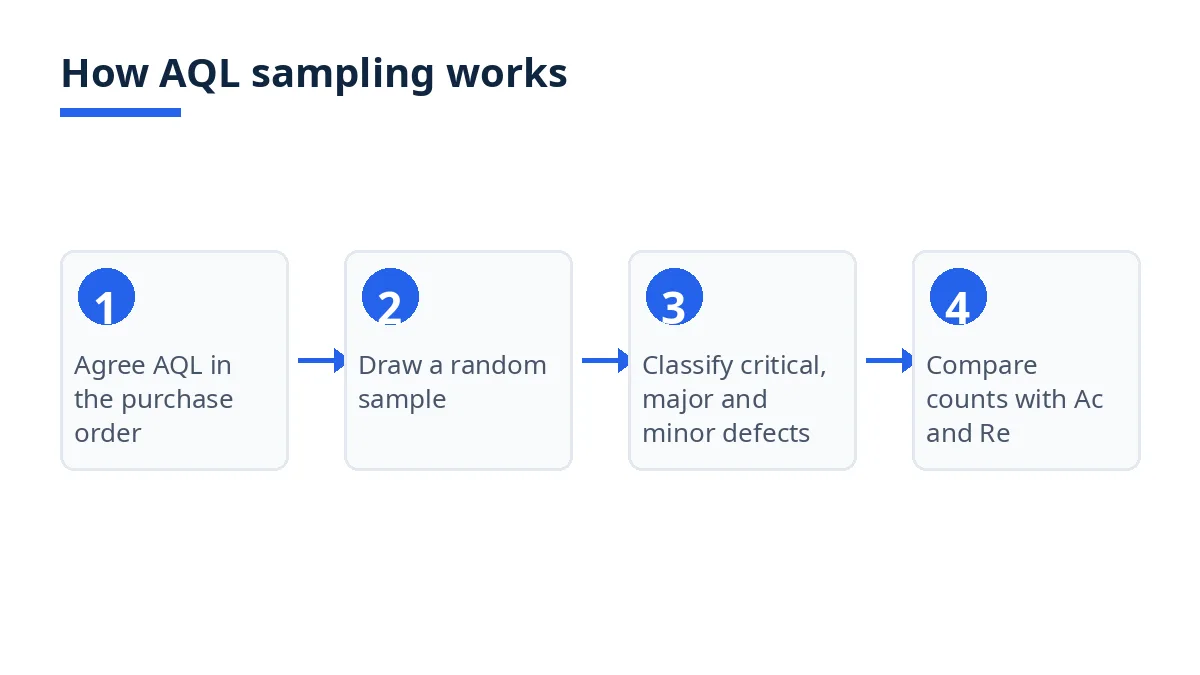
An AQL inspection follows this sequence:
Agree the terms before production ends. Fix the inspection level and the AQL for each defect class in the purchase order, not after goods are packed.
Fix the lot size, for example 8,000 finished T-shirts packed and ready in one shipment.
Choose the inspection level. General Level II is the default for garment inspections. Level I uses a smaller sample, Level III a larger one, and Special Levels S-1 to S-4 cover small or destructive tests.
Read the sample size from the table. The lot size and level give a code letter, which gives the number of units to draw at random from across the cartons.
Inspect and classify every defect as critical, major or minor.
Compare counts with the acceptance number (Ac) and rejection number (Re) for each AQL. At or below Ac that class passes; at or above Re it fails.
Decide and report. The lot is accepted, rejected or held for sorting and re-inspection, with findings recorded in the report.
ANSI/ASQ Z1.4 is the United States version. ASQ describes it as an acceptance sampling system used with switching rules on a continuing stream of lots for a specified Acceptance Quality Limit, providing tightened, normal and reduced plans.5 ISO 2859-1 includes similar rules.1
AQL sampling is normally the core of a pre-shipment inspection, carried out when production is complete and goods are packed.
Who is responsible for what
Party | Responsibility |
|---|---|
Buyer | Sets the AQL values and inspection level in the purchase order; defines critical, major and minor; decides what happens after a failure. |
Supplier or factory | Produces to the specification, runs in-line and final checks, presents the full finished lot for random sampling and sorts goods after a rejection. |
Inspector or inspection agency | Draws the sample randomly, applies the ISO 2859-1 or ANSI/ASQ Z1.4 tables, classifies defects against the buyer's definitions and reports the result. |
Buyer and supplier together | Agree in advance how re-inspection, sorting costs and delays after a failure will be handled. |
The inspector must be independent. A sample steered by the supplier does not test the lot.
Worked example with numbers (Bangladesh shipment)
Example figures: the order and defect counts are illustrative. The sampling numbers follow the ISO 2859-1 and ANSI/ASQ Z1.4 tables for the lot size, level and AQL values stated.
A European buyer orders 8,000 knit T-shirts from a factory in Bangladesh. The purchase order sets General Inspection Level II, normal inspection, with AQL 0 for critical, 2.5 for major and 4.0 for minor defects, matching the typical garment pattern.2
For a lot of 3,201 to 10,000 units at Level II, the tables give code letter L and a sample of 200 shirts drawn at random from the cartons:
Defect class | AQL | Accept (Ac) | Reject (Re) |
|---|---|---|---|
Critical | 0 | 0 | 1 |
Major | 2.5 | 10 | 11 |
Minor | 4.0 | 14 | 15 |
The inspector finds no critical defects, 7 major defects (open seams, wrong measurements, a misprinted print) and 11 minor defects (loose threads, light marks). Every class is at or below its acceptance number, so the lot passes. Had major defects reached 11, the lot would have failed on that class alone.
Purchase order wording: "Pre-shipment inspection to ISO 2859-1, General Inspection Level II, normal inspection; AQL: critical 0, major 2.5, minor 4.0. Shipment only after a passed inspection report."
AQL vs related terms
Term | How it differs from AQL |
|---|---|
Acceptable Quality Level | The older expansion of the same letters; ISO 2859-1 now uses Acceptance Quality Limit.1 |
Defects per hundred units | A factory-floor measure of defects per 100 units inspected during in-line checking. It aids production control, but it is not an acceptance sampling plan. |
100 percent inspection | Checking every unit instead of a sample, for very small lots or after a failed AQL inspection. It is slow, costly and still not error-proof. |
Limiting Quality (LQ) | The poor quality level a plan is designed to reject most of the time, used for isolated lots rather than a continuing series. |
See AQL testing for choosing levels and reading the tables.
Common mistakes to avoid
Writing "AQL 2.5" with no defect classes. One number with no critical, major and minor split leaves the inspector guessing.
Treating AQL as a guarantee of zero defects. A passed lot can still contain defective units up to the limit. AQL manages risk statistically; it does not remove it.
Agreeing AQL after production. If the level is set only when goods are packed, the supplier produced without knowing the bar.
Letting the sample be hand-picked. Samples must be drawn randomly from across the cartons.
Confusing the old and new full form. Both expansions are the same system, but the current ISO wording avoids reading AQL as a target.
How Exportain helps
Exportain is a B2B export marketplace based in Dhaka, Bangladesh. Buyers find Bangladeshi suppliers, exporters and trade service providers, post requests for quotation (RFQs), receive quotations, message suppliers and place orders. Exportain does not inspect goods itself. Buyers can state inspection requirements, including AQL values and level, in enquiries and the purchase order, and arrange independent inspection through services.
FAQs
What is AQL?
AQL is the Acceptance Quality Limit, the worst tolerable process average for a continuing series of lots submitted for acceptance sampling.1 It is defined in ISO 2859-1 and ANSI/ASQ Z1.4, applied separately to critical, major and minor defects.
How does AQL work in practice?
AQL works by turning the lot size and level into a random sample size, then comparing defect counts with the table. At or below the acceptance number a class passes; at or above the rejection number it fails.
Is AQL used for shipments from Bangladesh?
Yes. AQL sampling under ISO 2859-1 is a standard method for pre-shipment inspections of garments and other goods from Bangladesh, and buyers routinely write Level II with AQL 2.5 for major and 4.0 for minor defects into purchase orders, as above. Confirm the values for your product rather than copying them by habit.
What are common mistakes with AQL?
The common mistakes are stating one AQL number without splitting it by class, treating a pass as a guarantee of zero defects, agreeing the level after production, and allowing hand-picked samples.
Next steps on Exportain
Post an RFQ on Exportain at post an RFQ, stating your inspection level and AQL values, so suppliers quote against the same quality bar. Browse Bangladeshi suppliers by category, and read how to import from Bangladesh for the wider buying process.
Sources
- ISO 2859-1:2026 - Sampling procedures for inspection by attributes — Part 1: Sampling schemes indexed by acceptance quality limit (AQL) for lot-by-lot inspection. International Organization for Standardization (accessed )
- Understanding Acceptable Quality Level (AQL) in Quality Control. Investopedia (accessed )
- The Continuing Evolution of the Military Standard 105D Sampling System. Nokia Bell Labs (accessed )
- MIL-STD-105. Wikipedia (accessed )
- ANSI/ASQ Z1.4 & Z1.9 Sampling Plan Standards for Quality Control. ASQ (accessed )
Reviewed by Nourin Tabassum
About the author
Sourcing from Bangladesh?
Post a request for quotation and suppliers on Exportain can send you their quotes directly.
Post an RFQ