

Sustainable Leather & Leather Goods From Bangladesh: Certifications and Green Factories
Leather and leather products earned USD 1.23 billion in fiscal 2026 on EPB data. This guide separates the tannery claim, the tanning claim and the article claim, with LWG, OEKO-TEX and REACH checks and the Savar CETP record.
Short answer
Sustainable leather goods from Bangladesh are sourced claim by claim: the tannery, the tanning method and the finished article each carry separate evidence. Buyers fix the claim first, chrome-free, vegetable-tanned or tested for harmful substances, then require the tannery audit report, the product test certificate and the effluent record for the Savar estate, because no single label covers all three.
On this page
Key takeaways
EPB data put leather and leather products at USD 1.14 billion in fiscal 2025 and USD 1.23 billion in fiscal 2026, and no official series separates lower-impact production from the rest.
The Savar CETP was designed for 25,000 cubic metres a day but effectively treats about 14,000 to 15,000 cubic metres, and its effluent quality can affect a tannery LWG audit score.
LWG certifies the tannery, not the bag: its audit covers 17 sections, certification lasts 24 months for leather manufacturers, and chrome-free means less than 1000 mg/kg of total chromium.
There is no single typical MOQ, price or lead time for leather goods; the tanning method and the claim change all three.
If you buy leather goods with a sustainability requirement, separate three claims that are often sold as one. The first is about the tannery: how it uses water and energy, manages chemicals and treats its effluent. The second is about the tanning method: whether chromium was used, and what the finished leather contains. The third is about the finished article in your market: whether the bag, wallet or belt itself passes the chemical limits that apply where you sell it. Each claim has its own evidence, its own certificate and its own expiry date, and none proves the other two.
This guide covers the export data, the product families and clusters, the Savar tannery estate and its central effluent treatment plant (CETP), the audits and standards that carry each claim, and how to verify a supplier claim by claim. It gives no single typical price, minimum order quantity or lead time, because none exists across a vegetable-tanned belt and a chrome-tanned handbag.
Market overview with latest data
The Export Promotion Bureau (EPB) reports leather and leather products as one export line, covering raw and finished leather, leather goods and leather footwear together. No official series separates certified or lower-impact production from the rest.
Export earnings from leather and leather goods rose by 10.19 percent to USD 1.14 billion in fiscal year 2024-25, according to the Export Promotion Bureau, after USD 1.03 billion in fiscal 2024.1 The same EPB series put the sector at USD 1.17 billion in fiscal 2023 and USD 1.24 billion in fiscal 2022, a pattern New Age describes as earnings hovering around USD 1 billion for several years.1
The next year continued the recovery. Leather and leather products exports rose by 47.68 percent in June 2026 and by 7.09 percent for fiscal year 2025-26 as a whole, reaching USD 1.23 billion, according to provisional EPB data reported by The Financial Express.2
Reporting by The Business Standard, drawing on the Leathergoods and Footwear Manufacturers and Exporters Association of Bangladesh (LFMEAB), records that Bangladesh produces approximately 350 million square feet of leather annually and that the industry is not dependent on imports for its raw material, because rawhide is collected domestically.3 The same reporting puts the primary markets for Bangladeshi leather exports as the European Union, the United States, Japan and China, with footwear accounting for the largest share, followed by leather goods and finished leather.3
Main products and production clusters
The offer groups into product families, and the evidence differs by family. Fix your family and your claim first.
Handbags and travel goods. Handbags, shopping bags, travelling bags and rucksacks, specified by leather type and thickness, lining, edge finish, stitch density, hardware, zips and handles. The claim here sits in the leather itself, so ask which tannery produced it, not only which factory sewed the bag.
Small leather goods. Wallets, purses, card cases, belts and similar articles, specified by leather, splitting and skiving, edge paint, stitching and hardware. The claim still depends on the same tannery evidence as a bag.
Leather garments and gloves. Jackets and gloves in softer, thinner leather, specified by skin type, thickness, lining and fit. These articles sit against the skin, which makes the chromium VI limit a design input, not an afterthought.
Footwear uppers and finished footwear. Footwear is the largest segment reported for the industry, with annual production exceeding 400 million pairs according to LFMEAB data, and the same source estimates production of 80.22 million pieces of bags and 3.1 billion pieces of small leather goods.3
Where the clusters are
The tannery sector is the backbone of the chain. The Business Standard reports over 200 tanneries in the country, primarily concentrated in the Savar Tannery Industrial Estate, which was established to centralise operations and minimise environmental pollution, after tanneries were moved from previously scattered locations in Dhaka.3 The same reporting counts 271 leather factories in the industry overall.3 A goods factory may buy finished leather from Savar, from another tannery, or import it for a specific order, so record both addresses in the order file: the tannery that made your leather is not always the factory that sewed your goods.
Classification decides the duty line
Classify each article before you negotiate the final price, because the code follows the article type and its outer surface material, not the marketing name or the claim. Heading 4202 covers trunks, suitcases, briefcases, travelling bags, handbags, shopping bags, wallets, purses and similar containers, of leather or of composition leather, of sheeting of plastics, of textile materials, of vulcanised fibre or of paperboard, or wholly or mainly covered with such materials or with paper.4 The subheading then splits by outer surface, so a handbag with an outer surface of leather classifies apart from the same shape in plastic sheeting. Confirm the full national code in the destination tariff for your exact article.
The Savar estate, the CETP and what green means here
Bangladesh moved its tanneries out of Hazaribagh in Dhaka to the Savar estate so that effluent could be treated centrally. The sustainability question for most Bangladeshi leather is therefore, in large part, a question about one shared treatment plant.
The record is mixed, and buyers should read it as it stands. The Financial Express reported in September 2026 that the government plans to build a new central effluent treatment plant at the Savar Tannery Estate while remediating the existing facility, and that the existing plant has a designed treatment capacity of 25,000 cubic metres but can effectively treat only around 14,000 to 15,000 cubic metres.5 The same report records the commerce minister stating that all future tannery operators would have to maintain full environmental and other compliance and obtain certification from the Leather Working Group (LWG).5
TOB News gives the operating detail. Around 160 tanneries were moved to Savar in 2017.6 The CETP was formally finished in 2021, but its Central Chrome Recovery Unit, central sedimentation system and tertiary treatment facilities remained non-functional for years, and the plant has never met the required standards.6 Official documents claim the plant can treat 25,000 cubic metres of waste per day, while in practice its throughput has consistently ranged between 14,000 and 17,000 cubic metres, against tannery production of around 28,000 cubic metres of waste daily, rising to 40,000 to 50,000 cubic metres during the Eid al-Adha season.6 A 2023 report by the Bangladesh Investment Development Authority (BIDA), cited in the same reporting, notes that the absence of LWG certification is preventing many Bangladeshi tanneries from accessing Western markets.6
Three cautions follow. First, a shared plant means shared risk: under the LWG audit, the quality of the final effluent is assessed, common effluent treatment plants are not themselves audited, third-party evidence of CETP performance is required, and CETP efficiency can affect the scores of the leather manufacturing facility.7 Ask for the tannery audit report and the CETP evidence behind it.
Second, estate-level reporting is not a tannery certificate. Reports differ on how many Bangladeshi tanneries hold LWG certification, and the position changes as audits expire. This guide states no count: check the named tannery for your order on the certificate itself, with its site address, rating and expiry date.
Third, some tanneries are adding their own treatment: TOB News reports that several tanneries have been permitted to set up individual effluent treatment plants, of which two had been established at the time of reporting, while solid waste management continues to depend on the central plant.6
How to find and verify suppliers
Start from your specification and your claim, not from a supplier list. The specification states the article, dimensions, leather type, thickness, lining, hardware, stitching, edge finish, colour, labelling, packing and the evidence you require, with the claim in the same document. See how to write an RFQ and finding suppliers in Bangladesh.
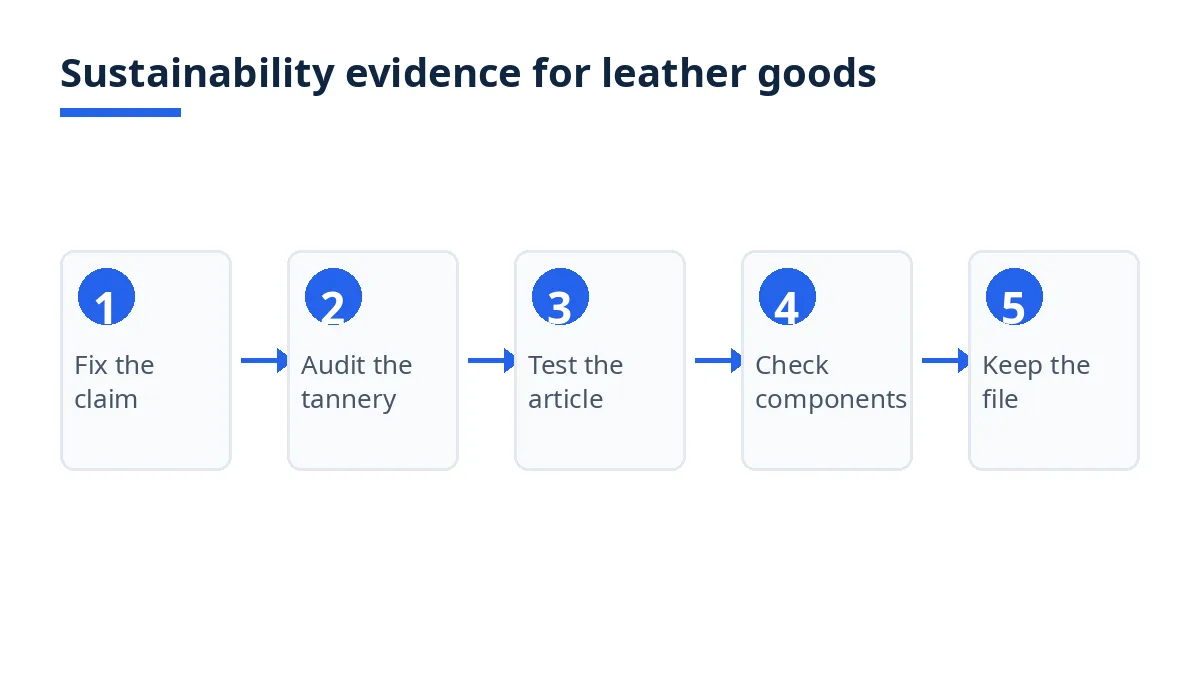
Build a shortlist from more than one route, then run the same verification sequence on every name:
Identity. Match the legal name, trade licence details and factory address across the supplier documents and its online presence. Resolve any inconsistency in writing.
Two addresses. Record separately the goods factory that cuts and sews your article and the tannery that produced the leather. A claim about tanning attaches to the tannery; a claim about making attaches to the factory. If the supplier cannot name the tannery for your order, the tanning claim is open.
Tannery audit scope. Ask for the audit report or certificate itself, not a logo. Check the holder name, the site address, the leather types covered, the rating and the expiry date. Leather Working Group certification is valid for 24 months for leather manufacturing facilities.7
Article evidence. Ask for the test certificate for the article or its leather, naming the standard, the product class where one applies, and the components covered. A test on a leather panel does not cover the lining, thread, edge paint or hardware of the finished bag.
Effluent evidence. Where the tannery sits in the Savar estate, ask how its effluent is treated: through the CETP, through its own plant, or both, and what third-party evidence supports the answer.
Sample in your specification. Order a pre-production sample in your leather, colour and hardware, check thickness, stitching, edge finish, zips and colour against a swatch, and seal a counter-sample once approved.
Export readiness. Ask which markets the supplier ships this family to, and its export registration position. See ERC verification.
Capacity in your window. Ask how much of the line is already booked, and when the leather for your order will be produced or drawn from stock.
Payment discipline. Confirm bank details through a second channel before paying, and treat any late change as a reason to pause and re-verify.
Warning signs include a claim with no tannery named behind it, a certificate naming a different company or site, and refusal to sample in your leather.
MOQ, pricing and lead times
None of the three figures buyers ask for most, a typical minimum order quantity (MOQ), price or lead time, exists as a single figure for this category. Each is quoted per supplier, per article, per leather and per colour against a written specification, and the tanning method changes all three. See the minimum order quantity definition.
MOQ is driven by the smallest workable lot at each stage: hide and tanning lots at the tannery, cutting yield, and hardware, lining, label and carton print runs. A chrome-free or vegetable-tanned requirement raises the floor, because your leather cannot be topped up from a chrome-tanned lot without changing the claim. Expect minimums per article, colour and leather, and ask which requirement sets the minimum.
Pricing is built from leather, lining and hardware, cutting and making, edge finishing, testing, certification costs where the supplier passes them on, packing, inland transport and margin, then expressed on the agreed delivery term. Compare quotations only on an identical specification and claim: a cheaper quote that prices chrome-tanned leather against your chrome-free specification is a different product, not a saving.
Example figures: two suppliers quote for the same vegetable-tanned wallet specification, one at USD 4.80 per piece EXW and one at USD 5.05 per piece FOB. Adding inland transport, export handling and loading of USD 0.22 per piece to the EXW quote gives a like-for-like FOB cost of USD 5.02 per piece, so the real gap is USD 0.03 per piece, not USD 0.25. Use the same adjustment with the landed cost for imports from Bangladesh method.
Lead times cover leather production or stock allocation, hardware and lining purchase, cutting and making, finishing, testing, packing and transport to port, after sample approval. The tannery stage is the usual long pole, because a specific tannage, colour and thickness must be produced or reserved before cutting can start.
Quality, certifications and compliance
Leather goods fail in predictable ways: stitching that opens at a stress point, edge paint that cracks, hardware that fails, colour that rubs off, and leather that varies in thickness or shade across the order. A sustainability claim adds a second failure mode: an article that performs well but cannot support the words on its label.
Specify measurable quality. Define leather type, thickness with tolerance, colour against a swatch, stitch density, edge finish, hardware, lining, measurements and packing. Words such as natural or sustainable cannot be inspected; numbers, a test method and an approved sample can.
Which certifications matter for the tannery?
The Leather Working Group audit is the standard buyers most often name for tannery performance. First launched in 2005, the LWG Audit Standard is an international certification standard for environmentally and socially accountable leather manufacturing, and the audit assesses how a tannery measures, controls and reports the impact of its manufacturing operations.7 The audit includes 17 separate sections, covering areas that include water and energy usage, environmental management, chemical management, waste management and effluent treatment, and health and safety.7
Scoring is by section, against minimum thresholds of 85 percent for Gold, 75 percent for Silver, 65 percent for Bronze and 50 percent for Audited, and a manufacturer is certified at the level of its lowest category.7 The audit also assesses traceability back to a specific slaughterhouse, rated separately from the environmental score.7 Its limits matter: it does not audit slaughterhouses or farms, it is not an assessment of legal compliance, and LWG certification does not guarantee that there will be no restricted substance failures in a final product.7
What do chrome-free and vegetable-tanned actually mean?
These two terms are not interchangeable, and only one of them has a testable threshold in the sources for this guide. Leather is classified as chrome-free if it contains less than 1000 mg/kg of total chromium, measured on a dry weight basis, in accordance with the BS EN 15987 standard.7 A chrome-free claim therefore stands or falls on a chromium test result for your leather, not on the tannery description of its process.
Vegetable-tanned describes a method that uses plant tannins rather than chromium salts. The OEKO-TEX LEATHER STANDARD factsheet records the semi-finished trade terms: wet blue for chrome-tanned hides and wet white for vegetable tanned hides.8 Chromium III is widely used in tanning and chromium VI is not used as part of the tanning process, but chromium VI can form during or after processing as a result of poor process control.7 That is why a chrome-tanned article can be fully compliant and a poorly controlled one can fail, and why the test result, not the tannage name, decides the market question.
What does OEKO-TEX LEATHER STANDARD cover?
The OEKO-TEX LEATHER STANDARD is a globally standardized, independent testing and certification system for leather products all along the supply chain, and its label is a product label for leather that has been tested for harmful substances.8 Certification can be awarded for leather semi-finished products, finished leather, leather fibre materials, up to finished articles and accessories.9 Articles are certified under four product classes, from Product Class I for babies and small children up to Product Class IV for home and decoration material, with limit values that differ by class.8
The criteria catalogue includes banned azo colorants, pentachlorophenol, perfluorinated compounds, chrome VI, cadmium and lead, and compliance with REACH Annex XIV and XVII, the US CPSIA lead rules and the EU persistent organic pollutants regulation.8 All components of the article must comply, leather from exotic species cannot be certified, the certificate is valid for one year, and leather origin must comply with Regulation (EU) 2023/1115.8 Note the boundary with facility claims: STeP, a separate OEKO-TEX certification, certifies production facilities which manufacture textile and leather articles under sustainable production conditions.9
What does ISO 14001 add?
ISO 14001 is the internationally recognized standard for environmental management systems (EMS), providing a framework for organizations to design and implement an EMS and continually improve their environmental performance.10 Certified organizations usually undergo surveillance audits annually, with a recertification audit every three years.10 An ISO 14001 certificate is evidence about a management system. It is not a test of your article and does not replace either the tannery audit or the article certificate.
What does EU REACH require for chromium VI in leather?
Market law sits beside every voluntary claim. Under Annex XVII to the REACH Regulation, as amended by Commission Regulation (EU) No 301/2014, leather articles coming into contact with the skin shall not be placed on the market where they contain chromium VI in concentrations equal to or greater than 3 mg/kg, 0.0003 percent by weight, of the total dry weight of the leather, and the same limit applies to any leather part of an article coming into contact with the skin.11 The restriction has applied since 1 May 2015, and the EN ISO 17075 standard method is the analytical method the regulation names for detecting chromium VI in leather, with a determination limit of 3 mg/kg.11 The LWG threshold points the same way: for Gold and Silver certification, chromium VI levels must be below 3 mg/kg, and any level above 3 mg/kg results in an automatic failure.7 Put the test, the method and the limit in the purchase order for skin-contact articles such as gloves, watch straps and bags carried against the body.
Test at the right stages. Approve a pre-production sample, check bulk leather against the swatch before cutting, then inspect before shipment against the sealed counter-sample. ISO 2859-1:2026 defines a system of acceptance sampling plans for inspection by attributes, indexed by acceptance quality limit (AQL), for lot-by-lot inspection, and the AQL is the maximum average percentage of defective items considered acceptable during random sampling.12 See AQL acceptance quality limit and pre-shipment inspection.
Shipping, Incoterms and duties
Leather goods ship mainly in cartons by sea, with samples and small urgent orders by air. Agree pieces per carton, dimensions and gross weights before the price is fixed, and keep the leather lot identifiable from the carton marks, so the claim file can be matched to the goods after arrival.
Duties and market access must be checked, not assumed. Duty depends on the HS classification, your destination tariff and any preferential scheme in force at import. For the European Union, Access2Markets describes Everything But Arms (EBA) as a special arrangement for least developed countries, granting full duty-free and quota-free access for all products except arms and ammunition.13 Confirm eligibility and origin rules with your broker first. The UK tariff line for commodity code 4202990090, an other line under heading 4202, carries a third country duty of 2.00 percent.4 A sustainability certificate does not change the duty line; origin and classification do.
Choose the delivery term deliberately. Under EXW, you arrange almost everything from the factory gate. Under FOB, the supplier delivers the goods on board at the named port. Under CIF, the supplier pays freight and minimum insurance to your destination port, while risk passes at loading. The Incoterms rules published by the International Chamber of Commerce are eleven three-letter trade terms used in contracts for the sale and purchase of goods, and they clarify the tasks, costs and risks involved in delivering goods from sellers to buyers.14 Incoterms 2020, the current version, entered into force on 1 January 2020.14 Read Incoterms for shipments from Bangladesh.
Documents decide whether goods move. Bangladesh Customs requires an export declaration, known as a Bill of Export or Shipping Bill, to be submitted and approved before goods are loaded for export, with documents enclosed that include the export letter of credit or, where there is none, the export contract or purchase order, a commercial invoice, a packing list, an EXP form certified by an authorised dealer bank, a certificate of origin issued by the EPB or a chamber of commerce, a VAT registration certificate and a taxpayer identification number.15 Keep the tannery audit copy, the article test certificate and the chromium VI report for the order in the same file, even though customs does not clear the claim itself.
Step-by-step buying process
Define the range and the claim. Fix product families, leather type and thickness, colours, hardware, labelling, packing and destination, and write down the exact claim, the standard behind it and the test that will support it.
Research the market. Check current EPB data and the Savar CETP position before setting expectations for tannery evidence.
Classify each article. Confirm the heading, then the full national code and duty line in your destination tariff.
Build the evidence list. List the tannery file, the article file and the market file you will require, claim by claim, before you ask for prices.
Shortlist and check suppliers. Run the identity, two-address, tannery audit scope and article evidence checks in this guide.
Request comparable quotations. Send the identical specification and claim wording to each supplier, requiring term, currency, validity, MOQ and lead time.
Sample and test. Approve pre-production samples in your leather and colour, test skin-contact articles for chromium VI where your market requires it, and seal a counter-sample.
Agree the contract. Issue a purchase order with the specification, tolerances, label wording, document list, inspection rights, payment terms and delivery term.
Control production. Confirm the leather lot and its tannery record and the production slot, and resolve any substitution of tannery or tannage in writing.
Inspect before shipment. Commission an independent inspection against the sealed sample, including stitching, edge, hardware and labelling checks.
Ship, clear and review. Check document drafts early, clear customs with your broker, then review the delivered goods and the claim file together.
Related guides
Read sustainable knitwear from Bangladesh and sustainable woven garments from Bangladesh, which apply the same separation of product claim, factory claim and market rules to garments, and how to import from Bangladesh for the wider sourcing route.
FAQs
Is Bangladesh a good place to source leather & leather goods?
It can be, when the article, the tannery and the claim are matched. The raw material base is domestic, Bangladesh produces approximately 350 million square feet of leather annually,3 and leather and leather products earned USD 1.23 billion in fiscal 2026 on EPB data.2 The constraint is evidence, not capacity: the Savar CETP effectively treats about 14,000 to 15,000 cubic metres against a designed capacity of 25,000,5 so the right tannery for your leather still has to document your claim.
What is the typical MOQ?
There is no single typical MOQ for this category. Minimums are set by hide and tanning lots at the tannery, by cutting yield, and by hardware, lining, label and carton print runs, and a chrome-free or vegetable-tanned requirement sets its own batch minimum on top. Ask each supplier to state its MOQ against your exact specification and claim.
How long is the lead time?
Lead time is article- and leather-specific. It covers leather production or stock allocation, hardware and lining purchase, cutting and making, finishing, testing, packing and transport to port, after sample approval. A tannage or colour produced for your order is the usual constraint. Require a written lead time for the specified tannage.
Which certifications matter?
It depends on your market, article and claim. For the tannery, the LWG audit covers 17 sections including chemical management and effluent treatment, with medal thresholds of 85 percent for Gold, 75 percent for Silver and 65 percent for Bronze, and certification valid for 24 months.7 For the article, the OEKO-TEX LEATHER STANDARD tests leather products for harmful substances, requires all components of the article to comply, and its certificate is valid for one year.8 For the management system behind a supplier, ISO 14001 covers the environmental management system, with surveillance audits annually and recertification every three years.10 For the European Union, REACH bars skin-contact leather articles at or above 3 mg/kg chromium VI,11 and chrome-free leather means less than 1000 mg/kg of total chromium on a dry weight basis.7
Next steps on Exportain
Start with how to import from Bangladesh, then use finding suppliers in Bangladesh to build your shortlist.
Sources
- Leather, leather-goods exports see 10pc growth. New Age (accessed )
- June exports surge by 25.91pc, FY26 earnings hold steady at $48b: EPB. The Financial Express, (accessed )
- From rawhide to finished products: The self-sufficiency of Bangladesh's leather industry. The Business Standard, (accessed )
- Commodity code 4202990090: Other - UK Integrated Online Tariff. GOV.UK (accessed )
- Govt plans to build new world-class CETP for leather industry. The Financial Express, (accessed )
- CETP failures hit leather industry hard. TOB News, (accessed )
- Certification - Leather Working Group. Leather Working Group (accessed )
- OEKO-TEX LEATHER STANDARD Factsheet. OEKO-TEX (accessed )
- OEKO-TEX - for more sustainability in the textile and leather industry. OEKO-TEX (accessed )
- ISO 14001:2026 - Environmental management systems. International Organization for Standardization (accessed )
- Commission Regulation (EU) No 301/2014 amending Annex XVII to Regulation (EC) No 1907/2006 (REACH) as regards chromium VI compounds. European Union, (accessed )
- ISO 2859-1:2026 - Sampling procedures for inspection by attributes — Part 1: Sampling schemes indexed by acceptance quality limit (AQL) for lot-by-lot inspection. ISO (accessed )
- Trade arrangements. European Commission, Access2Markets (accessed )
- Incoterms® rules. International Chamber of Commerce (ICC) (accessed )
- Customs Clearance Procedures for Export. Bangladesh Customs, National Board of Revenue (accessed )
About the author
Sourcing from Bangladesh?
Post a request for quotation and suppliers on Exportain can send you their quotes directly.
Post an RFQ


