

Sustainable Knitwear & T-Shirts From Bangladesh: Certifications and Green Factories
How to source sustainable knitwear and T-shirts from Bangladesh: what GOTS, OCS, GRS and OEKO-TEX Standard 100 actually evidence, how LEED green factories fit in, and how to verify a supplier before ordering.
Short answer
Sustainable knitwear from Bangladesh means matching a knit garment to evidence: GOTS or OCS for organic content, GRS or RCS for recycled content, OEKO-TEX Standard 100 for harmful-substance testing, and a LEED rating for the factory building only. Buyers should verify each certificate number, scope and validity in the scheme owner's register, then confirm MOQ, price and lead time against an identical specification.
On this page
Key takeaways
Sustainable knitwear is evidenced layer by layer: fibre content, factory systems, chemical management, safety and traceability each need separate proof.
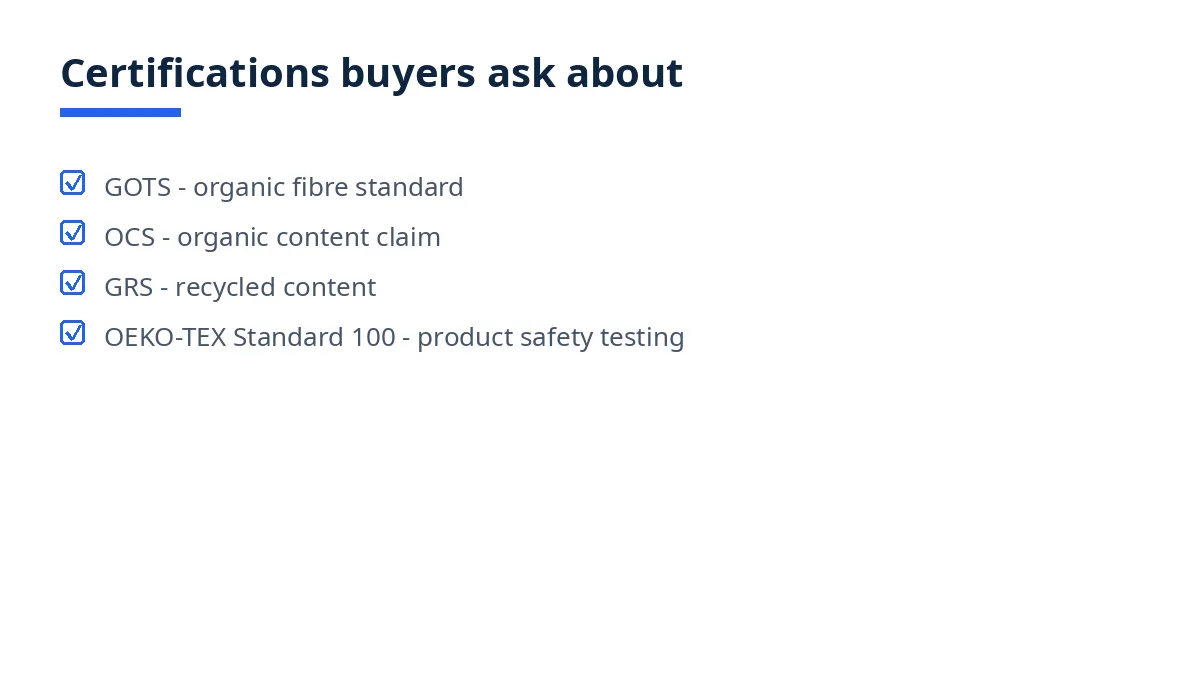
GOTS covers organic fibres with processing, chemical, wastewater and social criteria; OCS verifies organic content and chain of custody only.
GRS adds social, environmental and chemical requirements to recycled-content verification; RCS covers recycled input and chain of custody.
OEKO-TEX Standard 100 is a label for textiles tested for harmful substances; it is not an organic or recycled-content certificate.
A LEED rating describes the factory building, not the garment, and BGMEA reports 230 LEED-certified factories in Bangladesh.
If you are researching sustainable knitwear bangladesh as a sourcing option, you are looking at an established knitwear supply base through a new lens: not only price, capacity and reliability, but fibre choice, chemical management, energy and water use, worker safety and verifiable certification. This guide brings those two views together. It explains what Bangladesh makes, where production is concentrated, how green factories and certification systems work in practice, and how a buyer in the USA, the UK, the European Union or the UAE can find, verify and work with suppliers without relying on slogans or unverified claims.
Bangladesh has supplied knitwear and T-shirts to global brands for decades. That history matters, because the infrastructure for responsible production, including testing, certification, compliance teams, effluent treatment and experienced export departments, already exists at scale. Standards still vary from supplier to supplier, and the buyer's job is to match a specific product, fibre and claim to a specific factory that can evidence it.
The principles are the same for a brand building a lower-impact core range, a retailer adding certified lines, or a first-time importer: define the claim precisely, verify it with documents that can be checked, agree the full specification in writing, and manage sampling, production and shipment carefully.
Why buyers choose sustainable knitwear bangladesh
Buyers choose Bangladesh for knitwear for practical reasons that predate the sustainability agenda: depth of manufacturing skill, linked supply chains, experience with high-volume knit products, and export departments used to international buyers' manuals, testing regimes and shipment deadlines. Many factories have invested in newer equipment, energy-efficient utilities, effluent treatment, and systems that track fibre, chemicals and production lots more closely.
A factory already running certified production will usually have clearer documentation, more disciplined sampling and stronger quality control. Sustainability also adds cost and complexity that must be planned honestly. Certified fibres must be sourced and segregated, chain-of-custody paperwork must follow the lot, and additional testing may be required.
Key takeaways
Sustainable knitwear from Bangladesh is not a single product or a single certificate. It is a combination of fibre choice, factory systems, chemical and wastewater management, energy efficiency, worker safety and traceability, each of which must be evidenced separately.
The Global Organic Textile Standard (GOTS) is a certification for textiles made with organic fibres, with independent certification across the textile processing supply chain.1 The Organic Content Standard (OCS) verifies organic content and chain of custody on a narrower scope.2
For recycled content, the Global Recycled Standard (GRS) adds social, environmental and chemical requirements to recycled-content verification, while the Recycled Claim Standard (RCS) covers recycled input and chain of custody.3 OEKO-TEX Standard 100 is a label for textiles tested for harmful substances.4
A LEED rating describes a building. LEED is a green building rating system, and a LEED-certified factory building does not by itself certify a garment, a fibre or a production batch.5
Minimum order quantity, price and lead time depend on fibre, yarn availability, fabric construction, colour, size ratio, finishing, certification scope and factory loading. There is no single standard figure, so compare suppliers on an identical specification and confirm terms in writing.
Market overview with latest data
Knitwear is one of Bangladesh's two major apparel pillars alongside woven garments, and T-shirts and polo shirts are core products within it. For current export figures, use the release, period and product definition behind any number you quote, because trade sources publish on different cycles and with different product groupings. A headline figure without its period and definition is not a basis for a buying decision.
Three structural features explain the market's durability. First, scale and specialisation: production covers the full chain from yarn sourcing and knitting through dyeing, finishing, cutting, sewing, inspection and packing, often within one factory group or cluster, which helps lead-time control and the segregation certified production requires. Second, product breadth: alongside T-shirts and polo shirts, factories produce fleece, sweatshirts, underwear, sportswear and fashion knit tops. Third, market breadth: the European Union, the UK, the USA and other markets buy Bangladeshi knitwear, so factories are used to differing labelling, testing and documentation requirements by destination. See the knitwear industry in Bangladesh for the wider industry background.
Build a simple evidence habit: start with trade context, then move quickly to supplier-level evidence, because market strength never substitutes for factory verification. Note the exact HS headings behind any figure. Knit apparel sits principally in HS Chapter 61, and a figure may cover all knit apparel or a narrower line, so comparisons need the same definition on both sides.
Main products and production clusters
The core range covers everyday products in depth. T-shirts and polo shirts remain the volume foundation, typically in single jersey, piqué, interlock and slub or melange variations, with fibre composition, fabric weight, colour, print, embroidery and packing agreed per order. Around that core sit fleece, sweatshirts, hoodies, joggers and lounge sets, knit underwear and nightwear, children's knitwear, sportswear and fashion knit tops.
For a sustainability-focused range, product and fibre decisions are inseparable. The same T-shirt carries a different claim, cost and paperwork in conventional cotton, organic cotton, recycled blends or another certified fibre, so the fibre, its percentage and its certification must be in the specification from the start.
Fabric and garment capability should be checked rather than assumed. Ask which knitting gauges and fabric types the factory works with regularly, whether dyeing and finishing are in-house or with a named partner, and what testing is done in-house versus externally. For certified production, the certified scope must cover the actual processes and product categories for your order, and any subcontracted process must be included in the chain of custody where the scheme requires it.
Production is concentrated in clusters buyers will meet repeatedly. Greater Dhaka, including Gazipur and Savar, hosts many large composite factories. Narayanganj is a historic centre for knitwear, dyeing and finishing, and Chattogram combines garment production with the principal seaport. Confirm distance to port, capacity, utilities and destination experience for the individual supplier, not from the cluster's reputation.
How to find and verify suppliers
Finding suppliers is easy. Finding a verified match for a specific certified product is the real work. Begin by writing a one-page sourcing brief before you contact anyone: product and fabric construction, fibre composition and the exact sustainability claim you intend to make, target quantity by colour and size, destination market, required certificates, testing and labelling requirements, and your sampling and shipment timeline. A supplier who can genuinely meet a certified brief will respond to that precision with precise questions of their own. A supplier who answers every requirement with an unqualified yes, without asking about fibre source, certificate scope or lot segregation, should be treated with caution.
Use several discovery routes in parallel. Start with how to find suppliers in Bangladesh, check BGMEA and BKMEA member information, and compare any factory's claims against third-party evidence. For each shortlisted supplier, request the same evidence pack so comparisons are fair: business and export documentation, a factory profile covering machinery and capacity by product type, current certifications with certificate numbers and expiry dates, audit summaries where the factory will share them, main markets served, and examples of similar certified production.
Verification means checking, not collecting. Enter certificate numbers in the scheme owner's register and confirm that the entity name, address, product categories, processes and validity dates match the factory in front of you. GOTS requires annual on-site audits of certified facilities and transaction-based verification to help ensure product integrity throughout the supply chain.1 OEKO-TEX offers a Label Check where you can enter a certificate number or scan the label to check validity.4 Check that name and address are consistent across trade licence, export registration, certificates and bank beneficiary details, and resolve any mismatch before payment.
Sampling is the second verification stage. Order samples in the actual certified fibre and construction wherever the claim depends on it, require paperwork identifying the fibre lot and certificate reference for production, and test the sample for composition, weight, dimensions, shrinkage, colourfastness and appearance. Approve a pre-production sample in writing. A factory that cannot produce a compliant sample with coherent paperwork is not ready for a certified order.
On Exportain, trust badges are reviews of documents and photos. They are not factory inspections, sustainability certifications or guarantees, and Exportain does not certify that a supplier's garments meet GOTS, GRS or any other standard. Use a listing as a starting point for your own certificate checks, not as a substitute for them.
MOQ, pricing and lead times
Minimum order quantity, pricing and lead times for sustainable knitwear cannot be stated responsibly as single universal figures, because each is set by the interaction of your specification with a particular factory's supply chain.
What sets the MOQ?
The MOQ is typically driven by the minimum economical quantity of certified yarn or fabric in a colour, the knitting and dyeing lot size, the number of colours and sizes in the order, and any print, embroidery or special finishing setup. An order in a standard colour from a yarn the factory already holds in certified form is a different proposition from an order requiring a custom-dyed certified lot split across many colours and sizes. When a supplier states an MOQ, confirm in writing whether it applies per style, per colour, per size ratio or to the total order, and which element of the specification sets it.
What drives the price?
The unit price reflects fibre and yarn cost, fabric construction and weight, garment make and finishing, print or embroidery, testing and certification administration, packing, and the trade term and destination. Certified fibres carry their own market price and availability. Quotations are only comparable when both suppliers priced the identical specification, quantity breakdown, packing and Incoterm. Ask each supplier to explain the main cost drivers, and be alert to a certified quotation indistinguishable from a conventional one with no explanation of fibre and chain-of-custody costs. The gap may reappear later as a substitution, a delay or a paperwork failure.
How should lead time be planned?
Lead time must be broken into its real stages: certified yarn or fabric procurement, knitting, dyeing and finishing, sampling and approval, cutting and sewing, inspection, packing, inland transport, export handling and international carriage. Stages that depend on your approval, such as lab dips, strike-offs, samples and labelling artwork, sit partly in your control, so a realistic timeline assigns responsibilities on both sides. Build contingency around holidays, capacity peaks and transport disruption, confirm the production slot in writing, and require milestone updates. A shorter promise is not better if it depends on skipping lot segregation, testing or inspection. For certified goods, the paperwork timeline is part of the production timeline.
Quality, certifications and compliance
Quality management and sustainability compliance overlap but are not the same discipline, and a strong order needs both. Quality covers whether the garment matches its specification: fibre composition, fabric weight and construction, measurements, workmanship, colour consistency, shrinkage and colourfastness, labelling and packing. Compliance covers the systems behind the garment: fibre certification and chain of custody, chemical management, wastewater handling, social and safety management, and destination-market legal requirements. A garment can be well made yet fail a certified claim because its paperwork is broken. A fully documented lot can still fail on measurements. Specify, sample and inspect for both.
Which certifications matter for which claim?
The certifications buyers meet most often fall into clear families, and using the right family for the right claim prevents common labelling errors.
For organic claims, GOTS covers textiles made with organic fibres. GOTS certification covers every step of production, from fibre processing and spinning to wet processing, manufacturing and trading, and to label a product as GOTS-certified, all companies involved in its production must be certified by approved independent certification bodies.1 GOTS also defines requirements on chemical inputs and environmental management, wastewater treatment, human rights and social criteria, and traceability.1
OCS is narrower. The Organic Content Standard (OCS) is a chain of custody standard that provides companies with a tool to verify that a specific input material is in a final product, and it requires each organisation along the supply chain to take sufficient steps to ensure the integrity and identity of the input material is preserved.2 OCS verifies organic content and chain of custody. It does not, on its own, evidence the processing, chemical and social criteria that GOTS covers.
For recycled content, the Recycled Claim Standard (RCS) is an international, voluntary standard that sets requirements for third-party certification of recycled input and chain of custody, and its goal is to increase the use of recycled materials.3 The Global Recycled Standard (GRS) is an international, voluntary, full product standard that sets requirements for third-party certification of recycled content, chain of custody, social and environmental practices, and chemical restrictions.3 Under both standards, a professional third-party certification body audits each stage in the supply chain, and transaction certificates from certified suppliers verify that you are getting certified products.3
OEKO-TEX Standard 100 answers a different question. OEKO-TEX Standard 100 is a label for textiles tested for harmful substances, from yarn to finished product, and every thread, button and accessory has been tested against a list of over 1,000 harmful substances.4 The more intensive the skin contact, the stricter the requirements and laboratory tests.4 Standard 100 supports a product-safety claim. It is not an organic or recycled-content certificate.
Name the exact standard, claim wording and evidence expected, including the scope certificate, transaction certificate where issued, and labelling approval where required, rather than writing only a logo into a purchase order.
Claim you want to make | Standard family | What it evidences |
|---|---|---|
Organic fibre content with processing criteria | GOTS | Organic fibres, processing, chemical inputs, wastewater, human rights and social criteria, traceability1 |
Organic content only | OCS | Verified organic input in the final product and chain of custody2 |
Recycled content only | RCS | Recycled input and chain of custody3 |
Recycled content with processing criteria | GRS | Recycled content, chain of custody, social and environmental practices, chemical restrictions3 |
Product tested for harmful substances | OEKO-TEX Standard 100 | Testing of the article and its components against harmful substances4 |
How do green factory and safety claims fit in?
Green factory claims need the same precision. LEED is described by the U.S. Green Building Council (USGBC) as the most widely recognized green building rating system in the world, offering a framework for healthy, efficient and cost-effective green buildings.5 To achieve LEED certification, a project must complete all prerequisites and earn points by satisfying credit requirements, with levels of Certified, Silver, Gold and Platinum.5 A LEED rating therefore evidences the building within the rating's scope, not the garments made inside it.
BGMEA reports that Bangladesh has 230 LEED-certified factories, with 92 holding platinum status and 124 rated gold, and that Bangladesh is home to 62 of the world's top 100 highest-rated LEED green factories, including 9 of the top 10.6 Treat those figures as BGMEA's reported industry position at the time of that page, and confirm an individual factory's own rating and level directly before you rely on it in marketing.
Workplace safety is a separate layer again. The RMG Sustainability Council (RSC) is a safety monitoring body in the ready-made garment sector of Bangladesh, and the operations of the Bangladesh Accord were transitioned to the RSC.7 Its expertise covers fire, electrical, structural and boiler hazard identification, remediation plans, follow-up on identified issues, safety committee training and an independent complaints mechanism.7 Ask for the specific factory's current inspection and remediation position. RSC coverage of a factory is not a product certificate and not a guarantee about an individual order.
For due diligence, separate three layers: the building rating, the factory's operating and safety systems, and the product-level certificate for your garments. Ask which layer each piece of evidence belongs to, and avoid marketing language that merges them into a single unsupported claim about a T-shirt.
Destination-market compliance is the final layer, and it is yours as importer to confirm. Labelling, product-safety law, chemical restrictions and packaging rules differ by market and change over time. Give your supplier your market's current labelling requirements in writing, confirm test reports cover the correct standard and product, and have your broker confirm the position before production, not after shipment.
Shipping, Incoterms and duties
Most Bangladeshi knitwear moves by sea from Chattogram, with air freight reserved for urgent or high-value shipments. Choose between a full container load and a consolidated load by volume, carton count and deadline, and price the total landed picture, including goods, packing, inland transport, export handling, carriage, insurance where arranged, destination clearance and delivery, rather than the factory price alone.
Incoterms allocate tasks, costs and risk between seller and buyer. They do not transfer ownership or set the price. FOB remains common for Bangladesh apparel exports. CIF adds seller-arranged carriage and minimum insurance to a destination port, and terms such as EXW or DDP place very different shares of transport, clearance and duty on each party. Use the full term with its named place and the Incoterms 2020 reference, and be especially careful with delivered-duty-paid arrangements: the importer of record and responsibility for duty, tax and destination compliance must be explicit and workable.
Duties and market access cannot be given here as a fixed rate, because they depend on the garment's exact classification, fibre composition and construction, origin position and the destination's tariff and preference arrangements in force at import. Classify the product correctly, confirm origin documentation before shipment, and verify the current duty, preference eligibility and import requirements with your customs broker and your market's official tariff source. Never build a margin on a duty figure copied from another product, year or destination.
Document discipline protects the shipment. Expect a commercial invoice and packing list matching the actual cartons, a transport document, a certificate of origin and preference documentation where claimed, inspection or test reports, and the transaction documentation supporting a certified claim. Check drafts before the goods leave and keep names, quantities and certificate references consistent across every document.
Step-by-step buying process
A disciplined buying process turns the guidance above into an order that can be evidenced and repeated.
Define the product and the claim. Write the full specification: style, fabric type and weight, fibre composition with percentages, the exact sustainability claim and standard behind it, colours, size range and ratio, print or embroidery, labelling, testing and packing. Decide which claims will appear on the product, on packaging and in marketing, and confirm that the certification scheme permits that wording before artwork is produced.
Research the market and shortlist suppliers. Use trade data and supplier discovery to build a shortlist of factories whose regular product, cluster and certification scope match your brief.
Send an identical, complete RFQ. Issue the same specification, quantity breakdown and destination to each shortlisted supplier and ask for MOQ basis, pricing drivers, lead time by stage, certificate numbers and validity, and any element the factory cannot meet. Identical inputs are what make the replies comparable.
Verify certificates and factory evidence. Check every certificate in its official register, confirm entity and address consistency, review audit and test evidence proportionate to your risk, and resolve mismatches in writing. Do not proceed to price-only negotiation with a supplier whose core claim cannot be verified.
Sample, test and approve in writing. Develop samples in the production fibre and construction, test against your specification and market requirements, approve lab dips, artwork and a pre-production sample in writing, and record the fibre-lot and certificate references that production will use.
Confirm the commercial agreement. Record specification, quantity, price, Incoterm and named place, payment terms with a beneficiary that matches the contracting business, inspection arrangements, document list, claim wording and shipment window in one confirmed document. Include how changes will be approved, because informal mid-production changes are a common cause of both quality and chain-of-custody failures.
Monitor production at milestones. Agree progress points, such as fibre or fabric arrival, cutting, sewing and inspection booking, and require updates with the lot references intact. Book any pre-shipment inspection early enough for corrective work, and make clear that inspection covers both garment quality and packing and labelling accuracy.
Ship, clear and review. Check document drafts before departure, confirm the transport and origin documents, clear the goods with your broker against the verified classification and duty position, and file scope and transaction evidence with the shipment record. After delivery, review quality results, paperwork completeness and customer-facing claim accuracy, and carry the lessons into the next order's specification.
Related guides
Use this guide with the product-level import guides in the same cluster, including how to import cotton T-shirts from Bangladesh, and with the supplier verification steps above before you compare quotations.
FAQs
Is Bangladesh a good place to source knitwear & t-shirts?
Yes, for many buyers Bangladesh is a strong place to source knitwear and T-shirts. It combines long export experience, integrated knitting, dyeing and sewing capacity, product breadth, and many factories working with international certification and green building systems. Suitability still depends on your product. Verify that the factory's experience, certificate scope, capacity and destination-market knowledge match your specification, and judge the match on sampled product and checked documents, not reputation alone.
What is the typical MOQ?
There is no single typical MOQ. The minimum is set by your specification and the factory: certified yarn or fabric lot size by colour, knitting and dyeing economics, colours and sizes, and any print, embroidery or special finishing all change it. Ask each supplier to state its MOQ in writing, confirm whether it applies per style, per colour or to the total order, and ask which element sets it. For a smaller trial, discuss standard colours or yarns already held, fewer variants or a simpler specification, and record any agreed exception with its price in the confirmed order.
How long is the lead time?
Lead time is the sum of its stages, including certified fibre or fabric procurement, knitting, dyeing and finishing, sampling and approvals, sewing, inspection, packing and transport, so a single figure quoted without that breakdown is not a reliable basis for planning. Factories quote lead times for a specific specification, quantity and production slot, and approvals that sit with you affect the total as much as factory work does. Require a stage-by-stage timeline in writing, confirm the production slot when you confirm the order, track the agreed milestones, and build contingency for holidays, peak capacity and transport disruption rather than compressing testing, segregation or inspection.
Which certifications matter?
The certifications that matter are the ones that evidence the exact claim you intend to make. For organic content with processing criteria, buyers commonly work with GOTS.1 For organic content and chain of custody only, OCS applies.2 For recycled content, RCS covers recycled input and chain of custody, while GRS adds social, environmental and chemical requirements.3 For product testing against harmful substances, OEKO-TEX Standard 100 is widely used.4 Alongside product standards, review the factory's safety position and, where claimed, its LEED building rating as separate layers of evidence.5 In every case, verify the certificate number, legal entity, scope, product categories and expiry in the scheme owner's register, collect the transaction documentation your scheme requires for the shipment, and confirm that your intended label and marketing wording are permitted before you print or publish them.
Next steps on Exportain
Browse suppliers to build a shortlist against the brief in this guide, then post a structured request through post an RFQ stating the fibre, the standard, the quantity breakdown and the destination. If you are new to buying from Bangladesh, read how to buy first, and verify every certificate in the scheme owner's register before you place an order.
Sources
- GOTS – How the system works. Global Standards, (accessed )
- 2025 Sustainable Cotton Challenge – Second Annual Report 2020. Textile Exchange (accessed )
- Quick Guide to the Recycled Claim Standard (RCS) + Global Recycled Standard (GRS). Textile Exchange (accessed )
- OEKO-TEX Standard 100. OEKO-TEX (accessed )
- LEED rating system. U.S. Green Building Council (accessed )
- Another garment factory achieves LEED certification in Bangladesh. BGMEA (accessed )
- RSC Monthly Report May 2026. RMG Sustainability Council (RSC) (accessed )
- Knitwear Bangladesh
- Knitwear Exporters
- Bangladesh Export Data
- sustainable knitwear bangladesh
- GOTS
- GRS
- OEKO-TEX
- green factories
About the author
Sourcing from Bangladesh?
Post a request for quotation and suppliers on Exportain can send you their quotes directly.
Post an RFQ


