How to Import Men's Woven Shirts From Bangladesh in 2026: Complete Buyer Guide
How to import men's woven shirts from Bangladesh: specification, supplier checks, MOQ and samples, quality control, HS 6205 duty, shipping and landed cost for buyers.
Short answer
To import men's woven shirts from Bangladesh, write a specification covering fabric, construction and sizing, shortlist woven garment factories, and verify the chosen factory's documents and capacity. Then classify the shirts under heading 6205, approve a pre-production sample, agree the delivery term and inspection plan, confirm duty for your market, build the landed cost, and inspect the packed goods before shipment.
On this page
Key takeaways
Men's woven shirts classify under HS heading 6205, split by fibre into 6205.20 for cotton, 6205.30 for man-made fibres and 6205.90 for other textile materials.
The UK tariff lists a third country duty of 12 percent on the main 6205 cotton and man-made fibres lines, the US General rate for other cotton shirts under 6205.20.20 is 19.7 percent, and EU access for Bangladesh is duty-free under Everything But Arms when origin is proved.
BGMEA reports around 4,500 member factories, around 60 percent of them woven garment manufacturers, and its member factories account for 100 percent of Bangladesh's woven garment exports.
There is no single typical MOQ, price or transit time for men's woven shirts, so confirm each one in writing for your exact fabric, style and destination.
Approve a pre-production sample in production fabric, keep a sealed counter-sample, and inspect bulk and packed goods against it using an AQL sampling plan agreed in advance.
Importing men's woven shirts from Bangladesh is a different discipline from importing knitwear. A woven shirt stands or falls on fabric quality, cutting accuracy and construction details that a T-shirt does not have: collars, cuffs, plackets, buttons and fusing all have to match the approved sample across thousands of pieces. This guide is for brands, retailers, importers and sourcing agents in the United States, the United Kingdom, the European Union and the United Arab Emirates. It covers supplier checks, minimums, samples, quality control, shipping, duty under heading 6205 and landed cost.
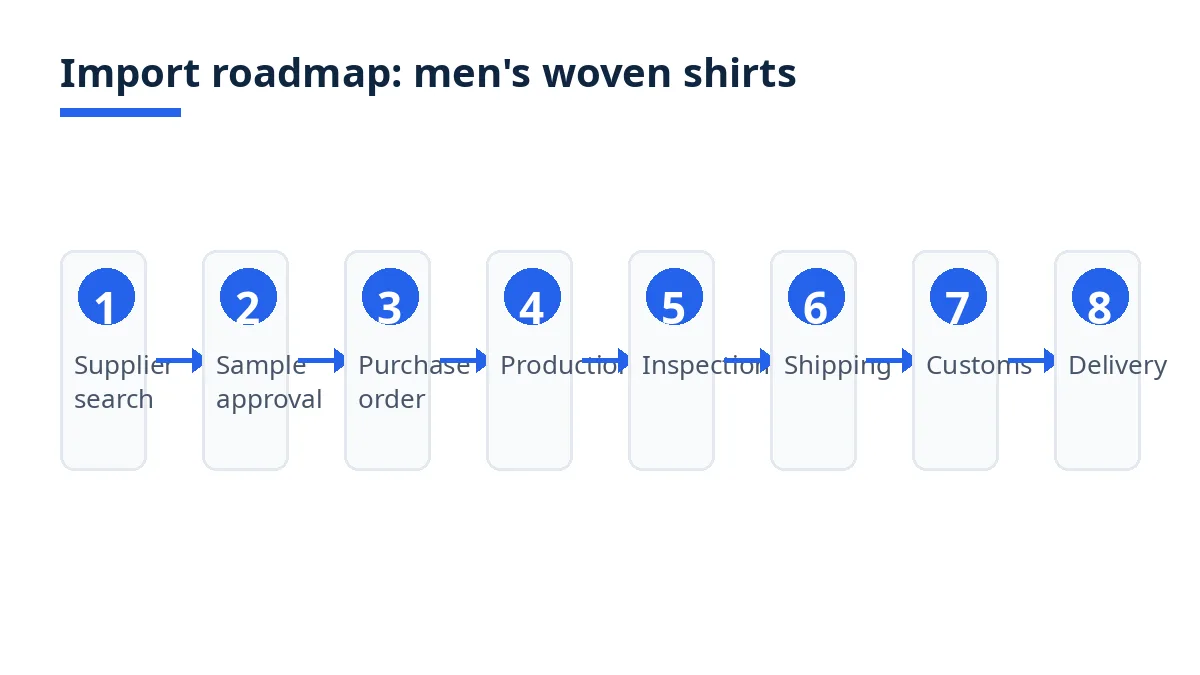
The roadmap below sets out the import process in eight stages, from supplier search to delivery.
Why source men's woven shirts from Bangladesh
Woven garments are a core part of Bangladesh's garment industry, not a sideline. The Bangladesh Garment Manufacturers and Exporters Association (BGMEA) states that it represents the readymade garment industry, particularly the woven garments, knitwear and sweater sub-sectors, and that it currently has around 4,500 member factories, of which around 60 percent are woven garment manufacturers, and that BGMEA member factories account for 100 percent of the country's woven garment exports.1 That depth means factories whose main product is woven shirting, with lines set up for structured garments rather than adapted from knit production.
The European Commission states that the EU's imports from Bangladesh are dominated by textiles, accounting for almost 94 percent of the EU's total imports from Bangladesh in 2025.2 The preference position in the duty section below can remove EU import duty on shirts from Bangladesh when its conditions are met and proved, which is one reason the landed-cost comparison often favours Bangladesh even after freight.
Find and verify suppliers
Where should you start the search?
Start with the shirt, not with a factory list. Write down each style, its fabric composition and construction, fabric weight, weave and finish, collar and cuff type, colours, sizes and target quantity, then shortlist factories whose regular range is men's woven shirts. A factory that mainly sews trousers or jackets may accept a shirt order, but its pattern, fusing and pressing setup will not match a dedicated shirt line. Browse suppliers on Exportain and the guide to finding suppliers in Bangladesh, and ask each candidate which shirt styles it produces every season.
Send every supplier the identical specification and tech pack, and ask for the price basis in writing: the fabric the price assumes, what is included, the validity period and the packing assumed. A quote far below the rest usually means a lighter fabric, a different blend, cheaper interlining or a lower construction standard, not a more efficient factory.
How do you verify a supplier before you pay?
Verification has three layers. The first is company documents: trade licence, export registration and association membership where applicable, with the company name, address and bank account name matching across all documents.
The second layer is capability for your product. Record the sewing lines running shirts, monthly capacity for a shirt of your complexity, whether cutting, fusing, buttonholing and pressing are in-house, and where the woven fabric comes from, because bought-in fabric is the input most likely to vary between sample and bulk. Ask which checks the factory runs on incoming fabric, and how shade lots are separated.
The third layer is payment discipline. Never pay a deposit to a personal bank account, and verify any later change of bank details through a separate route. For a first order, a live video walk-through of the shirt lines, or an independent factory audit, is a proportionate step. The page on how supplier verification works on Exportain explains what document and photo reviews cover, and how to import from Bangladesh covers the full process.
MOQ, pricing and samples
What is the typical MOQ for men's woven shirts from Bangladesh?
There is no single typical minimum order quantity for men's woven shirts from Bangladesh. The minimum is set per style and per colour, and often per fabric, because woven fabric is woven, dyed and finished in batches. A shirt in a stock fabric the factory buys regularly can carry a lower minimum than the same shirt in a custom-dyed or custom-woven fabric, where the fabric batch itself sets the floor. Ask how the minimum splits by colour and size ratio, which fabric it assumes, and at what quantity the unit price changes, in writing. The minimum order quantity definition explains how minimums are built.
How is the price built, and how should you negotiate it?
Woven fabric is usually the largest cost element in a men's shirt, followed by cutting and sewing, interlining and trims, finishing, testing, packing and the factory margin. Fabric consumption per shirt depends on the size range, fabric width and pattern layout, so ask each supplier to state the fabric composition, weight and width behind its price, and record the currency and validity date.
Negotiate on specification before you negotiate on price. A lower price obtained by thinning the fabric, softening the collar fusing or dropping a construction step produces a different shirt that your customers will notice at the collar first. If a price must come down, change a visible specification item openly, such as the fabric finish or the packing, and record it in the tech pack.
Which samples do you need, and how do you approve them?
Work in stages. A fit sample shows whether the factory can make your type of shirt and whether the fit block is right, and a size set confirms grading across your size range. A pre-production sample, made in the actual production fabric, interlining and trims, is the sample you approve for bulk.
Check the samples as your customers will judge them: collar shape and symmetry, fusing without bubbling, button spacing and attachment, buttonhole finish, placket alignment, stitch quality, shade against your standard, and measurements with agreed tolerances. Wash a sample and re-measure it, because woven shirts can shrink unevenly between warp and weft. Approve the pre-production sample in writing and keep one sealed counter-sample: production should match that sample, not a photograph. Lead time runs from final sample approval and deposit, not from your first inquiry.
Quality control and certifications needed
Which quality checks are specific to men's woven shirts?
The checks start before sewing. Incoming woven fabric needs inspection for weaving defects, shade variation between rolls, width consistency and shrinkage test results, because a defect woven into the fabric cannot be sewn out. Agree at order stage whether fabric is inspected roll by roll, and require shade lots to be kept separate through cutting so one garment is not sewn from two shades.
During and after sewing, check against the approved sample: measurements with tolerances, collar and cuff construction and fusing, seam puckering, stitch density, button security, buttonhole finish, placket and yoke alignment, pressing quality, and labelling and packing.
Agree the inspection method and defect limits before production starts. ISO 2859-1 is the standard for sampling procedures for inspection by attributes, and it uses the acceptance quality limit (AQL) to determine sample sizes and acceptance and rejection thresholds for a lot, where AQL is the maximum average percentage of defective items considered acceptable during random sampling.3 Inspect in stages: an inline inspection catches a fusing, grading or shade problem while it can still be corrected, and a final random inspection checks quantity, workmanship, measurements, packing, labelling and carton markings against the approved sample. If defects are found, agree the remedy in writing before the goods leave. The AQL acceptance quality limit and pre-shipment inspection guides go deeper on both.
Labelling needs attention before production, not at packing. In the European Union, Regulation (EU) No 1007/2011 of 27 September 2011 sets the rules on textile fibre names and the related labelling and marking of fibre composition, and fibre composition labelling is compulsory.4 Agree the exact fibre content wording, care instructions and origin marking for each destination at sampling stage.
Which certifications and audits should you ask for?
A men's woven shirt does not normally need a product certificate to be imported, but your customers may require evidence behind the claims you print and the standards you contract for. Buyers commonly ask a factory for recent social compliance audit reports, factory safety documentation and test reports covering fibre composition, colourfastness and shrinkage for the production fabric. Treat each document as evidence to be checked: confirm it names your contracting factory, covers the production site, and is in date for your production window.
Claims need the same discipline. If your shirt carries a recycled, organic or other certified-fibre claim, the claim depends on certification covering the fibre and the chain of custody for that order, so ask for the certificate and transaction paperwork for your shipment before you print the claim. If a supplier cannot produce the paperwork, sell the shirt without the claim.
Incoterms, shipping and transit time
Which delivery term should a first order use?
The Incoterms 2020 rules define the place of delivery, the transfer of risk and the allocation of costs between seller and buyer, and they also specify who is responsible for paying tariffs on export and import.5 Under EXW, you collect from the factory and carry almost all cost and risk: ICC Academy guidance notes that the buyer must pay all tariffs and handle all customs duties, while the seller only makes the goods available.5 Under FOB, the factory delivers goods on board the vessel at the Bangladeshi port, and you arrange and pay for the main freight. Under CIF, the factory arranges freight and minimum insurance to your destination port, while you handle import clearance and onward delivery. Under FOB and CIF alike, the seller is responsible for export clearance only.5 For a first order, FOB is a frequent choice: your forwarder handles the sea leg and you see the freight cost directly. The guide to the best Incoterm for importing woven garments from Bangladesh compares the options for this product group.
How long does shipping take?
There is no single typical transit time for shirts from Bangladesh. Sea freight is the economical route for bulk orders, and it takes weeks rather than days. The time varies by destination port, routing, transshipment and season, and production time is separate: it runs from final sample approval. Plan from your forwarder's current sailing schedule for your port pair, and add clearance and warehouse time at destination. Confirm pieces per carton, carton dimensions and gross weight in the specification, because your forwarder quotes from those figures.
Import duty, taxes and documents
How are men's woven shirts classified for duty?
Duty is charged on your product's classification in your destination market, not on the product name. Men's woven shirts sit in HS Chapter 62, which covers articles of apparel that are not knitted or crocheted, under heading 6205, men's or boys' shirts. The UK Integrated Online Tariff lists heading 6205 split by fibre: 6205 20 for cotton, 6205 30 for man-made fibres and 6205 90 for other textile materials.6 The same UK chapter notes draw the boundary of the heading: heading 6205 does not cover sleeveless garments, or garments with pockets below the waist, a ribbed waistband or another means of tightening at the bottom.6 A sleeveless woven top, or a shirt-style jacket with a drawstring hem, can therefore fall in a different heading, so treat 6205 as indicative until verified for your exact garment.
What import duty applies?
Your rate depends on your market, your exact subheading, the origin of the goods and any preference in force on the shipment date, so confirm the rate beside your confirmed code in the official tariff for the entry date, or have your broker confirm it in writing.
In the United Kingdom, the UK Integrated Online Tariff lists a third country duty of 12.00 percent for the cotton line 6205 2000 90 and for the man-made fibres line 6205 3000 00 under heading 6205.6
In the United States, the Harmonized Tariff Schedule lists a General rate of 19.7 percent for other men's or boys' shirts of cotton under 6205.20.20, and 8.7 percent for the certified hand-loomed and folklore products line 6205.20.10.7 For man-made fiber shirts, the General rate for the other line, 6205.30.20, is 29.1 cents per kilogram plus 25.9 percent.7 Read the rate in force on your entry date, because tariff measures can change between order and arrival.
In the European Union, Bangladesh, as a least developed country, benefits from the Everything But Arms arrangement, which grants duty-free, quota-free access to the EU for exports of all products except arms and ammunition, and Bangladesh is the largest beneficiary under that arrangement.2 Claiming that treatment depends on origin rules and proof of origin for the actual shipment, so confirm both with your broker before you price the goods. For the United Arab Emirates, this guide states no rate: confirm the duty beside your confirmed code in the official tariff, or in writing from your broker. Import taxes typically also include import VAT or goods and services tax on the customs value, often recoverable through tax returns but a cash-flow cost at clearance.
One caution applies in every market. KVK notes that a supplier's code is only a guide for your own search in the tariff database, and that only the first six digits travel across borders.8 Price the order on your confirmed destination code, never on the code on a supplier's pro forma invoice.
Which documents do you need for clearance?
The standard import set is the commercial invoice, packing list, bill of lading or air waybill, and proof of origin where a preference is claimed. The export documents from Bangladesh guide lists the Bangladesh-side paperwork. Descriptions, quantities, weights and carton counts must agree across every document, because mismatches are a common cause of customs delay. Keep the specification, inspection report and test reports with the shipment file.
Landed cost example
A landed cost is the true cost of one unit, ready to sell. Every number below is an example figure for illustration, not a quote or a confirmed rate: replace each line with your confirmed figures. The duty line uses the United States General rate for other cotton shirts under 6205.20.20 stated above, applied to the example customs value.7
Example figures: 10,000 men's cotton woven shirts, FOB Chattogram, sea freight to a United States port.
Cost element | Example figures (per unit) | How to obtain your figure |
|---|---|---|
Product price, FOB | $9.80 | Confirmed pro forma invoice |
International freight | $0.95 | Forwarder quote divided by units |
Insurance | $0.09 | Policy or forwarder quote |
Duty at 19.7 percent of the $9.80 customs value | $1.93 | Broker, from your confirmed heading and rate |
Port, clearance and broker fees | $0.28 | Broker and forwarder invoices divided by units |
Local delivery to warehouse | $0.21 | Local carrier quote divided by units |
Total landed cost | $13.26 | Sum of all lines above |
Import VAT or sales tax is not included, because its treatment depends on your market and tax position. Work the calculation twice: at quote stage and again after shipment, with actual invoices. The landed cost guide for imports from Bangladesh sets out the method.
Step-by-step import checklist
Write the specification: style, fabric composition, weave and weight, collar and cuff construction, colours, sizes, labels and packing.
Classify every style under heading 6205 or the correct alternative, confirm duty, taxes and preference eligibility with your broker, and note your market's labelling rules.
Shortlist woven shirt factories whose regular range matches your product, and request comparable quotes on the identical specification.
Verify the chosen supplier: company documents, association membership, shirt-line capability and fabric sourcing, plus a video or in-person factory check for a first order.
Order samples in stages, test and wash them, then approve a pre-production sample in production fabric and keep a sealed counter-sample.
Confirm the order in writing: purchase order, pro forma invoice, price basis, delivery term, payment terms, inspection plan, labelling, packing and shipment date.
Inspect fabric on arrival at the factory, inspect during production, and inspect packed goods against the approved sample before shipment.
Ship, clear customs with the confirmed code and document set, and reconcile the actual landed cost against the quote-stage calculation.
How Exportain helps
Exportain is a B2B marketplace where buyers can browse Bangladeshi suppliers, post an RFQ (request for quotation) and compare quotations before they order. Read how to write an RFQ before you post, and state the fabric, construction and target quantity, because shirt factories quote more accurately on a complete specification. Supplier badges on Exportain are reviews of documents and photos; they are not factory inspections or guarantees, and Exportain is not a party to the contract for goods, does not inspect goods, book freight or clear customs. The how to buy guide sets out each stage of ordering.
FAQs
What is the typical MOQ for men's woven shirts from Bangladesh?
There is no single typical minimum. It is set per style, per colour and often per fabric batch, because woven fabric is produced in batches and a custom-dyed fabric sets a higher floor than a stock fabric. Ask each supplier how its minimum splits by colour and size, which fabric it assumes, and at what quantity the unit price changes.
How long does shipping take?
Production time and transit time are separate, and neither has a single typical figure. Production runs from final sample approval and deposit. Sea transit takes weeks rather than days and varies by destination port, routing, transshipment and season.
What import duty applies?
Duty follows your confirmed classification, destination and origin. Men's woven shirts point indicatively to heading 6205, split by fibre into 6205.20 for cotton, 6205.30 for man-made fibres and 6205.90 for other materials.6 The UK tariff lists a third country duty of 12.00 percent on the main cotton and man-made fibres lines,6 the US General rate for other cotton shirts under 6205.20.20 is 19.7 percent,7 and in the EU, Bangladesh benefits from Everything But Arms duty-free, quota-free access, subject to origin rules and proof of origin.2 For other markets, confirm the rate in the official tariff for the entry date, through your broker.
How do I verify a supplier?
Check the company documents first: trade licence, export registration and association membership, with names, addresses and bank details matching across documents. BGMEA membership is a useful cross-check for a woven exporter.1 Then check capability for your shirt: shirt lines, monthly capacity, in-house cutting, fusing and pressing, and fabric sourcing. Keep payments to the company account named in the documents, and use a video walk-through or independent audit before a first order.
Next steps on Exportain
Read how to import from Bangladesh for the full ordering and shipping process, then work through the woven garments sourcing guide for product-level sourcing detail. When your specification is ready, use the guide to writing an RFQ to state the fabric, construction and quantity that shirt factories need in order to quote.
Sources
- BGMEA at a glance. Bangladesh Garment Manufacturers and Exporters Association (BGMEA) (accessed )
- EU trade relations with Bangladesh. European Commission, (accessed )
- ISO 2859-1:2026 - Sampling procedures for inspection by attributes — Part 1: Sampling schemes indexed by acceptance quality limit (AQL) for lot-by-lot inspection. International Organization for Standardization (accessed )
- Regulation (EU) No 1007/2011 on textile fibre names and related labelling and marking of the fibre composition of textile products. European Union, (accessed )
- Should tariffs be part of Incoterms® training?. ICC Academy (accessed )
- Heading 6205 - Men's or boys' shirts - UK Integrated Online Tariff. GOV.UK (accessed )
- Harmonized Tariff Schedule - heading 6205, men's or boys' shirts. United States International Trade Commission (accessed )
- How to find the right HS codes and commodity codes. Netherlands Chamber of Commerce (KVK) (accessed )
About the author
Sourcing from Bangladesh?
Post a request for quotation and suppliers on Exportain can send you their quotes directly.
Post an RFQ