

Best Incoterm for Importing Woven Garments & Denim From Bangladesh
Choose the Incoterm for woven garments and denim from Bangladesh by handover point: FCA for terminal delivery, CIP for seller-arranged carriage and broader insurance, FOB and CIF for on-board delivery.
Short answer
For most containerized woven garments and denim orders from Bangladesh, start with FCA if you have a forwarder and want risk to pass at terminal handover, or CIP if you want the seller to arrange carriage and broader insurance to a named place. Choose FOB or CIF only where an on-board handover at the port of shipment matches how the goods actually move.
On this page
Key takeaways
There is no single best Incoterm for woven garments and denim; the right rule matches the handover point, who contracts carriage and who insures.
FCA fits container loads handed over at a terminal, because delivery and risk pass to the buyer carrier at the named place.
FOB and CIF transfer risk on board the vessel, even though a container changes hands at a terminal before loading.
CIF requires only minimum Clause C insurance, while CIP requires broader Clause A cover to a named place.
If you are setting the shipping terms for woven shirts, trousers or denim jeans from Bangladesh, the best incoterm for importing woven garments from bangladesh is the one that matches how your order actually moves. The Incoterms rules are eleven three-letter trade terms published by the International Chamber of Commerce (ICC), and they clarify the tasks, costs and risks in delivery from sellers to buyers.1 No single term fits every order, so this guide works through the choice by handover point, container load and insurance need.
The short answer for woven and denim orders
Start from the handover, not from the price. GOV.UK groups the rules into seven rules for any mode of transport, including EXW, FCA, CPT, CIP, DAP, DPU and DDP, and four rules for sea and inland waterway transport only: FAS, FOB, CFR and CIF.2
For a full container load (FCL) or less-than-container load (LCL) that the seller hands to a carrier or terminal before loading, test FCA and CIP first. FCA fits when you appoint your own forwarder and want delivery and risk transfer at a named place, such as a container terminal. CIP fits when you want the seller to contract carriage and insurance to a named place instead. FOB and CIF remain valid where the parties agree an on-board delivery at the port of shipment, and CFR sits between them for buyers who arrange their own insurance.
Why the handover point matters for woven garments and denim
Woven garments and denim are not loaded onto a vessel in the way bulk cargo is. Cartons of shirts or jeans are packed, consolidated and handed over on land, often at a container terminal, well before the vessel sails. The term you choose decides who carries the risk during that land-side stage.
Under FCA, the seller delivers and transfers risk at the agreed location once the goods are delivered to the carrier or the person designated by the buyer, and that place can be the seller premises or a container terminal.3 ICC Academy states that FCA is the appropriate rule when goods are transported in containers or on pallets and multiple modes of transportation are used.3 Under FOB, by contrast, the seller delivers and transfers risk only once the goods are loaded onto the vessel at the named port of shipment.3 Between terminal handover and loading, an FOB seller still carries risk for a sealed container it no longer controls. FCA aligns the contract with the physical handover.
Denim orders are dense and heavy for their volume, so buyers often consolidate several styles into one container, or share a container through LCL consolidation. Each consolidation step is a carrier handover on land. A term built on carrier handover, such as FCA, CPT or CIP, records those points cleanly. A term built on the vessel rail records only the last one.
The main options for woven and denim orders, compared
Term | Mode | Delivery and risk pass | Who contracts main carriage | Seller insurance duty |
|---|---|---|---|---|
FCA | Any mode | To buyer carrier at the named place | Buyer | None |
FOB | Sea and inland waterway only | On board vessel at shipment port | Buyer | None |
CFR | Sea and inland waterway only | On board vessel at shipment port | Seller | None |
CIF | Sea and inland waterway only | On board vessel at shipment port | Seller | Minimum cover, Clause C |
CIP | Any mode | To the first carrier | Seller | Broader cover, Clause A |
FCA: the container default to test first
Under FCA, the seller completes export formalities and delivers the goods to your carrier at the named place, and risk passes to you at that point.3 You contract and pay for the main carriage from that place, so FCA suits buyers with a forwarder or several Bangladesh suppliers whose loads they consolidate themselves. Specify the delivery point precisely, because risk passes at that point inside the named place.2
FOB: on-board delivery at the port of shipment
Under FOB, the seller delivers the goods on board the vessel nominated by you at the named port of shipment, and risk passes when the goods are on board.2 You bear all costs from that moment and contract the ocean carriage.2 FOB is a port-to-port, sea-only rule, and ICC Academy describes it as the appropriate rule when goods are transported in bulk between ports, rather than in containers.3 Many woven orders are still quoted FOB out of habit. If you use it, agree in writing who pays terminal handling before loading.
CFR and CIF: seller-paid freight to your port
Under CFR, the seller delivers the goods on board and must contract for and pay the costs and freight necessary to bring the goods to the named port of destination, while risk still passes on board at shipment.2 CFR carries no seller duty to insure, so a CFR buyer arranges its own cover. ICC Academy notes that under CFR the seller must give notice of loading to the buyer in a timely manner after loading, and that the buyer handles cargo insurance.4
CIF adds insurance to the CFR structure. The seller contracts for insurance cover against your risk of loss or damage during the carriage, but only at minimum cover unless you agree more or arrange extra cover yourself.2 Read CIF shipping terms explained before you treat a CIF price as a protected price.
CIP: seller-paid carriage and broader insurance to a named place
CIP is the any-mode counterpart to CIF. Under CIP, the seller delivers and transfers risk when the goods are handed over to the carrier hired by the seller, and the seller must contract and pay for carriage and insurance up to the place of destination.5 The insurance level differs from CIF: under CIP the seller must obtain cover that complies with Clause A of the Institute Cargo Clauses, while under CIF the required level is Clause C, described as minimum cover.5 For an order that moves by truck, vessel and truck again, CIP follows that route as a port-to-port rule cannot. Compare the base definitions in CIF: cost, insurance and freight and FOB: free on board.
Two terms to use with care: EXW and DDP
Under EXW, the seller places the goods at your disposal at the seller premises or another named place, and the seller does not need to load the goods on any collecting vehicle or clear them for export.2 That leaves export formalities in Bangladesh with you, a weak position for most orders. Under DDP, the position reverses: the seller bears all costs and risks to the named place and must clear the products for export and for import, and pay duty for both.2
Step-by-step: how to choose your term
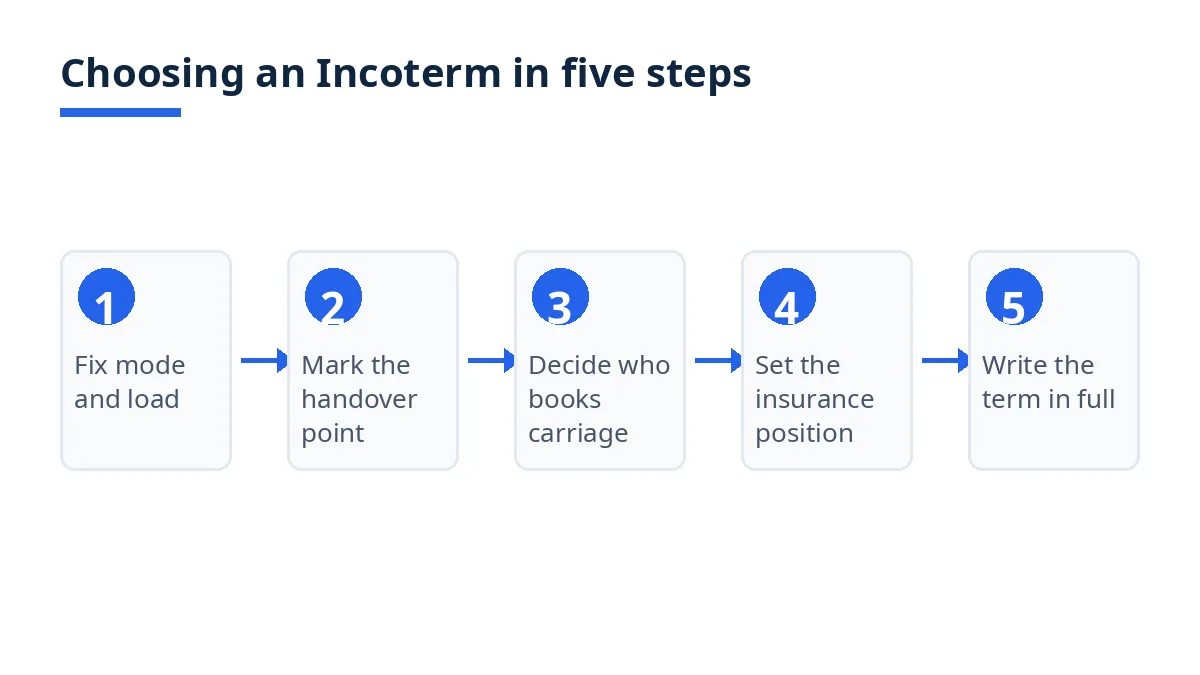
Fix the shipment mode and load type first. Write down whether the order moves as FCL, LCL, air freight for a small urgent top-up, or a mix. Container and multimodal movements point to the any-mode rules, and movements loaded directly on board point to the sea rules.2
Mark the real handover point. Ask where the seller physically gives up the goods: factory gate, consolidation warehouse or container terminal. If that point is on land, shortlist FCA, CPT or CIP. If it is genuinely on board, shortlist FOB, CFR or CIF.3
Decide who contracts the main carriage. If you hold the freight contract or the consolidation plan, keep carriage with you under FCA or FOB. If the seller has the stronger freight position, price CFR, CIF or CIP and ask for freight as a separate line.
Set the insurance position before comparing prices. Only CIF and CIP require the seller to insure, at Clause C for CIF and Clause A for CIP.5 Under FCA, FOB and CFR you arrange your own cover.
Write the term in full. State the rule, the named port or place and the version, for example FCA container terminal, Chattogram, Incoterms 2020, and confirm who completes export and import formalities under that rule.1
Costs, timelines and documents
Costs. An Incoterm allocates costs; it does not set them. Under the F rules the seller price covers the goods and export-side costs to the delivery point, and you pay carriage from there. Under the C rules the seller price also carries freight to the named port or place, and under CIF or CIP an insurance premium as well. Destination charges, import duty and taxes, and onward delivery stay outside all five terms. Build the full picture with the landed cost guide rather than comparing headline prices across terms.
Timelines. No Incoterm sets a production time, a sailing schedule or a transit time, and this guide states none. The term fixes who books the vessel or carrier, so it fixes who can act when a sailing is missed. Under FCA and FOB that party is you or your forwarder. Under CFR, CIF and CIP it is the seller, so build the booking deadline into the purchase order.
Documents. Expect the commercial invoice and the transport document for every order, plus the insurance document under CIF and CIP. Under CFR, the seller basic obligations include providing the goods, the bills of lading, invoices and other relevant documents in conformity with the contract.4 Add the packing list your forwarder and broker need, and keep the term, named place and version identical on every document.
Bangladesh-specific rules and tips
Export formalities sit with the seller under all five main options. Under FCA and FOB the seller is responsible for completing export formalities, and the C rules also require the seller to carry out export formalities.3 5 That is a practical reason to prefer any of them over EXW for a Bangladesh order.
Name the Bangladesh place, not just the country. Write the terminal, depot or port and the city in the term itself. Under FCA the point inside the named place decides where risk passes, so a vague place creates a vague risk point.2
Match the term to the consolidation point. If your styles are consolidated by a forwarder in Bangladesh before export, an FCA delivery at that point is usually cleaner than an on-board term that ignores the step.3
Agree the on-board document question early. If your payment method needs an on-board transport document while delivery happens at a terminal, agree before production how it is issued and who receives it.
Mistakes and red flags
Using FOB or CIF for a terminal handover without discussing it. Both rules transfer risk on board, while your container changes hands at a terminal.3 5 If neither side has insured the terminal-to-vessel stage, a loss there becomes a dispute.
Reading a CIF price as an all-in price. CIF freight is paid to the named port, insurance is minimum Clause C cover, and duty and destination charges remain yours.2 5
Assuming the seller carries transit risk because the seller paid freight. Under CFR and CIF, risk transfers when the goods are placed on board at the port of shipment, regardless of whether the goods arrive in sound condition.4 Under CIP, risk passes even earlier, at handover to the first carrier.5
Accepting EXW to get a lower headline price. The saving is usually the export clearance and loading work moving to you.2
Leaving the version or the named place out. A term written as FOB Bangladesh or CIP Europe fixes no port, no place and no rule edition. The current edition is Incoterms 2020, which entered into force on 1 January 2020.1
Comparing quotes written on different terms. An FCA quote and a CIF quote for the same denim order cover different cost blocks. Convert both to the same landed basis first.
Checklist
Shipment mode and load type recorded: FCL, LCL, air or mixed.
Real handover point identified and named in the term.
Rule group matches the handover: any-mode for terminal delivery, sea-only for on-board delivery.
Party contracting the main carriage named, with a booking deadline in the purchase order.
Insurance position stated, including Clause A or Clause C where the seller insures.
Export and import formalities assigned to the party that can complete them.
Term, named place and Incoterms 2020 written identically on the purchase order, invoice and transport document.
Destination charges, duty and onward delivery budgeted outside the seller price.
How Exportain helps
Exportain is a B2B export marketplace where buyers find Bangladeshi suppliers, post requests for quotation, receive quotations and place orders. In a woven or denim RFQ, state the term, the named place and the load type, and ask each supplier to quote on that same basis. Exportain is not a party to the contract for goods, and it does not book freight, arrange insurance or clear customs.
FAQs
What should I know first about Incoterms for importing woven garments and denim from Bangladesh?
Know first that the rules allocate tasks, costs and risks between seller and buyer, with no single correct rule for every order. ICC Academy puts the same point plainly: there is no right or wrong Incoterms rule, but rather the appropriate one.3 The deciding facts are the container handover point, who contracts carriage, and who insures the transit.
What are the typical costs and timelines?
Costs depend on the term, because the term decides which cost blocks sit inside the seller price. An FCA or FOB price stops at delivery in Bangladesh, a CFR or CIF price also carries freight to your port, and a CIF or CIP price carries an insurance premium as well. Duty and destination charges are extra under all of them. Timelines are set by production and booking arrangements, so agree those dates in the purchase order.
Which documents are needed?
You need the commercial invoice, the packing list and the transport document, plus an insurance document where the seller insures under CIF or CIP. Under CFR, the seller obligations include providing bills of lading, invoices and other relevant documents in conformity with the contract, and the pattern is similar across the C rules.4
What are the most common mistakes?
The most common mistakes are using an on-board term such as FOB or CIF for a container delivered at a terminal, treating a CIF price as a delivered price, assuming seller-paid freight means seller-carried risk, accepting EXW without a way to complete export formalities in Bangladesh, and comparing quotes written on different terms.
Next steps on Exportain
Read Incoterms for shipments from Bangladesh for the full rule set, work through the woven garments sourcing guide, and check EXW ex works before you accept an ex-works quote. When your term and named place are set, browse Bangladeshi suppliers and post your requirement with the term stated in the RFQ.
Sources
- Incoterms® rules. International Chamber of Commerce (ICC) (accessed )
- Customs valuation: Incoterms. HM Revenue & Customs (GOV.UK) (accessed )
- FCA & FOB Incoterms 2020 explained: Key differences. ICC Academy (accessed )
- CFR & CIF Incoterms 2020 explained: Key differences. ICC Academy (accessed )
- CIF & CIP Incoterms 2020 explained: Key differences. ICC Academy, (accessed )
About the author
Sourcing from Bangladesh?
Post a request for quotation and suppliers on Exportain can send you their quotes directly.
Post an RFQ


