How to Import Hilsa Fish From Bangladesh in 2026: Complete Buyer Guide
How to import hilsa fish from Bangladesh: export approval, supplier checks, samples, HS 0302 and 0303 duty, cold chain and landed cost for buyers.
Short answer
To import hilsa fish from Bangladesh, first confirm that your exporter holds current government approval, because hilsa is conditionally exportable. Then specify the fish by form, size grade and packing, verify the exporter and its Department of Fisheries health certificate route, approve a sample shipment, classify each form in headings 0302, 0303 or 0304, agree the cold chain and delivery term, and build the landed cost before you contract.
On this page
Key takeaways
Hilsa is conditionally exportable from Bangladesh: reporting on 8 October 2026 states that the export policy requires government approval, so confirm the exporter's current approval for your destination, quantity and window before you contract.
Whole hilsa is classified in the Other fish lines: 0302.89 fresh or chilled and 0303.89 frozen in the United States schedule, with fillets in heading 0304; the United Kingdom tariff splits each subheading into a freshwater line and an Other line.
In the United States schedule opened for this guide, Revision 16 (2026), the general rate is Free on 0302.89.50, 0303.89.00 and the frozen fillet lines 0304.89.10 and 0304.89.50, and 3 percent on 0302.89.11.
Bangladeshi hilsa received Geographical Indication status in 2017, and supply is seasonal: a 22-day hilsa fishing and marketing ban was reported in October 2026, running until 29 October.
There is no single typical MOQ, price or transit time for hilsa, so confirm each one in writing for your exact form, grade, packing, route, shipment date and approved quantity.
To learn how to import hilsa fish from Bangladesh, start with permission, not with a price per kilogram. Hilsa is not an open export line: a consignment moves only when the exporter holds the government approval the product requires, and that check comes before specification, sampling or payment.
The Harmonised System is an international commodity classification of approximately 5,000 six-digit product categories, organised by chapters, headings and sub-headings, and countries subdivide the six-digit categories further for their own tariffs.1 In the United States schedule, whole hilsa sits in the "Other fish" lines: subheading 0302.89 when fresh or chilled and subheading 0303.89 when frozen, while hilsa fillets fall in heading 0304.2 The form you buy decides the duty line before any price is final.
This guide is for seafood importers, wholesalers, restaurant groups and distributors in the United States, the United Kingdom, the European Union and the United Arab Emirates. It states no typical minimum, price or transit time, because none has a single figure across forms, grades, routes and seasons, and because export approval is granted case by case.
Why source hilsa fish from Bangladesh
Hilsa is the fish Tenualosa ilisha, and the Tenualosa ilisha of the Padma-Meghna river system is the most sought after form of the species.3 In Bangladesh, hilsa is recognised as the national fish, and in 2017 Bangladeshi hilsa received Geographical Indication (GI) status.3 Treat that GI status as a point to verify, not a marketing line: ask the exporter which origin wording it is entitled to use on your cartons and labels, and keep the wording it can document.
Supply is seasonal and managed. Hilsa migrate from the sea to freshwater rivers to spawn, and October to November is the peak breeding season.3 Reporting in October 2026 recorded a 22-day ban on catching, buying, selling, transporting, storing and marketing hilsa, running until 29 October.4
Hilsa exports are neither regular nor open-ended like those of other fish: the government allows exports of specified quantities through special approvals.3 A hilsa order therefore belongs with an exporter who can show both the fish and the paperwork. Compare the wider sector in the frozen seafood sourcing guide and the dedicated guide to how to import frozen fish from Bangladesh.
Find and verify suppliers
Where should you start the search?
Start with a specification, not with exporter names. Write down every line first: species as Tenualosa ilisha, form (whole fresh or chilled, whole frozen, or fillets), size grade by individual weight band as your own choice, whole round or dressed presentation, glazing and net weight basis for frozen fish, packing format, destination and market. Then shortlist exporters whose current trade is hilsa.
Send every candidate the identical specification and ask for the same reply format: form and grade assumed, price inclusions, validity, and the export approval position for your destination and window. Browse suppliers on Exportain and read finding suppliers in Bangladesh.
How do you verify a supplier before you pay?
Verification has four layers for hilsa. The first is company documents: trade licence, export registration and association membership where applicable, checked so that name, address and bank account name agree.
The second layer is export permission, and for hilsa it is the decisive one. Reporting by The Financial Express on 8 October 2026 states that Bangladesh's export policy classifies hilsa as conditionally exportable, requiring government approval.4 The same reporting records that exports had been suspended following 2012, that limited exports to India have been allowed ahead of Durga Puja every year since 2019, and that, as of that report, no government decision on that year's exports to India had yet been announced.4 Ask the exporter to show the current approval covering your destination, quantity and window, in writing, before you sign or pay. An approval for a past window, a different quantity or a different buyer does not cover your consignment.
The third layer is the certification route. The Department of Fisheries e-certification system covers licences, health certificates and additional health certificates as per the importing country's requirements, together with sample collection, inspection, test reports and certificate issuance, and it is connected to customs.5 Ask for a recent health certificate issued through that route for a comparable market and form.
The fourth layer is payment discipline. Keep payments to the company account named in the documents, never to a personal account, and verify any change of bank details separately. Read how supplier verification works on Exportain for what document and photo checks cover. A badge is a review of documents and photos, not a factory inspection or a guarantee, and Exportain is not a party to the goods contract.
MOQ, pricing and samples
What is the typical MOQ for hilsa fish from Bangladesh?
There is no single typical minimum order quantity for hilsa fish from Bangladesh. The minimum is set per consignment and usually per size grade, because graded whole fish are selected fish by fish and an approval, where one is granted, is written for a specified quantity. Ask each exporter how its minimum splits by form, grade and packing, and whether your quantity sits inside the quantity its approval covers.
How is the price built, and how should you compare quotes?
Price follows grade and season first. Individual fish weight, form and presentation set the raw material cost, and that cost moves with landings, river conditions and the closed season. On top of the fish cost sit grading labour, packing, freezing for frozen forms, documentation, cold storage, transport to the port or airport, and freight where the delivery term includes it.
Two quotes can differ because one assumes a smaller grade mix, a dressed rather than whole-round fish, a higher glaze share on frozen fish, or a window the exporter has no approval for. Compare quotes only on the same specification, delivery term and window, and confirm the net weight basis in writing: for frozen hilsa, whether the price is per kilogram of net fish weight excluding glaze decides what a quote is worth.
Which samples do you need, and how do you approve them?
For whole hilsa, the sample is a small first consignment on the full specification, not a courier parcel of loose fish. Agree a trial shipment in the intended form, grade and packing, and evaluate it on arrival: species and grade against the specification, count and weight per carton, glaze share on frozen fish checked after deglazing a sample carton, and fish condition, including belly condition, gill colour on fresh fish and any freezer burn on frozen fish. Record the result carton by carton, with photographs, and share the record the same day.
Approve the exporter for bulk shipments only after the trial record is acceptable, and keep the trial grade definition, packing and net weight basis as the approved baseline.
Quality control and certifications needed
Which quality checks are specific to hilsa?
Quality control for hilsa is grading and cold-chain control, in four stages. The first stage is intake grading: fish sorted by individual weight band, with damaged, soft or undersized fish rejected before packing, because a mixed carton cannot be regraded at destination. The second stage is temperature control from packing to loading, with a temperature record for the consignment: fresh or chilled fish held on ice, frozen fish held at the core temperature your specification names. The third stage is the pre-shipment check on packed goods: grade, count, net weight and glaze share on frozen cartons, labels and carton condition. The fourth stage is the arrival check, where the arrival record is compared line by line with the packing record, so a loss can be traced to grading, glazing, packing or a cold-chain break.
ISO 2859-1:2026 defines a system of acceptance sampling plans for inspection by attributes, and its summary states that AQL stands for acceptance quality limit, the maximum average percentage of defective items considered acceptable during random sampling, used to determine sample sizes and acceptance and rejection thresholds.6 See the acceptance quality limit and pre-shipment inspection guides.
Which certifications do you actually need?
The certificate that matters on every consignment is the health certificate issued through the Department of Fisheries route for your destination. The e-certification system provides health certificates and additional health certificates as per the importing country's requirements, with sample collection, inspection and test reports handled inside the same system.5 Name your destination at order stage, because the additional wording follows the importing country.
Beyond that base, each main market adds its own layer:
Market | What the route requires, in brief |
|---|---|
European Union | Health approval by an authorised country, an approved establishment, health certificates and health control for fishery products for human consumption.7 |
United States | No health certificate is required with each seafood shipment and no approved-processor list is maintained. Seafood HACCP controls apply to processors, and the importer must hold written verification procedures for its foreign supplier.8 |
Singapore | Hilsa falls in the Fish and Fish Products category: check high-risk status, check CITES, comply with the high-risk requirements where they apply, and keep labels accurate and complete.9 |
Confirm the destination layer before the order: a consignment certified for one market may not be transferable to another. The export documents from Bangladesh guide covers the paperwork set in full.
Incoterms, shipping and transit time
Which delivery term should a first order use?
The Incoterms 2020 rules set out, for each rule, where delivery takes place, and risk passes from seller to buyer at the same point and time as delivery.10 Under FOB, CFR and CIF the seller must place the goods on board the vessel.10 On customs, in all rules but EXW the seller must carry out export formalities, and in all rules but DDP the buyer must carry out import formalities.10
For a first frozen order in a reefer container, weigh FOB at the Bangladeshi port against FCA at the named terminal. Under FOB, the exporter delivers the goods on board and your forwarder handles the sea leg. Under FCA, delivery happens when the goods are handed to your carrier, which matches how containerised cargo moves. For fresh or chilled hilsa moving by air, use an air rule such as FCA at the named airport or CIP to your destination airport, and name the flight and the maximum time out of chilled storage in the written order. See the best Incoterm for importing frozen seafood from Bangladesh.
How long does shipping take?
There is no single typical transit time for hilsa fish from Bangladesh. Frozen hilsa moves by sea in reefer containers and takes weeks rather than days, varying by port, routing, transshipment and season. Fresh or chilled hilsa moves by air, and its consignment time runs from grading and packing to release at destination. Plan from your forwarder's current schedule, keep production and approval time separate from transit time, and confirm that your window does not fall inside the closed season confirmed for that year.
Import duty, taxes and documents
How are hilsa fish classified for duty?
Duty follows the classification of each form in your destination tariff, not the supplier's product name. Whole hilsa is a shad, Tenualosa ilisha, and in the United States schedule it falls in the "Other fish" lines: 0302.89 for fresh or chilled fish and 0303.89 for frozen fish, with the statistical suffix for shad and sturgeon shown inside the frozen line.2 Hilsa fillets are classified separately in heading 0304, in the frozen fillets "Other" lines 0304.89.10 and 0304.89.50.2 In the United Kingdom tariff, fresh or chilled hilsa is read against subheading 0302 89 and frozen hilsa against subheading 0303 89, each of which splits into a freshwater fish line and an "Other" line.11 12 Confirm the full national code for each form before you price or ship.
What import duty applies?
Your rate depends on your market, each form's code, the origin and any preference in force on the entry date. In the United States schedule opened for this guide, Revision 16 (2026), the general rate for fresh or chilled hilsa on line 0302.89.50 is Free, while the scaled line in small immediate containers, 0302.89.11, carries 3 percent.2 For frozen whole hilsa, 0303.89.00, the general rate is Free, and the frozen fillet lines 0304.89.10 and 0304.89.50 also carry a general rate of Free.2 Confirm the current rate before you commit to a selling price.
In the United Kingdom Integrated Online Tariff opened for this guide, the third country duty for fresh or chilled fish on the freshwater line 0302 8910 00 is 8 percent, and on the "Other" line 0302 8990 90 it is 14 percent.11 For frozen fish, the freshwater line 0303 8910 00 carries 8 percent and the "Other" line 0303 8990 92 carries 14 percent.12 Which line a hilsa consignment falls on is a classification question for your broker, because hilsa is caught in both rivers and the sea. In the European Union, the Everything But Arms scheme grants full duty-free and quota-free access for least developed countries for all products except arms and ammunition.13 In the United Kingdom, the Developing Countries Trading Scheme lists Bangladesh in the Comprehensive Preferences tier, with 0 percent import tariffs on 99.8 percent of products.14 A preference depends on origin rules, so agree the proof of origin at order stage. The Netherlands Chamber of Commerce (KVK) makes the closing point: customs classifies products using HS codes and commodity codes, each code is unique, and using the correct code matters because it determines which import duties apply and whether you need permits or certificates.15 Import VAT is separate from duty. For the United Arab Emirates and other markets whose schedule was not opened for this guide, confirm the rate with your broker against the destination tariff for the entry date.
Which documents do you need for clearance?
The standard import set is the commercial invoice, packing list, bill of lading or air waybill, the health certificate issued for your destination through the Department of Fisheries route, and proof of origin where a preference is claimed. Add the exporter's export approval for hilsa to the file your broker holds. The invoice should name the product plainly, for example frozen whole hilsa, Tenualosa ilisha, with grade bands, carton count, gross and net weights, glaze basis for frozen fish, unit prices and the delivery term. Keep fresh, frozen and fillet lines on separate invoice lines matching their classifications, and make quantities, weights and carton counts agree across every document.
Landed cost example
A landed cost is the full cost of one kilogram of hilsa, ready to sell. Every number below is an example figure only, not a quote.
Example figures: 2,000 kg of frozen whole hilsa, FOB Chattogram, reefer sea freight to a United Kingdom port, duty at an example rate only.
Cost element | Example figures (per kg) | How to obtain your figure |
|---|---|---|
Product price, FOB | $9.80 | Confirmed pro forma invoice |
International freight | $1.35 | Forwarder quote divided by kilograms shipped |
Insurance | $0.08 | Policy or forwarder quote |
Duty | $0.49 | Broker calculation from confirmed codes and rates |
Port, clearance and broker fees | $0.32 | Broker invoices divided by kilograms |
Local delivery to warehouse | $0.21 | Local carrier quote divided by kilograms |
Total landed cost | $12.25 | Sum of all lines above |
Import VAT or sales tax is not included, because its treatment depends on your market and tax position. Work the calculation twice: at quote stage, form by form and grade by grade, and again after shipment with the actual invoices. See landed cost for imports from Bangladesh.
Step-by-step import checklist
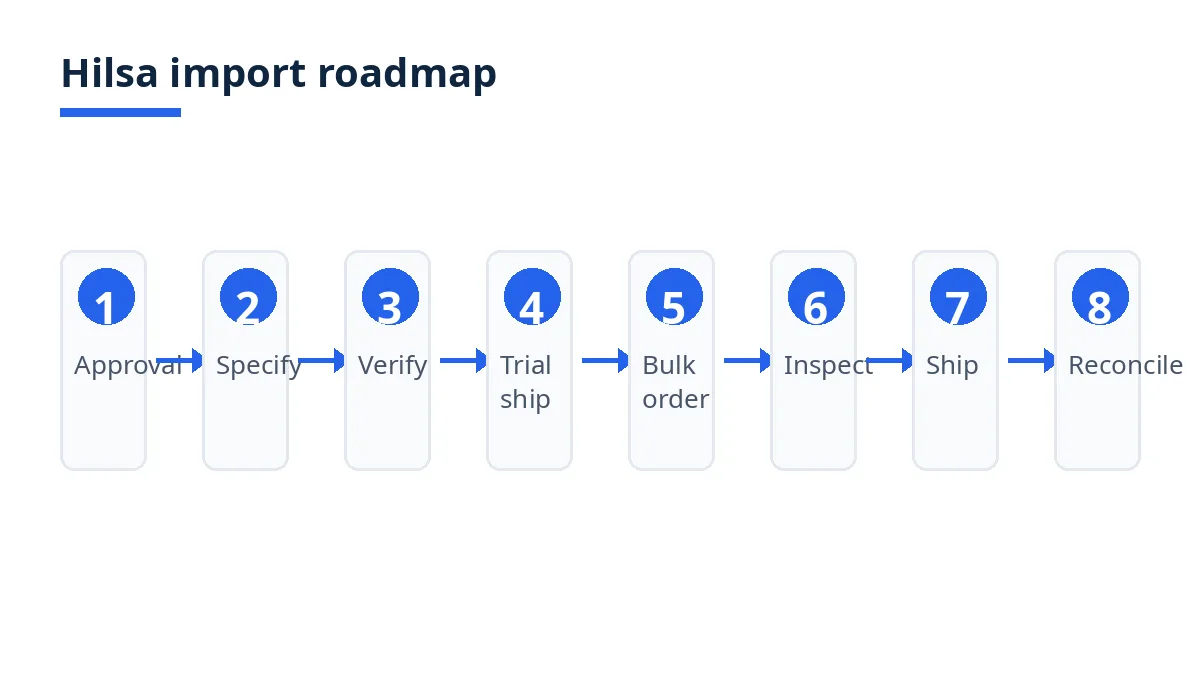
Confirm the export position first: ask the exporter to show the current government approval for hilsa covering your destination, quantity and window, and check the window against that year's closed season.
Write the specification: species as Tenualosa ilisha, form, size grade bands, presentation, glazing and net weight basis for frozen fish, packing, destination and market.
Classify every form, starting from 0302.89 for fresh or chilled whole fish, 0303.89 for frozen whole fish and heading 0304 for fillets, and confirm each full code and duty with your broker.
Shortlist exporters whose current trade is hilsa, and request comparable quotes on the identical specification, delivery term and window.
Verify the chosen exporter: company documents, the export approval, and a recent health certificate from the Department of Fisheries route for a comparable market.
Run a trial shipment in the intended form and packing, and record grade, count, net weight and glaze share carton by carton on arrival.
Confirm the bulk order in writing: purchase order, pro forma invoice, delivery and payment terms, grading and inspection plan with AQL and defect limits, labelling, packing and shipment date inside the approved window.
Ship, clear customs with the confirmed code for each form, and reconcile the actual landed cost.
How Exportain helps
Browse suppliers for Bangladeshi seafood exporters and compare their ranges against your form and grade list. Then post your specification and target quantity as an RFQ and compare replies on the same terms before you choose an exporter for a trial shipment. Exportain is a B2B marketplace where buyers post RFQs, receive quotations and message suppliers. It does not inspect goods, book freight or clear customs.
FAQs
What is the typical MOQ for hilsa fish from Bangladesh?
There is no single typical minimum. It is set per consignment and usually per size grade, because graded fish are selected fish by fish and any export approval is written for a specified quantity.
How long does shipping take?
Production, approval and transit time are separate, and none has a single typical figure. Frozen hilsa moves by sea and takes weeks rather than days, varying by port, routing and season, and a shipment window can also be closed by the seasonal fishing ban.
What import duty applies?
Duty follows the confirmed classification of each form, the destination and the origin. Whole hilsa sits in 0302.89 fresh or chilled and 0303.89 frozen, and in the United States schedule opened for this guide the frozen line 0303.89.00 and the fresh or chilled line 0302.89.50 carry a general rate of Free.2 Bangladesh has duty-free access to the European Union under Everything But Arms, subject to origin rules,13 and is listed under Comprehensive Preferences in the United Kingdom, with 0 percent tariffs on 99.8 percent of products.14 Confirm the line and rate with your broker for the entry date.
How do I verify a supplier?
Check company documents first, so that name, address and bank account agree across every document. Then check the export approval for your destination, quantity and window, and the certification route, with a recent Department of Fisheries health certificate for a comparable market. Approve the exporter through a trial shipment before bulk orders.
Next steps on Exportain
Read how to import from Bangladesh for the full process, then use how to write an RFQ to set out your form and grade list. When ready, post a free RFQ on Exportain and compare quotes on the same terms.
Sources
- Harmonised System. European Commission (accessed )
- Harmonized Tariff Schedule of the United States, Chapter 3. United States International Trade Commission (accessed )
- Can fishing bans alone replenish Bangladesh's dwindling Hilsa production?. The Business Standard, (accessed )
- Will Bangladesh send hilsa to India this Durga Puja amid uncertainty?. The Financial Express, (accessed )
- Bangladesh rolls out online certification system to simplify fish and seafood trade. International Collective in Support of Fishworkers (ICSF) (accessed )
- ISO 2859-1:2026 - Sampling procedures for inspection by attributes — Part 1: Sampling schemes indexed by acceptance quality limit (AQL) for lot-by-lot inspection. International Organization for Standardization (accessed )
- Health and consumer protection for animal and plant product. European Commission, Access2Markets (accessed )
- A Summary of the United States Food and Drug Administration's Food Safety Program for Imported Seafood; One Country's Approach. PubMed Central (accessed )
- Import Requirements for Food & Food Products. Singapore Food Agency (accessed )
- Insider thoughts: Bob Ronai on Incoterms 2020 Rules; What are they about?. International Chamber of Commerce (accessed )
- Subheading 030289 - Other | UK Integrated Online Tariff. UK Government (accessed )
- Subheading 030389 - Other | UK Integrated Online Tariff. UK Government (accessed )
- Trade arrangements. European Commission, Access2Markets (accessed )
- Preference tiers under the Developing Countries Trading Scheme. GOV.UK (Department for Business and Trade), (accessed )
- Why do you use a commodity code when importing?. Netherlands Chamber of Commerce (KVK), (accessed )
About the author
Sourcing from Bangladesh?
Post a request for quotation and suppliers on Exportain can send you their quotes directly.
Post an RFQ