The Ultimate Frozen Seafood & Fish Sourcing Guide for Bangladesh
A buyer guide to sourcing frozen seafood and fish from Bangladesh: EPB market data, shrimp species and forms, supplier verification, MOQ, pricing, lead times, HACCP, cold chain and duties.
Short answer
Use this frozen seafood sourcing guide to source shrimp, prawns and frozen fish from Bangladesh: check the latest EPB market data, match species, form and count size to the right plant, verify exporters and market approval in layers, approve thawed samples and lab tests, and compare MOQ, price and lead time only on a deglazed net weight basis.
On this page
Key takeaways
Shrimp exports from Bangladesh earned $296.29 million in fiscal 2024-25, up about 19 percent year on year, per EPB data.
Black tiger shrimp (bagda) and giant freshwater prawn (galda) together account for 92 percent of production by species share.
There is no single typical MOQ, price or lead time; compare quotations per kilogram of deglazed net product on the same delivery term.
Frozen product must be held and transported at -18 degrees Celsius or below, with temperature records for the actual container.
Market access is plant-specific: United States buyers need a working seafood HACCP system, and EU consignments need an approved establishment and health certificate.
This frozen seafood sourcing guide is for buyers in the United States, the United Kingdom, the European Union and the United Arab Emirates who buy shrimp, prawns and frozen fish from Bangladesh. It covers what the country sells, where it is produced and processed, how to find and verify exporters, and how minimum order quantity, price and lead time are set for a perishable product that must stay frozen from the processing plant to your warehouse. It also sets out the food safety controls and import conditions that decide whether a consignment can be sold in your market at all.
Frozen seafood is less forgiving than most categories. A seafood order can lose its value in a single broken cold chain, a wrong count size or a missing health certificate, so this guide treats specification, temperature control and documents as parts of one buying decision.
Market overview with latest data
Shrimp is the core of Bangladesh's frozen seafood export trade. According to data from the Export Promotion Bureau (EPB), shrimp exports earned $296.29 million in the fiscal year 2024-25, up about 19 percent from the previous fiscal year, on export volume of 23,238 tonnes.1 The same report puts the longer trend in context: in fiscal 2012-13 Bangladesh exported about 50,000 tonnes of shrimp earning about $454.93 million, so the recent growth is a partial recovery after a long decline rather than a new peak.1
Capacity is not the binding constraint. According to the Bangladesh Frozen Foods Exporters Association (BFFEA), there are 109 processing plants in the country, but only about 48 are currently operational, and stakeholders at the Bangladesh Shrimp and Fish Foundation put use of installed processing capacity at less than 10 percent, pointing to a shortage of raw material rather than a shortage of factories.1 Plants have room for new programmes, but raw material supply decides whether a supplier can fill a large order on schedule, so ask about raw material sourcing with the same care you apply to processing capacity.
Destination data shows where Bangladeshi shrimp is sold. In the last fiscal year the top destinations were China at $56.7 million, the Netherlands at $47.4 million, the United Kingdom at $45 million, Belgium at $40.1 million, Germany at $29.6 million and the United States at $20.8 million, followed by France, Japan, Portugal and Spain, as per data from the Fisheries department, citing EPB.2 Europe is therefore the reference market for Bangladeshi frozen shrimp: its hygiene and certification conditions shape how export plants are set up, even for buyers shipping elsewhere.
Product form follows the market. Bangladesh primarily exports individual quick frozen (IQF), semi-IQF, peeled un-deveined (PUD), peeled and deveined (P&D) and semi-cooked shrimp products to Europe, while block frozen shrimp exports were historically limited to Japan and China.2 That changed for one line in 2025: the European Union certified five Bangladeshi vessels in February 2025 to export on-board block frozen seafood to Europe, after an EU inspection mission in December 2023.2 The frozen seafood industry in Bangladesh overview gives wider sector background.
Main products and production clusters
Two farmed species anchor the range. The predominant species are the black tiger shrimp (Penaeus monodon), locally called bagda, which constitutes 50 percent of overall production, followed by the giant freshwater prawn (Macrobrachium rosenbergii), locally called galda, accounting for 42 percent, with the remaining 8 percent made up of various wild shrimp species.3 Bagda is a brackish-water marine shrimp and galda is a freshwater prawn, so the two products come from different farming systems, carry different flavour and texture profiles, and are graded and priced separately. Never accept a quotation for shrimp without the species stated in writing.
Around those anchors sits a wider range: other wild-caught shrimp such as brown, white and flower tiger shrimp, frozen finfish whole and in fillets, and crab lines where exporters list them. In October 2025 a consignment of block frozen Ocean Tiger shrimp was shipped to Belgium after being caught and processed aboard a deep-sea vessel.2 Wild-caught lines depend on the marine catch, so availability and size mix vary more than for farmed bagda and galda.
The form you buy is a second specification layer. The main forms are whole head-on, headless shell-on, peeled un-deveined, peeled and deveined, peeled and deveined tail-on, and cooked or semi-cooked lines, each sold IQF, semi-IQF or block frozen. Count size, the number of pieces per pound or kilogram, is the commercial grade: state the count range, whether it is counted before or after glazing, and the tolerance. Glazing is the protective ice layer on a frozen product, and the Codex Alimentarius Code of Practice for Fish and Fishery Products treats freezing as complete only when the product reaches -18 degrees Celsius or below at the thermal centre after thermal stabilization.4 State net weight excluding glaze, target glaze percentage, and how both will be checked at inspection.
Production clusters follow the water. Major shrimp-producing districts include Khulna, Satkhira, Bagerhat and Cox's Bazar.3 The southwestern districts of Khulna, Satkhira and Bagerhat form the main brackish-water bagda belt and the freshwater galda farming area, while Cox's Bazar anchors the southeastern coast and marine landing. Processing plants cluster near those production zones and the ports, because raw shrimp must reach a freezer quickly after harvest. Bagda shrimp of Bangladesh also holds a geographical indication registration granted in 2022, recognising it as a product linked to its place of production.3 A geographical indication is a marketing asset for the finished pack, not a food safety control, so it never replaces the plant-level checks in the quality section below.
Classification ties the product range to your customs entry. Most frozen seafood from Bangladesh sits in HS Chapter 03, which covers fish and crustaceans, molluscs and other aquatic invertebrates. Within that chapter, heading 0303 covers frozen fish excluding fillets, heading 0304 covers fish fillets and other fish meat, and heading 0306 covers crustaceans, including frozen shrimps and prawns, with other shrimps and prawns on the frozen line 0306.17.5 Treat those headings as indicative. Species, preparation and packing can move a product between lines, and the full national code in your destination tariff decides the duty and controls applied. The HS code explainer sets out how the system is structured.
Product | Typical form | Indicative HS heading |
|---|---|---|
Black tiger shrimp (bagda) | Headless shell-on, P&D, IQF or block | 0306 |
Giant freshwater prawn (galda) | Whole, headless, IQF | 0306 |
Other wild shrimp | Whole, headless, block or IQF | 0306 |
Frozen finfish | Whole, gutted, fillets | 0303 or 0304 |
Crab and shellfish lines | Whole, sections, meat | 0306 or 0307 |
How to find and verify suppliers
Start from a specification, not a supplier list. A useful enquiry states the species and product form, count size and tolerance, glazing percentage and net weight basis, packing format and carton weight, monthly or per-shipment volume, destination port and market, required certificates and lab tests, and your target shipment window. A request for a shrimp price per kilogram without those fields draws quotations that cannot be compared, because no two exporters are pricing the same product. The guide to how to write an RFQ lists the fields a complete enquiry needs.
Build a longlist from several channels: association member information, trade data showing which exporters ship your product to your market, referrals, and curated marketplaces. The BFFEA is the sector association for frozen food exporters, and its plant count shows how much of the industry it covers.1 Association membership is a first identity reference, not proof that a plant can run your product. On Exportain, browse the frozen seafood exporter overview and the suppliers directory, then post one structured request so exporters answer the same specification.
Verification works in layers, each with a document behind it. First, identity and export status: confirm the business is a real, operating exporter, check association membership and export registration, and confirm the plant address is where your goods would be produced, because trading and plant names often differ. Second, market approval: ask which markets the plant is approved and currently shipping to, and check the claim against the destination arrangements in the compliance section. Third, capability: ask what is done in-house, from raw material intake, washing, grading, peeling, freezing, glazing and metal detection to packing and cold storage, because bought-in raw material and outside cold storage are where traceability most often breaks.
Sampling is the fourth layer, and it must be a physical test, not a photograph review. Order samples in your exact form and count size, thaw them under controlled conditions, and check thawed count, net weight after deglazing, uniformity, odour, texture and cooking result against your specification. Send samples to an accredited laboratory for the microbiological and residue tests your market requires before you commit to a container. Approve or reject in writing, and keep a retained sample as the reference for bulk inspection, as the guide to pre-shipment inspection explains.
Finally, protect the transaction. Agree everything in a written purchase order: species, form, count, glaze, packing, price and delivery term, shipment window, testing and inspection requirements, and payment terms. Health certificates for export consignments are obtained from the Fish Inspection and Quality Control (FIQC) office before shipment, and each batch undergoes final scanning to confirm it is free of contaminants in the on-board freezing trade.2 Ask your supplier which office certifies its land-based consignments and how the certificate number ties to your lot numbers. Treat pressure to pay into an unrelated personal account, or refusal to share plant approval or test documents, as reasons to walk away.
MOQ, pricing and lead times
Buyers regularly ask for the typical minimum order quantity, price and lead time, and for frozen seafood there is no single standard figure for any of the three. What can be set out clearly is what drives each number, so you can judge quotations on an identical basis. The MOQ guide explains how minimums are set and quoted.
What is the typical MOQ?
Minimum order quantity is set by plant and product economics, not a trade-wide rule. The practical floor is usually a full reefer container for a single specification, because part-loads carry high freight and cold-store cost per kilogram and are hard to keep at temperature through consolidation. Species and size matter: a common count size in season is easier to accumulate than a narrow count band, and a standard form such as headless shell-on is easier than a small cooked, retail-packed run with its own packing setup. The only MOQ that matters is the one your shortlisted exporters quote for your exact specification, confirmed in writing.
What does the price consist of?
The main cost components are raw material, processing labour for peeling and deveining, freezing and cold storage, packing, laboratory testing, inspection, export documentation and inland transport, plus freight and insurance where your term puts them on the seller. Raw material is the largest and most variable component, because farm-gate and landing prices move with season, size mix and catch. Two quotations for the same sounding shrimp can differ widely because one is priced on a larger count, higher glaze or different species mix. A useful quotation names species, form, count basis and glaze, states net weight excluding glaze, and identifies the delivery term. Compare prices per kilogram of deglazed net product, not gross frozen weight.
For scale only, consider this worked comparison. Example figures: two exporters quote the same headless shell-on bagda at $8.40 per kilogram gross weight with 20 percent glaze, and at $9.60 per kilogram on a net weight basis with 10 percent glaze. On a deglazed basis the first quote is $8.40 for 0.80 kilograms of shrimp, or $10.50 per kilogram of product, while the second is $9.60 for 0.90 kilograms, or about $10.67 per kilogram. The real gap is about $0.17 per kilogram, not the $1.20 the headline prices suggest, and it may reverse once freight on the extra ice weight is counted. Glaze basis changes the comparison more than negotiation usually does.
How long is the lead time?
Lead time is a chain: raw material accumulation to your count size, processing and freezing, laboratory testing, inspection, health certification, reefer booking, and loading before the vessel cut-off. Accumulation is frequently the longest stage for a narrow specification, and wild-caught lines depend on landing patterns no plant controls. Reefer capacity on your sailing is a second constraint outside the plant. Plan backwards from your required arrival date, put each stage in writing with dates, and ask each exporter to quote lead time stage by stage.
Quality, certifications and compliance
Quality in frozen seafood is a temperature record and a test record, agreed before production and checked before shipment. The Codex Code of Practice for Fish and Fishery Products is the reference text for harvesting, processing, transport and sale of fish and fishery products, and it sets the cold-chain expectations your specification should mirror: frozen fish, shellfish and their products are to be transported at -18 degrees Celsius or below, and a frozen storage facility should be capable of maintaining the temperature of the fish at -18 degrees Celsius with minimal fluctuation.4 Write those points into your purchase order as measurable conditions: product core temperature at loading, cold-store temperature records for the production lot, and a temperature logger in the container, with the data shared before you release final payment.
Hygiene controls sit underneath the temperature record. The Codex code covers prerequisite hygiene programmes and a hazard analysis and critical control point (HACCP) approach, including time and temperature control to minimise deterioration from harvest onward.4 Ask each plant for its HACCP plan summary, raw material reception checks, metal detection and glazing control records, and water and ice hygiene programme. A plant that can produce those records for a recent shipment to your market is a different risk from one that describes the same controls without paperwork.
For the United States, the control system is a legal requirement, not a buyer preference. The Food and Drug Administration (FDA) seafood HACCP programme, set out at 21 CFR part 123, requires processors of fish and fishery products to operate preventive control systems incorporating the seven principles of HACCP, establish critical control points, monitor them systematically, keep records, and develop written HACCP plans.6 The requirement reaches foreign processors shipping to the United States, and FDA guidance states that a foreign processor's failure to allow inspection or access to HACCP records can lead to its products being treated as adulterated and to import action.6 United States importers must also take affirmative steps to verify that foreign suppliers meet the regulation.6
For the European Union, market access runs through country and establishment approval. Imports of fishery and aquaculture products for human consumption into the European Union must comply with general health requirements covering health approval by an authorised country, an approved establishment, health certificates and health control.7 European Union rules also limit chemical residues in food, and imports of animal products are permitted only where they comply with European Union legislation on residues of veterinary medicines, pesticides and contaminants.7 Bangladesh's route into that system runs through its competent authority and the FIQC certification noted earlier, and the 2025 listing of five vessels for on-board block frozen exports shows the establishment-by-establishment nature of the approval: each vessel was assessed and listed on its own merits.2
Voluntary certifications sit on top of those legal controls. Retail and food-service buyers commonly ask for third-party food safety certification of the plant and, for farmed shrimp, an aquaculture standard covering farm practice. Which scheme matters depends on your customer, not the supplier's brochure. Request the certificate itself, check its number, certified site, product scope and expiry, and verify it in the scheme owner's register before you rely on it. A certificate for a different plant in the same group does not cover your consignment.
Domestic law provides the enforcement base. Bangladesh's fisheries framework includes the Fish and Fish Products (Inspection and Quality Control) Act 2020, alongside the Fish Hatchery Act 2010, the Fish Feed and Animal Feed Act 2010 and the Fish Quarantine Act 2018.3 That framework is background for due diligence, not a substitute for it: your contract, lab tests and inspection remain the controls you can enforce directly.
Test directly for the recurring failures in this category: excess glaze sold as product weight, mixed count sizes within a carton, species substitution between sample and bulk, temperature abuse during port handling, and residue findings in farmed product. Your defences are the deglazed net weight check, count verification on thawed samples from multiple cartons, lot-level lab testing, retained samples and temperature records for the actual container, each written into the purchase order before production starts.
Shipping, Incoterms and duties
Frozen seafood moves in refrigerated containers at -18 degrees Celsius or below for the full voyage, and the Codex transport expectation of -18 degrees Celsius or below applies through transportation, storage and distribution up to final sale.4 Air freight suits samples and small high-value consignments only; the economics are built on sea freight in full reefer containers. Transit time depends on destination, routing and transshipment, so take the estimate for your lane from your forwarder in writing, and add clearance, inland delivery and a buffer for inspection delays.
Delivery terms decide who arranges and pays for each leg and where risk passes, so name the term and port precisely. The Incoterms rules are eleven three-letter trade terms, recognised as the global standard for interpreting common trade terms, clarifying the tasks, costs and risks in delivering goods from sellers to buyers.8 Under FOB, the seller delivers goods on board at the load port and the buyer arranges main carriage and insurance. Under CFR the seller also pays freight to destination, while risk passes on loading. Under CIF the seller adds insurance. For reefer cargo handed over at a terminal, FCA with a named terminal is often cleaner, because delivery happens at handover to the carrier. Whichever term you choose, state who books the reefer, who sets and records container temperature, and who pays if a container is held for inspection.
Duty is where classification and origin meet money. Your product's HS classification sets the duty line in your destination market, and preferential schemes can reduce or remove duty where the goods qualify under the relevant rules of origin and you hold the correct proof of origin. Preferential positions change as trade policy develops, so this guide states no duty rate for any seafood product: a rate copied from a general guide can be wrong for your heading, your market and your shipment date. Confirm the current rate, the origin requirements and the health control conditions for your exact product with your customs broker and your government's official tariff and import guidance before you confirm the order. Build landed cost in full: goods price on the agreed term, freight and insurance where they fall to you, duty, port and clearance charges, cold-store and inspection costs at destination, and inland delivery, using the method in the landed cost guide.
Step-by-step buying process
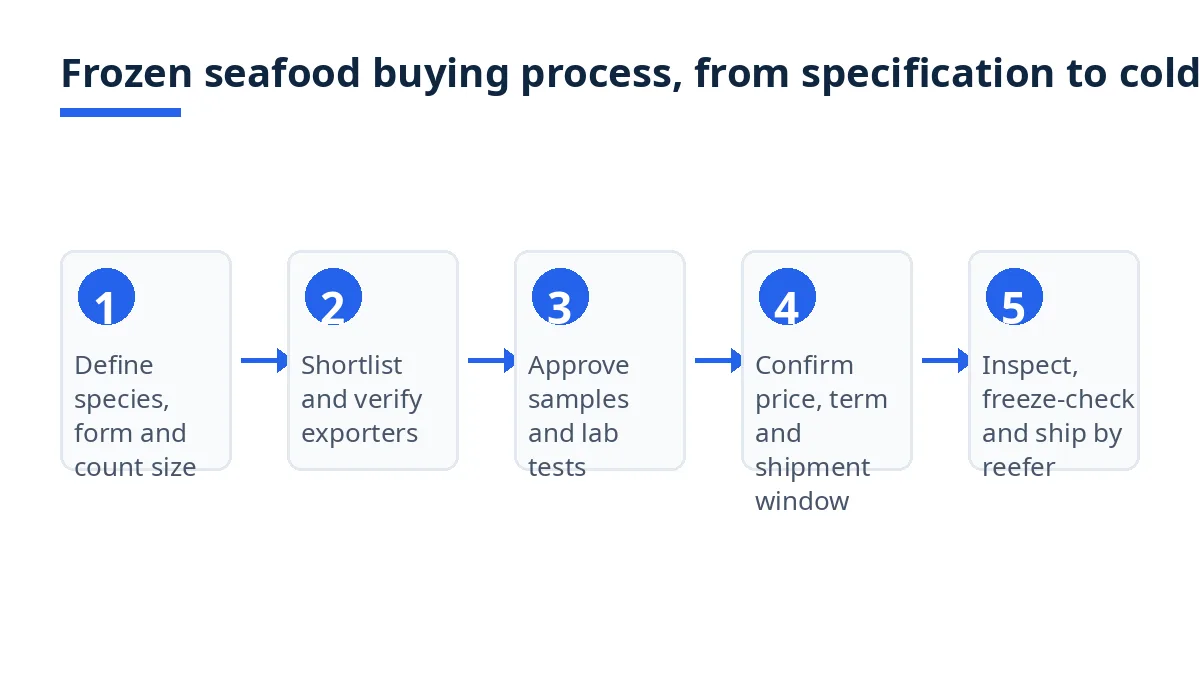
Define the product precisely: species, form, count size and tolerance, glaze percentage and net weight basis, packing and carton weight, destination market and port, target volume and shipment window.
Build a longlist and send every candidate the identical specification, so quotations can be compared on the same deglazed, per-kilogram basis.
Verify the shortlist in layers: identity and export status, approval for your destination market, in-house processing and cold storage capability, and current HACCP and certificate documents checked at source.
Sample and test properly: thawed count and deglazed weight checks, cooking and sensory checks against your standard, and accredited laboratory tests for the microbiological and residue requirements of your market.
Confirm commercial terms in a written purchase order: specification, price and delivery term, temperature and record requirements, testing and inspection rights, shipment window and payment terms.
Manage production actively: confirm raw material accumulation, production and freezing dates, lab results and inspection booking against the purchase order.
Inspect before shipment: open cartons from across the lot, verify count, glaze, net weight, packing and labelling, check core temperature, and witness container loading and seal numbers.
Ship and clear: confirm the health certificate, transport documents and origin paperwork match the lot, and give your broker the full document set before the vessel sails.
Review the order after delivery: deglazed yield, count accuracy, temperature data and customer feedback are the raw material of a tighter second order.
Related guides
Keep your market picture current with Exportain's trade intelligence resources and the Bangladesh export data summaries. The guide for frozen seafood exporters from Bangladesh profiles the exporter side of the trade, and finding suppliers in Bangladesh sets out the wider search and shortlisting process.
FAQs
Is Bangladesh a good place to source frozen seafood and fish?
Yes, for buyers whose products match the country's strengths. Bangladesh has an established farmed shrimp base built on bagda and galda, which together account for 92 percent of production by species share, a processing sector with spare capacity, and a long export record into the European Union, China, the United Kingdom and the United States.1 2 3 Shrimp exports recovered to $296.29 million in fiscal 2024-25.1 The fit is strongest for farmed shrimp programmes in standard forms and count sizes. The result still depends on matching your specification to a plant approved for your market and managing glaze, count and temperature controls in writing.
What is the typical MOQ?
There is no single typical MOQ for frozen seafood from Bangladesh. In practice the floor is set by reefer container economics for a single specification, then adjusted by species, count size, product form, packing setup and the plant's raw material position. A standard headless shell-on line in a common count size is easier to run in a smaller quantity than a cooked, retail-packed line with private label artwork. Ask each shortlisted exporter to quote the minimum for your exact specification, state whether it is per shipment or per production run, and confirm it in writing before you plan volumes around it.
How long is the lead time?
Lead time is a chain rather than a single number, and in frozen seafood the front of the chain is usually raw material accumulation to your count size. Processing and freezing, laboratory testing, inspection, health certification, reefer booking and vessel cut-off each add their own stage, and wild-caught product adds landing variability on top. Seasonal patterns in farming and fishing move the achievable dates through the year. Ask each exporter to quote lead time stage by stage against your required arrival date, agree the stage dates in writing, and confirm the transit estimate for your shipping lane with your freight forwarder.
Which certifications matter?
The certifications that matter first are the legal controls for your market, not voluntary labels. For the United States, the plant needs a working seafood HACCP system under 21 CFR part 123, with written plans, monitored critical control points and records available for official review.6 For the European Union, the consignment needs an authorised country, an approved establishment, a health certificate and health control on entry.7 Bangladeshi export consignments are certified through the Fish Inspection and Quality Control office before shipment.2 On top of that base, add the third-party food safety or aquaculture scheme your own customer requires, and check the certificate's site, scope and expiry in the scheme owner's register before you rely on it.
Next steps on Exportain
Browse Bangladeshi suppliers and note exporters whose range matches your specification, then read how to import from Bangladesh for the steps around ordering and shipping. When your specification is ready, post an RFQ so suppliers reply against the same requirements, and keep the sector picture current with the frozen seafood industry in Bangladesh overview while you negotiate.
Sources
- Bangladesh's shrimp sector needs structural reforms, not short-term solutions. The Financial Express, (accessed )
- Bangladesh shrimp exports set for rebound with first on-board frozen shipment to Europe. The Business Standard, (accessed )
- Portraying the Bangladesh Shrimp Industry: A SWOT Analysis. MDPI Sustainability (accessed )
- Code of Practice for Fish and Fishery Products (CXC 52-2003). FAO and WHO, Codex Alimentarius (accessed )
- Chapter 3: Fish and crustaceans, molluscs and other aquatic invertebrates, Australian Customs Tariff. Australian Border Force (accessed )
- Guidance for Industry: Refusal of Inspection or Access to HACCP Records Pertaining to the Safe and Sanitary Processing of Fish and Fishery Products. U.S. Food and Drug Administration, (accessed )
- Health and consumer protection for animal and plant product. European Commission, Access2Markets (accessed )
- Incoterms Rules. International Chamber of Commerce (accessed )
About the author
Sourcing from Bangladesh?
Post a request for quotation and suppliers on Exportain can send you their quotes directly.
Post an RFQ