The Frozen Seafood & Fish Industry in Bangladesh: Capacity, Clusters and Key Players
Frozen fish and shrimp exports were USD 388.7 million on the EPB series in 2024-25. This guide covers products and clusters, supplier checks, MOQ and pricing, quality, duties and the buying process.
Short answer
Bangladesh freezes black tiger shrimp, freshwater prawn, sea-caught shrimp, white fish, cephalopods and crab for export, mainly from the Khulna belt and Chattogram. EPB data put frozen fish and shrimp exports at USD 388.7 million in fiscal year 2024-25. Buyers source it by specifying species, form, count size and glaze, checking plant approvals for their market, testing samples, and managing the cold chain.

On this page
Key takeaways
Frozen fish and shrimp exports were USD 388.7 million on the EPB shipment series in 2024-25, up 19.33 percent, with frozen shrimp at USD 296.29 million on 23,238 tonnes and frozen fish at USD 92.41 million.
Bangladesh Bank receipts figures are a separate series from EPB shipment figures; the two measure different moments in the trade and must not be merged or averaged.
Raw material, not plant capacity, is the constraint: 110 processing facilities were reported, with only 30 to 40 active and just 10 at full capacity.
Market access is approval-based: FIQC inspection in Bangladesh, EU establishment listing in TRACES for EU shipments, and FDA seafood HACCP compliance under 21 CFR Part 123 for US shipments.
There is no single typical MOQ, price or lead time; all three are quoted per species, form, count size, glaze and season against a written specification.
If you import shrimp, prawns or frozen fish for retail, foodservice or wholesale, the frozen seafood industry in bangladesh deserves a place on your sourcing map. Processors in the south-west and on the Bay of Bengal coast freeze black tiger shrimp, freshwater prawn, sea-caught shrimp, white fish, cephalopods and crab for buyers in the European Union, the United Kingdom, the United States, Japan, China and the Gulf. This guide explains what the industry sells, where production and processing sit, how much of its installed capacity is actually working, who regulates it, and how a buyer can find, check and buy from Bangladeshi suppliers in a disciplined way.
The guide gives no single typical price, minimum order quantity or lead time, because none exists for this category. All three are quoted per species, form and season against a written specification. It also names no company as a leading exporter: judge each plant on its current approvals, documents and test results.
Market overview with latest data
Only a minority of Bangladesh fish production is exported, and the frozen segment is dominated by shrimp and prawns. In export-value terms, Bangladeshi seafood mostly means shrimp, with frozen fish, crab and cephalopods making up most of the remainder.
The recent record shows a recovery after two weaker years. Fresh data from the Export Promotion Bureau (EPB) show exports of frozen fish and shrimp reached USD 388.7 million in fiscal year 2024-25, up 19.33 percent from USD 325.73 million a year earlier, a rise the reporting attributes to improved compliance and quality control and to strong demand from India and China.1 Within that total, Bangladesh shipped 23,238 tonnes of frozen shrimp worth USD 296.29 million, up 19.32 percent in value and 21.5 percent in volume, while frozen fish exports rose 19.38 percent in value to USD 92.41 million even as fish volumes fell 10.7 percent to 7,951 tonnes.1 The same reporting records an average frozen shrimp export price of USD 12.75 per kilogram, down slightly from USD 12.98, and notes that China was the largest shrimp market in that year at USD 56.69 million, followed by the Netherlands and the United Kingdom, with European markets accounting for more than half of frozen shrimp earnings.1 For frozen fish, India was reported as the largest destination, followed by China and the United Kingdom.1
Read that frozen-only total alongside the wider EPB category, not as a substitute for it. EPB data reported for the same fiscal year put frozen and live fish exports together at USD 441.58 million, up 17.23 percent, led by a 20.37 percent rise in crustacean exports.2 The difference is coverage: one series covers frozen fish and shrimp only, the other adds live fish and other lines. Quote the series that matches your product, and name it when you quote it.
A second series needs the same care. Bangladesh Bank publishes export receipts by commodity, recorded through the banking channel when proceeds are received, in its annual export receipts publication covering the years to 2024-25.3 Receipts figures and EPB shipment figures measure different moments in the same trade and can differ in valuation, timing and coverage. Keep the two series separate in your market notes: do not average them, and do not present a receipts figure as a shipment figure. See Bangladesh export data for how the series are compiled.
Installed capacity is not the constraint in this industry. Raw material is. According to the Bangladesh Frozen Foods Exporters Association (BFFEA), as reported in the same EPB coverage, Bangladesh has 110 fisheries processing facilities, but only 30 to 40 remain active and just 10 operate at full capacity.1 Industry voices in that reporting link the idle capacity to low farm production, unfavourable weather, siltation in rivers and canals, disease pressure and difficult bank financing.1 The lesson for buyers is direct: a plant will usually be able to schedule your order, provided the raw shrimp or fish is there to fill it. Verification, realistic lead times and early raw-material booking matter more than freezer space.
Main products and production clusters
The product range divides into farmed shrimp and prawn, sea-caught shrimp, white fish, and cephalopods and crab. Each group has its own geography, season and processing logic, so treat them as separate supply chains that share cold stores.
Black tiger shrimp (Penaeus monodon), known locally as bagda, is the flagship farmed product. It is grown extensively in brackish-water ponds called ghers in the south-west, typically at low stocking density. Buyers specify it by form: head-on shell-on, headless shell-on, peeled and deveined, peeled deveined tail-on, easy-peel and skewered presentations, frozen in block, semi-IQF or IQF form. Freshwater prawn (Macrobrachium rosenbergii), known as golda, is farmed in freshwater ponds, often alongside fish, and is sold mainly headless shell-on in block and IQF forms. Sea-caught shrimp from the Bay of Bengal includes white shrimp, brown shrimp and smaller harina types, supplied largely in block and peeled forms. White fish and other species include hilsa, pomfret, sea bass, ribbon fish and croaker, together with cuttlefish, squid, octopus and mud crab. Treat that list as a range to enquire about, not a stock list: availability follows landings and harvests, and a plant that handles farmed shrimp may not handle sea fish at all.
Two specification points decide whether quotations can be compared at all. The first is count size, the number of pieces per pound or per kilogram for the stated form. The second is glaze: the percentage of protective ice applied at freezing, and whether the quoted weight is gross weight with glaze or net weight after deglazing. Two quotations at different glaze levels are different products, not the same product at different prices. Put species, form, count size, glaze, freezing method and packing on one page before you contact any supplier.
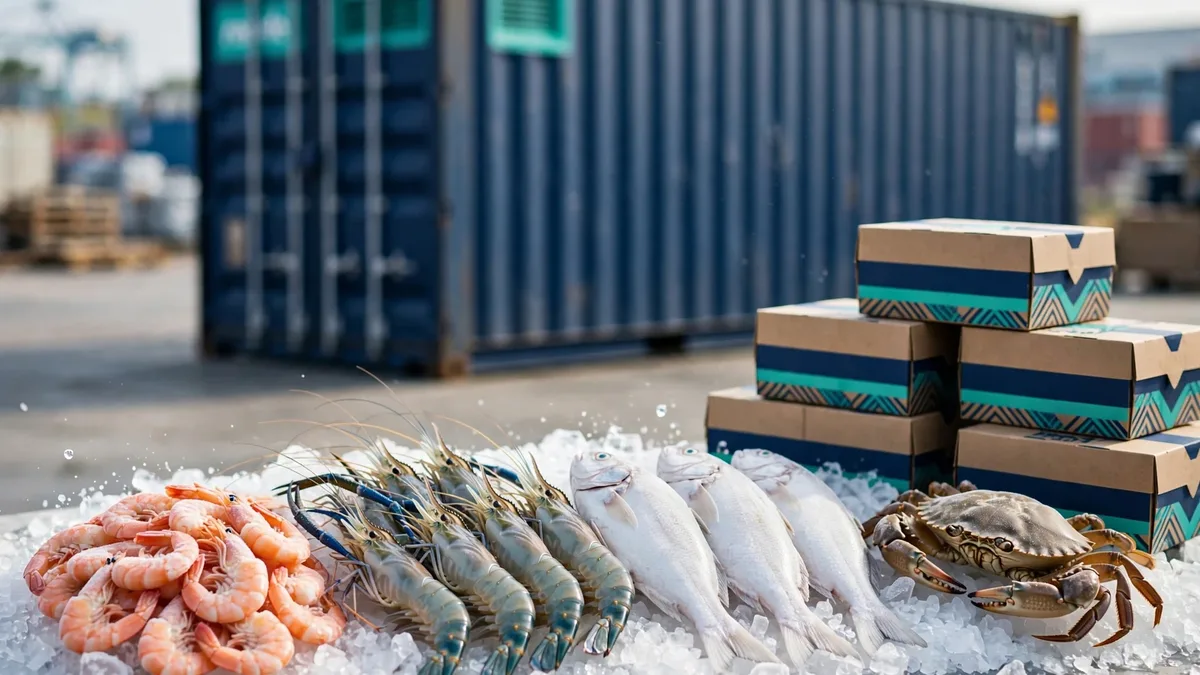
The clusters follow the species. The Khulna, Bagerhat and Satkhira belt in the south-west is the heartland of bagda and golda farming and of processing, with plants drawing raw material from farms and depots across the belt and shipping through Mongla and Chattogram. The reporting behind the market figures names Khulna, Bagerhat, Satkhira and Chattogram among the coastal regions where fisheries livelihoods and processing concentrate.1 Chattogram combines the principal seaport with a processing base oriented to sea catch from the Bay of Bengal, including white fish, sea shrimp and cephalopods, while Cox's Bazar contributes marine landings and hatchery activity. Match the cluster to the species before you shortlist plants, and confirm the address of the plant that will actually process your order, because trading offices and processing plants are not always in the same place.
How to find and verify suppliers
The key players in this trade are institutional as much as commercial. Processors and exporters, many organised through the BFFEA, do the freezing and shipping. The Department of Fisheries and its Fish Inspection and Quality Control (FIQC) wing inspect plants and support export certification. The EPB registers exporters and issues certificates of origin. Judge any intermediary by the checking it adds, not by the length of its supplier list.
Start with a one-page specification: species with common and scientific name, form, count size, glaze percentage, freezing method, packing, destination market, required approvals, quantity per shipment and per season, and your shipment window. Suppliers respond to precise specifications with precise answers. A vague enquiry gets a vague price.
Build a shortlist from several routes in parallel: association information, trade data for your product lines, referrals, and supplier platforms. Browse suppliers in Bangladesh and the guide to a frozen seafood exporter in Bangladesh as starting points, then run the same checks on every name. Use how to write an RFQ to keep each enquiry identical, so replies can be compared.
For each shortlisted plant, request the same evidence pack: trade licence, export registration, FIQC plant approval position, the establishment's listing status for your destination market, current HACCP documentation, recent laboratory test reports for your product, the markets and forms currently being produced, and references for similar shipments. Then check documents against their issuers, rather than collecting files at face value.
Three market-access checks matter most. For the European Union, goods can only enter from listed countries, and establishments producing food of animal origin for export to the EU must comply with the applicable public health requirements, with compliance checked and guaranteed by the competent authority of the exporting country before the establishment is proposed for listing; the published lists are held in the TRACES platform managed by DG SANTE, and Section VIII covers fishery products.4 Confirm that your plant appears on the current list for Bangladesh under that section before you discuss price. For Bangladesh itself, the fish inspection law provides for inspection of processing plants on hygiene and sanitation and for physical, chemical and bacteriological examination of fish and fish products, for registration of plants and licensing of operators, and for a quality control certificate before fish is marketed for export.5 Ask which FIQC station inspects the plant and how health certification for your destination is arranged. For the United States, the FDA seafood HACCP regulation at 21 CFR Part 123 requires processors to develop and implement HACCP systems, and its importer provisions require United States importers to hold written verification procedures showing the product was processed in accordance with that part.6 Your supplier's HACCP plan and records are therefore part of your own compliance file.
Identity checks come before payment checks. Confirm that the legal name and factory address match across the trade licence, export registration, plant approval and bank beneficiary details. Then test samples of the exact form and count size for count uniformity, glaze, deglazed net weight and sensory quality, with laboratory testing proportionate to your market. A pre-shipment inspection of the first consignment, covering count, glaze, temperature records and carton condition at stuffing, is money well spent. On Exportain, supplier checks are document and photo reviews of the material a business submits: a screening step, not a factory inspection and not a guarantee of any consignment. Your own checks, samples and inspection remain necessary on every order.
MOQ, pricing and lead times
There is no standard minimum order quantity for Bangladeshi frozen seafood, because the binding constraint is rarely the freezer. It is the raw material. Trial orders are often built around a single reefer container or a part-container consolidated shipment, and a plant's willingness to run a small trial depends on whether it already holds the species, form and count size you want in stock or in its daily intake. A common specification in season is a different proposition from an unusual count size, a retail-ready pack or a value-added form that needs a dedicated run. State your trial quantity and your realistic seasonal volume together, because plants reserve raw material for buyers whose programme justifies it. See MOQ minimum order quantity for how minimums are built.
Pricing is species-, season- and specification-specific, and this guide publishes no price list, because a printed figure would be wrong for your form and your month. Understand the drivers instead. The raw shrimp or fish price at the depot is the largest component and moves with landings, harvests and competing demand. Processing cost varies with form, because a peeled and deveined product carries labour that a headless shell-on block does not, and with count size, because smaller counts mean more pieces handled per kilogram. Glaze, packing, testing and the delivery term complete the picture. The reported average frozen shrimp realisation of USD 12.75 per kilogram in 2024-25 is a mixed-basket average across forms and counts.1 Use it only as a sense check that a quotation sits in a plausible range, never as a quotation for your specification. Ask each supplier to price the identical specification, state the glaze and net-weight basis inside the quotation, and confirm how long the price holds.
Lead time divides into raw-material assembly, processing and freezing, inspection and documentation, and transport. Stocked product can move quickly once inspection and documents clear. Product accumulated from daily intake takes as long as the season dictates. Build the timeline backwards from your required arrival date, including FIQC inspection and health-certificate issuance, laboratory turnaround, reefer booking and the voyage, and put dated milestones in the contract: production, inspection, stuffing and sailing. In peak harvest the constraint is plant scheduling. Outside it, the constraint is raw material.
Quality, certifications and compliance
Quality in frozen seafood is controlled at four points: raw-material freshness at intake, hygiene and temperature discipline during processing, freezing and cold-store stability, and the integrity of the reefer chain to destination. The system that binds those points together is HACCP. The FDA regulation requires processors to develop and implement HACCP systems, supported by the FDA Fish and Fishery Products Hazards and Controls Guide, which sets out the hazards reasonably likely to occur for species and processes and the controls appropriate to them.6 When you assess a plant, ask to see the HACCP plan's critical control points for your product, covering receiving temperature, freezing core temperature and cold-store monitoring, together with the records that show the plan is actually kept.
Separate certifications and approvals into two kinds. The first kind is market-access approval, which is mandatory and checkable: FIQC approval and inspection in Bangladesh under the fish inspection law,5 EU establishment listing for EU shipments,4 and FDA seafood HACCP compliance with facility registration and prior notice for United States shipments.6 The second kind is voluntary certification, which buyers require according to their channel. For farmed shrimp, the schemes buyers most often name are BAP and ASC. The BAP standards, developed under the Global Seafood Alliance, address environmental responsibility, social responsibility, food safety and traceability through the production chain, and BAP certification is available for shrimp farms and hatcheries and for seafood processing plants.7 Plant-level schemes such as BRCGS or IFS are required by some retail supply chains. In every case, ask for the certificate reference, its scope in species, processes and site, and its expiry date, and check it with the issuing scheme or authority. A logo on a brochure is not evidence.
Three compliance risks deserve explicit management in the contract. Residues: importing markets test for banned veterinary substances, and the sector reporting records stricter EU work on antibiotic residues and traceability raising compliance costs.1 Protect your programme with a written residue-control position from the plant and pre-shipment testing proportionate to your market. Cold chain: specify minus 18 degrees Celsius or colder throughout, require the temperature record for your consignment to travel with the documents, and agree the response to an excursion before the vessel sails. Labelling and documentation: destination rules govern species naming, allergen declaration, since crustaceans are a declared allergen in the EU, the UK and the USA, net weight and glaze declaration, and lot traceability. The health certificate, certificate of origin, packing list and invoice must agree with each other and with the cartons, so reconcile the document set before shipment, not after arrival.
Shipping, Incoterms and duties
Frozen seafood moves in reefer containers from Chattogram and Mongla. Choose the delivery term to reflect who controls the cold chain, and write the temperature requirement, reefer set point and document list into the contract and the booking. The Incoterms rules published by the International Chamber of Commerce are eleven three-letter trade terms used in contracts for the sale and purchase of goods, and they clarify the tasks, costs and risks involved in delivering goods from sellers to buyers; the current edition, Incoterms 2020, entered into force on 1 January 2020.8 Under FOB, the supplier delivers on board at the named Bangladeshi port and you control the main freight. Under CFR the supplier also pays freight to your port, and under CIF the supplier adds minimum-cover insurance. Delivered terms place more of the journey with the seller, but a seller cannot control destination clearance for you, so they are a poor default for a first order. For a first order, a full reefer under one specification is the cleaner test of a supplier.
Export documents decide whether goods move at all. Bangladesh Customs states that goods may not be loaded or stuffed for export until an export declaration, known as a Bill of Export or Shipping Bill, has been submitted and approved, enclosed with the export letter of credit or, where there is none, the export contract or purchase order, a commercial invoice with a detailed description of the goods, a packing list, an EXP form certified by an authorised dealer bank, a certificate of origin issued by the EPB or a chamber of commerce, a VAT registration certificate and a taxpayer identification number.9 For frozen fish, Customs also notes that a quality control certificate from the Department of Fisheries is necessary where the destination country requires it.9 Check names, addresses, classification, weights and quantities across every draft as soon as drafts arrive: correcting documents after a vessel sails is slower than checking them before it leaves. The wider sequence sits inside how to import from Bangladesh.
Duties depend on your market, the exact classification and the origin status of the goods, so confirm them in the official tariff for your destination before you cost a programme. Classification comes first. Chapter 03 of the Harmonised System covers fish and crustaceans, molluscs and other aquatic invertebrates, with heading 0303 covering frozen fish other than fillets and heading 0306 covering crustaceans, including frozen shrimps and prawns.10 Prepared or preserved shrimp moves to heading 1605, so a value-added form can change the duty as well. In the United States tariff published by the USITC, subheading 0306.17.00 for other frozen shrimps and prawns carries a general rate of duty of Free in the current Chapter 3 text.11 Treat that as a starting point only: trade-remedy measures, additional duties in force on your import date and FDA admissibility are separate questions, so confirm the position at hts.usitc.gov and with your broker. In the United Kingdom tariff, the lines under subheading 030695 for other shrimps and prawns show a third-country duty of 12.00 percent for most lines and 18.00 percent for the Crangon lines shown, before any preference.12 Your rate depends on the exact commodity code and the preference evidence you hold at import.
Preference is the point buyers most often assume and least often check. Bangladesh has benefited from preferential access in the EU under the Everything But Arms arrangement and in the UK under its developing-country preferences, subject to rules of origin and to each scheme's current terms. Bangladesh is scheduled to graduate from least-developed-country status on 24 November 2026, and reporting on the transition notes both a request to defer graduation and an expected three-year transition buffer that would extend EBA-level benefits to around 2029.13 Do not cost a multi-season programme on today's preference treatment alone. Check, for your actual shipment date, the position in EU TARIC or the UK Trade Tariff, and record which origin proof your supplier will provide. For UAE and other Gulf destinations, confirm duties and food-import requirements against the current official tariff in the same way. In every market, the duty question and the food-safety admissibility question are different doors, and your goods must pass both.
For payment, use the structure your own risk policy sets, for example staged payment against inspection and shipping documents, with the beneficiary name matching the exporter's registered name exactly. Never pay to a personal account, or to a name that differs from the documents you checked.
Step-by-step buying process
Define the specification. Species with scientific name, form, count size, glaze, freezing method, packing, destination market and required approvals, on one page, in writing.
Shortlist and check suppliers. Gather the evidence pack from several plants, check approvals against the issuing authority or the official list for your market, and reconcile company identity across all documents.
Sample and test. Evaluate samples of the exact specification for count, glaze, deglazed net weight and sensory quality, with laboratory testing appropriate to your market, and keep a sealed counter-sample.
Agree commercial terms. Price on the stated glaze and net-weight basis, quantity and shipment window, delivery term, payment structure, inspection rights and the document list, all in a written contract or confirmed pro forma.
Book production and inspect. Confirm production and freezing dates, commission a pre-shipment inspection covering count, glaze, temperature records and carton condition, and confirm FIQC inspection and health-certificate arrangements.
Ship and track the cold chain. Confirm the reefer set point and booking, receive the temperature record with the documents, and reconcile the document set, covering invoice, packing list, health certificate, certificate of origin and bill of lading, before arrival.
Clear, check and feed back. On arrival, verify temperature history, count and net weight promptly, document any claim with inspection evidence inside the contract window, and give the supplier structured feedback.
Related guides
Work outward from this pillar in a deliberate order. Use Bangladesh export data to read EPB shipment figures and Bangladesh Bank receipts figures without mixing the two series. Use HS codes and how to classify your product before you cost duties, because a value-added form can move your goods to a different heading. Follow how to import from Bangladesh for the end-to-end import sequence and documents.
FAQs
Is Bangladesh a good place to source frozen seafood and fish?
It can be, for the right products and with proper checking. Bangladesh has a long-established industry centred on black tiger shrimp and freshwater prawn, a diversified destination record across the EU, the UK, the USA, Japan and China, and installed capacity well above current raw-material supply. EPB data show frozen fish and shrimp exports recovering 19.33 percent to USD 388.7 million in fiscal year 2024-25.1 The same reporting shows only 30 to 40 of 110 processing facilities active, because raw material, not plant capacity, is the constraint.1 Buyers do well with realistic lead times, precise specifications and plants whose approvals for their market they have checked, rather than spot buying on price alone.
What is the typical MOQ?
There is no single typical MOQ, because it is set by raw-material availability, species, form and the plant's current stock and intake. Trial orders are commonly built around one reefer container or a consolidated part-load, and a plant is far more likely to accommodate a small trial of a specification it already produces in season than an unusual form or count size that needs a dedicated run. State your trial quantity and seasonal volume together, and confirm the MOQ in writing against the exact specification.
How long is the lead time?
Lead time depends on whether your product is already in cold store or must be accumulated from harvests and landings, plus processing and freezing, FIQC inspection and health certification, laboratory testing, and reefer booking and voyage time. A stocked product can move quickly once inspection and documents clear. A product assembled from daily intake takes longer, and an out-of-season requirement takes longest. Agree dated milestones for production, inspection, stuffing and sailing in the contract.
Which certifications matter?
Start with mandatory market-access requirements: FIQC plant approval and inspection in Bangladesh,5 EU establishment listing held in TRACES for EU shipments,4 and FDA seafood HACCP compliance under 21 CFR Part 123, with facility registration and prior notice, for United States shipments.6 Then add the voluntary certifications your channel requires, for example BAP or ASC for farmed shrimp programmes, or BRCGS or IFS where a retailer requires plant-level certification. In every case, check the holder, site, scope and expiry date with the issuing scheme or authority. A logo alone is not evidence.
Next steps on Exportain
Browse suppliers in Bangladesh by product category and note the processors whose species and forms match your specification, then read how to import from Bangladesh before your first enquiry. When your specification is ready, compare it with the route set out for a frozen seafood exporter in Bangladesh and send the same one-page specification to each plant on your shortlist, so every reply is priced on identical terms.
Sources
- Frozen fish, shrimp exports rebound with 19% growth, India and China top destinations. The Business Standard, (accessed )
- Textiles, seafood and bicycles led export surge in FY2024–25. TOB News, (accessed )
- Annual Export Receipts of Goods and Services 2024-25. Bangladesh Bank (accessed )
- Non-EU countries authorised establishments. European Commission (accessed )
- The Fish and Fish Products (Inspection and Quality Control) Ordinance, 1983. Ministry of Law, Justice and Parliamentary Affairs, Bangladesh (accessed )
- Guidance for Industry: Seafood HACCP Transition Guidance. U.S. Food and Drug Administration (accessed )
- Best Aquaculture Practices. Ecolabel Index (accessed )
- Incoterms® rules. International Chamber of Commerce (accessed )
- Customs Clearance Procedures for Export. Bangladesh Customs, National Board of Revenue (accessed )
- HS 2017 - Code 03: Fish and crustaceans, molluscs and other aquatic invertebrates. United Nations Statistics Division (accessed )
- Harmonized Tariff Schedule of the United States, Chapter 3. United States International Trade Commission (accessed )
- Subheading 03069530 - Other shrimps and prawns, UK Integrated Online Tariff. GOV.UK (accessed )
- New trade deals vital before LDC graduation. The Daily Star (accessed )
- quality control
- Bangladesh Export Data
- Category Pillars
- Supplier Sourcing
- Frozen seafood Bangladesh
- Shrimp exports
About the author
Sourcing from Bangladesh?
Post a request for quotation and suppliers on Exportain can send you their quotes directly.
Post an RFQ