Best Incoterm for Importing Frozen Seafood & Fish From Bangladesh
No single Incoterm fits every frozen seafood order from Bangladesh. This guide matches FCA, FOB, CIF and CIP to reefer handover point, freight control and insurance, with Bangladesh export documents and a pre-signing checklist.
Short answer
For most reefer container orders, CIP or FCA is the best incoterm for importing frozen seafood from Bangladesh. Choose CIP when the seller should arrange carriage with broader Clause A insurance, and FCA when you book freight yourself from a terminal handover. Choose CIF only for port-to-port sea shipments where minimum Clause C cover is enough for the load.
On this page
Key takeaways
There is no single best term: the ICC Academy states there is no right or wrong Incoterms rule, only the appropriate rule for the specific circumstances of the transaction.
FCA matches reefer container handovers at a terminal, FOB matches cargo loaded on board, and both leave main carriage with the buyer.
CIF places seller-arranged sea freight and Clause C minimum insurance inside the price, while risk still passes on board at origin.
CIP places seller-arranged carriage and broader Clause A insurance inside the price, with risk passing at handover to the first carrier.
If you import frozen shrimp, fish or other seafood from Bangladesh, the best incoterm for importing frozen seafood from Bangladesh is the term that matches how your reefer container is handed over, who books the main carriage, and who carries the risk while the cold chain is moving. This guide works through that match, so you can choose between FCA, FOB, CIF and CIP with a clear reason for each order.
Why the term matters for frozen seafood orders
Frozen seafood is perishable cargo in a sealed refrigerated container. Once the container is moving, a delay or a temperature problem becomes a quality claim, and the term decides which party bears that risk at each stage. The Incoterms rules published by the International Chamber of Commerce (ICC) are a set of eleven three-letter trade terms, and they clarify the tasks, costs and risks involved in the delivery of goods from sellers to buyers. The current edition, Incoterms 2020, entered into force on 1 January 2020.1
The ICC Academy makes the starting point plain: there is no right or wrong Incoterms rule, only the appropriate rule for the specific circumstances of a trade transaction.2 For frozen seafood, those circumstances are the reefer handover point, your freight booking experience, and the insurance cover a perishable load needs. Compare quotes only after you set them on the same term.
The four decision criteria
Work through these four criteria in order before you look at any single term.
1. Shipment mode and handover point. Seven rules work for any mode of transport: EXW, FCA, CPT, CIP, DAP, DPU and DDP. Four rules are for sea and inland waterway transport only: FAS, FOB, CFR and CIF.3 A frozen seafood container is normally handed to the carrier at a terminal, depot or cold store before vessel loading, so the any-mode rules often fit the physical handover better. For air freight, only the any-mode rules apply at all.
2. Container load versus bulk or loose cargo. FOB, CFR and CIF are written around delivery on board a vessel.3 A sealed reefer container handed over at a terminal changes hands earlier, which is why FCA and CIP exist as the any-mode options. The ICC Academy notes that CIP is the appropriate rule when goods are transported in containers or on pallets and when multiple modes of transport will be used.2
3. Buyer experience and freight control. If you run regular volumes and hold your own freight contracts, a term that leaves main carriage with you, such as FCA or FOB, lets you control routing, carrier choice and the reefer booking. If you are placing a first or occasional order with no forwarder relationship, a term under which the seller arranges carriage, such as CIF or CIP, reduces the parties you must manage.
4. Risk appetite and insurance. Under the C terms, cost and risk split at different points. Under CIF, the seller pays freight to your port, but risk passes when the goods are loaded on board at origin, and the seller-arranged insurance is minimum cover under Clause C of the Institute Cargo Clauses.2 Under CIP, the seller must obtain insurance that complies with Clause A of the Institute Cargo Clauses, the broader level of cover.2 For a perishable, high-value seafood load, the cover level and the risk point are deciding factors, not details. Under FCA and FOB, no seller insurance duty exists, so you arrange your own cover from the handover point.
The main options compared
Term | Mode | Who books main carriage | Insurance duty | Risk passes |
|---|---|---|---|---|
FCA (Free Carrier) | Any mode | Buyer | None on seller | On handover to the carrier at the named place |
FOB (Free On Board) | Sea only | Buyer | None on seller | When goods are on board the vessel |
CIF (Cost, Insurance and Freight) | Sea only | Seller | Seller, minimum Clause C cover | When goods are on board the vessel |
CIP (Carriage and Insurance Paid To) | Any mode | Seller | Seller, Clause A cover | On handover to the first carrier |
DAP (Delivered at Place) | Any mode | Seller | None stated in the rule | At the named destination, ready for unloading |
Under FCA, the seller delivers the goods to the carrier or another person nominated by you at the seller premises or another named place, and the parties are advised to specify the point within that place as clearly as possible, because risk passes to you at that point.3 Under FOB, the seller delivers the goods on board the vessel nominated by you at the named port of shipment, and risk passes when the goods are on board.3
For a standard reefer container of frozen seafood from Chattogram, that comparison usually produces one of three answers. FCA Chattogram terminal suits the buyer who wants freight control with a handover that matches container practice. CIF named destination port suits the buyer who wants one seller-arranged price to port and accepts minimum insurance and origin risk transfer. CIP named place suits the buyer who wants seller-arranged carriage with the broader Clause A level and a first-carrier handover.2
One distinction matters for every C term. The ICC Academy states that all C terms are shipment terms, not delivery terms: risk passes to you before the main leg of transport, even though the seller has paid for that leg.2 Under DAP, the seller bears the risk for the entire journey to the named destination, while you complete import formalities.4
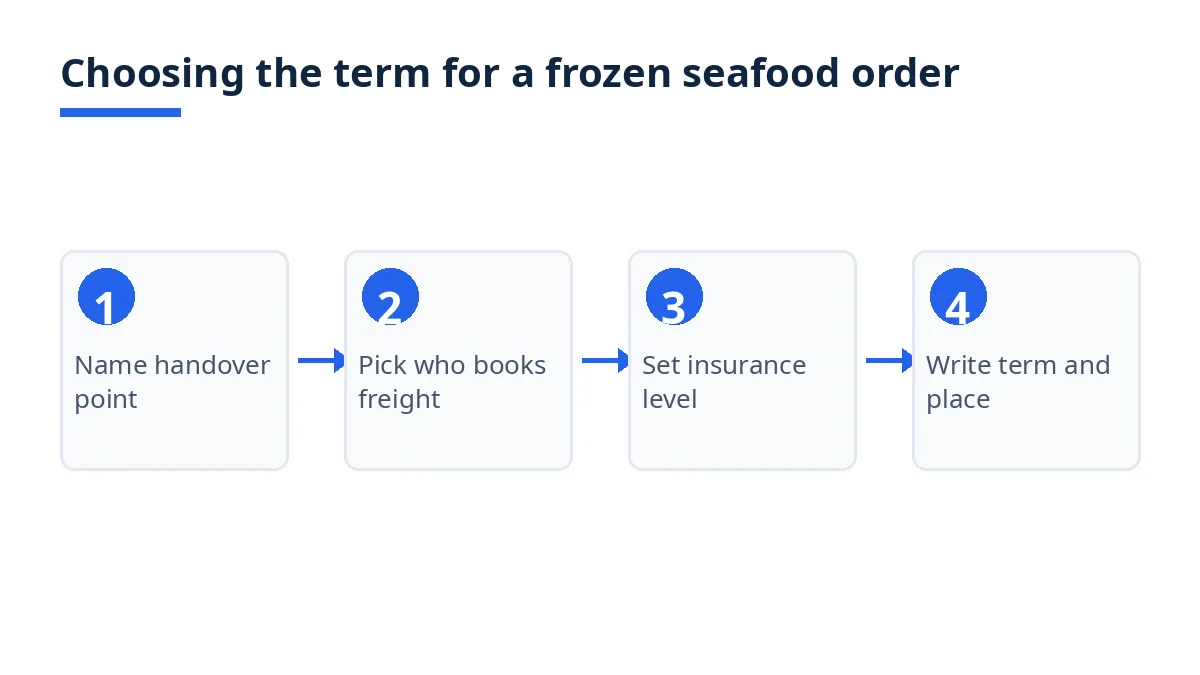
The diagram below sets out the decision flow.
Step by step: how to choose for one order
Write down how the order travels: reefer container or loose cargo, sea or air, full container load (FCL) or less-than-container load (LCL), and the exact handover place.
Rule out terms that do not fit that mode. Sea-only terms, FAS, FOB, CFR and CIF, drop out for air freight or a terminal handover.3
Decide who books the main carriage. Your forwarder and your rates point to FCA or FOB. The seller network and a single price to destination point to CIP, CFR or CIF.
Decide the insurance position. If the seller insures, choose between CIF with Clause C minimum cover and CIP with Clause A cover, and record the insured amount agreed.2
Confirm who clears export in Bangladesh and who clears import at destination. Under FCA the seller clears export, which is one reason it is preferred over EXW: under EXW the seller does not need to load the goods or clear them for export.3
Agree the cold-chain record in the contract: who monitors the reefer in transit, who receives the temperature record on arrival, and what evidence supports a claim.
Write the term in full in the contract and on the invoice: the three-letter rule, the named place or port, and Incoterms 2020.
Ask every supplier to quote on that same term, with goods, freight and insurance shown as separate lines where the term includes them.
Costs, timelines and documents
Costs. The term sets which costs sit inside the seller price. On FCA and FOB, your costs after handover or loading include main carriage, insurance if you buy it, destination handling, import duty and tax, and onward delivery. On CIF and CIP, main carriage and the stated insurance level sit inside the seller price, while destination charges, import clearance, duty and onward delivery remain yours. Build your landed cost on the term you chose. See landed cost for imports from Bangladesh.
Timelines. This guide states no transit times, because schedules, transshipment and port conditions change by route and season. If the seller books under CIF or CIP, agree when the seller must send the bill of lading and insurance document, because you need both to clear import and to claim on damaged goods.
Documents. Goods cannot be loaded or stuffed into containers for export from Bangladesh unless an export declaration, the Bill of Export or Shipping Bill, has been submitted to Customs and approved by the Customs authority.5 The documents enclosed with the Bill of Export include the export letter of credit, or where there is none the export contract, purchase order or export guarantee approved by the negotiating bank, a signed commercial invoice with a detailed description of the goods, a packing list, an EXP form certified by an Authorized Dealer, a certificate of origin issued by the Export Promotion Bureau or a Chamber of Commerce and Industry, the VAT registration certificate, and the Taxpayer Identification Number.5 For frozen fish, Bangladesh Customs lists a further requirement: a quality control certificate issued by the Department of Fisheries, as per the requirements of the country of destination.5 Your term does not change that list, but it changes who instructs the clearing agent. The full set is covered in export documents from Bangladesh.
Bangladesh-specific points
Export clearance sits in Bangladesh under every term except EXW, because the Bill of Export is filed with Bangladesh Customs and the declaration states the description of goods, value, name of exporter, name of foreign buyer or importer, and name of transport operator.5 FCA keeps that duty with the seller, who is the party able to perform it, which is why buyers tend to treat FCA as the early-handover option and EXW as the exception.
The frozen fish quality control certificate is the Bangladesh-specific document to plan around.5 It is issued per the requirements of your destination country, so confirm that requirement with the seller before the order is packed. A frozen load waiting on paperwork is a cold-chain risk in itself.
Port practice points the same way. Reefer containers are typically handed over at a terminal or off-dock before vessel loading at Chattogram, so the FCA handover point can be written to match the real custody change. Under FOB, risk passes only when the goods are on board the vessel.3 For the wider pattern, read Incoterms for shipments from Bangladesh and the guide to sourcing frozen seafood from Bangladesh.
Mistakes and red flags
Choosing CIF for a reefer container and assuming risk runs to destination. Under CIF the seller pays freight to your port, but risk passes on board at origin and the included insurance is Clause C minimum cover.2 If that cover does not match the load value, agree wider cover or buy your own top-up.
Using FOB because it is familiar, for cargo handed over at a terminal. The risk point under FOB is on board the vessel,3 not the terminal gate. If your handover is at a terminal, FCA states the point you mean.
Accepting EXW to get the lowest headline price. Under EXW the seller does not need to load the goods or clear them for export,3 so the costs and the export filing move to you or your agent in Bangladesh.
Leaving the cold-chain record unassigned. If no one is named to monitor the reefer and hold the temperature record, a quality dispute on arrival has no evidence base.
Leaving the named place or the version out. Write the rule, the named place or port, and Incoterms 2020 in full.
Agreeing DDP without checking import ability. DDP places import clearance and duty on the seller in your country. If the seller cannot act as importer, the shipment stalls at arrival. DAP, with you clearing import, is the usual substitute.4
Checklist before you sign
Shipment mode and handover place written down, and the term matches that mode.
One term chosen, quoted identically by every supplier.
Named place or port and Incoterms 2020 written after the three-letter rule.
Insurance level stated: none, Clause C under CIF, or Clause A under CIP, with the insured amount agreed.2
Export clearance owner named, with the Bill of Export document set confirmed.5
Department of Fisheries quality control certificate confirmed against destination requirements.5
Cold-chain monitoring and temperature record named in the contract.
Import clearance, duty and destination charges budgeted outside the seller price.
Document flow agreed: who sends the bill of lading, invoice, packing list and insurance document, and by when.
How Exportain helps
Exportain is a B2B export marketplace where buyers find Bangladeshi suppliers, post requests for quotation (RFQs), receive quotations and place orders. On an RFQ for frozen seafood, state the term you chose and the named place, and ask each supplier to quote on that basis. Exportain is not a party to the contract for goods, and it does not book freight, arrange insurance or clear customs. Read the FOB definition and the CIF definition for the two sea terms in full.
FAQs
What should I know first about Incoterm for Importing Frozen Seafood & Fish From Bangladesh?
Know first that no single term fits every order. The ICC Academy states that there is no right or wrong Incoterms rule, only the appropriate rule for the specific circumstances of the transaction.2 Start from your shipment mode, handover point, who should book carriage, and the insurance level a perishable load needs.
What are the typical costs and timelines?
Costs follow the term. FCA and FOB leave main carriage and insurance to you after handover or loading, while CIF and CIP place carriage and a stated insurance level inside the seller price, with destination charges, import duty and onward delivery still yours. No fixed timelines are given, because schedules vary by route and season.
Which documents are needed?
For export from Bangladesh, the Bill of Export must be submitted and approved before goods are loaded, and it is enclosed with the export letter of credit or approved contract, purchase order or guarantee, the signed commercial invoice, the packing list, the certified EXP form, the certificate of origin, the VAT registration certificate and the Taxpayer Identification Number.5 Frozen fish also requires a quality control certificate from the Department of Fisheries, as per the requirements of the country of destination.5 At destination you also need the bill of lading and, under CIF or CIP, the insurance document.
What are the most common mistakes?
The most common mistakes are using a sea-only term for a terminal handover, reading a CIF price as a delivered price, accepting Clause C minimum cover without checking it against the load value,2 comparing quotes on different terms, leaving the cold-chain record unassigned, and leaving the named place or the Incoterms 2020 version out of the contract.
Next steps on Exportain
Set your term using the criteria above, then work through the frozen seafood sourcing guide and post your requirement with the term and named place stated in the RFQ. Compare the replies against Incoterms for shipments from Bangladesh, and check your full arrival cost with landed cost for imports from Bangladesh.
Sources
- Incoterms® rules. International Chamber of Commerce (ICC) (accessed )
- CIF & CIP Incoterms 2020 explained: Key differences. ICC Academy, (accessed )
- Customs valuation: Incoterms. HM Revenue & Customs (GOV.UK) (accessed )
- DAP & DPU Incoterms 2020 explained: Key differences. ICC Academy, (accessed )
- Customs Clearance Procedures for Export. Bangladesh Customs, National Board of Revenue (accessed )
About the author
Sourcing from Bangladesh?
Post a request for quotation and suppliers on Exportain can send you their quotes directly.
Post an RFQ