FCA for Small Importers: Is It the Right Incoterm for Your First Order?
Small importers weighing FCA for a first order from Bangladesh: when the handover, the named place and your forwarder make it fit, and what to settle in writing before you sign.
Short answer
Under FCA, the seller delivers your goods, cleared for export, to a carrier you nominate at an exact named place, and risk passes at that handover. FCA fits a first order when you have a forwarder and broker appointed before signing and you want visible freight costs; it does not fit when you have no carrier arranged or you want the seller to carry the journey.
On this page
Key takeaways
FCA turns on one handover: the seller delivers cleared goods to your nominated carrier at an exact named place, and risk passes there, so the place, the carrier and the Incoterms 2020 edition must be settled in writing before signing.
FCA fits a first order when a forwarder and destination broker are appointed before signing and you want freight shown as its own cost line; it does not fit when no carrier is arranged or you want the seller to carry the journey.
Name the place with a full address, not a city: a factory address, a terminal and a forwarder's warehouse carry different loading duties and different collection points.
Ask for every cost and every date as a separate line, lay the order out on an example-figures basis, and confirm duty and import VAT with your broker rather than estimating them from a guide.
In Bangladesh, export loading needs an approved Bill of Export with its enclosures, and at destination a United Kingdom buyer needs the correct EORI prefix for the movement, so prepare both sides before the goods move.
A first order from Bangladesh is where a small importer learns whether the paperwork, the freight booking and the delivery term actually fit together. The goods may be ready, the sample approved and the price right, yet the order can still stall on one question: who was supposed to do what, and where exactly did responsibility change hands. FCA, short for Free Carrier, answers that question in a particular way, and the answer suits some first orders well and others poorly.
FCA means the seller delivers the goods, cleared for export, to a carrier or another person you nominate, at a named place. If the named place is the seller's premises, the seller loads the goods onto your carrier's vehicle. If it is anywhere else, such as a forwarder's warehouse, the seller delivers them ready for unloading, and unloading is the carrier's concern. Risk passes at that handover.1 That single handover is the whole decision: everything before it is the seller's job, and everything after it is yours, including the main freight, import clearance and onward delivery.
This guide is written for the buyer placing a first or early order. It helps you judge whether FCA fits your order, your team and your budget, and what to settle in writing before you sign. For a line-by-line look at what an FCA price contains, read the FCA price guide. For a full treatment of the common errors, read the FCA mistakes guide.
Why this matters for buyers and sellers
For a small importer, FCA is attractive for one reason and demanding for one reason, and both come from the same handover. The attraction is control: you choose the carrier and the forwarder, you see the freight cost as its own line, and you are not paying a margin inside a seller-arranged freight price you cannot inspect.
The demand is work. Under FCA you, not the seller, arrange the main carriage from the named place, and you carry the risk from the handover onward. A buyer with a forwarder already appointed can absorb that work easily. A buyer with no forwarder, no broker and no plan for import clearance takes on a chain of bookings and filings while still learning the supplier, the product and the market. The Incoterms 2020 rules allocate cost, risk and obligations between seller and buyer, rule by rule, so the choice of rule is a choice about how much of the journey you run yourself.2
For the seller, FCA is a clean commitment: deliver cleared goods to your carrier at the agreed place, with proof of delivery, and the seller's delivery duty is done. It does not mean the seller will arrange your freight, insure your cargo or clear your import. If your enquiry reads as though you expect those services, the quotation and the contract will disappoint both sides.
The first-order test is practical. FCA fits when you can answer yes to three questions: you have, or will appoint before signing, a forwarder and a customs broker for your destination; you are comfortable carrying risk from the named handover point; and your order suits a handover at a named place. If any answer is no, fix that gap first, or choose a term where the seller carries more of the journey, and compare it on a landed-cost basis using the FCA quotation comparison guide.
Step-by-step: how it works
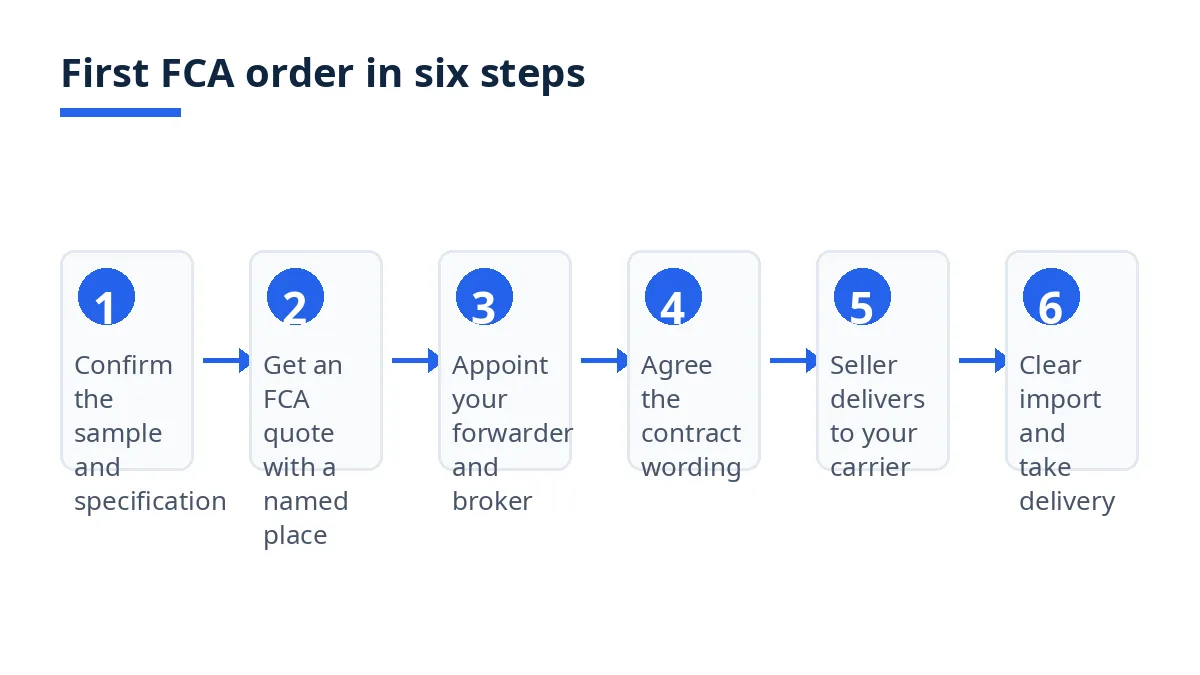
Confirm the sample and the specification in writing. Approve the product, pack size, labelling and quality standard before discussing delivery terms. A first order fails more often on a vague specification than on a delivery term.
Ask for an FCA quotation with a named place, in full. The quotation should state "FCA" plus the exact named place, the Incoterms 2020 edition, the goods price, and what the price includes and excludes. A factory address, a terminal and a forwarder's warehouse are different handover points with different loading duties.
Appoint your forwarder and broker before you sign. Give the forwarder the named place, the expected ready date and the cargo details, and ask what documents and booking lead time it needs. For a United Kingdom destination, check your Economic Operator Registration and Identification number early: Great Britain movements need a number starting with GB, Northern Ireland movements one starting with XI, and EU declarations an EORI from an EU country.3
Agree the contract wording, not just the term. Write "FCA [exact named place], Incoterms 2020" into the purchase order or contract, with the carrier nomination procedure, the delivery notice and the proof of delivery you require. If you pay by letter of credit and need an on-board bill of lading, agree that instruction now: under Incoterms 2020, the parties can agree that the buyer will instruct the carrier to issue one to the seller once the goods have been loaded on board.2
Seller delivers, clears export and hands over. The seller clears the goods for export and delivers them to your carrier at the named place. In Bangladesh, goods may not be loaded for export unless an export declaration, the Bill of Export or Shipping Bill, is submitted to Customs and approved, with enclosures including the export contract or purchase order, the commercial invoice, the packing list, the EXP form certified by an authorized dealer, and a certificate of origin issued by the Export Promotion Bureau or a Chamber of Commerce and Industry.4
You take over at the handover. From that point your forwarder runs the main carriage, you arrange cover for the cargo, and your broker handles import clearance at destination. Keep the delivery proof, invoice, packing list and transport document in one file, and track the shipment against the booked sailing or flight.
Clear import, receive and check against the order. On arrival, clear import, take delivery, and check quantity, condition and documents against the purchase order before confirming acceptance. Any claim starts from the handover record, so log the receiving check.
Costs, timelines and documents
What are the typical costs and timelines?
There are no typical FCA costs or timelines a guide can state as fact for a first order from Bangladesh: each supplier prices your goods, each route carries its own freight, and each destination has its own clearance charges. Ask for every cost as a separate line, and for sampling, ready, shipment and arrival dates as separate lines.
Example figures: the table below is illustrative only, not a quotation. It shows how to lay out the lines before comparing suppliers.
Cost line | Who usually pays under FCA | Example figures |
|---|---|---|
Goods price, FCA named place | Buyer, to the seller | Example figures: 8,000 USD for the order value |
Main freight from the named place | Buyer, through its forwarder | Example figures: 1,200 USD |
Cargo cover from the handover | Buyer, under its own arrangement | Example figures: priced per shipment, confirm with broker |
Export clearance in Bangladesh | Seller | Included in the FCA goods price |
Import duty and import VAT at destination | Buyer | Example figures: none stated here, confirm with broker |
Destination handling and delivery | Buyer | Example figures: priced per shipment, confirm with broker |
For the detailed breakdown of an FCA price, read the FCA price guide, and for how freight is calculated, read the FCA freight cost guide. Treat any single all-in figure with caution until its lines are shown separately.
Which documents are needed?
For a first order, hold three sets in one file: the commercial set (purchase order, invoice, packing list), the transport set (the carrier's receipt and the seller's delivery proof), and the clearance set (the seller's export documents and your destination's import documents). The Bangladesh export set starts with the approved Bill of Export and its enclosures.4 For the full checklist, read the FCA documents checklist, and for who clears export versus import, read the FCA customs clearance guide. Do not sign until you know which document each side must produce and by when.
Bangladesh-specific rules and tips
Name the place with an address, not a city. "FCA Dhaka" and "FCA seller's factory, Gazipur, Incoterms 2020" are not the same commitment. The first leaves the handover point, the loading duty and the collection point open to argument. The second tells the forwarder exactly where to collect. Put the full address, the collection contact and the collection hours in the purchase order.
Confirm export readiness with the seller, not just the price. Ask whether the seller holds the export registration and documentation needed for your goods, and whether any product-specific certificate applies, since Bangladesh Customs requires additional product-wise certification for some categories.4 A supplier that cannot name its export documents is a supplier whose ready date is a guess.
Settle the carrier nomination in writing. FCA only works if the seller knows which carrier to expect. Give the seller the carrier name, the booking reference procedure and the notice period, and agree what happens if the carrier arrives late or the goods are not ready. A first order with no nominated carrier is a contract that cannot be performed.
Use the on-board bill of lading option deliberately, if you need it. If your payment method needs one, agree before signing that the buyer will instruct the carrier to issue one to the seller after loading, as Incoterms 2020 provides for.2 Agreeing it after shipment is too late, and it is a common source of payment delay on first orders.
Prepare your destination side before the goods sail. For a United Kingdom buyer, that means the correct EORI prefix and a broker or agent appointed to handle the declaration.3 A business that deals with customs only sporadically may find it easier to hire an agent for customs matters, with services and liability set by the agreement.3 The same principle holds for the United States, the European Union and the United Arab Emirates: appoint the destination help before the handover, not after arrival.
Mistakes and red flags
What are the most common mistakes?
Signing FCA before appointing a forwarder. This causes the most delay on first orders. Without a nominated carrier, the seller cannot deliver under FCA and the goods sit ready while you search for freight. Appoint the forwarder first, even for a small order.
Leaving the named place vague. A city name, a port name without a terminal, or a warehouse without an address each create a different handover, and vague wording leaves the loading duty unclear, since loading depends on whether the place is the seller's premises or somewhere else.1
Assuming the seller arranges freight or import clearance. Under FCA the seller delivers to your carrier and clears export; the main carriage, the cargo cover and import clearance are yours. If your budget assumed otherwise, the landed cost will surprise you.
Treating risk as starting at arrival. Risk passes at the named handover, not at your warehouse, so cargo cover must run from the handover point. For the full treatment, read the FCA risk transfer guide, and for who must insure, read the FCA insurance guide.
Red flags on a supplier reply. A reply that will not name the exact handover place, will not state the Incoterms edition, or quotes a single figure with no lines: each is a reason to pause and clarify in writing before paying anything.
Checklist
Before you confirm, every line should be answered in writing.
Product, pack size, labelling and quality standard approved in writing, with a sample reference.
FCA quotation showing the exact named place with a full address, the Incoterms 2020 edition, and the goods price with inclusions and exclusions.
Forwarder and destination broker appointed, with booking lead time and documents confirmed.
Carrier nomination procedure, delivery notice and proof of delivery agreed in the purchase order.
On-board bill of lading instruction agreed now, if your payment method needs one.
Export documents confirmed with the seller, including the Bill of Export set for Bangladesh.4
Cargo cover arranged from the named handover point, not from arrival.
Import requirements confirmed for your destination, including the correct EORI prefix for a United Kingdom movement.3
Cost lines separated: goods, freight, cover, destination handling, duty and import VAT, with duty and VAT confirmed with your broker.
Receiving check planned: quantity, condition and documents checked against the purchase order.
How Exportain helps
On Exportain, browse suppliers and post the product specification, quantity and preferred delivery term on the RFQ board, so suppliers quote against the same first-order specification. Read how to buy before you post, and ask each reply for its exact FCA named place, its Incoterms edition, and its export documents.
Read badges for what they record. Exportain's seller checks cover identity with a live selfie, business registration, the Export Registration Certificate and photos of the factory or office, reviewed by the Exportain team, and badges are earned through these checks and cannot be bought.5 That review is a document and photo review, not a factory inspection or a guarantee, so sample approval and receiving checks stay with the buyer.
FAQs
What should I know first about FCA?
Know the handover first: the seller delivers cleared goods to your nominated carrier at an exact named place, and risk passes there, with loading duties depending on whether the place is the seller's premises or elsewhere.1 Confirm the place, the carrier and the edition before comparing prices, and appoint your forwarder first.
What are the typical costs and timelines?
There are no typical figures to rely on: goods price, freight, cargo cover, destination handling, duty and import VAT all vary by order, route and destination. Ask for each cost and each date as a separate line, use the example-figures table above only as a layout, and confirm duty and import VAT with your broker.
Which documents are needed?
Hold the commercial set, the transport set and the clearance set in one file. The Bangladesh export set starts with the approved Bill of Export and its enclosures, including the contract or purchase order, invoice, packing list, EXP form and certificate of origin.4 The full checklist is in the FCA documents checklist.
What are the most common mistakes?
The most common first-order mistakes are signing before appointing a forwarder, leaving the named place vague, assuming the seller arranges freight or import clearance, and treating risk as starting at arrival rather than at the handover.1 Each is preventable in writing before shipment; the fuller list is in the FCA mistakes guide.
Next steps on Exportain
Browse suppliers, then post your first-order specification, quantity and preferred FCA named place on the RFQ board so suppliers quote on the same terms. Before you confirm, read how to buy, the Incoterms guide for shipments from Bangladesh and the FCA quotation guide.
Sources
- Incoterms 2020 Explained: Complete Guide (2026 Update). Inecta (accessed )
- Incoterms® 2020. International Chamber of Commerce (ICC) (accessed )
- Customs authorisations - Pre application - Guidance. GOV.UK (accessed )
- Customs Clearance Procedures for Export. Bangladesh Customs, National Board of Revenue (accessed )
- Sell Bangladeshi Products to Global Buyers | Exportain. Exportain (accessed )
About the author
Sourcing from Bangladesh?
Post a request for quotation and suppliers on Exportain can send you their quotes directly.
Post an RFQ