

Insurance Under FCA: Who Must Insure the Cargo and for How Much?
FCA imposes no insurance duty on either party, so the buyer must arrange cover from the delivery point. What to insure, for how much, and the gaps to close.
Short answer
Under FCA, neither the seller nor the buyer is required to buy cargo insurance. The seller's duty ends at delivery to the buyer's carrier at the named place, and risk passes to the buyer at that point. The buyer should therefore arrange cover that starts at the delivery point and runs to the final destination, with a sum insured and clause tier agreed with an insurer before the goods move.
On this page
Key takeaways
Under FCA, neither party is required to buy cargo insurance, so the buyer must arrange cover from the delivery point or carry the loss after handover.
Clause A covers all risks unless excluded, while Clauses B and C cover only listed perils, and theft is covered under A but not under B or C.
Cover must attach at the named place, not at the port, and a certificate dated after shipment does not backdate cover.
Use the CIP benchmark of Clause A at 110 percent of contract value only as a discussion point with an insurer, never as an FCA rule.
Check the termination point, name the claimant, and notify the insurer promptly after any loss, with photographs, packaging and a carrier report kept.
FCA insurance is not a duty the Incoterms 2020 FCA rule places on either party. Under FCA, short for Free Carrier, the seller delivers the goods to a carrier or another person nominated by the buyer at the seller's premises or another named place, and risk transfers from the seller to the buyer once the goods are handed over at that place.1 The seller clears the goods for export, while the buyer handles main carriage, import clearance and, if the buyer wants protection, cargo insurance.1 That split is the whole insurance question under FCA: nobody is obliged to insure, so the buyer must arrange cover from the delivery point, or accept the loss after handover.
The Incoterms 2020 rules allocate cost, risk and obligations across 11 rules, and they set different insurance levels only for the CIF and CIP rules.2 For CIF, which is reserved for maritime trade, Institute Cargo Clauses (C) remains the default level, while CIP now requires the higher Institute Cargo Clauses (A) level.2 FCA has no equivalent default. A buyer who assumes the seller's FCA price includes insurance is relying on cover that the contract never promised.
Why this matters for buyers and sellers
For the buyer, the gap opens at handover, not at the destination port. Once the seller hands the goods to the buyer's carrier at the named place, any later damage or loss is the buyer's responsibility.1 If the goods travel uninsured from that point, the buyer pays for the loss, even though the buyer may not yet hold the goods and may have no claim against the seller for a transit event after delivery.
For the seller, the same split limits exposure but creates a different risk: a dispute about a loss the seller did not cause. A buyer who believed insurance was included may press the seller for compensation after handover. Putting the insurance position in writing at quotation stage prevents that dispute, and the seller can offer, as a separate written agreement, to arrange cover at the buyer's request and cost.
The contrast with CIP shows what a seller-insurance rule looks like. Under CIP, the seller must normally obtain insurance complying with Institute Cargo Clauses (A), for at least 110 percent of the contract value, extending to the named destination, with a policy or certificate enabling the buyer or another named party with an insurable interest to claim.3 FCA gives the buyer none of those defaults, so every element CIP fixes by rule must be fixed by agreement under FCA.
What should I know first about FCA?
FCA stands for Free Carrier. The seller delivers the goods to the buyer's carrier at a named place and clears them for export, and risk passes to the buyer at handover.1 FCA does not require either party to get insurance, which may leave the goods unprotected if damage or loss occurs after handover, so the buyer should arrange cargo insurance from the handover point to the final destination.1 The named place matters as much as the term itself: cover must start where delivery happens, whether that is a factory, a warehouse, or a terminal.
Step-by-step: how it works
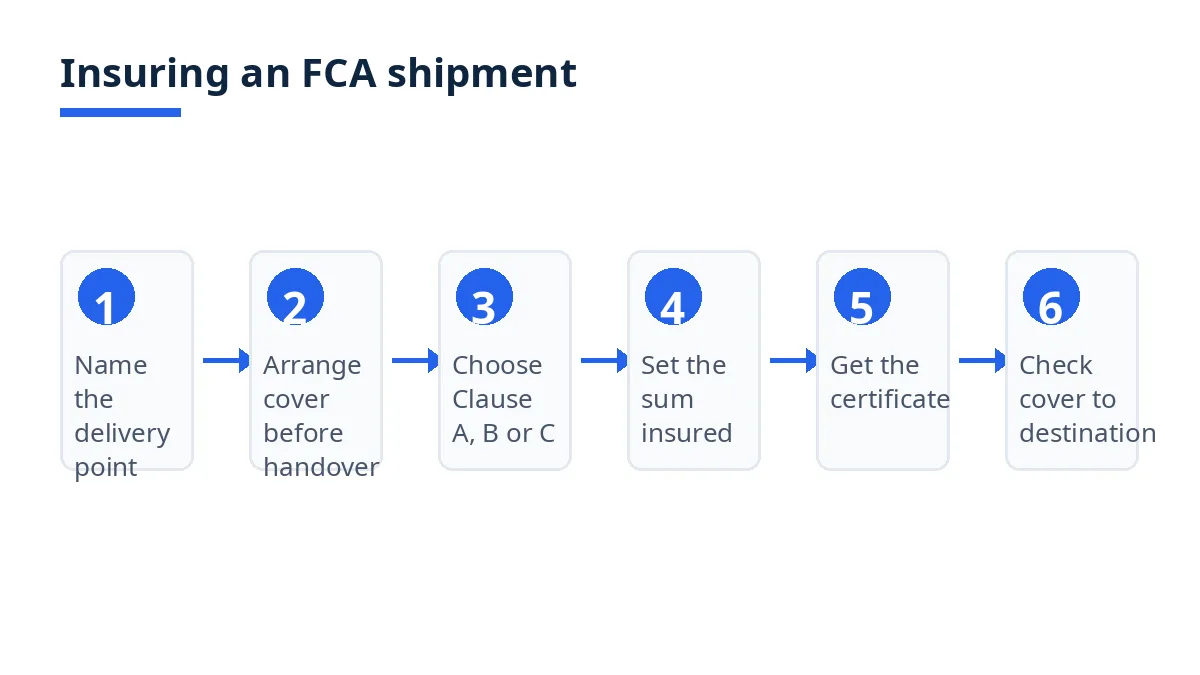
Name the exact delivery point in the contract. State the full address and the place type, for example a seller's premises or a named terminal, and write "FCA [named place], Incoterms 2020". The delivery point is where risk passes and where the buyer's cover must begin.
Arrange cover before handover, not after shipment. Ask the insurer to confirm the start point, the destination, and the period of cover in writing before the goods move. A policy or certificate dated after shipment does not backdate cover to an earlier point.
Choose a clause tier for the cargo and route. Compare Institute Cargo Clauses (A), (B) and (C) against the realistic perils on the route, rather than choosing the cheapest tier by default.
Set the sum insured and the claimant in writing. Agree the sum insured with the insurer, and make sure the policy or certificate names the buyer, or another party with an insurable interest, as able to claim.
Get the certificate before the goods move. Hold the insurance certificate or policy, the commercial invoice, and the carrier receipt for the handover before the carrier leaves the named place.
Check the cover runs to the final destination. Read the termination point in the policy wording. If cover ends at discharge, at another storage point, or after a set number of days, arrange additional cover for the remaining leg and any storage.
Costs, timelines and documents
What are the typical costs and timelines?
FCA sets no premium rate, no minimum sum insured, and no standard timeline, so there are no typical costs a guide can state as fact. An insurer quotes per shipment, and the quote turns on the clause tier, the sum insured, the cargo, and the route. The practical cost question is therefore comparative: ask for the premium and the exclusions under each clause tier for the same cargo, route and sum insured, and weigh the premium saved under a narrower tier against the value of a loss that tier would not pay.
Who pays is a contract question, not an FCA rule. The buyer pays for a policy the buyer arranges. If the seller arranges cover at the buyer's request, the agreement should state who pays the premium, the clause tier, the sum insured, and who may claim, because FCA supplies none of those terms by default. Record it on the quotation and the purchase order.
On timing, three dates control the position. First, cover should be agreed before handover, since the buyer's risk starts at that point. Second, the certificate should be in hand before the goods leave the named place, so a loss on the first leg is already inside the insured period. Third, after a loss, notify the insurer as soon as the loss or damage becomes known, even if the full extent is not yet clear, since delayed notification can give an insurer grounds to reduce or reject a claim.4
Which documents are needed?
For the insurance position itself, the buyer needs the policy or certificate showing the clause tier, the sum insured, the insured transit, and the party entitled to claim. For a claim, an insurer will typically request the commercial invoice, the bill of lading or airway bill, a survey report from an independent loss assessor, and the packing list and any delivery receipts noting damage.4 Photographs, retained packaging, and a written carrier or port report support the claim, and the insurer will require independent evidence that the damage occurred during the covered transit period.4
For the FCA handover, the buyer also needs proof of delivery to the carrier at the named place. Agree in advance which party provides the transport documents and the proof of delivery, since a failure to define that responsibility can cause delays or disputes.1 Keep the certificate, invoice, packing list and carrier receipt together, so a claim does not depend on reconstructing the handover later.
Bangladesh-specific rules and tips
Bangladesh shipments make the named place especially important, because delivery under FCA may happen inland, at a factory or warehouse, rather than at a port. If the named place is inland and the policy only starts at the port, the factory-to-port leg travels uninsured. Name the inland place in the policy wording, and confirm cover attaches when the goods leave the warehouse named in the policy for commencing transit.4
The seller's export clearance duty does not change the insurance position. The seller clears the goods for export under FCA,1 but export clearance is not insurance, and a seller's domestic arrangements do not automatically extend to the buyer's main carriage. Ask the seller in writing whether any insurance is included in the FCA price. If the answer is no, which is the FCA default, arrange the buyer's own policy before handover.
On the Bangladesh market, the Insurance Development and Regulatory Authority is the government body responsible for supervising and developing the insurance sector, including licensing insurers and protecting policyholders.5 Press coverage of Bangladesh marine insurance has focused on a minimum premium rate for imports into Bangladesh and on the regulator setting premium rates and conditions for general insurance.6 That discussion concerns imports into Bangladesh, so do not assume it prices a buyer's policy for exports from Bangladesh. If a Bangladeshi seller arranges cover at the buyer's request, confirm the insurer, the clause tier, the sum insured, and the claim route at the destination before the goods move.
Mistakes and red flags
What are the most common mistakes?
Assuming the seller insured the goods. FCA does not require either party to get insurance.1 Unless the contract says otherwise in writing, no insurance is included, and a seller's own policy does not automatically protect the buyer.
Buying port-to-port cover for an inland delivery. Cover that starts at the port leaves the first leg exposed. The Institute Cargo Clauses follow a warehouse-to-warehouse principle, but the timing rules are more specific than that phrase suggests, and a warehouse-to-warehouse clause does not backdate cover to a date before the insurance document was issued.7 Arrange cover prospectively, before the goods leave the named warehouse.
Choosing Clause C for theft-prone or handling-sensitive cargo. Clause A covers all risks of loss or damage unless a specific exclusion applies, while Clauses B and C only cover losses caused by specific perils listed in the wording.4 Clause B includes earthquake, washing overboard and water ingress that Clause C does not, and theft or pilferage is covered under Clause A but not under B or C.4 Standard exclusions across all three include deliberate damage by the insured, inherent vice, and losses caused by delay.4
Accepting a certificate dated after shipment. A warehouse-to-warehouse clause sets the prospective time for commencement of cover, and it does not provide retrospective coverage from the warehouse at the place of departure for a shipment that already moved.7 If the certificate arrives late, ask the insurer to confirm the insured period in writing rather than assuming the clause cures the gap.
Letting cover lapse in storage. Cover ends at the earliest of delivery to the final warehouse at the destination named in the policy, delivery to any other storage the carrier uses before that destination, or the expiry of 60 days after discharge from the vessel, on the wording described for the Institute Cargo Clauses.4 Goods held beyond the policy wording can fall outside cover, so arrange additional cover for long storage.
Naming no claimant. A policy that only names the seller leaves the buyer unable to claim directly. Under the CIP benchmark, the policy or certificate must enable the buyer or another named party with an insurable interest to claim.3 Under FCA, write the same protection into the agreement, since no rule supplies it.
Notifying late or discarding evidence. Notify the insurer as soon as loss or damage becomes known, document the damage before goods are moved or repaired, take photographs, retain all packaging, and obtain a written carrier or port report.4 A late or undocumented claim is a common reason for a reduced or rejected settlement.
Checklist
Before the goods move, every line should be answered in writing.
Named place stated in full, with "FCA [named place], Incoterms 2020" in the contract.
Insurance position stated on the quotation: included or not included, and who pays if the seller arranges it.
Cover agreed before handover, starting at the named place, not at the port.
Clause tier chosen for the cargo and route: A, B or C, with exclusions read.
Sum insured agreed with the insurer, using the CIP 110 percent benchmark only as a discussion point, never as an FCA rule.
Policy or certificate in hand before movement, naming the buyer or another party with an insurable interest as claimant.
Termination point checked: final warehouse, other storage, and any days-after-discharge limit.
Handover documents ready: commercial invoice, packing list, carrier receipt, and insurance certificate.
Claim routine agreed: immediate notification, photographs, retained packaging, carrier report, and survey.
Seller confirmation on file that export clearance is handled, separate from insurance.
How Exportain helps
On Exportain, post a request for quotation stating the quantity and unit, target price, destination, Incoterm, required certifications and deadline, so suppliers in that category can quote against the same terms.8 State FCA with the named place in the request, and ask each reply to state whether insurance is included. If a reply includes insurance, ask for the clause tier, the sum insured, and the certificate wording before accepting.
Compare quotations on the same basis: every quotation is versioned with unit price, MOQ, lead time, Incoterm, payment terms and validity, and accepting creates an order record with those terms.8 Put the agreed insurance position into that record, including who arranges cover, who pays the premium, and who may claim. Badges on a profile record which checks the Exportain team has reviewed, and a badge is not a capacity or quality guarantee, so read what each badge covers before relying on it.8
FAQs
What should I know first about FCA?
FCA means the seller delivers the goods to the buyer's carrier at a named place and clears them for export, and risk passes to the buyer at handover.1 Neither party is required to insure the goods, so the buyer should arrange cargo insurance from the handover point to the final destination before the goods move.1
What are the typical costs and timelines?
There are no typical FCA premium rates or timelines, because FCA sets none. Cost depends on the clause tier, the sum insured, the cargo and the route, and timing turns on agreeing cover before handover, holding the certificate before movement, and notifying the insurer promptly after any loss.4
Which documents are needed?
The insurance certificate or policy, the commercial invoice, the packing list, the bill of lading or airway bill, and the carrier receipt for the handover. For a claim, add a survey report, photographs, retained packaging, delivery receipts noting damage, and a carrier or port report.4
What are the most common mistakes?
Assuming the seller insured the goods, buying cover that starts at the port for an inland delivery, choosing a narrow clause tier for theft-prone cargo, accepting a certificate dated after shipment, letting cover lapse in storage, naming no claimant, and notifying the insurer late.1 4 7
Next steps on Exportain
Read the Incoterms for shipments from Bangladesh overview to compare FCA with the other ten rules, then read the CIF guide to see how a seller-insurance rule quantifies cover. When you are ready to buy, follow the steps in how to buy, post your FCA terms and named place on the RFQ board, and ask every supplier reply to state its insurance position in writing.
Sources
- FCA Incoterms 2026: Free Carrier Meaning and Rules. Drip Capital (accessed )
- Incoterms® 2020. International Chamber of Commerce (ICC) (accessed )
- CPT vs CIP: A Comprehensive Guide to Carriage-Based Incoterms 2020. Visiwise (accessed )
- Institute Cargo Clauses Explained: A, B and C Cover Compared. National Cover (accessed )
- Insurance Laws Bangladesh. LawGratis (accessed )
- Marine insurance in Bangladesh: 0.30% minimum premium hurts importers, competitiveness. The Business Standard (accessed )
- Insurance documents: warehouse-to-warehouse. TradeFinance.training (accessed )
- How to source and buy from Bangladesh. Exportain (accessed )
About the author
Sourcing from Bangladesh?
Post a request for quotation and suppliers on Exportain can send you their quotes directly.
Post an RFQ


