

FCA Freight Cost: Who Pays and How It Is Calculated
Under FCA the buyer pays main-carriage freight from the delivery point. How FCL and LCL freight is calculated, which surcharges apply, and who pays origin and destination charges on shipments from Bangladesh.
Short answer
Under FCA, the seller pays the costs of getting the goods to the delivery point and cleared for export, and the buyer pays the main-carriage freight from that point onward, plus destination charges. Ocean freight is priced per container for a full container load, and for a smaller load on the higher of volume and weight, with fuel, currency, peak-season and terminal surcharges added. There are no typical rates to quote: every quotation is route, cargo and validity specific, so compare itemized quotations on the same named place.
On this page
Key takeaways
Under FCA the seller pays costs up to the delivery point and export clearance, and the buyer pays main-carriage freight from that point onward, plus destination charges.
At the seller's premises the seller loads; at any other named place the buyer loads, so the named place must be written in full in the contract.
Full container load freight is priced per container, while less than container load freight is charged on the higher of volume in cubic metres and gross weight in metric tons.
Fuel, currency, peak-season, congestion and security surcharges, plus origin and destination terminal handling, are buyer costs under FCA and must appear as separate lines in the quotation.
There are no typical freight rates to rely on: compare itemized quotations on the same named place, check the validity date, and price the full route to the final destination.
Under FCA, the fca freight cost is split at one named point: the seller pays the costs of getting the goods to the delivery point and cleared for export, and the buyer pays the main-carriage freight from that point onward, plus the destination charges. The buyer also carries the risk from delivery, so the freight contract, the insurance decision and the destination bill all sit with the buyer. This split is what makes an FCA quotation look low next to a delivered-price quotation: the ocean or air freight to your port is not in the seller's price at all, and it must be budgeted separately.
The Incoterms 2020 rules give a clear allocation of cost, risk and obligations for each of the 11 rules, and the costs for a given rule are gathered in its costs article so a user can see the full list at a glance.1 FCA can be used for any mode of transport, including sea, air, rail and road, because a carrier can be any person or company that undertakes the transportation of goods.2 That flexibility suits container shipments from Bangladesh, but the named place in the contract does most of the work: change the named place and the freight bill changes with it.
Why this matters for buyers and sellers
For the buyer, the FCA freight bill is the largest cost absent from the supplier's quotation, and the cost most likely to be underestimated when two quotations are compared. A supplier quoting FCA at the factory gate and one quoting FCA at a Chittagong terminal quote two different delivery points, so the buyer's freight cost differs even when the goods price is identical. For the seller, the mirror benefit is freedom from freight-rate movement after the goods leave the delivery point.
The split also decides who must act when something goes wrong in transit. Once the goods reach the named place, the buyer assumes all costs and risks of loss or damage, and must arrange insurance, carrier charges to the final destination, and destination terminal charges.2 A buyer without cover or a carrier arranged before the delivery date can face storage or delay charges at the terminal.
What should I know first about FCA?
Know the named place before you compare any freight figure. Under FCA the seller is responsible for export clearance and delivery to a specific place, and once the goods reach that place the buyer assumes all costs and risks.2 At the seller's premises the seller loads the goods on the buyer's collecting transport; at any other named place the buyer loads. Confirm that loading point in writing, because it decides which side of the bill carries the loading charge.
Step-by-step: how it works
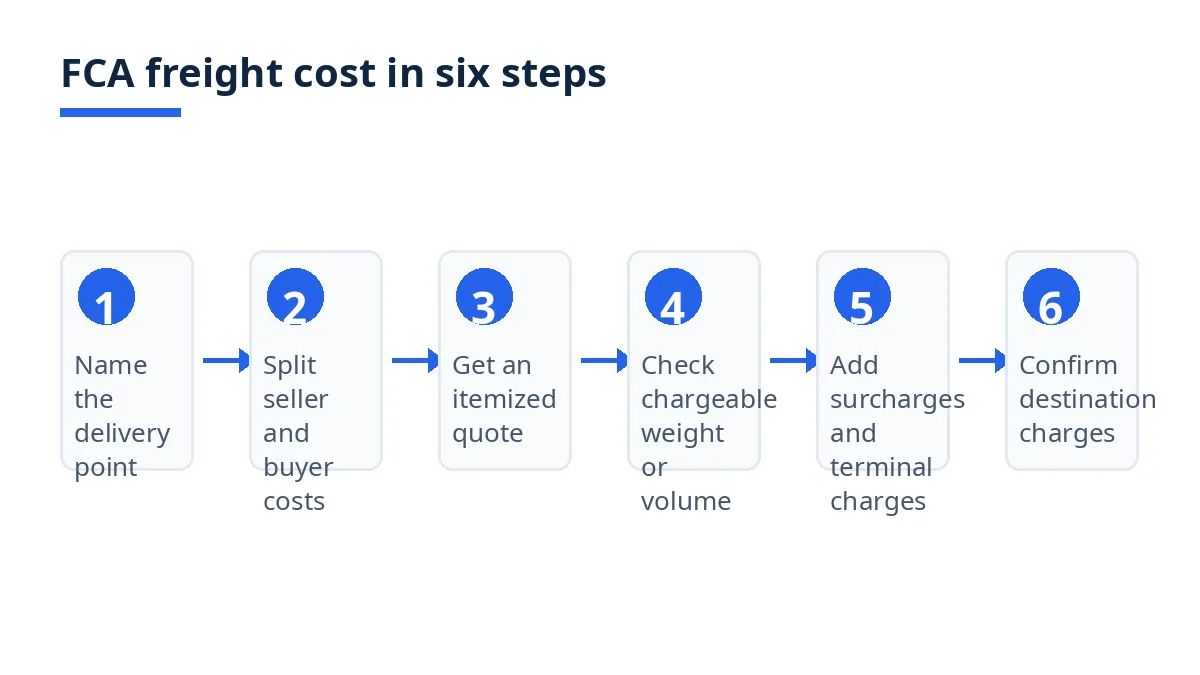
Agree the named place in the contract. State FCA followed by the exact place: the seller's factory, a named container freight station or a named terminal. A city name alone cannot be priced.
Confirm who loads. At the seller's premises the seller loads; at another named place the buyer arranges loading. Record the answer in the purchase order.
Let the seller complete the export side. The seller handles export packaging and labelling, export clearance and delivery to the named place, with export duties and taxes on the seller's side.2 These are seller costs up to handover, not part of the buyer's freight.
Book the main carriage as the buyer. Contract with a carrier or forwarder for transport from the delivery point to the destination, and arrange insurance from the delivery point, a buyer obligation under FCA.2
Ask for an itemized freight quotation. Require base freight, each surcharge, origin and destination terminal handling, documentation fees and any inland transport as separate lines, so quotes compare line by line.
Pay the destination charges. On arrival, the buyer pays destination terminal charges, import clearance and duties, and unloading and onward transport.2
Costs, timelines and documents
Who pays what
Cost item | Paid by |
|---|---|
Export packaging, marking, pre-carriage | Seller |
Export clearance, export duties and taxes | Seller |
Loading at the seller's premises | Seller |
Loading at any other named place | Buyer |
Main-carriage freight from the delivery point | Buyer |
Fuel, currency, peak-season, congestion, security surcharges | Buyer |
Origin and destination terminal handling | Buyer |
Documentation fees on buyer's transport documents | Buyer |
Cargo insurance from the delivery point | Buyer |
Import clearance, duties, taxes | Buyer |
Unloading and inland transport | Buyer |
Insurance and customs clearance under FCA each have a companion guide and are not repeated here.
How freight is calculated
Ocean freight charges are calculated based on the volume or weight of the cargo and are usually the largest component of ocean freight costs, varying with the route, distance and demand.3 The calculation differs by load type.
Full container load (FCL). The freight is normally priced per container for the route, with the container size and type as the pricing unit. Weight and volume still matter, because they decide whether the goods fit the container and whether any overweight or special-handling charge applies.
Less than container load (LCL). LCL is usually charged by W/M, meaning the higher number between cargo volume in cubic metres and gross weight in metric tons, and volume is found with the formula length multiplied by width multiplied by height multiplied by quantity.4 The total is then the sum of ocean freight, origin and destination charges, surcharges, clearance, inland transport, insurance, duties and taxes, and possible extra charges such as storage.4
Example figures: cartons measuring 0.5 metres by 0.4 metres by 0.4 metres, 25 cartons, give a volume of 2 cubic metres. If the gross weight is 800 kilograms, or 0.8 metric tons, the chargeable figure is 2, because the volume figure is higher than the weight figure. The example shows the method only, not a rate; a forwarder's quotation will apply its own rate per cubic metre or per ton to that chargeable figure, plus any minimum charge for small LCL shipments.
Surcharges. The bunker adjustment factor accounts for fluctuations in fuel prices, is usually expressed as a percentage of the base freight rate and is adjusted periodically.3 The currency adjustment factor accounts for fluctuations in exchange rates, while a peak season surcharge may apply during times of high demand, and other surcharges may include congestion, security or port charges.3 Terminal handling charges cover loading and unloading at the port terminals, are typically imposed by the terminal operator, and may vary with cargo type, handling equipment and terminal facilities.3 Because surcharges move with fuel, currency and season, a freight quotation has a validity period, and an expired quote should be repriced rather than assumed.
Origin charges versus destination charges. Origin charges are the handling, documentation and terminal costs incurred before and at departure, after the seller's handover; destination charges are the terminal handling, documentation and delivery costs incurred on arrival. Under FCA both sets fall to the buyer, which is why a quotation showing only the ocean leg understates the buyer's bill. Ask every forwarder to confirm whether origin and destination terminal handling are included in the quoted figure or billed separately.
FCA versus CPT and CIP on cost. Under CPT and CIP the seller pays the carriage to the named destination, while under FCA the buyer pays the main carriage from the delivery point. That is the whole cost difference: the goods price under CPT or CIP contains a freight element that the FCA price does not. Risk still transfers to the buyer when the goods are handed to the carrier under CPT and CIP, so a higher seller-paid freight figure does not move the risk point. Compare FCA and CPT quotations only after stripping the freight element out of the CPT price.
What are the typical costs and timelines?
There are no typical freight costs or transit times a guide can state as fact, because the base rate, surcharges and terminal charges are set per route, cargo, container type and sailing, and they change with fuel, currency and season.3 A quotation is valid only for its stated route, cargo details and validity period. For timelines, ask for the sailing or flight schedule, terminal cut-off and expected arrival as separate items, not a single delivery week. Air freight under FCA follows the same cost split; the companion guide on FCA for air freight covers the airport handover.
Which documents are needed?
The documents that affect the freight cost are the ones the carrier prices from: the commercial invoice and packing list, stating goods, quantities, weights and dimensions; the booking confirmation, stating the route, container or chargeable volume, and the validity of the rate; and the transport document, such as the bill of lading for sea freight, evidencing the contract of carriage. Weights and dimensions on the packing list must match the cargo exactly, because the carrier charges on the declared volume or weight and can re-measure and rebill. The full export document set sits in the companion guide on documents required for FCA shipments.
Bangladesh-specific rules and tips
Name the delivery point with terminal-level precision. For a shipment from Bangladesh, "FCA Chittagong" can mean the seller's factory in Chattogram, a container freight station or a port terminal, and each choice changes who loads, who pays pre-carriage and where the buyer's freight begins. Write the full address into the contract and purchase order, and make sure the forwarder's quotation uses the same place.
Confirm export clearance in the same document. Under FCA the seller manages customs clearance for export,2 so confirm it is complete before the carrier's cut-off: a late clearance can miss a sailing and create storage charges. Ask who pays storage for a missed sailing, and record the answer before booking.
Get every forwarder's quotation in the same currency and on the same basis. Surcharges expressed as percentages of base freight, such as the bunker adjustment factor,3 change when the base rate changes, so two quotations with the same base rate can still differ once surcharges are applied. Ask for surcharge percentages and terminal handling figures in writing, with the validity date.
Mistakes and red flags
Comparing quotations on different named places. Two FCA prices are not comparable unless the named place, loading arrangement and delivery term match. Align the named place first, then compare the freight lines.
Assuming the FCA price includes freight. Treating an FCA goods price as a delivered price is the most expensive mistake here. Under FCA the buyer pays the main carriage,2 so a budget built on the goods price alone will be short by the full freight and destination bill.
Accepting a single lump-sum freight figure. A lump sum hides which surcharges and terminal charges are included. Terminal handling, documentation fees and surcharges such as the bunker adjustment factor and currency adjustment factor are separate components,3 and a lump sum that omits destination terminal handling will be rebilled at arrival.
Using declared weights and dimensions the carrier will not accept. LCL freight is charged on the higher of volume and weight,4 so understated dimensions or weights lead to re-measurement and a revised invoice. Measure packed cartons, not product dimensions, and state gross weight including packing.
Letting the quotation expire unnoticed. Fuel and currency surcharges are adjusted periodically,3 so a quotation relied on after its validity date can change. Reconfirm rate and surcharges before the goods reach the carrier.
Leaving loading unassigned. At the seller's premises the seller loads, and at other named places the buyer loads, and the difference decides who pays for loading equipment and labour. An unassigned loading point becomes a dispute at the terminal.
What are the most common mistakes?
The most common mistakes are comparing FCA quotations on different named places, assuming the FCA goods price includes main-carriage freight, accepting a lump-sum figure that hides destination terminal handling, and letting a quotation expire while fuel and currency surcharges move.3 Name the place precisely, require an itemized quotation with a validity date, and price the full route.
Checklist
Named place written in full in the contract and purchase order
Loading confirmed: seller at the seller's premises, buyer elsewhere
Export clearance complete before carrier cut-off
Itemized quotation received: base freight, surcharges, terminal handling, documentation fees
Chargeable figure checked: FCL per container, LCL on the higher of volume and weight
Surcharge percentages and validity date recorded in writing
Destination charges budgeted
Insurance arranged before handover
Packed weights and dimensions match the cargo
Full route priced, not the ocean leg alone
How Exportain helps
On Exportain, a buyer can post a request for quotation stating the goods, quantity and FCA named place, and compare supplier quotations on that same named place and term, so goods prices are comparable before freight is added. Freight itself is contracted separately with a carrier or forwarder chosen by the buyer, and the checklist in this guide can be sent with the enquiry so each forwarder prices the same route, cargo and delivery point. For background on the wider term set, read the Incoterms guide for shipments from Bangladesh, and for the contrasting seller-paid-freight term, read the CIF cost, insurance and freight guide.
FAQs
What should I know first about FCA?
Know the named place first. Under FCA the seller handles export clearance and delivery to a specific place, and once the goods reach that place the buyer assumes all costs and risks.2 At the seller's premises the seller loads; elsewhere the buyer loads.
What are the typical costs and timelines?
There are no typical freight costs or transit times that hold across routes, because ocean freight charges vary with route, distance, demand, cargo volume or weight, and surcharges adjusted periodically.3 Use an itemized quotation for your route and cargo, with its validity date, and ask for the sailing schedule and terminal cut-off separately.
Which documents are needed?
The freight-cost documents are the commercial invoice and packing list with exact weights and dimensions, the booking confirmation stating the route and rate validity, and the transport document for the carriage. The full export document set sits in the companion documents guide.
What are the most common mistakes?
Comparing quotations on different named places, assuming the FCA price includes freight, accepting a lump-sum figure that hides destination charges, and relying on an expired quotation while surcharges move. Name the place precisely, require an itemized quotation, and price the full route.
Next steps on Exportain
Start with the Incoterms guide for shipments from Bangladesh to place FCA among the other terms, then read the CIF cost, insurance and freight guide to see how a seller-paid-freight price is built. When ready to buy, follow how to buy on Exportain and post a request for quotation stating your FCA named place.
Sources
- Incoterms® 2020. International Chamber of Commerce (ICC) (accessed )
- FCA Incoterm Guide: Free Carrier Rules and Shipping Impact. FreightAmigo (accessed )
- A Primer for The Costs Associated with Ocean Freight. St. Onge Company (accessed )
- How to Calculate Sea Freight Costs: Step-by-Step Guide with Examples (2026). ShippingWilson (accessed )
About the author
Sourcing from Bangladesh?
Post a request for quotation and suppliers on Exportain can send you their quotes directly.
Post an RFQ


