

Who Handles Customs Clearance Under FCA? Export vs Import Explained
Under FCA, export clearance belongs to the seller and import clearance belongs to the buyer. This guide separates the two clearances, names the broker on each side, and lists the papers each clearance needs.
Short answer
Under FCA, the seller is responsible for export clearance in the country of origin, and the buyer is responsible for import clearance, duties and taxes in the country of destination. The two clearances are separate filings, usually handled by different brokers, and neither one covers the other. A seller who has cleared goods for export has not cleared them for import.
On this page
Key takeaways
Under FCA, export clearance is the seller's job at origin and import clearance, duties and taxes are the buyer's job at destination.
The two clearances are separate filings in different countries, usually handled by different brokers, and neither covers the other.
At the seller's premises the seller loads the buyer's vehicle; at another named place the seller delivers the goods ready to be unloaded.
In Bangladesh, the seller's C&F agent files the Bill of Export through ASYCUDA World, with the EXP form, invoice, packing list and certificate of origin.
Name the exact FCA place in writing, confirm export clearance is included, and give your import broker written authority before arrival.
FCA customs clearance is not one clearance. It is two separate clearances, in two countries, handled by two different parties, and neither one covers the other. Under FCA, the seller is responsible for export clearance in the country of origin, and the buyer is responsible for import clearance, duties and taxes in the country of destination. The handover between those two jobs happens at the named place in the contract, when the goods are delivered to the carrier the buyer nominates.
This guide stays inside one question only: who clears customs at each end, who signs the filing, who pays, and what each side needs from the other before the goods can move.
FCA stands for Free Carrier, one of the 11 Incoterms 2020 rules published by the International Chamber of Commerce (ICC).1 Under FCA, the seller delivers the goods, cleared for export, to the carrier or another person nominated by the buyer at the named place.2 If the named place is the seller's premises, the seller loads the goods onto the buyer's collecting vehicle. If the named place is somewhere else, such as a container terminal or an airport cargo terminal, the seller delivers the goods ready to be unloaded, and unloading is then the buyer's or the carrier's job.2 In either case, the seller is responsible for completing the export formalities, and the buyer is responsible for arranging transport and for the import formalities.2
Why this matters for buyers and sellers
For the buyer, the practical consequence is that an FCA price never includes import clearance. The buyer must have an import broker, an import entry, and a way to pay destination duties and taxes ready before the goods arrive, or the shipment will wait at destination while storage and demurrage-type charges build. The seller clearing the goods for export does not create any right to enter them at destination.
For the seller, the consequence runs the other way. Export clearance is the seller's filing, made in the seller's name or through the seller's agent, and it must match the commercial invoice, packing list and transport document. A seller who leaves export clearance to the buyer has not agreed FCA at all. That is the EXW pattern, where the buyer carries export clearance as well, and it is a different bargain with a different price. The contrast is set out in the customs clearance under EXW guide.
Step-by-step: how it works
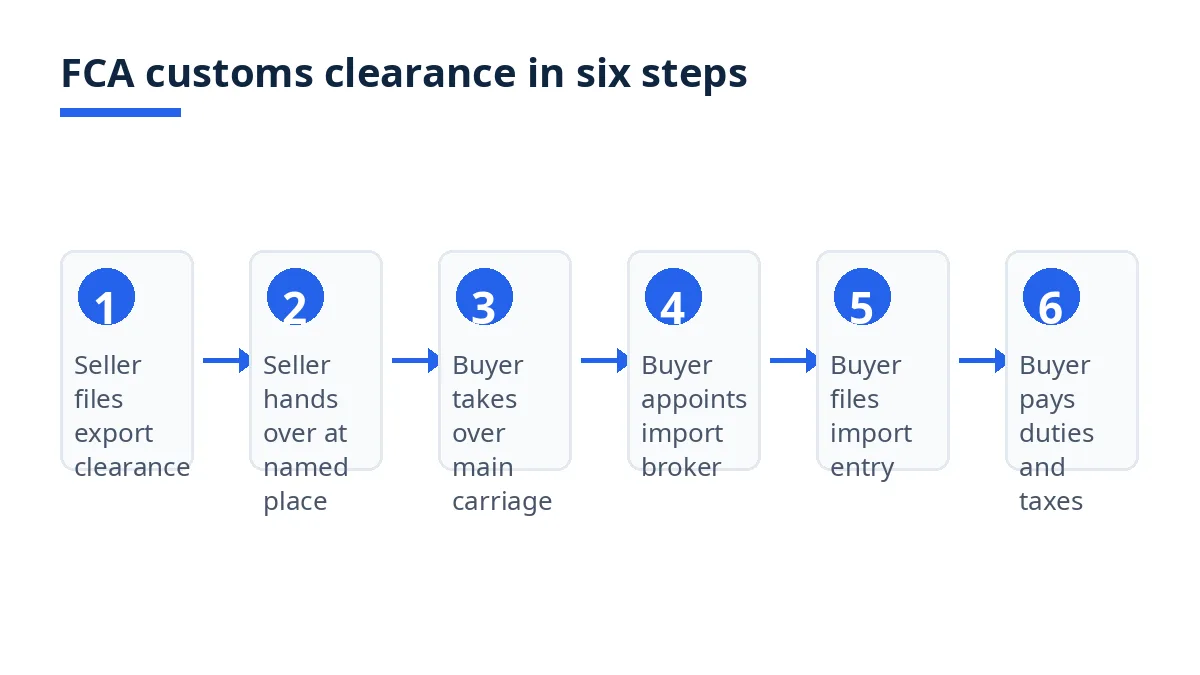
The seller prepares the export filing. The seller, usually through a licensed clearing and forwarding (C&F) agent at origin, prepares the export declaration with the commercial invoice, packing list, export contract or letter of credit, and any product permits. The seller's agent files the declaration with customs at origin and obtains approval to load or ship.
The seller hands the goods over at the named place. Delivery happens when the goods, cleared for export, are handed to the buyer's carrier at the named place. At the seller's premises, that means loaded onto the buyer's collecting vehicle. At another named place, it means delivered ready to be unloaded from the seller's vehicle.2
The buyer takes over the main carriage. From the handover point, the buyer contracts and pays for the main carriage, and arranges any cargo insurance it wants. FCA imposes no obligation on either party to insure the goods, so insurance must be agreed separately and confirmed in writing.
The buyer appoints an import broker at destination. Before arrival, the buyer gives a licensed customs broker at destination written authority to act for it, with the importer's legal name, address and identification details, and shares the commercial invoice, packing list and transport document so the entry can be prepared in advance.
The import entry is filed and duties are paid. The broker files the import entry with the destination customs authority, using the HS classification, value, quantity and origin shown on the documents. The buyer pays the import duties, taxes and any other destination charges that the entry produces.
The goods are released and delivered onward. Once customs releases the goods, the buyer arranges onward transport to its warehouse or final destination. Release at destination is not the same event as export approval at origin, and one does not imply the other.
Costs, timelines and documents
What are the typical costs and timelines?
There are no typical costs or timelines that apply to every FCA shipment, because each clearance is priced and processed under its own country's rules. The cost split, however, is fixed by the rule itself. The seller bears the costs up to delivery at the named place, including export clearance and, where the named place is the seller's premises, loading.2 The buyer bears the costs from delivery onward, including main carriage, import clearance, import duties and taxes, and onward delivery.2 The FCA costs stated in the ICC comparison cover the value of the goods, their packaging, loading onto the collecting vehicle where delivery is at the seller's premises, and the cost of export formalities, while transport costs beyond the FCA delivery point are the buyer's.2
For timelines, work backward from the two filings. The export filing must be approved before loading, and the import entry should be prepared before arrival. A shipment cleared for export on time can still wait at destination if the import broker receives the packing list only after arrival.
Which documents are needed?
The documents below are the clearance documents, not the full shipment set. The full FCA document set is listed in the documents required for FCA shipments guide, in one sentence only: this guide names each document at the clearance where it is used.
Clearance | Who files | Core documents |
|---|---|---|
Export clearance at origin | Seller, usually through a C&F agent | Export declaration (Bill of Export), commercial invoice, packing list, export contract or letter of credit, EXP form, certificate of origin, VAT and tax registration papers, product permits where required |
Import clearance at destination | Buyer, usually through a licensed import broker | Import entry, commercial invoice, packing list, transport document (bill of lading, air waybill or road consignment note), certificate of origin where a preference or origin claim is made, destination licences or permits, written broker authority |
On the import side, the broker's authority matters as much as the cargo papers. Most importers grant a licensed broker authority through a customs power of attorney or equivalent written authorisation, which lets the broker sign entry paperwork, pay duties and handle customs transactions on the importer's behalf.3 The document normally carries the importer's business legal name and address and the signature of an authorised officer.3 Without that authority on file, the broker cannot file, however complete the invoice and packing list are.
Bangladesh-specific rules and tips
Bangladesh is the origin side for a shipment bought from a Bangladeshi seller, so the export clearance described here is the clearance the seller must complete. Bangladesh Customs states that goods shall not be allowed to load or be stuffed in containers for export unless an export declaration, known as the Bill of Export or Shipping Bill, is submitted to Customs in the prescribed format and approved by the customs authority.4 The declaration specifies the description of goods, value, name of the exporter, name of the foreign buyer or importer, and name of the transport operator.4
The C&F agent submits the Bill of Export online to the ASYCUDA World system and submits the printed Bill of Export with the supporting documents to Customs.4 The enclosed documents listed by Bangladesh Customs are the export letter of credit, or where there is no export letter of credit, the export contract, purchase order or export guarantee approved by the negotiating bank; the commercial invoice; the packing list; the EXP form certified by an Authorized Dealer; the certificate of origin issued by the Export Promotion Bureau (EPB) or a Chamber of Commerce and Industry; the VAT registration certificate; and the Taxpayer Identification Number.4 Product-specific documents apply for some categories. Bangladesh Customs lists a document processing fee of BDT 30 per Bill of Export.4
Two Bangladesh steps deserve a buyer's attention even though they are the seller's jobs. First, the EXP form is the exporter's declaration to the banking channel: Bangladesh Bank introduced an electronic option for EXP form submission, under which exporters submit the form through the bank's online reporting portal before customs formalities, and the information is then available in the customs electronic system.5 Second, certificates, licences and permits for import and export now move through the Bangladesh Single Window (BSW). The National Board of Revenue made online submission of export-import certificates, licences and permits compulsory from 1 July 2025, through the BSW platform, with 19 state agencies integrated and registration using the business identification number.6 A permit that still arrives only on paper may not be accepted for customs processing.
A practical tip for buyers: ask the seller, before you confirm the order, to name the C&F agent who will file the Bill of Export and to confirm, in writing, that export clearance is included in the FCA price at the named place you have agreed. That one written line prevents the most common FCA clearance dispute, which is a seller treating export clearance as an extra and a buyer treating it as included.
Mistakes and red flags
What are the most common mistakes?
Treating FCA as door-to-door clearance. FCA covers export clearance only. Import clearance, duties and taxes at destination are the buyer's, and no FCA price includes them unless the contract says so in separate words.
Letting the seller's C&F agent act as the import broker. The two roles sit in different countries, under different licences, for different principals. A C&F agent at origin cannot file an import entry at destination, and an import broker at destination cannot approve a Bill of Export at origin.
Naming a vague place. "FCA Bangladesh" names no handover point and no clearance boundary. Name the place and point precisely, for example FCA seller's warehouse at a named address, or FCA a named container terminal, and state which side loads and unloads at that point.
Sending the import documents late. If the import broker receives the invoice, packing list and transport document only after arrival, the entry cannot be prepared in advance and the goods wait. Send soft copies when the goods are handed over, not when they arrive.
Letting the HS code differ between the two filings. The export declaration and the import entry describe the same goods. A classification that changes between origin and destination invites questions at both ends, so agree the product description, quantity and value wording with the seller before the export filing is made.
Assuming the seller will pay destination duties. Under FCA the buyer pays import duties and taxes.2 If a quotation appears to include them, it is describing a different term or a separate service, and it should be written as such.
Accepting a broker appointment by word of mouth. Put the broker's authority, scope and fee basis in writing on both sides. A verbal appointment is difficult to prove when customs asks who authorised the filing.
Checklist
Before the goods move, every line below should be answered in writing.
Named place and point agreed in the contract, with loading and unloading responsibilities stated for that point.
Seller confirms export clearance is included in the FCA price at that named place.
Seller names the C&F agent who will file the Bill of Export, and the export document set is listed.
Buyer names the licensed import broker at destination and gives written authority to act.
Commercial invoice, packing list and transport document are shared with the import broker before arrival.
Product description, quantity, value and HS classification wording are agreed between seller and buyer.
Destination licences, permits and any BSW-route permits for a Bangladesh-origin shipment are confirmed.
Import duties and taxes are budgeted by the buyer, with a payment route agreed with the broker.
Cargo insurance for the main carriage is agreed separately, since FCA does not impose it on either party.
How Exportain helps
On Exportain, browse suppliers and post a request for quotation on the RFQ board stating the FCA named place, so sellers quote export clearance at the same point you intend to use. Ask each reply to confirm, in writing, that export clearance at that named place is included, and to name the agent who will file it. Arrange your own import broker at destination separately, and do not treat a seller's export filing as an import filing.
Exportain is a marketplace, not a party to the goods contract, and it does not clear customs for either side. Its trust and safety pages describe its checks as document and photo reviews, not factory inspections or guarantees.7 The filings themselves belong to the parties and their brokers.
FAQs
What should I know first about FCA?
Know first that FCA splits customs work in two. The seller clears the goods for export at origin and delivers them to the buyer's carrier at the named place, and the buyer then clears them for import at destination and pays the destination duties and taxes. Nothing in an FCA price bridges that gap.
What are the typical costs and timelines?
There is no typical cost or timeline across FCA shipments, because each country's clearance runs on its own rules. The fixed part is the split: the seller bears costs up to delivery, including export clearance, and the buyer bears costs from delivery onward, including import clearance, duties and taxes. Build the timeline around the two filings.
Which documents are needed?
Export clearance needs the Bill of Export with the commercial invoice, packing list, export contract or letter of credit, EXP form, certificate of origin and tax registration papers, plus product permits where required. Import clearance needs the import entry with the commercial invoice, packing list, transport document, certificate of origin where claimed, destination licences, and the broker's written authority to file.
What are the most common mistakes?
The most common mistakes are treating FCA as door-to-door clearance, expecting the seller's origin agent to file the import entry, naming a vague place, sending import documents after arrival, letting the product description differ between the two filings, assuming destination duties are included, and appointing a broker only by word of mouth.
Next steps on Exportain
Browse suppliers, then post your FCA named place and product details on the RFQ board so sellers confirm export clearance at that exact point. Before you confirm, read the Incoterms for shipments from Bangladesh guide to compare FCA with the other rules on the same route.
Sources
- Incoterms® 2020. International Chamber of Commerce (ICC) (accessed )
- FCA & EXW Incoterms® 2020 explained: Key differences. ICC Academy (accessed )
- How Does Import Export Work? Customs, Duties, and Documents. LegalClarity (accessed )
- Customs Clearance Procedures for Export. Bangladesh Customs, National Board of Revenue (accessed )
- FE Circular No. 17: Introduction of electronic option of EXP Form submission for export of goods from Bangladesh. Bangladesh Bank, (accessed )
- Online submission of export-import papers made mandatory. The Daily Star (accessed )
- Trust & Safety Center. Exportain (accessed )
About the author
Sourcing from Bangladesh?
Post a request for quotation and suppliers on Exportain can send you their quotes directly.
Post an RFQ


