Documents Required for FCA Shipments: Complete Checklist
A printable FCA document checklist for shipments out of Bangladesh: commercial invoice, packing list, shipping bill, EXP form, certificate of origin, transport document and buyer import papers, split by seller and buyer, with fixes for common failures.
Short answer
For an FCA shipment out of Bangladesh, the seller prepares the contract, signed commercial invoice, packing list, bank-certified EXP form, shipping bill, certificate of origin, any product or inspection certificates, and the delivery receipt at the named place. The buyer nominates the carrier, arranges main carriage and insurance, and prepares the import and payment documents. Both sides then cross-check the four core papers line by line.
On this page
Key takeaways
Under FCA, the seller completes export clearance and delivers to the buyer's nominated carrier at the named place, while the buyer arranges main carriage, insurance and import formalities.
The seller file is the contract, signed commercial invoice, packing list, bank-certified EXP form, shipping bill, certificate of origin and any product certificates, plus the delivery receipt.
An FCR certifies receipt but is not a transport document for LC purposes; an on-board bill of lading under FCA requires advance agreement under Incoterms 2020.
Cross-check the commercial invoice, packing list, transport document and certificate of origin line by line before the transport document is finalised.
An FCA shipment stands or falls on its paper file. Goods can be packed, cleared and handed over on time, yet payment stalls or the carrier will not release the cargo because one document names the goods differently from the rest. This checklist covers every document the seller and the buyer must prepare for an FCA shipment out of Bangladesh, split by who prepares each item, so both sides tick off the same list before the goods move.
Under FCA (Free Carrier), one of the Incoterms 2020 rules, the seller delivers the goods to the carrier or person the buyer nominates at the agreed place, and the seller completes export clearance, while the buyer arranges transport and import formalities.1 That split drives the whole list: the seller builds the export file, and the buyer builds the transport and import file.
Why this checklist matters
Documents do three jobs at once: they prove what was shipped, they satisfy Bangladesh customs at export, and they let the buyer clear the goods at destination and pay through the bank. A packing list weight that differs from the transport document can hold up any of the three.
Two parties prepare the file in two countries, and the carrier adds a third set of details, so cross-checking is a step in its own right below. Agree the full document list in the sales contract before production finishes.
Before you start
Fix four items in writing first: the exact FCA named place, the payment method, the transport mode, and the destination country requirements. The named place decides which delivery receipt applies, the payment method decides whether a bank will check the documents against a letter of credit (LC), the transport mode decides the transport document type, and the destination decides which certificates the buyer needs.
Gather the standing seller papers first: the Export Registration Certificate (ERC), the VAT registration certificate, and the Taxpayer Identification Number (TIN). The Bangladesh Trade Portal lists these among the documents required to obtain a shipping bill, together with the commercial invoice, packing list, EXP form certified by an Authorised Dealer bank, and certificate of origin.2 Renew any expired paper before the shipment file opens, and confirm the issuing authority and lead time for each product certificate: a certificate of origin for export goods is issued by the Export Promotion Bureau (EPB) or a chamber of commerce and industry.2
The full checklist (numbered, printable)
Seller prepares: the commercial and export file
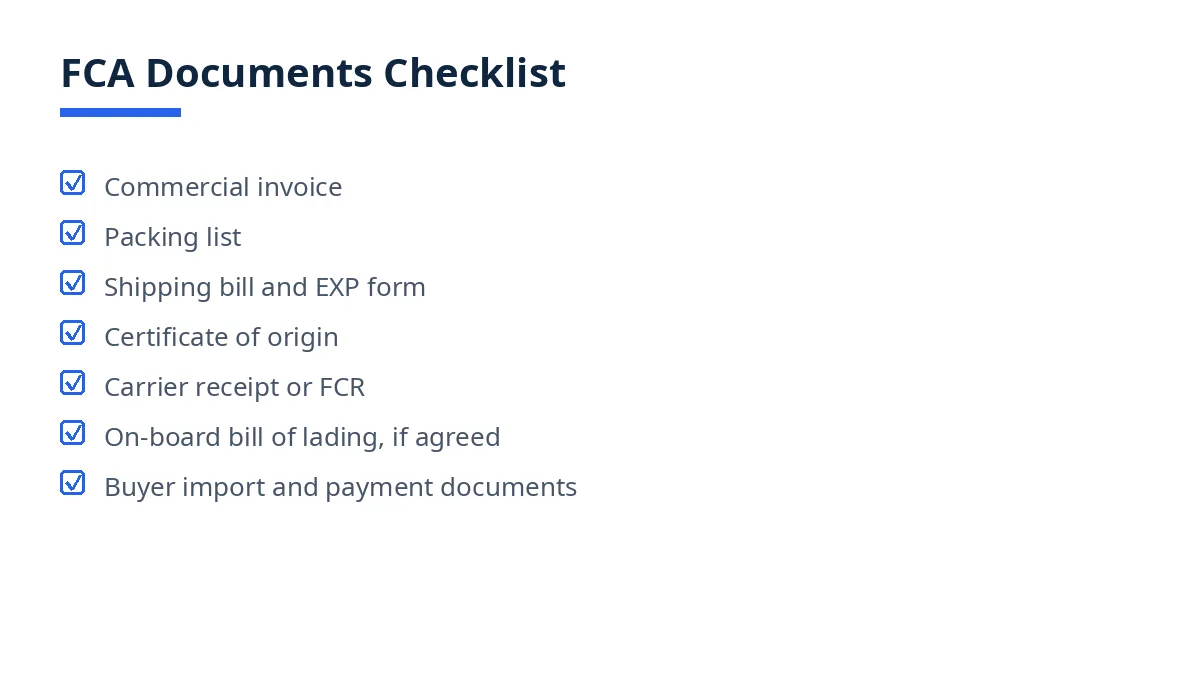
Sales contract or purchase order, recording names and addresses, goods description, quantity, price, FCA named place, shipment date, and payment terms. Every later document must match the contract names and description word for word.
Pro forma invoice, where the buyer needs one to open an LC or arrange payment. Use the same description, quantity and price as the final invoice, marked clearly as pro forma.
Commercial invoice, signed by the exporter, with a detailed description of the goods. The Trade Portal requires a signed invoice with a detailed description for the shipping bill,2 and notes that in the buyer country the invoice is the document customs officials use to assess import duties and taxes.2 Check the number, date, currency, quantity, prices, total value, marks and numbers, and the FCA term with its named place.
Packing list, with quantity, weight and packing information per carton, including package dimensions, weights, and marks and numbers.2 List cartons in order with gross and net weight, and total the count for checking at handover.
EXP form, certified by the Authorised Dealer bank where the exporter holds its account, to ensure the realisation of export proceeds.2 Confirm certification for this shipment value and destination before customs filing.
Shipping bill (bill of export), filed with Bangladesh Customs. It is the mandatory document to complete customs clearance, load the goods, and claim duty drawbacks.2 Keep the assessed copy on file for final customs approval.2
Certificate of origin, of the type the destination requires. A non-preferential certificate states origin for general customs purposes, while a preferential certificate supports a duty preference under a trade agreement. Apply early, since the issuing authority checks the export papers behind it.
Product and inspection certificates, only where the product, destination or contract requires them, such as a phytosanitary certificate for plant products or an inspection certificate where the buyer or the LC names one. Each must name the same goods, quantity and shipment as the invoice, with the inspection date and place.
Delivery receipt at the FCA named place: the carrier collection note signed at loading, or the terminal receipt or forwarder certificate of receipt (FCR). An FCR is issued by FIATA member forwarders and certifies receipt of a specific consignment, but it does not include a contract of carriage and is not accepted as a transport document for LC purposes.3 Never present an FCR to a bank as if it were a bill of lading.
On-board bill of lading, only where agreed in advance. Under FCA, delivery normally happens before loading on board, so Incoterms 2020 provides that the buyer will instruct the carrier to issue one to the seller once loaded, and the seller then tenders it to the buyer, often through the banks.4 Without that agreement, the carrier has no duty to issue one.
Buyer prepares: the transport and import file
Carrier nomination and shipping instructions, sent to the seller in writing before the delivery date. Under FCA the buyer nominates the carrier or person who receives the goods, and the seller delivers to that carrier at the agreed place.1 Name the carrier, delivery place and date, consignee details, and any notify party.
Main carriage booking and transport document: the bill of lading for sea freight or the air waybill for air freight, naming shipper, consignee, goods description, quantity, weight, port of loading and destination. A bill of lading is the carrier-issued legal document stating the type, quantity and destination of the goods and the carriage agreement.2 Ask for a draft before it is finalised, and check it line by line against the invoice and packing list.
Insurance arrangement and cover note, where the buyer wants cover. FCA places no insurance duty on the seller, so the buyer arranges cargo insurance for the main carriage. An insurance certificate certifies a policy for cargo on board, listing the policyholder, effective date, coverage type and limits.2 Confirm the insured value, voyage and goods description match the invoice before the goods sail.
Import documents for the destination, typically the import declaration, any import licence the destination requires for the product, and the duty and tax payment records. The buyer, who handles import formalities under FCA,1 should confirm the destination list before shipment, since a licence applied for after arrival cannot clear goods already at the port.
Payment documents. For an LC, the buyer opens the credit with a document list that matches this checklist, and checks that the list names documents the seller can actually obtain, including the on-board bill of lading question in item 10. For telegraphic transfer (TT), the buyer keeps the payment proof and the agreed document dispatch route, since the seller sends documents directly rather than through banks.
Both sides: the consistency check
Cross-check every document against the other three core papers: commercial invoice, packing list, transport document and certificate of origin. Names, goods descriptions, quantities, weights, carton counts, marks and numbers, and the FCA named place must agree across all four. Under an LC, the bank checks presented documents against the credit terms, so a tolerated mismatch can still block payment.
File the complete set in one place, with copies to both sides and to the bank where an LC applies. Keep the shipping bill, EXP form, certificate of origin, transport document, insurance note and payment proof together, since a later query from customs, the bank or the buyer will ask for the set, not one paper.
Common failures and how to fix them
The most common failure is a name or description mismatch across documents. Copy the contract description into every document from a single source text, and check the draft transport document before it is finalised, since correcting a finalised bill of lading costs time and, on some routes, a correction fee.
The second failure is a weight or carton-count difference between the packing list and the transport document, usually from a carton added or removed after the packing list was printed. Re-weigh and re-count at packing close, reprint the packing list, and send the revised list to the carrier before the transport document is issued.
The third failure is a certificate applied for too late, especially the certificate of origin and any phytosanitary certificate. Start certificate applications when the commercial invoice is drafted, and confirm the issuing authority and lead time in the "Before you start" stage.
The fourth failure is presenting an FCR to a bank under an LC. An FCR certifies receipt, but it is not a transport document for LC purposes.3 Agree the transport document in the LC itself, and use the Incoterms 2020 on-board bill of lading option in item 10 where the LC requires an on-board document.4
The fifth failure is an unsigned or undetailed commercial invoice. The shipping bill process requires a signed invoice with a detailed description.2 Sign the invoice and write the full goods description, quantity and value on it, rather than a short product name alone.
Downloadable template / summary table
Copy the table into a spreadsheet, add a column for the document number and date, and mark each row as done, pending or not applicable.
Document | Prepared by | Check |
|---|---|---|
Sales contract or purchase order | Seller and buyer | Names, description, FCA named place |
Pro forma invoice | Seller | Matches final invoice figures |
Commercial invoice | Seller | Signed, detailed description, value |
Packing list | Seller | Carton count, weights, marks |
EXP form | Seller, bank-certified | Bank certification for this shipment |
Shipping bill | Seller via customs | Assessed copy kept on file |
Certificate of origin | Seller via EPB or chamber | Correct type, goods match invoice |
Product and inspection certificates | Seller via authority or inspector | Goods, quantity, date match |
Delivery receipt or FCR | Carrier or forwarder | Signed; FCR is not a transport document |
On-board bill of lading | Carrier, if agreed | Agreed in contract before loading |
Carrier nomination and shipping instructions | Buyer | Carrier, place, date, consignee in writing |
Transport document | Carrier | Draft checked against invoice, packing list |
Insurance certificate or cover note | Buyer | Value, voyage, goods match invoice |
Import declaration and licence | Buyer | Licence applied for before arrival |
Payment documents | Buyer, via bank where LC | List matches what the seller can obtain |
Consistency check and filed set | Both sides | Four core papers agree line by line |
How Exportain helps
Exportain is a B2B marketplace where buyers find Bangladeshi suppliers, post requests for quotation, and message suppliers about an order. The document list for an FCA order can be agreed at the enquiry stage, so the seller and buyer start from the same checklist rather than discovering a missing certificate at the port. Agree the FCA named place, payment method and document list in writing before production finishes, and read the how-to-buy guide. Exportain is not a party to the goods contract and does not clear customs, book freight or inspect goods, so the seller and buyer remain responsible for their own documents and checks.
FAQs
When should this checklist be used?
Use it at the enquiry stage to agree the document list, again when the commercial invoice is drafted to start certificate applications, and a final time at packing close to run the consistency check.
Who should complete it?
The seller completes the commercial and export file, the buyer completes the transport and import file, and both sides complete the consistency check together. A forwarder or broker can prepare filings, but the seller and buyer still own the accuracy of their own documents.
What are the most common failures?
Name and description mismatches across documents, weight or carton-count differences between the packing list and the transport document, late certificate applications, presenting an FCR as a transport document under an LC, and unsigned or undetailed commercial invoices.
Can a third party do it?
Yes, in part. A forwarder or broker can file the shipping bill, book carriage and prepare the transport document, and an inspection firm can issue an inspection certificate. The seller and buyer cannot hand over the consistency check, since only they hold the contract, the invoice and the payment terms the documents must match.
Next steps on Exportain
Agree the FCA named place, payment method and full document list with your supplier before production finishes, then read the Incoterms guide and the CIF explainer to compare how document duties change under a different rule, and work through the how-to-buy guide to post your enquiry.
Sources
- FCA & EXW Incoterms® 2020 explained: Key differences. ICC Academy (accessed )
- Bangladesh Trade Portal FAQ: Export Registration Certificate (ERC). Bangladesh Trade Portal (accessed )
- FCR document – Forwarder's Certificate of Receipt. ShipHub, (accessed )
- Incoterms® 2020. International Chamber of Commerce (accessed )
About the author
Sourcing from Bangladesh?
Post a request for quotation and suppliers on Exportain can send you their quotes directly.
Post an RFQ