

Who Handles Customs Clearance Under EXW? Export vs Import Explained
Under EXW, the buyer handles export clearance in Bangladesh and import clearance at destination, while the seller only makes the goods available. This guide explains who files each declaration, who pays duties and taxes, and how to handle the case where the buyer has no local presence at origin.
Short answer
Under EXW, the buyer handles customs clearance at both borders: export clearance in Bangladesh and import clearance at destination, including all duties and taxes. The seller only makes the goods available at the named place and provides the invoice and export papers. Buyers with no filing presence in Bangladesh must appoint a local origin agent or switch to FCA before shipment.
On this page
Key takeaways
Under EXW, the buyer handles both customs clearances: export clearance in Bangladesh and import clearance at destination, including all duties and taxes.
The seller only makes the goods available at the named place, provides the invoice and export papers, and assists the buyer with export documents, but does not file the export declaration or load the goods.
In Bangladesh, goods may not be loaded for export until the Bill of Export is submitted and approved by Customs.
A buyer with no filing presence in Bangladesh should appoint a local origin agent who can file, agree a written seller-filing variation, or switch the term to FCA.
For EU imports, an EORI number is mandatory for customs operations, and the destination broker and importer registration must be confirmed before the goods sail.
Under EXW (Ex Works), the buyer handles customs clearance twice: export clearance in Bangladesh and import clearance at destination. The seller's job ends when the goods are made available at the named place. This causes the most trouble, because the buyer is usually a foreign company with no office, staff or filing rights in Bangladesh.
This guide covers the clearance split only: who files each declaration, who pays each charge, which documents each side supplies, and what to do when the buyer has no local presence at origin. For the full rule, read the EXW guide.
The buyer files both declarations and pays both sets of charges, using an origin agent in Bangladesh and a destination broker at import.
The Incoterms 2020 rules are 11 rules published by the International Chamber of Commerce (ICC), and each rule allocates cost, risk and obligations between seller and buyer.1 Under EXW, the seller's role is the smallest of any rule: the seller makes the goods available, provides the commercial invoice, and assists the buyer in obtaining export documents, but is not required to load the goods or file the export declaration.2
Why this matters for buyers and sellers
For the buyer, the split changes the real price of an EXW deal. An EXW quotation covers the goods at the factory gate, plus export packaging. It does not cover loading, inland transport, export filing, freight, import filing, duties or taxes. Comparing an EXW price with a delivered price without adding both clearances understates the landed cost, as the landed cost guide for imports from Bangladesh shows.
Risk also moves earlier than many buyers expect. Under EXW, risk passes to the buyer the moment the goods are placed at the buyer's disposal at the named place, before loading.2 Damage during loading or inland transport is then the buyer's loss, even though the goods have not left the seller's country. Insurance is the buyer's choice under EXW, and it should be arranged before collection.
For the seller, the split matters because the seller's papers make the filing possible. If the invoice, packing list or product certificates are late, inconsistent or in the wrong legal name, the buyer's origin agent cannot file a clean declaration, and the shipment waits.
Clearance cannot be rebooked the way freight can. A forwarder can change a sailing, but a declaration filed by the wrong party, or with no party entitled to file, stops the shipment at the border. Settling the filer for each border before the goods are ready is the single most useful step in an EXW purchase.
Step-by-step: how it works
The sequence below follows one shipment from factory gate to buyer warehouse.
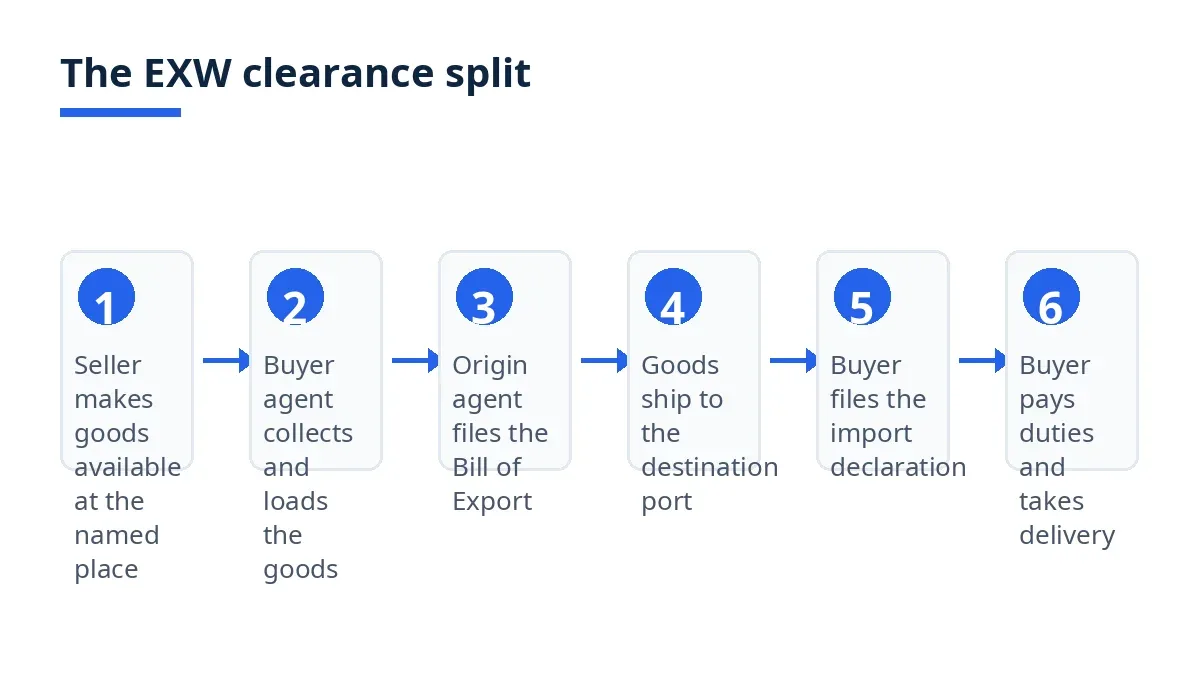
Name the place and the filers in writing. Write the EXW named place in full, for example "EXW Dhaka factory, Incoterms 2020", and name who will file each declaration. Do not leave either filer as "to be confirmed" past the purchase order stage.
Seller makes the goods available and hands over the papers. The seller places the goods at the buyer's disposal at the named place on the agreed date, provides the commercial invoice and packing list, and assists the buyer in obtaining any other export documents needed.2 The seller is not required to load the collecting vehicle.
The buyer's origin agent collects and loads the goods. The buyer, or the buyer's forwarder, appoints a local agent in Bangladesh to collect, load and carry the goods to the port or airport. Confirm the appointment before the ready date, not on it.
The origin agent files the export declaration. In Bangladesh, goods may not be loaded for export unless the Bill of Export or Shipping Bill is submitted to Customs and approved.3 The declaration names the exporter, the foreign buyer and the transport operator.
Main carriage runs to the destination. The buyer's forwarder moves the goods by sea or air. Keep the bill of lading or air waybill, invoice and packing list together for the destination broker.
The destination broker files the import declaration. The buyer, or the buyer's broker at destination, files the import declaration, states the customs value and classification, and pays the duties and taxes assessed. The buyer is the importer of record, so the buyer carries the duty and tax liability even when a broker files on the buyer's behalf.
Delivery and record keeping. Once customs releases the goods, the buyer arranges inland delivery and keeps the full clearance file: both declarations, duty receipts, invoice, packing list and transport documents.
Costs, timelines and documents
Under EXW, the buyer pays every clearance-related charge at both borders, plus every transport charge between them: loading, inland transport, export filing, freight, import filing, duties and taxes, and inland delivery. The seller pays nothing beyond making the goods available.
Example figures (structure only, not quoted rates): goods at 10,000 currency units, origin handling and export filing at 450, freight at 1,800, and import duty and tax at 2,100 give a landed figure of 14,350 before inland delivery. Actual amounts come from your forwarder's quotation and your destination tariff schedule.
There are no standard timelines for EXW clearance to plan around. Export clearance in Bangladesh follows documentary check and physical verification before loading.3 Import clearance follows the broker's filing and the assessment of duties. A complete document set and a broker appointed before shipment keep both clearances short. Do not promise a delivery date until the import entry has been accepted and the goods released.
The documents split into two sets, one per filing, and values, weights and descriptions must match across both.
Document | Export set (Bangladesh) | Import set (destination) |
|---|---|---|
Commercial invoice | Yes, signed by the exporter | Yes, same value and description |
Packing list | Yes, quantity, weight and packing details | Yes, same packing details |
Bill of Export / Shipping Bill | Yes, the export declaration itself | No, keep a copy |
EXP form certified by an authorized dealer | Yes | No |
Certificate of origin | Yes, EPB or Chamber of Commerce and Industry | Yes, where required |
VAT registration certificate and TIN | Yes | No |
Bill of lading or air waybill | No, issued after loading | Yes, to claim the goods |
Import declaration and importer identification | No | Yes, EORI number for EU imports |
The Bangladesh export documents above are those Bangladesh Customs lists as enclosed with the Bill of Export.3 For EU imports, an EORI number is mandatory for customs operations in the EU, including import, export and transit.4
Bangladesh-specific rules and tips
Bangladesh export clearance has one hard gate: no loading without an approved declaration. Section 131 of the Customs Act, 1969 requires customs clearance for export, and goods shall not be loaded or shipped for export unless the Bill of Export is submitted in the prescribed format and approved by the customs authority.3 Build the shipping schedule around that approval, not around the truck booking.
The declaration names three parties: the exporter, the foreign buyer or importer, and the transport operator.3 That naming is where the no-local-presence problem shows up: the buyer appears on the declaration but may have no filing presence in Bangladesh. The practical answers, in order of preference, are:
Switch to FCA. Under FCA, the seller handles export clearance and delivers the goods to the buyer's carrier. This is the cleanest fix when the buyer cannot file at origin, and the alternative the ICC guidance points to for cross-border trade where the buyer cannot legally file the export declaration.5
Appoint a local origin agent who can file. Where the buyer's forwarder has a Bangladesh agent entitled to file, the agent files the Bill of Export on the buyer's behalf, using the seller's invoice, packing list, EXP form and certificate of origin. Confirm the entitlement in writing before the ready date.
Agree a written seller-filing variation. Some sellers agree to file the export declaration themselves, often described as "EXW loaded". This is not part of the standard EXW rule and should be spelled out in the purchase order, including who pays the filing cost and who bears the risk during loading.5 A verbal understanding here is a common source of dispute.
Two further points deserve attention. First, product-specific documents sit on top of the standard set: an Export Registration Certificate (ERC) is listed for jute, jute goods and tea, and a phytosanitary certificate applies to agricultural goods where the destination country requires it.3 Ask the seller early which product-specific papers your goods need. Second, keep one legal name consistent across every paper: the seller name should match across the quotation, invoice and Bill of Export set, and the buyer name should match the purchase order.3
Ask the seller for the full export paper set with the ready notice.
Mistakes and red flags
What are the most common mistakes?
Assuming the seller clears export. This is the most common EXW mistake. Under EXW, export clearance is the buyer's duty, and the seller is not required to file it.2 Any quotation that leaves export clearance unassigned will stall at the factory gate.
Leaving the export filer unnamed. "The forwarder will handle it" is not a plan. Name the filing party, confirm the party is entitled to file, and record the arrangement in the purchase order. If no party can file, switch the term to FCA before shipment.
Accepting an unwritten "EXW loaded" deal. If the seller agrees to load the truck or file the declaration, write it down: who loads, who files, who pays, and who bears the risk during loading. An informal arrangement not in the contract leaves both sides exposed when goods are damaged.5
Arriving at destination without an importer set-up. A buyer importing into the EU needs an EORI number for customs operations.4 A buyer importing elsewhere needs whatever importer registration that destination requires. Appoint the destination broker and confirm the registration before the goods sail.
Reading a marketplace badge as clearance capacity. A badge records document and photo checks, not whether the supplier's papers will be ready on time, and it is not a promise about delivery.6 Judge clearance readiness on the paper set and the named filer, not on the profile.
Paying the wrong party for duties. Duties are assessed on the import declaration and paid as the destination authority directs, usually through the broker. Never pay duty amounts to a party who cannot show the assessment.
Checklist
Before the goods are ready, every line below should be answered in writing.
EXW named place written in full, with the Incoterms 2020 version stated.
Export filer named and confirmed entitled to file in Bangladesh.
Destination broker named, with importer registration confirmed.
EORI number confirmed for EU imports, or the destination equivalent.4
Loading responsibility stated: who loads and who bears the risk during loading.
Invoice and packing list received, matching the purchase order values and descriptions.
EXP form, certificate of origin and product-specific papers confirmed with the seller.
One seller legal name across the quotation, invoice and Bill of Export set.
Bill of Export filing scheduled before the truck booking, with approval needed before loading.3
Freight, insurance and both clearance charges quoted separately from the goods price.
Destination duty and tax estimate from the broker or tariff schedule.
Clearance file kept after delivery: both declarations, duty receipts, invoice, packing list and transport documents.
How Exportain helps
On Exportain, browse suppliers and post a request for quotation on the RFQ board stating the EXW named place and asking each reply to confirm who will file the export declaration. When you accept a quotation, Exportain creates one order and issues one proforma invoice from the accepted terms, including quantity, unit price, currency and Incoterm.6 Read the how to buy page before placing the order, so the term on the invoice matches the term you negotiated.
Read badges for what they record. Exportain verification is a document review by staff, not a factory inspection, and a badge is not a guarantee of production capacity, product quality or delivery.6 Exportain Verified means Exportain has checked identity, phone, email and business registration, and Export Verified means it has checked the Export Registration Certificate (ERC).6 Neither badge files a declaration for you.
Exportain is a marketplace, not a customs broker. It does not file your declarations or pay your duties. Use the platform to find the supplier and agree the term, then use a forwarder and brokers at each border to carry out the two clearances.
FAQs
What should I know first about EXW?
Know first that EXW gives you both customs clearances. The seller makes the goods available at the named place, and you handle loading, export filing in Bangladesh, freight, import filing at destination and all duties and taxes.2 If you have no filing presence in Bangladesh, settle that problem before you sign, with a local origin agent or by switching to FCA.5
What are the typical costs and timelines?
There are no typical costs or timelines a guide can state as fact, because each forwarder quotes your route, and each destination assesses duty on your goods and value. The buyer pays loading, inland transport, export filing, freight, import filing, duties and taxes, and inland delivery, and the example figures in the costs section show the structure only. For timelines, a complete document set and brokers appointed before shipment matter more than any average, because Bangladesh requires approval of the Bill of Export before loading.3
Which documents are needed?
The export set for Bangladesh is the Bill of Export with the export contract or purchase order where there is no export letter of credit, the invoice, the packing list, the EXP form certified by an authorized dealer, the certificate of origin, the VAT registration certificate and the TIN, plus product-specific papers.3 The import set is the import declaration with the importer's identification, the invoice, the packing list and the bill of lading or air waybill, with an EORI number for EU imports.4 Values and descriptions must match across both sets.
What are the most common mistakes?
The most common mistakes are assuming the seller clears export, leaving the export filer unnamed, accepting an unwritten loading or filing arrangement, and arriving at destination without an importer registration or broker.2 5 4 Each is preventable in the purchase order: name both filers, state who loads, confirm the importer set-up, and check the papers before filing.
Next steps on Exportain
Browse suppliers, then post your named place and delivery term on the RFQ board and ask every reply to confirm its export filer in writing. Before you confirm, read the EXW guide, the documents checklist for EXW shipments and the risk transfer guide so the term, the papers and the risk point are settled together.
Sources
- Incoterms® 2020. International Chamber of Commerce (ICC) (accessed )
- EXW Incoterm (Ex Works) - Use and Meaning. iContainers (accessed )
- Customs Clearance Procedures for Export. Bangladesh Customs, National Board of Revenue (accessed )
- Economic Operators Registration and Identification number (EORI). European Commission, Taxation and Customs Union (accessed )
- Ex Works (EXW) Incoterms 2026: Complete Guide for Freight Forwarders. GoFreight (accessed )
- Trust & Safety Center. Exportain (accessed )
About the author
Sourcing from Bangladesh?
Post a request for quotation and suppliers on Exportain can send you their quotes directly.
Post an RFQ


