Documents Required for EXW Shipments: Complete Checklist
A printable, numbered checklist for EXW shipments from Bangladesh: which documents the seller supplies, which the buyer or forwarder must arrange, and how to check invoice, packing list, export declaration, certificate of origin, transport document and insurance before collection.
Short answer
Under EXW, the seller must make the goods available at the named place and help with documents at the buyer's risk and expense, while the buyer arranges loading, export clearance, carriage, insurance and import clearance. This checklist splits every document by owner, so the buyer can confirm the commercial invoice, packing list, export declaration, certificate of origin, transport document and insurance note before collection, and nothing is discovered at the port.
On this page
Key takeaways
Under EXW the buyer owns export clearance, carriage and insurance, so the seller's document cooperation must be agreed in writing before production ends.
Split every document by owner, seller, buyer, forwarder, carrier, bank or broker, and work deadlines backward from collection day.
Use one master data set on every document, because a count, weight or description mismatch between invoice, packing list and transport document stops the shipment.
Request the certificate of origin as soon as the commercial invoice is final, in the preferential or non-preferential form the destination requires.
Picture collection day at a factory outside Dhaka. The buyer's truck is booked, the cartons are ready, and the driver is waiting at the gate. The shipment still cannot move, because one paper is missing: the certificate of origin has not been issued, or the packing list shows a carton count that does not match the invoice. Under EXW, that delay lands on the buyer. This checklist exists so the folder is complete before the truck is booked.
Under EXW, the seller delivers by placing the goods at the buyer's disposal at the named place, not loaded on a collecting vehicle, and the seller's part in export clearance is limited to assisting with documents and information the buyer requires.1 The Incoterms 2020 rules allocate costs and risks for transport and export and import formalities.2 This is a documents checklist, not a general EXW guide: the question is who holds each paper, and when it must be in hand.
Why this checklist matters
An EXW price buys goods at the factory gate. It does not buy a ready export file. The buyer, or the buyer's forwarder, must still assemble loading, export clearance, carriage, insurance and import clearance from separate parties, and each party works from documents. A missing document stops a different step: customs cannot approve an export declaration without its enclosures, a carrier cannot issue a clean transport document against a packing list that disagrees with the invoice, and a destination broker cannot claim a preference without a certificate of origin.
It also guards against the main EXW paperwork trap. A foreign buyer may not be able to act as exporter of record in Bangladesh without local help, so the seller's cooperation must be agreed in writing before production ends. The ICC Academy notes that where a buyer anticipates difficulty obtaining export clearance, FCA, under which export clearance lies with the seller, may be the better rule.1 If you stay on EXW, agree that cooperation, and the document deadlines, in the contract, not at the gate.
Before you start
Settle four items before collecting papers. First, the contract must name the place exactly, for example "EXW [factory address], Incoterms 2020", and state who loads, who acts as exporter of record, and who files the export declaration. Second, name the document owner for every item below: seller, buyer, forwarder, carrier, bank or broker. Third, agree deadlines working backward from collection day, requesting the certificate of origin and any product certificate first. Fourth, agree one master data set, used identically on every document: legal names and addresses, goods description, HS code, quantities, carton count, weights, values and currency.
Check consistency at every handover. The information on a commercial invoice must match the corresponding fields on the packing list, including the quantity of units for each product.3
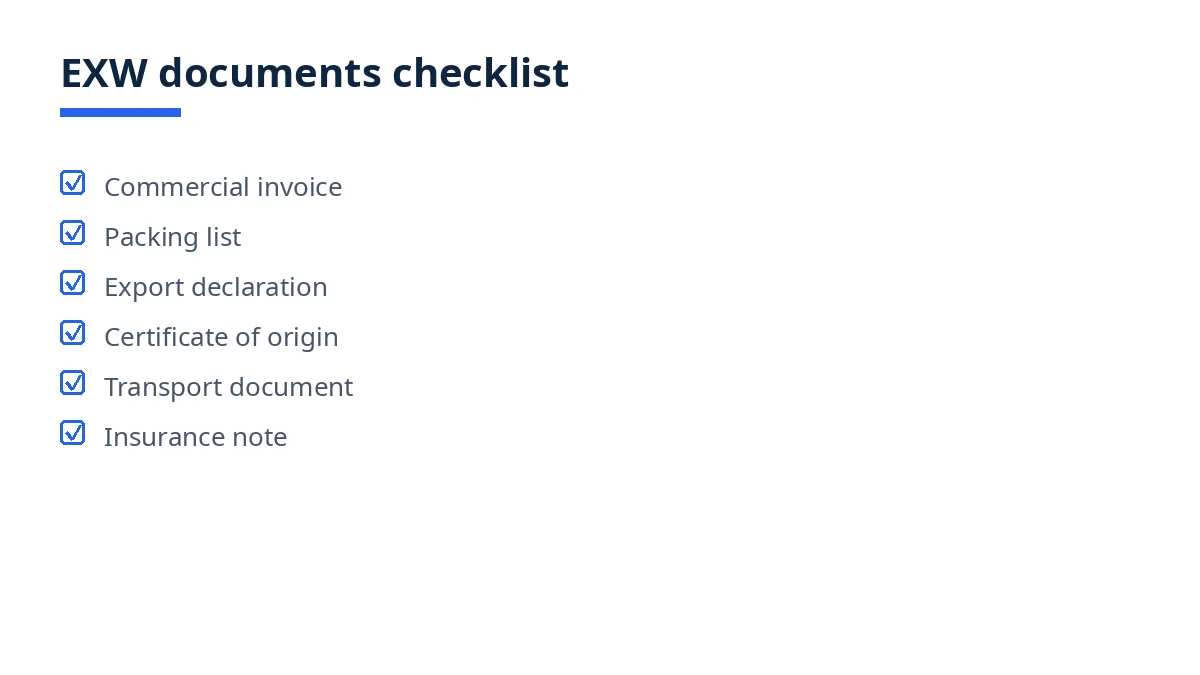
The full checklist (numbered, printable)
Work through the list in order.
A. Seller-side documents: request these first
Commercial invoice, signed by the exporter, with detailed goods description, quantities, unit and total values, currency, EXW named place and Incoterms 2020 reference.4
Packing list showing carton count, contents per carton, quantities, net and gross weights, dimensions and marks, matching the invoice line by line.3
Sales contract, purchase order or export letter of credit, as the payment route requires; where there is no letter of credit, an export contract, purchase order or export guarantee approved by the negotiating bank.4
Certificate of origin, in the form the destination requires: preferential where a preference is claimed, non-preferential otherwise. EPB is the government-appointed agency for preferential certificates, while chambers issue non-preferential certificates.5
Product certificates the goods or destination require, such as a phytosanitary certificate for agricultural goods or a quality control certificate where one is obligatory.4
Seller registration papers the export file needs copies of: Export Registration Certificate, VAT registration certificate and Taxpayer Identification Number.4
EXP form certified by an Authorized Dealer bank, to support realisation of export proceeds.4
Readiness notice in writing, stating the date, the named place and that the goods are at the buyer's disposal.
Loading instruction, agreed in writing, if the seller will load the collecting vehicle. Under EXW the seller is not required to load.1
B. Buyer and forwarder documents: the export clearance file
Written appointment of the forwarder or customs agent, naming who acts as exporter of record and who files the export declaration, with the seller's cooperation undertaking attached.
Bill of Export, also called the shipping bill, in the prescribed format and approved by the Customs authority. Goods must not be loaded or stuffed for export unless it has been submitted and approved.4 6
Copy of the approved Bill of Export, retained by buyer and forwarder, with the shipped-on-board endorsement checked where the route requires it.4
Transport booking confirmation naming carrier, vessel or flight, port of loading, port of discharge and document cut-off.
Export licence or permit, only where the goods, destination or parties are controlled. Mark it not applicable in writing where none applies.
Destination import requirements sheet from the buyer's broker, listing the import declaration, duty treatment and any permit the destination requires.
C. Transport document and insurance: check before the goods move
Bill of lading, air waybill, truck receipt or railway receipt, as the mode requires, issued to the buyer or forwarder, with shipper, consignee, notify party, description, package count and gross weight matching the invoice and packing list.
On-board notation, only where the payment route requires it, such as a letter of credit calling for an on-board bill of lading. Request it before loading, not after sailing.
Cargo insurance certificate or cover note, arranged by the buyer, with cover starting at the EXW named place, not at the port of loading. Under EXW the rule obliges neither party to insure.
Container or vehicle loading record, with seal number, carton count loaded and photographs of the loaded cartons, signed by the loader.
D. Destination and payment pack: close the file after arrival
Full document set for the destination broker: commercial invoice, packing list, transport document, certificate of origin and insurance certificate, with consistent names, descriptions, counts and weights throughout.3
Import declaration and duty calculation from the destination broker, based on the destination tariff and the classification in the file.
Payment documents required by the agreed route, such as the letter of credit documents or bank collection set, checked against the bank's wording before presentation.
Proof of delivery and any shortage or damage note, recorded at arrival, with the transport document and loading record attached.
Closed shipment file, holding every document above plus the contract, readiness notice and forwarder correspondence.
Common failures and how to fix them
The most common failure is a count or weight mismatch between the invoice, the packing list and the transport document. Fix it before loading: recount the cartons against the packing list, correct the document that is wrong, and reissue rather than annotating by hand. The second failure is a certificate of origin requested too late. Fix it by requesting the certificate as soon as the commercial invoice is final, and by confirming whether the destination needs a preferential or a non-preferential form before applying.5
The third failure is an assumed exporter of record. A buyer who arrives expecting the seller to have cleared the goods will find them still at the seller's premises, because export clearance under EXW belongs to the buyer, with only assistance from the seller.1 Fix it in the contract, with a named filer and a cooperation undertaking, or reconsider FCA. The fourth failure is insurance that starts at the port while risk passed at the factory. Fix it by writing the named place into the insurance instruction and checking the certificate before collection. The fifth failure is a destination document the origin file never requested. Fix it by sending the broker's requirements sheet to the seller before production ends.
Downloadable template / summary table
Copy the table into a spreadsheet, adding owner, deadline, checker and date columns.
Section | Documents | Checked against |
|---|---|---|
Seller-side | Invoice, packing list, contract, origin certificate, product certificates, registration papers, EXP form, readiness notice, loading instruction | Master data set3 |
Export clearance | Forwarder appointment, Bill of Export, approved copy, booking confirmation, licence, requirements sheet | Bill of Export enclosures4 |
Transport and insurance | Transport document, on-board notation, insurance certificate, loading record | Invoice, packing list, named place |
Destination and payment | Broker set, import declaration, payment documents, delivery proof, closed file | Destination tariff, bank wording |
How Exportain helps
Exportain is a B2B marketplace connecting international buyers with Bangladeshi suppliers, so the document owners in this checklist can be agreed at the enquiry stage. State the EXW named place and the document deadlines in the enquiry, and ask each supplier which origin documents it will supply and by when. Supplier profiles show which document and photo checks have been recorded. Exportain is not a party to the goods contract and does not inspect goods, book freight or clear customs, so the buyer still owns the export file. For the wider cost picture, see the landed cost guide, and for the full rule comparison, see the Incoterms guide.
FAQs
When should this checklist be used?
Use it from enquiry stage, and again when the commercial invoice is final, when the certificate of origin is applied for, and on collection day, before loading.
Who should complete it?
The buyer owns it, because export clearance and insurance under EXW belong to the buyer, but seller, forwarder, carrier and destination broker each complete their own section. A forwarder can run the export file only with the seller's documents and cooperation agreed in advance.1
What are the most common failures?
Count and weight mismatches, a certificate of origin requested too late, an assumed exporter of record, insurance starting at the port instead of the factory, and a destination certificate nobody requested at origin.
Can a third party do it?
Yes. A forwarder or customs agent can prepare the export declaration, book carriage and assemble the transport file, and a destination broker can handle import clearance. A third party cannot replace the seller's documents, so the invoice, packing list, certificate of origin and registration papers must still be supplied on time.
Next steps on Exportain
Before you agree EXW terms, read the EXW guide to confirm the named place and cost split, work the full cost picture with the landed cost guide, and follow the buying steps in how to buy so document owners and deadlines are agreed at enquiry stage.
Sources
- DDP & EXW Incoterms® 2020 explained: Key differences. ICC Academy (accessed )
- Incoterms® 2020. International Chamber of Commerce (ICC) (accessed )
- Commercial Invoice and Packing List: What You Need to Know. Flexport (accessed )
- Customs Clearance Procedures for Export. Bangladesh Customs, National Board of Revenue (accessed )
- Certificate of Origin SOP. Bangladesh Export Processing Zones Authority (accessed )
- Bangladesh Trade Portal FAQ: Export Registration Certificate (ERC). Bangladesh Trade Portal (accessed )
About the author
Sourcing from Bangladesh?
Post a request for quotation and suppliers on Exportain can send you their quotes directly.
Post an RFQ