Custom Jute Rugs and Carpets Manufacturer in Bangladesh: OEM Process From Tech Pack to Bulk
An OEM guide to custom jute rugs and carpets from Bangladesh: write the construction and tolerances into the tech pack, vet the mill, approve samples in rounds, and inspect the bulk lot before it ships.
Short answer
A custom jute rug order in Bangladesh runs from a written tech pack through three sampling rounds to bulk production: the mill builds your braided, handwoven or hand-tufted design to your specification, you approve a pre-production sample in writing, and the lot passes a final AQL inspection before it ships from Chattogram.

On this page
Key takeaways
A rug tech pack holds eight pages the mill cannot guess, from the construction drawing to the revision log, and the approved sample is always tied to a version number.
Braided, handwoven and hand-tufted rugs each need different specifications: braid width and coil plan, weave count, or pile height and backing.
OEKO-TEX Standard 100 tests components for harmful substances and is not a quality certification; most residential rugs fall under Product Class 2 and certificates last one year.
Example figures put 2,000 braided jute rugs at 32,370 dollars landed, or 16.19 dollars a rug, with 125 rugs inspected at AQL 2.5 for major defects.
A custom jute rug order in Bangladesh is a manufacturing project, not a catalogue purchase. You send a mill a written specification, the mill builds samples against it, you approve one sample in writing, and only then does bulk production start.
What does a custom jute rug OEM order actually cover?
An OEM order means the mill makes your design to your specification, under your label. The mill supplies the fibre, the looms, the dyeing and the finishing; you supply the construction, the sizes, the colours and the quality standard.
Three constructions cover most custom rug orders. Braided rugs are made by twisting jute yarn into ropes, braiding the ropes into plaits, coiling the plaits and stitching the coils together.1 Handwoven rugs are woven on a loom as a flat fabric.1 Hand-tufted rugs are made by punching jute yarn through a primary backing, then locking the pile with latex adhesive and a secondary backing cloth.
The construction decides the rest of the order: a braided rug needs a braid width and a coil plan; a handwoven rug needs a weave count; a hand-tufted rug needs a pile height and a backing specification. Jute suits this work because the fibre is strong and biodegradable, and Bangladesh and India together produce about 95 percent of the world supply.2 The same fibre absorbs water, so a jute rug is a poor choice for a bathroom or an uncovered outdoor space.1
How do you write a tech pack a rug mill can build from?
A tech pack is the master document that turns a design into exact specifications a factory can execute, and it acts as the single source of truth for the brand and the manufacturer.3 Without one, the mill fills in the missing details with its own assumptions, which leads to wrong samples and late delivery.3
Tech pack page | What it fixes |
|---|---|
Cover and style sheet | Style number, design name, colourways, size range |
Construction drawing | Front and back views, braid or weave detail, edge finish |
Bill of materials | Yarn count, backing cloth, latex, dyes, labels, packing |
Measurement chart | Length, width and pile height for every size |
Tolerances | Limits for size, weight, pile height, colour |
Colour standard | Physical swatch or Pantone reference |
Labels and packing | Label positions, care wording, carton marks |
Revision log | Version number, date and what changed |
Colour and size need the same discipline. Send a physical swatch with the pack, because a mill cannot match a colour from a screen photograph, and state the finished size after 48 hours lying flat, since jute moves. Natural dyes shift more between batches than reactive dyes, so a natural-dye design needs a wider shade tolerance.
How do you find and vet a rug mill in Bangladesh?
Start with capability, not with price. A mill that weaves sacks on shuttle looms cannot necessarily braid a round rug, and a braiding workshop may have no dye house. Ask how many braiding frames or hand looms run today, and whether dyeing, drying and latex backing happen in-house.
Then check the evidence of export work: three recent export shipments of rugs or carpets, with the destination country and the construction. Bangladesh earned 883.7 million dollars from jute and jute products in the 2025-26 fiscal year, up 7.75 percent on the year before.4
Certification is a separate question from capability. OEKO-TEX Standard 100 tests textile components for harmful substances such as formaldehyde, banned azo dyes, heavy metals, phthalates and PFAS, and it is not a quality certification.5 Every component is tested separately, so the yarn, the backing, the latex, the dyes and even the hang tag must pass, or the whole product fails.5 Most residential carpets and rugs fall under Product Class 2, and certificates are valid for one year, so check the class and the expiry date.5
What should the sampling rounds prove before you approve bulk?
Sampling has three rounds. The proto sample proves the construction: the braid width, the weave, the pile height and the edge finish. The pre-production sample proves the colour and the size, made from the bulk yarn lot and dyed in the bulk dye lot. The shipping sample proves the packing.
Measure every sample against the tech pack, not against the previous sample. Lay the rug flat, measure length and width at three points each, check the pile height at five points, and weigh the rug. Record every deviation in the revision log.
Compare colour against the physical swatch under natural daylight, and keep the approved swatch sealed in a bag with the style number on it. Check the backing as carefully as the face: on a hand-tufted rug, the latex must not bleed through; on a braided rug, check the stitching where coils meet. Jute backing is made by retting, spinning and weaving the fibre into a fabric, treating it, and stitching or bonding it to the rug.6 It gives stability and grip, but it is not suited to places with excessive moisture.6
How is the price built, and what sets the MOQ for each design?
A rug quotation has five cost lines: the yarn and backing materials, the labour for braiding or weaving and finishing, the dyeing and treatment, the labels and packing, and the mill margin.
MOQ follows the setup cost, not the rug size alone. A braided design needs braid frames set up and a stitching plan; a dyed design needs a dye lot large enough to hold shade. A mill will set a higher MOQ for a design with three colourways than for the same rug in one colourway.
Cost moves with three inputs you can track. Raw jute prices rose after floods damaged production, and exporters reported that higher raw jute prices pushed up production costs for diversified jute products.4 A finer yarn costs more per kilo and takes longer to braid, and a dark colourway costs more than a natural undyed rug.
How does bulk production run, and where do you check it in line?
Bulk production runs in four stages: yarn and dye preparation, construction, finishing, and packing. The mill should give you a dated schedule for each stage.
Check the work while it runs, not only at the end. Inspectors check work at each operation while production runs, and the aim is to correct a faulty machine setting early, before it repeats across the lot.7 For rugs, the in-line checks are yarn shade against the approved swatch, braid width on the first ten pieces, and backing adhesion on the first finished rugs. Hold a mid-production meeting at about 30 percent completion.
How does final inspection work for jute rugs?
Final inspection is a random sample drawn from the finished, packed lot, and it decides whether the shipment is released. The final random inspection is carried out once production is complete and normally at least 80 percent of the order is packed.7
The sampling plan most buyers use comes from ISO 2859-1, with General Inspection Level II as the default.7 One table turns the lot size and the inspection level into a code letter, and the second turns the code letter into a sample size and an accept and reject number for each AQL.7 AQL stands for acceptance quality limit, with separate limits by defect class: critical defects are not allowed at all, major defects carry a limit of 2.5, and minor defects a limit of 4.0.7
Lot size | Code letter, Level II | Sample | Major AQL 2.5, accept / reject | Minor AQL 4.0, accept / reject |
|---|---|---|---|---|
501 to 1,200 | J | 80 | 5 / 6 | 7 / 8 |
1,201 to 3,200 | K | 125 | 7 / 8 | 10 / 11 |
3,201 to 10,000 | L | 200 | 10 / 11 | 14 / 15 |
10,001 to 35,000 | M | 315 | 14 / 15 | 21 / 22 |
Single sampling, normal inspection, General Inspection Level II, per ISO 2859-1 and ANSI/ASQ Z1.4.7 If the sample holds more major defects than the accept number, the lot fails. A single critical defect, such as a wrong fibre content on the label, rejects the lot under the AQL 0 rule.7
Write the defect list before inspection day, using the quality control checklist for jute rugs and carpets as a starting point. Major defects include a wrong size outside tolerance, a wrong colour against the approved swatch, a loose or missing backing, an open braid stitch, and a stain or hole in the face. Minor defects include a loose thread end and a slightly uneven fringe.
How are rugs packed, labelled and shipped?
Rugs travel rolled, not folded, because a fold leaves a crease that does not come out of jute. Each rug is rolled face-in around a cardboard core, wrapped in polythene, and taped at both ends. The carton holds the rolls as the tech pack states, with a moisture-absorbing sachet inside and a "keep dry" mark outside, because jute absorbs water and can mould or discolour in transit.1
Carton marks carry the style number, the colourway, the size, the quantity and the carton number, so the warehouse can pick a carton without opening it. Shipping from Chattogram is usually FOB, with the buyer booking freight, or CIF, with the mill booking it. For the code to put on the invoice and the customs declaration, see the HS code guide.
Worked example: 2,000 braided jute rugs for a US home-goods buyer
A US home-goods buyer orders 2,000 hand-braided jute rugs, 120 by 180 centimetres, natural jute with a dyed indigo border, FOB Chattogram to New York. The tech pack is v1.2. Example figures.
Cost line | Amount |
|---|---|
Rugs, 2,000 pieces at 14.50 dollars | 29,000 dollars |
Sampling, three rounds | 420 dollars |
OEKO-TEX testing for the design | 650 dollars |
Ocean freight and insurance to New York | 2,300 dollars |
Total cash outlay | 32,370 dollars |
Cost per rug, landed | 16.19 dollars |
The inspection plan follows the lot size. A lot of 2,000 pieces falls in the 1,201 to 3,200 band, so Level II gives code letter K and a sample of 125 rugs.7 At AQL 2.5, seven major defects or fewer means a pass and eight means a fail; at AQL 4.0, ten minor defects or fewer means a pass and eleven means a fail.7
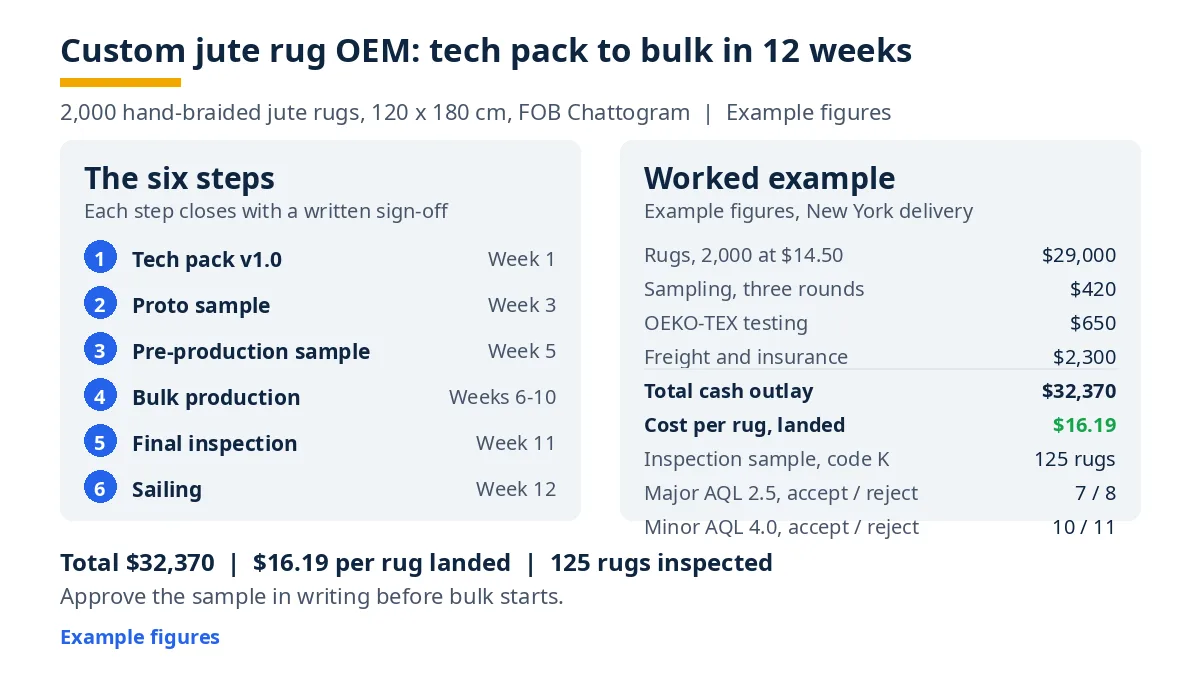
Twelve weeks run from tech pack to sailing: week 1 the tech pack is issued, week 3 the proto sample arrives, week 5 the pre-production sample is approved, weeks 6 to 10 are bulk production, week 11 is final inspection, and week 12 is sailing.
Mistakes that stall a rug OEM order
The first mistake is sending a photograph instead of a tech pack: a mill can copy a photograph, but it cannot price it, size it or inspect against it. The second is approving a sample by colour on a phone screen, when screen colours shift with the device and the light. The third is skipping the backing check: a hand-tufted rug with latex that bleeds through looks fine in a photograph and fails in a living room. The fourth is ordering three colourways at the MOQ for one, since each colourway needs its own dye lot. The fifth is booking freight before inspection passes.
Questions buyers ask about custom jute rugs
How long does a custom jute rug order take from tech pack to bulk?
Twelve weeks is a realistic plan for a first order of 2,000 braided rugs: two weeks for the tech pack and the proto sample, two more weeks for the pre-production sample and colour approval, five weeks for bulk production, and a week each for final inspection and sailing.
Next steps on Exportain
Start by reading the jute products sourcing guide, then check the sustainable jute products guide. When the tech pack is ready, post an RFQ with the construction, the sizes and the target MOQ.
Sources
- Braided Jute Rugs: Handwoven, Natural and Built to Last. Handmade Rug, (accessed )
- Jute. EBSCO (accessed )
- How To Create a Tech Pack To Send To Manufacturers. Shopify (accessed )
- Jute exports rise 37% as Bangladesh plans to double earnings by 2031. bdnews24.com, (accessed )
- OEKO-TEX Carpet Certification | Importing from China. China Carpet, (accessed )
- What Is Jute Backing On A Rug. Citizenside (accessed )
- Textile Quality Control: AQL Sampling And Inspection Guide. TextileTuts (accessed )
About the author
Sourcing from Bangladesh?
Post a request for quotation and suppliers on Exportain can send you their quotes directly.
Post an RFQ