How to Import Leather Gloves From Bangladesh in 2026: Complete Buyer Guide
Leather gloves are bought by the pair, and the pair you receive depends on the glove type, the leather, the size curve, and the test file. This guide covers the 4203 code, UK duty, EN 388, chromium VI limits, and a worked order of 5,000 pairs to the UK.
Short answer
To import leather gloves from Bangladesh, pick the glove type first, then name the animal, layer, tannage, and thickness in the specification. Dress and work gloves classify under heading 4203: sports gloves pay 8 per cent UK duty, protective gloves 8 per cent, and other gloves 6 per cent. Skin-contact leather must stay below 3 mg/kg of chromium VI under REACH. Check the size curve, the EN 388 report for work gloves, and the tannery file before ordering.

On this page
Key takeaways
Leather gloves classify under heading 4203: sports gloves under 4203.21 and other gloves under 4203.29, with UK third-country duty of 8 per cent for sports and protective gloves and 6 per cent for other gloves.
Pick the leather by use: lamb nappa and kidskin for dress gloves, goatskin for dexterity, and cowhide grain for abrasion resistance in work gloves.
EN 388 rates work gloves on six positions, abrasion, coupe cut, tear, puncture, straight-blade cut, and impact, and EN ISO 21420 sets sizes from 4 to 13 by hand circumference and length.
Skin-contact leather must stay below 3 mg/kg of chromium VI under REACH, tested by EN ISO 17075, and an LWG medal rates the tannery, not the gloves.
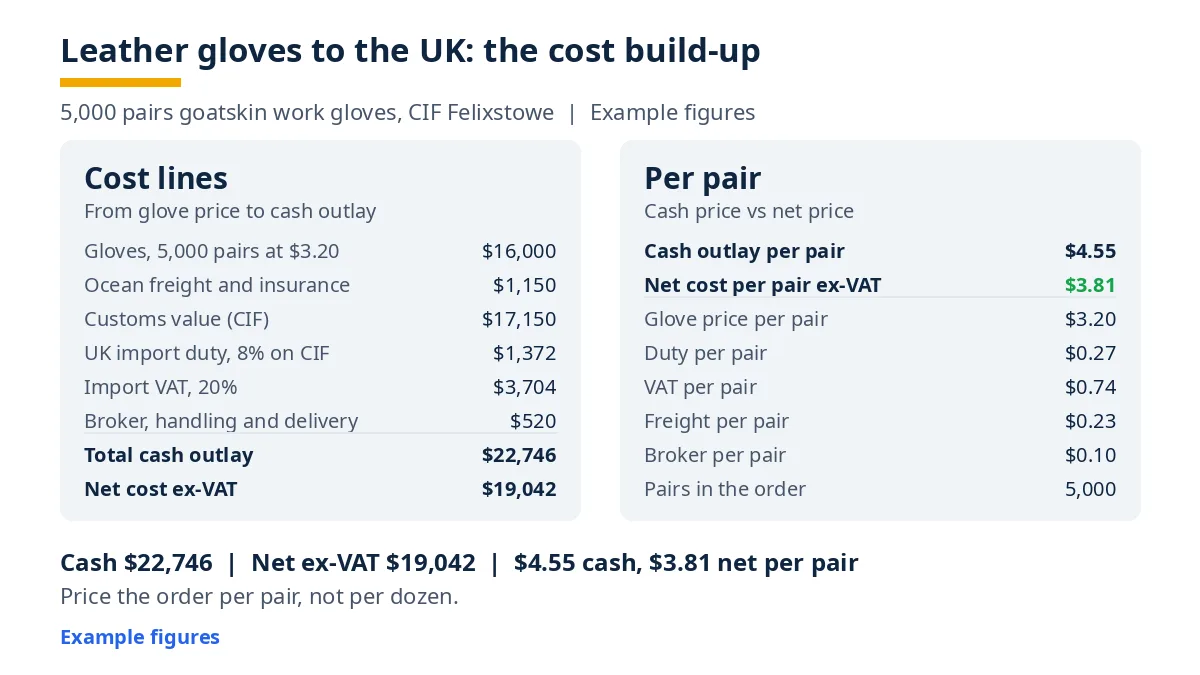
Example figures price 5,000 pairs of goatskin work gloves to the UK at $22,746 in cash, or $4.55 per pair and $3.81 net of VAT.
A leather glove order fails in small places: a finger half a size short, a lining that pulls out with the hand, a palm that fails a chromium test at the border. This guide is for buyers who order gloves from Bangladesh and want those details settled before the bulk run starts.
Bangladesh earned $1.14 billion from leather and leather goods in FY25, up 10.19 per cent on the $1.03 billion of FY24, according to Export Promotion Bureau figures reported by New Age.1 Glove makers work in small batches, cut by hand, and take orders a large garment factory would turn away.
Which glove type should you order first?
Start with the use, not the leather. A glove built for a winter commute and a glove built for a warehouse shift share almost nothing except the word glove. Dress gloves are thin and close-fitting, usually unlined or lined in silk or cashmere; evening gloves in kidskin or nappa are worn unlined for the closest fit.2 Work gloves are built for abrasion and grip, with reinforced palms and a longer cuff.
Glove type | Wearer needs | Leather | Lining |
|---|---|---|---|
Dress and daywear | Close fit, soft hand | Lamb nappa, kidskin | Unlined, silk, cashmere |
Driving | Grip, flex, no bulk | Hairsheep, lamb nappa | Unlined, light wool |
Winter | Warmth | Cowhide, deerskin | Cashmere, wool, fleece |
Work and rigger | Abrasion resistance, grip | Cowhide, goatskin, pigskin | Cotton drill, cut-resistant knit |
Sports | Grip, single-motion fit | Goatskin, hairsheep | Mesh, unlined |
Which leather suits each glove?
Leather choice is a trade between durability and dexterity. Cowhide is the most common leather in safety gloves: thick, rugged, economical, and high in abrasion resistance, though it can feel stiff before it breaks in.3 Goatskin is thinner and more supple than cowhide, with high dexterity, but it is less durable and cannot be split into split leather because the skin is too thin.3
Leather | Feel | Strength | Weakness |
|---|---|---|---|
Lamb nappa | Thin, soft, supple | Follows the hand | Marks easily |
Goatskin | Thin, supple, light | Dexterity, grip | Less abrasion resistance |
Cowhide grain | Thick, firm, rugged | Abrasion resistance | Stiff at first |
Pigskin | Rugged, soft when wet | Wet-work gloves | Less supple than goatskin |
Sheepskin | Soft, velvety, light | Comfort | Wears through fast |
Name the animal, the layer, and the tannage in the specification. "Goatskin, grain, chrome-tanned, 0.6 to 0.8 mm" leaves no room for a factory to swap in split cowhide at the same price. |
How is a leather glove made, from pattern to pair?
A glove is cut from a pattern of about ten pieces: fingers, thumb, palm, back, fourchettes between the fingers, and a cuff. Handsewn gloves use a saddle stitch that shows on the outside; machine-sewn gloves use a lockstitch that is faster and cheaper.
Stitching is where glove orders most often fail inspection, so check the stitch count per inch on the sample and write it into the specification. Linings are sewn in as a separate inner glove and attached at the fingertips and cuff; if the lining is only tacked at the cuff, it will pull out with the hand. Liners in work gloves may be a cut-resistant knit sewn into the shell to add protection against cuts and punctures.3
How do you size a glove order across markets?
Glove sizing is measured on the hand, not on the glove. The general-requirements standard for protective gloves, EN ISO 21420, sets sizes from 4 to 13, based on hand circumference and hand length, the distance from the wrist to the tip of the middle finger.4
Dexterity is tested by picking up steel pins. Under EN ISO 21420, four gloves are tested, and dexterity is graded by the diameter of the smallest steel pin that can be picked up from a flat surface three times in 30 seconds; if no pin can be picked up, the level is zero.4
What does EN 388 mean on a work glove?
EN 388 is the European standard for protective gloves against mechanical risks, and it covers abrasion, blade cut, tear, puncture, and impact where that is claimed.5 The marking under the hammer pictogram runs in six positions: abrasion, coupe cut, tear, puncture, straight-blade cut under EN ISO 13997, and impact.5 Abrasion, tear, and puncture are each rated from 0 to 4, the coupe cut from 0 to 5, the straight-blade cut from A to F, and impact is shown with a P when the test is passed.5 An X in any position means that test was not performed or does not apply.5
Read the code as six separate results, not as one score. A glove marked 4X43F has level 4 abrasion, no coupe test, level 4 tear, level 3 puncture, level F straight-blade cut, and no impact claim. Ask for the lab report behind the code before you place the order.
What code and duty apply to leather gloves?
Leather gloves classify under heading 4203, which covers articles of apparel and clothing accessories of leather or composition leather.6 The UK tariff splits gloves into three lines: sports gloves under 4203 2100 00 at 8.00 per cent third-country duty, protective gloves for all trades under 4203 2910 00 at 8.00 per cent, and other gloves under 4203 2990 00 at 6.00 per cent.6 The supplementary unit is the pair, so the customs declaration states the number of pairs.6 UK import VAT on the lines is 20 per cent, or 0 per cent where a relief applies.6
The split between the three lines turns on use, not on leather. A golf glove goes under 4203 2100 00 because it is specially designed for sport. A rigger glove goes under 4203 2910 00 because it is protective for all trades. A dress glove goes under 4203 2990 00. For a deeper look at the code, see our HS code guide for leather gloves.
How do you prove the leather is safe to touch?
A glove touches skin for hours, so the chemical file matters as much as the stitching. Under REACH, the EU bars skin-contact leather goods whose chromium VI reaches 3 mg/kg or more, measured against the dry weight of the leather.7 The test method is EN ISO 17075, and its determination limit is 3 mg/kg, which is why the limit sits where it does.7 Ask for the EN ISO 17075 report on the bulk leather, not on a swatch from a different batch. Test the bulk lot again if the tannery changes, because tanning is a batch process.
EN ISO 21420 adds its own chemical limits for protective gloves: chromium VI below 3 mg/kg for all leather materials, a pH value above 3.5 and below 9.5 for all materials, and azo colourants below 30 mg/kg for each listed carcinogenic aromatic amine in dyed leather and textiles.4
The Leather Working Group audits tanneries in 17 sections, covering water and energy use, environmental management, chemical management, waste and effluent treatment, and health and safety.8 Ratings run from Gold at 85 per cent, through Silver at 75 per cent and Bronze at 65 per cent, down to Audited at 50 per cent, and a tannery must reach the rating in every section to hold it overall.8
Where are Bangladesh gloves made, and what should you check there?
Most Bangladesh leather is tanned at the Savar estate outside Dhaka, where the tanneries moved from Hazaribagh in 2017.9 The estate's central effluent treatment plant has run below capacity since the move, treating about 14,000 cubic metres of wastewater a day against peak demand of about 35,000 cubic metres, and untreated waste has flowed into the Dhaleshwari River.9 That gap is the reason so few tanneries hold LWG certification: Italy has 952 LWG-certified factories and India has 334, while Bangladesh has fewer than 10.9 The shortfall costs Bangladesh about $500 million in lost export earnings a year, by the estimate reported in the same account.9
Ask where the leather comes from, which tannery supplied it, and whether that tannery holds a current LWG rating. For more on finding and checking makers, see our leather gloves manufacturers guide.
Worked example: 5,000 pairs of goatskin work gloves to the UK
The numbers below are example figures for one order: 5,000 pairs of goatskin rigger gloves, unlined palm with a cotton drill cuff, FOB Chattogram, shipped by sea to Felixstowe and delivered to a warehouse near Birmingham. The gloves classify as protective for all trades under 4203 2910 00, so the UK third-country duty rate is 8 per cent.6
Cost line | Example figures |
|---|---|
Gloves, 5,000 pairs at $3.20 | $16,000 |
Ocean freight and insurance | $1,150 |
Customs value (CIF) | $17,150 |
UK import duty, 8% on CIF | $1,372 |
Import VAT, 20% on CIF plus duty | $3,704 |
Broker, handling, and delivery | $520 |
Total cash outlay | $22,746 |
Net cost excluding VAT | $19,042 |
Cash outlay per pair | $4.55 |
Net cost per pair excluding VAT | $3.81 |
The duty is 8 per cent of the $17,150 CIF value, which gives $1,372. VAT is 20 per cent of the CIF value plus duty, $18,522, which gives $3,704. The cash outlay is $22,746 and the net cost is $19,042, which is $4.55 and $3.81 per pair. |
How do you inspect a glove shipment before paying?
Inspect gloves in pairs, not as single pieces, because a left and a right can differ in ways a single-glove check misses. Pull pairs at random from sealed cartons across the shipment, and check each pair for finger length, thumb position, stitching, lining attachment, and colour match between the two gloves.
Check the lining by turning one glove inside out: the lining should reach every fingertip and sit flat, without twists or bunching. Write the inspection plan into the order before production starts, including the sample size, the acceptance limits, and who pays for a re-inspection if the first one fails. Our leather gloves quality checklist lists the inspection points in order.
Glove import checklist
Pick the glove type by use, and split mixed types into separate orders.
Name the animal, layer, tannage, thickness, and lining in the specification.
Confirm the size system, the size curve in pairs per size, and the finished measurements.
Confirm the HS line: 4203.21 for sports, 4203.2910 for protective, 4203.2990 for other gloves.6
Ask for the EN ISO 17075 chromium VI report on the bulk leather, and the EN ISO 21420 chemical limits in the same file.4 7
For work gloves, ask for the EN 388 test report from a lab, and read all six positions.5
Questions buyers ask about leather gloves
Can a dress glove and a work glove come from the same factory?
They can, but ask which type the factory makes most often. A maker that spends its week on dress gloves will cut a work glove with dress-glove habits, and the palm reinforcement and cuff will show it. Split the order if the factory is strong in one type and weak in the other.
Does a leather glove need an EN 388 rating?
Only if it is sold as a protective glove. A work glove sold into the EU needs the general requirements of EN ISO 21420 and, where mechanical protection is claimed, the EN 388 rating that matches the job.4 5
Next steps on Exportain
Search Bangladeshi suppliers for glove makers, compare their product ranges, and post an RFQ with your specification attached, including the glove type, leather, size curve, and the test reports you need. Read our leather goods sourcing guide for the wider steps of finding and checking a supplier.
Sources
- Leather, leather-goods exports see 10pc growth. New Age (accessed )
- Men's Leather Gloves Guide. Gentleman's Gazette (accessed )
- Glove Shell Materials. Superior Glove, (accessed )
- The requirements of EN ISO 21420:2020+A1:2024. SATRA (accessed )
- BS EN388 Gloves to Guard Against Mechanical Risks. Unigloves (accessed )
- Articles of apparel and clothing accessories, of leather or of composition leather. GOV.UK (UK Integrated Online Tariff) (accessed )
- Commission Regulation (EU) No 301/2014 amending Annex XVII to Regulation (EC) No 1907/2006 as regards chromium VI compounds. EUR-Lex, (accessed )
- Certification - Leather Working Group. Leather Working Group (accessed )
- 'Billion-dollar cage': What keeps leather from becoming Bangladesh's next export powerhouse?. The Business Standard, (accessed )
About the author
Sourcing from Bangladesh?
Post a request for quotation and suppliers on Exportain can send you their quotes directly.
Post an RFQ