

Quality Control Checklist for Leather Gloves From Bangladesh
Leather gloves quality control checklist for Bangladesh orders: pair matching, finger and palm measurements, thumb and fourchette checks, lining and closure function, lab evidence, and flat packing, with a numbered checklist, failure fixes, and a summary table.
Short answer
This leather gloves quality control checklist covers pair matching, leather grain and shade, finger length and symmetry, palm width, cuff length and elastic, thumb construction, fourchette panels, stitching, lining attachment, closure function, hand fit, labels, lab evidence by named method, flat packing, and the sampling decision. Use it before production, during production, and at final inspection.
On this page
Why this checklist matters
A leather glove is sold and worn as a pair, and that fact shapes the whole inspection. A glove with one short finger, one tight thumb, or one darker hand is a pair the buyer cannot sell. Most glove faults hide in small parts: a twisted panel between fingers, a lining that pulls out at the fingertip, a cuff that loses grip. A checklist built for jackets or bags will miss them, because it never asks whether the left hand matches the right finger by finger.
Glove inspection guides list the same recurring faults: thin or uneven leather within a pair, severe color difference, left-right asymmetry, uneven or skipped stitching, non-round fingertips, an asymmetrical thumb, and insecure straps or fastenings.1 Leather also needs a different mindset from synthetic material. Natural marks such as scars, insect holes, blood veins, and wrinkles are inherent to hides, so inspection grades by position and size, not by rejecting every marked skin.2
Before you start
Gather the reference set before anyone opens a carton: approved sample pair, signed specification sheet, size chart with tolerances, defect list with classes, written sampling plan, and packing specification. A glove inspection guide describes the same sequence: confirm the standard samples and technical documents first, then inspect appearance, dimensions, and workmanship against the sampling plan.1
Set measurement rules in advance: palm width, finger length, cuff relaxed or stretched, and thumb position for its length check. One sizing method measures around the widest point, across the knuckles excluding the thumb.3 Measure every pair the same way, keep pairs together, and photograph borderline cases against the approved sample. Color difference is judged against a stable light source and color datum, not mixed factory lighting.2 Agree defect classes and the sampling plan in writing: standard, level, buyer-specified AQL values per class, and the action on a fail. AQL figures here are buyer-specified values and published table figures only, never a universal rule for leather gloves.
The full checklist (numbered, printable)
Work through the list in order, pair by pair, marking each item pass, fail, or not applicable, and record measurements wherever numbers are involved.
Pair matching. Left and right gloves match in size, color, grain, and finish, checked palm to palm and back to back.
Leather type and grain. Leather type, grain character, and finish match the approved sample.4
Natural marks graded by position and size. Scars, insect holes, veins, loose grain, cracking, and wrinkles are graded by position and size.2
Thickness within the pair. Thickness is even across the pair, with no thin fingertips or palm on one hand.1
Color and shade. Color is even within each pair and across the sampled lot against the approved sample, under the agreed light.1
Finger length. Each finger is measured against the chart and compared with its pair on the other hand.
Fingertip shape. Fingertips are round and symmetrical, not pointed or lopsided.1
Palm width. Palm width at the agreed point matches the chart.
Overall length. Total length, fingertip to cuff end, matches the chart.
Cuff length and edge finish. Cuff length matches the chart, and the edge is clean, without rolling or fraying.
Cuff elastic. Where the cuff is elasticated, tension is even, recovery is good, and none is twisted in its casing.
Thumb construction. Thumb length, position, and angle match the sample, and the two thumbs mirror each other.1
Fourchette panels. The narrow side panels between the fingers, called fourchettes, lie flat and are not twisted or puckered.3
Quirks at the finger bases. Where specified, the diamond-shaped pieces at the finger bases are present, even, and do not pull on closing.3
Back points. Where the design has points, back-of-hand stitching is neat and even.3
Seam stitching. Stitching is tight and even, with no skipped or missing stitches and no loose threads at the fingertips.1 3
Seam behavior on flexing. On flexing, seams must not gape, pull, or split at finger bases and thumb joint.
Lining type. Lining matches the specification: cashmere, wool, silk, or unlined.3
Lining attachment. The lining lies flat, is attached at fingertips and cuff, and does not bunch or pull out when worn.3
Closure function. The closure ordered, elastic, strap, or button, closes fully, holds under a gentle pull, and is secure and symmetrical.1
Hand fit and movement. Wearing the sampled pair, close the hand and spread the fingers: it must not bind at the knuckles or pull across the back.3
Odor, dampness, and mold. Check for strong odor, dampness, and mold, especially inside cuff and lining; set aside and photograph affected pairs.
Labels. Content, size, origin, and care labels are correct in content and spelling, in the agreed position, and the size label matches the measured pair.
Hangtags and barcodes. Hangtags are correct and correctly placed; barcodes scan where required.4
Lab evidence by named method. Where the buyer specification requires lab testing, record method and result per test. Colorfastness to rubbing is tested by rubbing leather with wool felt and assessing felt staining and color change against a gray scale.5 No grade or threshold is stated here.
Abrasion resistance where specified. Where the buyer specification names an abrasion method, record method and result; otherwise record the test as not specified.
Flat packing that prevents creasing. Pairs are packed flat with fingers straightened, not folded, banded, or crushed.3
Sampling decision on the finished, packed lot. Apply the agreed plan to the finished, packed lot. As a published standard-table example only, a lot of 16 to 25 gloves at General Inspection Level II gives code letter C, sample size 5, and acceptance and rejection numbers of 0 and 1 for major defects at AQL 2.5 and 1 and 2 for minor defects at AQL 4.0.6 7 Your lot uses the values in your purchase order.
Common failures and how to fix them
One finger longer than its pair. Cause: pattern drift or mixed sizes in cutting. Fix: re-cut the affected size run from the corrected pattern and re-measure every finger. Do not trim a finished finger to length.
Twisted fourchette or puckered finger seam. Cause: a panel sewn in reversed or pulled tight during stitching. Fix: open the seam, reset the panel flat, and re-stitch. Check the whole finger run.
Lining pulls out at the fingertips. Cause: lining fingers cut short or left unattached. Fix: re-attach or replace the lining so it reaches the fingertip and is secured there, then re-check by wearing the pair.
Cuff elastic slack or twisted. Cause: elastic cut short, stretched during sewing, or twisted in its casing. Fix: replace the elastic in the affected pairs and check tension on both cuffs of every remade pair.
Shade split inside a pair. Cause: left and right hands cut from different skins or dye lots. Fix: sort the lot back into matched pairs by shade under the agreed light, and remake any pair that cannot be matched.
Thumb set at the wrong angle. Cause: thumb piece sewn to the wrong position on the palm. Fix: reset the thumb to the approved sample position and re-check hand fit on a worn sample.
Creased fingers from packing. Cause: pairs folded or banded tightly across the fingers. Fix: re-pack flat with fingers straightened, set aside permanently marked pairs, and change the packing instruction.
Downloadable template / summary table
No file download is offered with this article. Use the table below as the template: copy it into your own inspection sheet and fill in the evidence column during inspection.
Checklist group | Items | Record as evidence |
|---|---|---|
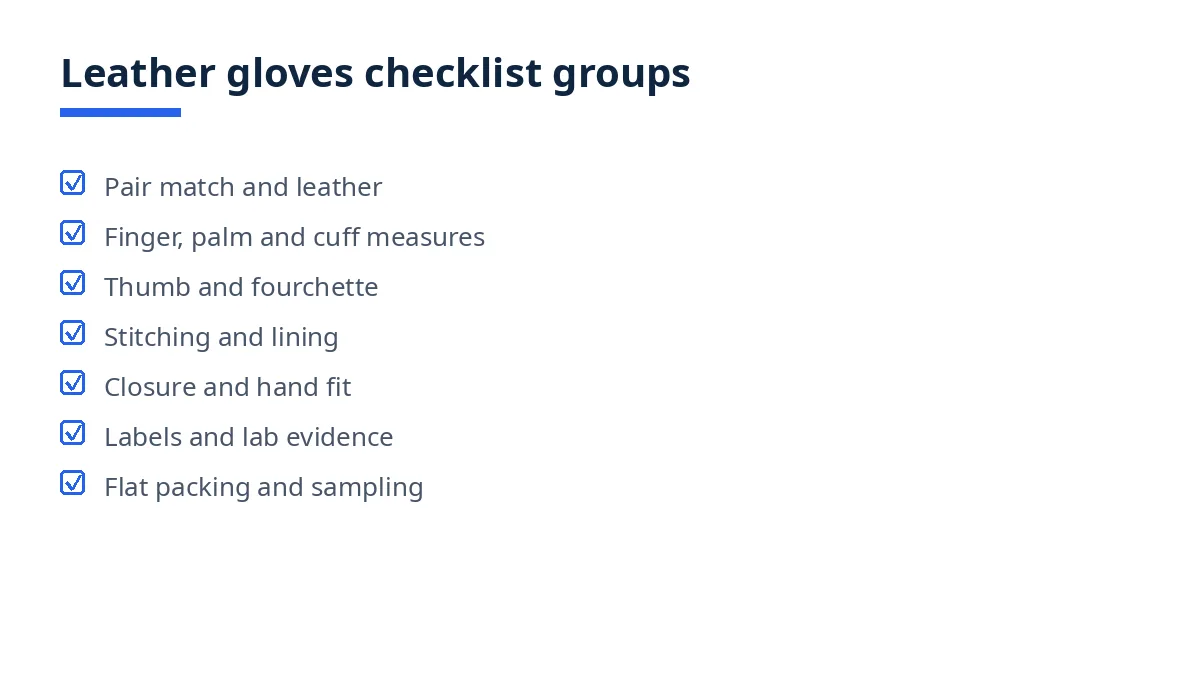
Pair match and leather | 1-5 | Pair shade and grain notes, mark positions |
Finger, palm, and cuff measures | 6-11 | Each measurement against the chart |
Thumb and fourchette | 12-15 | Thumb angle note, panel condition |
Stitching and lining | 16-19 | Stitch faults photographed, lining check |
Closure and hand fit | 20-21 | Closure pull result, worn-fit note |
Labels and lab evidence | 22-24, 25-26 | Label check, method and result per test |
Packing and sampling | 27-28 | Packing note, lot, sample, counts, decision |
Keep lot size, standard and level, sample size, AQL values per class, defect counts with photographs, measurements, lab results, and packing findings with the decision.
How Exportain helps
Exportain is a marketplace where buyers post requirements and connect with sellers and service providers in Bangladesh. Inspection is arranged directly between buyer and provider, who works to the buyer's checklist and pass criteria. For the inspection step, see the inspection services category on Exportain: No services published in this category yet. Agree the sampling plan in writing before production starts.
FAQs
When should this checklist be used?
Before production, when leather, lining, thumb, and closure are approved against the sample; during production, when early pairs show repeating faults; and at final inspection, on finished, packed pairs. A pre-shipment inspection is generally conducted when production is complete and at least 80 percent of the goods are packed.8
Who should complete it?
The buyer, the buyer's inspection provider, or the supplier's quality team can each complete it, but roles stay separate: a supplier checking its own work is factory quality control, not independent inspection. A pre-shipment inspection is arranged by the buyer, usually through an independent third-party firm.8
What are the most common failures?
Recurring glove faults are thin or uneven leather within a pair, severe color difference, left-right asymmetry, uneven or skipped stitching, fingertips that are not round and symmetrical, an asymmetrical thumb, loose threads, and straps or fastenings that are not symmetrical or secure.1 Leather goods inspections add scratches, uneven dyeing, misaligned stitching, glue marks, weak seams, and inconsistent grain.4 On gloves, finger length, fourchette twist, lining pull-out, and cuff elastic join that list.
Can a third party do it?
Yes. A third-party provider can carry out sample, during-production, and pre-shipment checks against this checklist and the buyer's sampling plan, and arrange lab testing where the buyer specification requires it. Require a report recording lot, sample size, defects with photographs, measurements, lining and closure results, lab results, and packing findings. On a fail, agree rework, sort, or remake, then book a re-inspection before shipment.8
Next steps on Exportain
Write leather type, lining, thumb and fourchette specification, defect list, and sampling plan into one requirement, then read the AQL guide and the pre-shipment inspection guide before setting values for a leather glove order. The AQL guide states that the AQL numbers are what buyer and supplier agree and write into the purchase order.7
Sources
- Detailed Explanation of Glove Inspection Methods and Standards. QC Inspection (accessed )
- Genuine Leather Inspection | Grading and Defects. NITR (accessed )
- Leather Gloves: How to Choose, Size and Look After a Good Pair. Hispotion (accessed )
- Leather Goods Inspection and Quality Control in Asia & China. V-Trust (accessed )
- ISO 11640 Leather - Color Fastness Tests - Color Fastness Against Back and forth Rub Cycles. EUROLAB (accessed )
- AQL Tables Reference: ISO 2859-1 Guide for China Importers. TradeAider (accessed )
- AQL Meaning: Acceptance Quality Limit, Tables. Exportain (accessed )
- Pre-Shipment Inspection (PSI). Exportain (accessed )
About the author
Sourcing from Bangladesh?
Post a request for quotation and suppliers on Exportain can send you their quotes directly.
Post an RFQ


