Top Leather Gloves Manufacturers in Bangladesh: How to Find and Verify Them
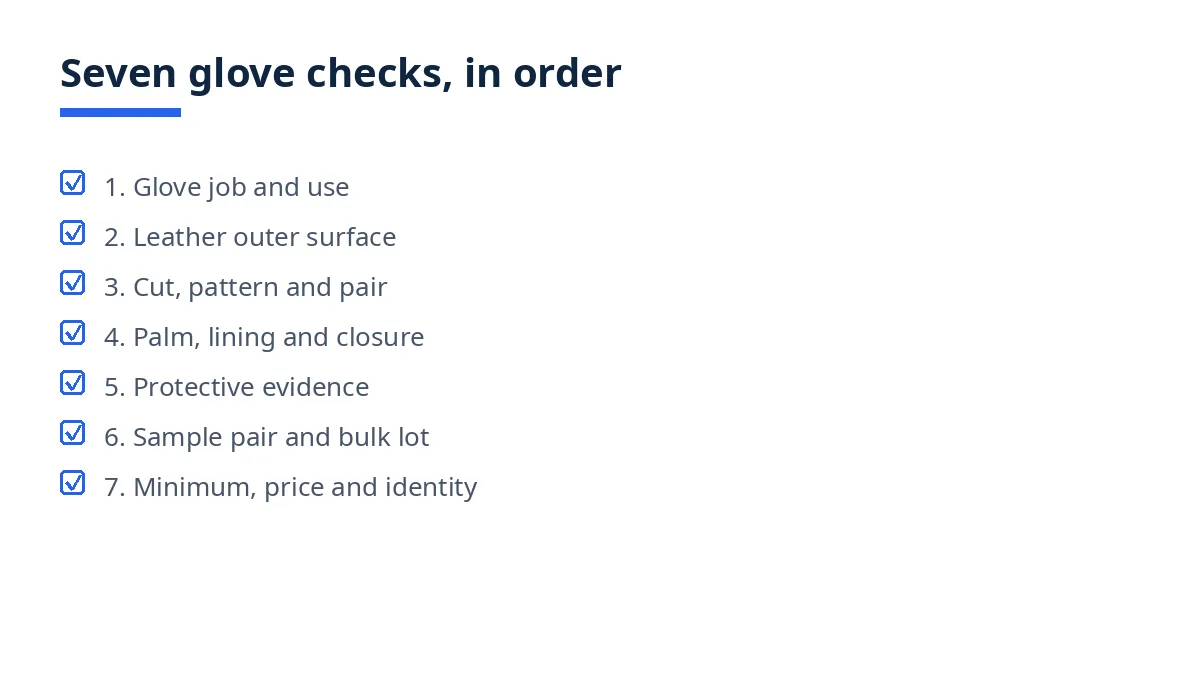
Seven checks for sourcing leather gloves from Bangladesh: glove purpose, leather and classification, cut and fit, palm and lining, protective evidence, sample discipline, and minimums, price unit and identity.
Short answer
Find leather gloves manufacturers in Bangladesh by checking the glove in hand: name the glove job, prove the outer surface is leather, test cut and pair fit, settle palm, lining and closure, require protective evidence where claimed, hold the bulk lot to a sealed sample pair, and count the minimum and price on the same unit while checking identity documents and badges. Order only when every check is closed.
On this page
Key takeaways
Name the glove job first: purpose decides leather, lining, classification, and the evidence to ask for.
Prove the outer surface is leather part by part, and record leather type, finish, and composition in writing.
Judge gloves as pairs: finger length, thumb angle, fourchettes, lining attachment, and closure, left and right together.
Hold bulk lots to a sealed sample pair and a written sampling plan, and count every minimum with its unit.
A leather glove is judged as a pair on a moving hand, not as a flat piece of leather in a photograph. One short finger, one tight thumb, one darker hand, or a lining that pulls out at the fingertip can make the pair unsellable, even when each glove on its own looks sound. The supplier who matters is the one who made the pair in the sample, to a specification the buyer can test.
This article names no companies and ranks no supplier. It sets seven checks for leather gloves manufacturers in Bangladesh: the job the glove must do, the leather in its outer surface, the cut and fit, the palm and lining, the protective evidence where protection is claimed, the sample discipline that keeps a bulk lot true to the sample, and the minimum, price unit, and identity that close the order. No factory name, capacity, price, or certificate is stated as a fact. Figures that illustrate a calculation are labelled "Example figures".
Start from the hand, not the catalogue
Begin with the wearer and the task. A dress glove, a driving glove, a work glove, and a sports glove share the word glove and little else: they differ in leather choice, lining, palm treatment, closure, and evidence.
State the use in one sentence, then the conditions around it: indoor or outdoor wear, wet or dry handling, grip, warmth, abrasion, cut risk, or a sporting action such as holding equipment. Add the size range, the colors, and the quantity per size and color. That sentence becomes the first line of the specification sheet.
Check 1: Name the glove job before the leather
What to pin down. The glove type and its purpose, in the supplier's own written words: dress, fashion, driving, work, protective, or sport, with the task it serves. Ask whether the glove is specially designed for a sport, with functional features such as protection for the hand or help holding equipment. A sport name on packaging does not settle that question on its own.1
Why it matters. Purpose decides the classification, the lining, and the evidence. Gloves whose outer surface is leather or composition leather fall indicatively under heading 4203, with subheading 4203.21 for gloves specially designed for use in sports and 4203.29 for other gloves.1 A warm, multi-purpose winter glove belongs in 4203.29 unless its features show a special sporting purpose, while a padded batting glove points to 4203.21.1
How to verify it. Put the glove job, the task, and any sporting or protective features in the request for quotation, and ask the supplier to confirm them in the quotation. Compare the confirmed purpose with the sample: padding, grip features, and reinforcement should match the job described, not merely the listing title.
Check 2: Prove the outer surface is leather, and name the leather
What to pin down. The material forming the outer surface, the leather type, and the finish, for the palm, back, fingers, and any cuff. Gloves are classified by the material forming the outer surface, and where the shell combines materials, the rule looks to the material giving the goods their essential character.1 Ask for the exact composition in writing: "leather look" or "PU leather" alone is a warning, not an answer.1
Why it matters. The outer surface decides the heading, and imitation leather is not leather for heading 4203: it is based on plastics, rubber, paper or paperboard, or coated textile fabrics, and gloves made from it are classified by their actual material.1 Heading 4203 covers leather and composition leather, including chamois, patent, and metallised leather.1 Natural marks such as scars, insect holes, and wrinkles are inherent to hides, so inspection grades by position and size.2
How to verify it. Ask the supplier to state leather type, finish, and composition for each part, and to confirm whether any part is composition leather, coated textile, or imitation leather. Judge the sample against that statement, part by part. Note what the destination tariff asks for: the United States tariff splits other gloves by leather type, seaming, and lining, and the United Kingdom tariff gives protective gloves their own line.1
Check 3: Test the cut, the pattern, and the pair
What to pin down. The size chart, the measurement method, and the pattern details: finger length, fingertip shape, palm width, overall length, cuff length, thumb position and angle, the narrow side panels between the fingers (fourchettes), and any diamond-shaped pieces at the finger bases (quirks).2
Why it matters. Glove faults hide in small parts: thin or uneven leather within a pair, severe color difference, left-right asymmetry, uneven or skipped stitching, fingertips that are not round, an asymmetrical thumb, and insecure straps or fastenings.2 A twisted fourchette or a thumb at the wrong angle will not be fixed by a better lining or a lower price. Measure the same way every time: around the widest point, across the knuckles excluding the thumb.2
How to verify it. Approve one sample pair per style, color, and size range, and measure it against the chart, finger by finger, against its pair. Check round, symmetrical fingertips, flat fourchettes, even quirks where specified, and mirroring thumbs.2 Wear the pair, close the hand, and spread the fingers: it must not bind at the knuckles or pull across the back.2
Check 4: Settle the palm, the lining, and the closure
What to pin down. The palm material and any reinforcement, the lining type and how it is attached, and the closure ordered. Linings include cashmere, wool, silk, or unlined; closures include elastic, strap, or button. Each must be named, not assumed.2
Why it matters. The palm takes the wear, the lining decides warmth and comfort, and the closure decides whether the glove stays put. A lining must lie flat, attach at fingertips and cuff, and not bunch or pull out when worn.2 A cuff with slack or twisted elastic will not hold its shape, and a closure that does not hold under a gentle pull will fail in ordinary wear.2 Lining alone does not move a glove out of heading 4203, but a lining presented separately is a part, not a glove.1
How to verify it. Write the palm, lining, attachment points, and closure into the specification sheet, then test each on the sample pair. Pull the lining at the fingertips, flex the hand, and check seams at the finger bases and thumb joint.2 Work the closure repeatedly: it must close fully, hold under a gentle pull, and sit symmetrically on both hands.2
Check 5: Ask for protective evidence only where protection is claimed
What to pin down. The exact protective claim, the standard, the performance levels, and the assessing body, where the glove is sold as protective. For mechanical risks, EN 388 covers resistance to abrasion, cut, tear, puncture, and impact.3 Under the pictogram, "0" means the glove did not meet the minimum for that test, and "X" means a test was not carried out or is not applicable.3
Why it matters. A protective claim without a named standard, method, and result for the glove in hand is only a description. EU personal protective equipment (PPE) is grouped by risk category: Category I covers minimal risks including superficial mechanical injury and hot surfaces not exceeding 50 °C, Category II covers risks other than those in Categories I and III, and Category III covers risks that may cause very serious consequences, including hazardous substances, high-temperature environments comparable to at least 100 °C, and cuts by hand-held chainsaws.4 Confirm which category and route apply to the destination market with the importer or a compliance adviser before ordering.
How to verify it. Ask for the laboratory report or certificate naming the glove, standard, method, and result for each risk claimed, and confirm any certificate with its issuer. Read the glove marking against the report: a claim with no report behind it is unproven.
Check 6: Hold the bulk lot to the approved sample pair
What to pin down. The sealed sample pair, the shade and pair-matching rule, the inspection plan, and the packing instruction, agreed before bulk production. Gather first: approved sample pair, signed specification sheet, size chart with tolerances, defect list with classes, written sampling plan, and packing specification.2
Why it matters. Bulk lots diverge from samples in shade, size, and small-part faults, and gloves are sold in pairs. Left and right gloves must match in size, color, grain, and finish, palm to palm and back to back, and color must be even within each pair and across the sampled lot, under the agreed light.2 Thickness must be even across the pair, with no thin fingertips or palm on one hand.2
How to verify it. Seal one sample pair per style and color, and judge the bulk lot pair by pair against it. Agree defect classes and the sampling plan in writing, including standard, level, buyer-specified values per class, and the action on a fail, and apply the plan to the finished, packed lot.2 Test capacity with a trial lot, and ask whether cutting and sewing will run in one run or several. Pack pairs flat with fingers straightened, not folded, banded, or crushed.2
Check 7: Count the minimum, the price, and the supplier on the same basis
What to pin down. The minimum order quantity (MOQ) with its counting unit, the unit price with its basis, and the supplier's identity documents, each in writing. An MOQ is the smallest quantity a supplier will accept on normal terms, counted per order, per style, or per color, and sometimes alongside a minimum order value.5
Why it matters. The same minimum means very different commitments counted per pair, per style, per color, or per size range, and more than one minimum can apply at once.5 There is no standard MOQ for Bangladesh that can safely be assumed: read each minimum with its unit and confirm it in the quotation.5 Price moves with the same drivers: leather type, lining, palm work, size range, closure, protective testing, and packing. To lower a minimum, ask about stock leather or lining, fewer colors and sizes, standard trims and packing, a surcharge, a trial order, or sharing a planned run, and expect a trade-off in unit price.5
How to verify it. Ask whether the minimum is counted per pair, per style, per color, per size range, or by order value, and whether a minimum order value also applies, then check that the quotation states unit price, MOQ, lead time, Incoterm, payment terms, and validity.5 Example figures: 500 pairs per color across three colors in one style means 1,500 pairs, not 500. Request the trade licence and Export Registration Certificate (ERC), and check name and address against quotation and invoice.6 On Exportain, read each badge for the checks its name records: Exportain Verified, Export Verified, Factory Verified, Trading Company Verified, and Trusted Trader.6 Verification is a document and photo review, not a factory inspection, not a check against any government database, and a badge is not a guarantee of capacity, quality, or delivery.6
Seven checks at a glance: what to hold before you order
Check | Evidence to hold | Walk-away signal |
|---|---|---|
1. Glove job | Purpose, task, and sporting features in writing | Price before purpose, or a sport name with no feature |
2. Leather surface | Leather type, finish, and composition per part | "Leather look" only, or imitation leather as leather |
3. Cut and pair | Size chart, measurement points, matched sample pair | One hand judged alone, or fingers unchecked |
4. Palm, lining, closure | Palm, lining, attachment, and closure specified | Lining pulls out, or closure untested |
5. Protective evidence | Standard, method, and report naming the glove | A protective claim with no report behind it |
6. Sample and bulk lot | Sealed pair, sampling plan, trial record, flat packing | Bulk judged without a reference pair or plan |
7. Minimum, price, identity | Counting unit, quotation fields, licence and ERC | Minimum with no unit, or names that differ |
Order only when every check is closed.
What is the biggest mistake buyers make when sourcing leather gloves in Bangladesh?
Buying from a photograph, a company name, or a headline price before fixing the glove job, the leather, and the pair. A photograph cannot show whether the surface is leather or imitation leather, whether the lining reaches the fingertip, whether the thumb mirrors its pair, or whether the price is per pair, per style, or per color. Fix purpose, leather, and specification first, then judge the sample pair, finger by finger.1 2
How can I avoid a bulk lot that does not match the approved sample pair?
Seal one sample pair per style and color, agree the size chart, shade standard, defect classes, and sampling plan in writing, and judge the bulk lot by that record, pair by pair. Retest whenever leather, lining, closure, or pattern changes, and require reports naming the glove and method.2 3 Re-inspect after any rework before shipment.2
Who is responsible for verifying a leather gloves supplier?
The buyer owns the decision. The supplier supplies documents and the sample pair, the issuing body confirms certificates, a broker completes classification, and an inspector or laboratory completes sample and protective checks. A badge records only the checks its name records: verification is a document and photo review, not a factory inspection or a guarantee.6 Cash in advance is the least attractive option for a buyer, while a letter of credit protects both sides because payment depends on documents showing the goods were shipped as agreed.6
Where can I get help verifying a leather gloves supplier on Exportain?
Start on the Trust Center and the supplier verification guide, then open the trust and verification checklist before shortlisting.6 Use the leather gloves quality control checklist and HS code guide, and ask a broker where the glove is borderline.1 2 Report suspected fraud through the Trust Center.6
Next steps on Exportain
Browse Bangladeshi suppliers and open each profile's trust and verification checklist. Read how supplier verification works, the leather gloves quality control checklist, the HS code guide for leather gloves, and the MOQ guide. Then post a free RFQ with your glove job, specification sheet, quantities and counting unit, and destination.
Sources
- HS Code for Leather Gloves: Classification Guide for Importers. Exportain, (accessed )
- Quality Control Checklist for Leather Gloves From Bangladesh. Exportain, (accessed )
- Laboratory Tests - Mechanical Risks. Polyco Healthline (accessed )
- Regulation (EU) 2016/425 of the European Parliament and of the Council of 9 March 2016 on personal protective equipment. European Union, (accessed )
- MOQ Meaning (Minimum Order Quantity). Exportain (accessed )
- How Supplier Verification Works on Exportain. Exportain, (accessed )
About the author
Sourcing from Bangladesh?
Post a request for quotation and suppliers on Exportain can send you their quotes directly.
Post an RFQ