

HS Code for Leather Gloves: Classification Guide for Importers
HS code for leather gloves: the indicative 4203 heading, the 4203.21 sports versus 4203.29 other boundary, outer-surface and lining tests, and US, EU and UK national lines to confirm before declaring.
Short answer
For a leather glove whose outer surface is leather or composition leather, the indicative heading is 4203: subheading 4203.21 for gloves specially designed for use in sports, and 4203.29 for other gloves. Confirm the full national code in the destination tariff with a broker or customs authority on the entry date, because material, construction, lining and design can change the line.
On this page
A leather glove is a hand covering, not a torso garment or container. Customs reads it by what covers the hand, what material forms its outer surface, and whether its design is made for a sport.
Quick answer: indicative HS heading
For a glove whose outer surface is leather or composition leather, the indicative international heading is 4203, articles of apparel and clothing accessories of leather or of composition leather, with subheading 4203.21 for gloves specially designed for use in sports, and 4203.29 for other gloves.1 Verify note: 4203 is indicative only. Confirm the subheading and full national code in the destination tariff for the actual glove, with a broker or customs authority, on the entry date. A knitted, textile, imitation leather or wholly furskin glove may fall outside 4203.
How HS codes are structured (2-4-6 digits)
The Harmonized System narrows in stages: the first two digits give the chapter, the first four give the heading, and all six give the subheading, the internationally agreed level of detail. For leather gloves that reading is chapter 42, heading 4203, then subheading 4203.21 or 4203.29.1 The WCO schedule lists heading 4203 as 4203.10 apparel, 4203.21 sports gloves, 4203.29 other gloves, 4203.30 belts and bandoliers, and 4203.40 other clothing accessories.1 Chapter note 4 includes gloves, mittens and mitts, including those for sport or protection, in heading 4203, with watch straps excluded.1 National tariffs then extend the six digits, and those added digits differ by country, so a supplier code is a starting point for the six digits only.
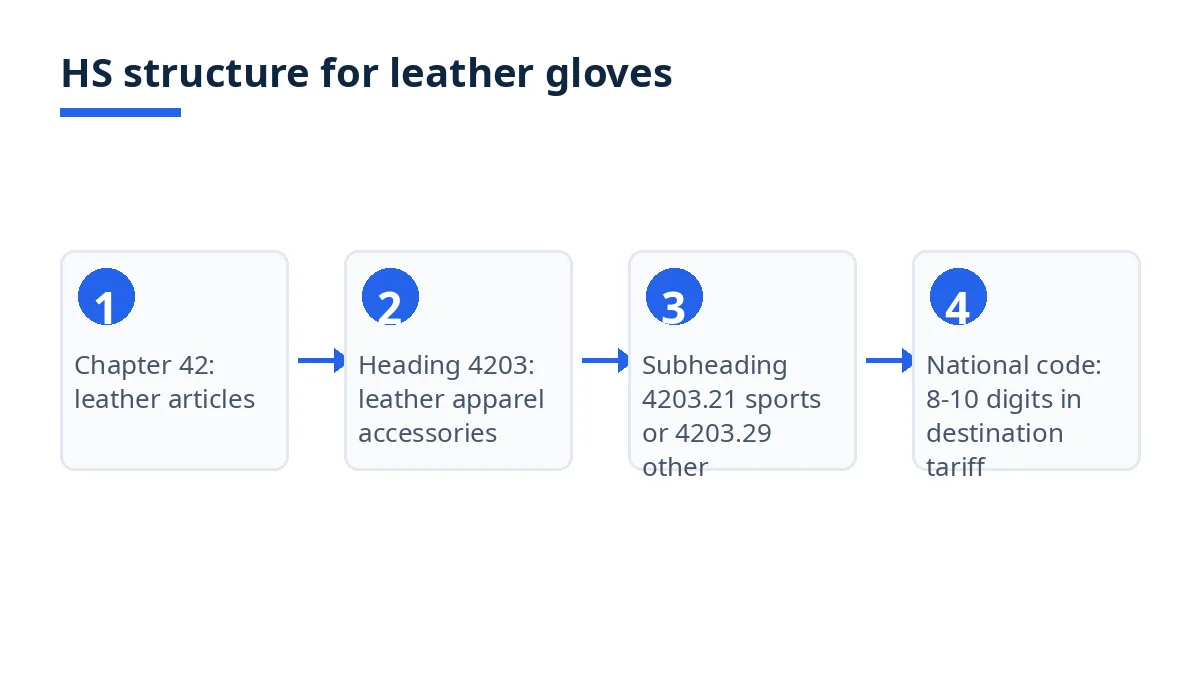
Factors that decide the code for leather gloves
First, what is the outer surface. Gloves are classified by the material forming the outer surface, the exterior shell covering the palm, the back of the hand and, where present, the fingers, wrist and forearm.2 A leather or composition leather shell is a candidate for 4203; a textile, knitted or coated textile shell must be tested under the textile headings first. Where the shell combines materials, the General Rules for Interpretation apply, including the composite-goods rule, which looks to the material giving the goods their essential character.2
Second, is the glove specially designed for use in sports. Subheading 4203.21 covers gloves having functional design features which make them particularly suitable for use in sports, such as features to protect the hands or to assist the holding of equipment.2 A sport name on packaging or a general outdoor claim does not meet that test. A batting glove must be judged on its actual design features, and a warm, multi-purpose winter glove belongs in 4203.29 unless its features show a special sporting purpose.
Third, what is the glove for, if not sport. Subheading 4203.29 covers dress, fashion, driving and protective work gloves made of leather, provided the outer surface test is met. National tariffs split that group further by protective use, leather type, seaming and lining, as below. Lining alone does not move a glove out of 4203, while a lining presented separately is a part, not a glove.2
Fourth, is the material really leather. For chapter 42, leather includes chamois, patent, patent laminated and metallised leather, and heading 4203 covers leather and composition leather.1 Gloves of imitation leather are not gloves of leather for heading 4203: imitation leather is based on plastics, rubber, paper or paperboard, or coated textile fabrics, and gloves made from those materials are classified by their actual material.2 A leather glove combined with furskin or artificial fur stays in heading 4203 irrespective of proportions, while a wholly furskin glove falls under heading 4303 and a wholly artificial fur glove under heading 4304.2 A description saying only "leather look" or "PU leather" is a warning to ask for the exact composition in writing.
For example, a plain goatskin dress glove points to 4203.29, while a padded batting glove points to 4203.21.
National codes: US HTS, EU CN/TARIC, UK commodity code
National codes are national lines, never universal codes. Each line below comes from the tariff named, and each must be re-checked in that tariff on the entry date.
United States, Harmonized Tariff Schedule (HTS). The sports subheading splits by sport and type: 4203.21.20 batting, 4203.21.40 other baseball and softball, 4203.21.55 cross-country ski, 4203.21.60 other ski or snowmobile, 4203.21.70 ice hockey, and 4203.21.80 other sports gloves.3 The other-glove subheading splits by leather and construction: 4203.29.05 and 4203.29.08 wholly horsehide or cowhide, 4203.29.15 and 4203.29.18 other horsehide or cowhide, 4203.29.20 not seamed, 4203.29.30 men's, with lined and not lined splits, and 4203.29.40 and 4203.29.50 other persons, not lined and lined respectively.3 A United States importer must therefore know sport, leather type, seaming and lining first.
United Kingdom, Trade Tariff commodity code. The United Kingdom tariff lists gloves at 4203 2100 00 for sports gloves, and, under other gloves, 4203 2910 00 for protective gloves for all trades and 4203 2990 00 for other gloves.4 A protective work glove is therefore 4203 2910 00, while a dress glove with no protective or sporting design falls under 4203 2990 00, subject to current-tariff confirmation.4
European Union, Combined Nomenclature and TARIC. The European Union extends the same six digits to eight in the Combined Nomenclature, and adds further TARIC detail for measures and controls.5 For leather gloves, the sports line is CN 42032100, and other leather gloves start from CN 420329, completed in the current TARIC lookup for the member state of entry, not copied from a United Kingdom or United States line.
System | Sports gloves | Other leather gloves |
|---|---|---|
International (6 digits) | 4203.21 | 4203.29 |
United States (HTS) | 4203.21.20 batting, 4203.21.70 ice hockey, 4203.21.80 other sports | 4203.29.20 not seamed, 4203.29.30 men's, 4203.29.40 not lined, 4203.29.50 lined |
United Kingdom (commodity code) | 4203 2100 00 | 4203 2910 00 protective, 4203 2990 00 other |
European Union (CN/TARIC) | CN 42032100, then TARIC | CN 420329, then TARIC |
How to confirm the code officially
Start with a written description a customs officer can test: glove type, outer surface materials and proportions, construction, lining, leather type, and design features showing a sporting or protective purpose, if any.6 Ask the supplier for that description in writing, because a change in material, lining or design can change the code.
Next, read the heading text and chapter notes in the destination tariff, then compare subheadings only at the same level. The classification guide sets out that method: describe the product precisely, find the chapter, choose the heading from the texts and notes, choose the subheading comparing only at the same level, extend the six digits in the destination tariff, and record the reasoning.6 If two headings still compete, a customs broker in the destination country is the first call.
For a decision customs must honour, apply before shipment for an advance ruling: an advance tariff ruling in the United Kingdom, binding tariff information in the European Union, or a binding ruling from United States Customs and Border Protection. The hub guide notes that advance rulings are legally binding decisions given before import or export.5 Each glove type needs its own application, and another trader's ruling is not a decision about your glove.
Common classification mistakes
The most frequent mistake is copying a full national code from another country. Only the first six digits are international; the rest are national, so a United States line does not become a European Union or United Kingdom code by changing its punctuation.
The second mistake is classifying from a photograph, trade name or marketing label. A glove photographed as a sports glove may have no functional sporting feature, and a glove photographed as a leather glove may be imitation leather. Customs classifies goods as presented, by objective characteristics, not by the listing name.
The third mistake is stopping at the glove heading and ignoring neighbouring headings. A leather jacket is apparel under 4203.10, not a glove, even if sold with matching gloves. A leather belt is 4203.30. A leather bag, wallet or similar container is 4202, with pocket articles at 4202.31 when their outer surface is leather or composition leather, not 4203, because the article is carried, not worn on the hand.1 A knitted or crocheted glove belongs under heading 6116, and a woven textile glove belongs under heading 6216, not under heading 6211, which covers other textile apparel such as track suits, not handwear.
The fourth mistake is treating lining as a reason to change heading. An attached lining does not by itself move a leather glove out of 4203, while a removable lining presented separately is a part, not a glove. The fifth mistake is never re-checking. A supplier may switch leather type, add a lining, change seaming, or add a padded palm for a sport. Each change can move the national line, even when the six digits stay the same, so an old quotation, invoice or tariff edition is not confirmation for a new shipment.
Related duties and documents
This guide states no duty rate. Duty treatment is national, changes over time, and depends on the full national code, origin, and any preference, measure or control applying on the entry date. Read the current rate and any measure in the destination tariff for the exact line chosen, and confirm origin and preference paperwork with your broker before shipment. A wrong code can lead to reclassification, a reassessed amount, delay, and penalties.
For the shipment file, keep a specification sheet answering the four deciding questions, a copy of the tariff line as checked, with its date, and the broker or ruling reference, if any. On the commercial documents, state glove type, outer surface materials, lining and design features in plain words, so declaration, invoice and specification sheet agree. Where buyer and seller use different codes, resolve the difference in writing before shipment. No document can cure a code that does not match the goods as presented, so check the sample against the specification sheet before the first bulk shipment.
FAQs
What is the HS code for leather gloves?
The indicative international heading is 4203, with 4203.21 for sports gloves and 4203.29 for other gloves of leather or composition leather.1 That is a starting point only. The full code is the national line in the destination tariff, chosen after outer surface, construction, lining and design features are confirmed, and verified on the entry date.
Is the HS code the same in every country?
The first six digits should be the same internationally for the same product, because they come from the shared Harmonized System. The full code is not the same everywhere, because countries add their own digits and measures after the six digits. The lines above agree on 4203.21 and 4203.29, and differ after that point.
How do I confirm the correct code?
Write down the full glove description, read the heading texts and chapter notes in the destination tariff, compare subheadings only at the same level, extend the six digits in that tariff, and record the reasoning.6 If the answer still turns on a design feature or competing heading, ask a destination-country broker, or apply for an advance ruling before shipment.
What happens if I use the wrong code?
Customs may reclassify the goods, reassess duty and taxes, hold the shipment, and impose penalties, and a wrong code can mean a missed licence, preference or control. Tell your broker promptly if you find an error. Penalties and procedures are national and vary, so none are stated here as a fixed outcome.
Next steps on Exportain
Post a free RFQ on Exportain at https://exportain.com/rfqs, stating glove type, outer surface materials, lining, design features, quantity and destination country, so suppliers can quote against the same specification you will declare. Read the Harmonized System hub at https://exportain.com/blog/hs-code-harmonized-system and the classification guide at https://exportain.com/blog/hs-codes-how-to-classify-your-product, and browse suppliers at https://exportain.com/suppliers. Share the specification sheet and tariff line with your broker before you confirm the order.
Sources
- HS Nomenclature 2022, Chapter 42. World Customs Organization (accessed )
- Memorandum D10-14-29: Tariff Classification of Gloves. Canada Border Services Agency (accessed )
- Harmonized Tariff Schedule of the United States, Chapter 42 (2026 Revision 18). U.S. International Trade Commission (accessed )
- UK Integrated Online Tariff: Heading 4203, Articles of apparel and clothing accessories of leather. UK Government (accessed )
- HS Code (Harmonized System Code). Exportain (accessed )
- How to Find an HS Code: Step-by-Step. Exportain (accessed )
About the author
Sourcing from Bangladesh?
Post a request for quotation and suppliers on Exportain can send you their quotes directly.
Post an RFQ


