Private Label Jute Rugs and Carpets Manufacturing in Bangladesh: A Brand Owner's Guide
A private-label rug is built to your specification alone: your sizes, weave, backing and label. This guide covers the tech pack, sampling rounds, labelling rules and a worked 1,000-rug order to London.
Short answer
A private-label jute rug from Bangladesh is built to your specification alone: you set the size, weave, weight, backing and label, and the mill builds that rug for your brand. Brief the mill with a numbered tech pack, approve the shade and a full-size proto sample, then a pre-production sample from the bulk dye lot, and lock the specification before bulk. Labels must meet EU and US fibre rules, and large rugs must pass the US flammability test.
On this page
Key takeaways
Private label means the mill builds a rug to your specification alone, with your sizes, weave, backing, edge finish and label, and does not sell it to another buyer.
Write the tech pack before you ask for a price: size, construction, fibre composition, weight, backing, edge, shade, labels, packing, quantity and tests, each with a tolerance.
Sample in three rounds: the proto proves the design, the pre-production sample proves the line can repeat it, and the bulk inspection judges the lot against the sealed sample.
Example figures price 1,000 branded braided rugs to London at USD 22.06 per rug before duty, or USD 23.70 landed with 8.00 per cent UK duty on the CIF value.
A private-label rug order starts with your specification, not with a catalogue page. You define the size, weave, weight, backing and label wording, and the mill in Bangladesh builds that rug for your brand alone.
In the year to June 2025, Bangladesh exported jute and jute goods worth 820.16 million dollars, down from 855.23 million dollars the year before, per Export Promotion Bureau data.1 Jute yarn and twine still earned the most at 461.83 million dollars, while sacks and bags rose to 125.96 million dollars.1
What does private label mean for a rug
A stock rug is a design the mill already makes: you pick a size and a shade from its range. A private-label rug is built to your specification alone, with your sizes, weave, backing, edge finish and label, and the mill does not sell it to another buyer.
You own the design, artwork, shade references and label wording; the mill owns the loom setup and production method. Put that split in writing before sampling, including who holds the dye formula and the sealed shade reference.
Private label differs from wholesale: wholesale buys existing designs at volume, while private label creates a design and pays its set-up.
How do you brief a mill? Write the rug tech pack first
Write the tech pack before you ask for a price: a numbered specification with a tolerance on every measurement.
Spec field | What to state |
|---|---|
Design code and name | Your code, name, version date |
Size and shape | Length, width, shape, tolerance |
Construction | Braided, flatweave, tufted or hand-knotted |
Fibre composition | Each fibre by weight |
Weight | Grams per square metre |
Backing | None, cotton, latex or non-slip, and its material |
Edge finish | Bound, turnover or fringed |
Shade | Natural or dyed, Pantone reference |
Labels and hangtag | Text, position, languages, hangtag art |
Packing | Rolled, polybag, carton marks |
Quantity | Pieces per design, size, shade |
Tests | Flammability, fibre content, chemical tests |
Send the tech pack and artwork to three to five mills, and ask each to confirm which steps it does in house. Our supplier verification guide explains how to check a mill before you order.
Which construction, size and backing should the brief lock in
Braided rugs are coiled strips stitched together, and they suit round and oval shapes. Flatweave rugs are woven flat on a loom, with no pile, and suit large rectangular rooms. Tufted rugs carry pile pushed through a backing cloth and fixed with a glued second backing. Hand-knotted rugs are knotted pile by hand and take the longest to make.
One retail hand-woven rug in 100 per cent jute, woven by the Panja technique, weighs 4,700 grams per square metre.2 A rug that heavy lies flat and costs more to ship, so state the weight in the tech pack.
The same retail rug is sold in 80 by 200 cm, 170 by 240 cm, 200 by 300 cm and 250 by 350 cm, with custom sizes up to 5 metres wide and 9 metres long.2
Braided and flatweave rugs usually have no backing. Tufted rugs need one, and it changes the composition, the weight and the flammability result.
How does a private-label rug order run, from brief to bulk
Seven steps, each ending with a written approval.
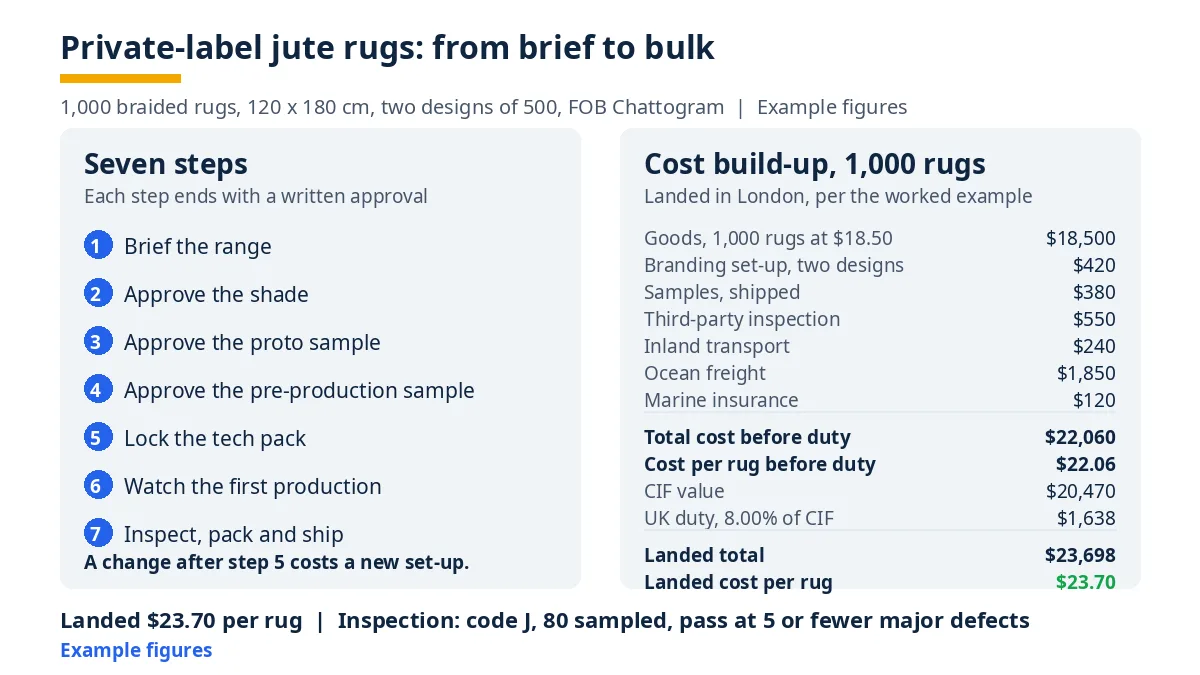
Brief the range: send the tech pack, artwork and target price to three to five mills.
Approve the shade: the mill dyes a strike-off to your Pantone reference; approve the dyed yarn, not a screen photo.
Approve the proto sample: one rug per design, full size, with backing, edge and labels fitted.
Approve the pre-production sample: made on the production line from the bulk dye lot; seal one and keep it.
Lock the tech pack: freeze size, construction, shade, backing, edge and label text at one version and date.
Watch the first production: hold the first rugs off the line for your check.
Inspect, pack and ship: run the sampling plan on the packed lot, then load.
A change after step five costs a new set-up, so price every change as a fresh order.
What does each sampling round prove
Three rounds, each proving something different: a rug approved as a small swatch is not an approved rug.
The proto sample proves the design, checked in full size on a flat floor. The pre-production sample proves the line can repeat the design from the bulk dye lot: seal it and keep it where the inspector can reach it. The bulk inspection proves the lot: packed rugs are checked against the sealed sample, not the catalogue photo.
Shade is the most common failure: jute takes dye unevenly, so approve a shade range and reject a lot outside it. Shedding is normal for jute, and the care line should say so.2
The sampling plan comes from ISO 2859-1: at General Inspection Level II, a lot of 501 to 1,200 rugs takes code letter J and a sample of 80 rugs: AQL 2.5 passes at 5 or fewer major defects and fails at 6; AQL 4.0 passes at 7 or fewer minor defects and fails at 8.3
What labels, care wording and hangtags does a branded rug need
A branded rug carries three layers of wording: the sewn-in content label, the care instruction, and the hangtag on the packed rug.
Under Regulation (EU) No 1007/2011, the fibre composition must use only the fibre names in Annex I, each named with its share by weight in descending order.4 The words 100 per cent, pure and all are reserved for a rug made of one fibre alone.4 The label has to stay readable and fixed to the rug, and use the official language of the country of sale.4
In the United States, the Federal Trade Commission requires most textile products, including rugs and mats, to carry a label with the fibre content, the country of origin and the responsible business.5 Fibres are named by generic name in descending weight order, and a fibre below 5 per cent is shown as other fibre.5 A 3 per cent tolerance applies, but none where the label claims a single fibre, and rug backings are not covered.5
The FTC Care Labeling Rule covers textile wearing apparel only, so it does not impose a care label on a rug, and its symbol route is limited to the ASTM D5489-96c set.6 Retailers still expect a care line: vacuum without a brush, blot spills at once, keep the rug dry, and use a professional service for deeper cleaning.2
A large rug, one side over 6 feet and area over 24 square feet, that fails the surface flammability test cannot be sold in the United States. A small rug that fails may still be sold with the permanent warning label the rule prescribes, opening FLAMMABLE (FAILS U.S. DEPARTMENT OF COMMERCE STANDARD FF 2-70).7 A 1997 recall of more than 249,000 braided rugs turned on this point: most were small and unlabelled.7
Chemical safety is usually shown with OEKO-TEX Standard 100: rugs fall under Class IV, the decoration class, where the formaldehyde limit is 300 mg/kg, against 16 mg/kg for Class I baby articles. The limits for heavy metals, amines and PFAS are the same in every class.8 A certificate runs for 12 months and is renewed by re-submitting samples.8
The hangtag carries the brand, design code, size, composition, care line, origin and certificate number.
How do MOQ per design and cost per piece work
The minimum order for a private-label rug is set per design, not per order. Each design needs its own dye lot, label run and sampling, so two designs at 500 pieces each cost more per piece than one design at 1,000 pieces. Our MOQ guide explains how minimums work; for rugs, the design count drives the set-up.
Set-up is the one-off cost a stock rug does not carry: dye matching, label tooling, hangtag plates and sample freight. Spread across 1,000 rugs it is small per piece; spread across 200 it is not, so ask the mill to quote it as a separate line.
The cost per piece is the goods, set-up, samples, inspection, inland transport, freight and insurance, divided by the number of rugs. Duty sits outside that sum, because it is charged on the CIF value at the border.
Which code and duty apply to a branded rug
Woven rugs that are not tufted or flocked fall under heading 5702; the UK tariff lists jute rugs under 5702 9900 10, with third-country duty of 8.00 per cent and import VAT of 20 per cent, charged per square metre.9 The heading follows the construction and the fibre, not the brand or the label.
Worked example: 1,000 branded braided rugs for London
Example figures. A London home-goods brand orders 1,000 braided jute rugs, 120 by 180 cm, in two designs of 500 each, one natural and one dyed, FOB Chattogram. All figures are illustrative, not market prices.
Cost line | Amount |
|---|---|
Goods, 1,000 rugs at USD 18.50 each | USD 18,500 |
Branding set-up, two designs | USD 420 |
Samples, shipped | USD 380 |
Third-party inspection | USD 550 |
Inland transport | USD 240 |
Ocean freight | USD 1,850 |
Marine insurance | USD 120 |
Total cost before duty | USD 22,060 |
Cost per rug before duty | USD 22.06 |
CIF value is USD 20,470: 18,500 plus 1,850 plus 120. UK duty at 8.00 per cent is USD 1,638, giving a landed total of USD 23,698, or USD 23.70 per rug.9
The lot falls in the 501 to 1,200 band: code J, 80 sampled, passing at 5 or fewer major defects and failing at 6.3
How is quality checked at each stage
Quality is checked at the stage where the fault is made, not only at the end.
Stage | Check | If it fails |
|---|---|---|
Yarn and dye lot | Shade against the Pantone reference and the sealed rug | Reject the dye lot |
Weaving and braiding | Even braid, no stitch gaps, no loose ends | Rework or remake |
Backing and edge | Backing fixed, edge bound, no fraying | Re-glue or re-bind |
Labels and hangtag | Wording, position, language, certificate number | Re-label the lot |
Packing | Rolled, labelled, dry, cartons marked per design | Re-pack |
Final inspection | AQL sample against the sealed rug | Hold, sort or remake |
Mistakes brand owners make on a first private-label rug order
First, approving the shade from a screen photo: only a dyed rug in daylight counts. Second, approving a sample in one dye lot and accepting bulk in another, with no sealed reference held back. Third, printing 100 per cent jute on a rug whose backing or cord is a different fibre. Fourth, ordering two designs at 500 pieces each and expecting one-design pricing. Fifth, printing the labels before the flammability result.
Frequently asked questions
What is a private-label jute rug?
A rug built to your specification alone, which the mill does not sell to another buyer.
How many rugs do I need to order per design?
The minimum is set per design, because each design needs its own dye lot and label run. Ask the mill for both, then compare the cost per piece at one design and at two.
Who is responsible for the label wording?
You are. The mill prints what you approve, so approve the fibre composition, the languages and the origin marking in writing before the labels are printed.
Next steps on Exportain
Start with the tech pack, then put it in front of mills: send an RFQ or browse suppliers on Exportain. Read the quality control checklist for rugs before the first inspection, and the HS classification guide to confirm the code before ordering.
Sources
- Exports of jute and jute goods keep falling. The Financial Express, (accessed )
- GLEN Natural Check custom-size. Woven Works (accessed )
- AQL Calculator | Sample Size and ISO 2859-1 Tool. AQMBD (accessed )
- Regulation (EU) No 1007/2011 of the European Parliament and of the Council of 27 September 2011 on textile fibre names and related labelling and marking of the fibre composition of textile products. EUR-Lex (accessed )
- Threading Your Way Through the Labeling Requirements Under the Textile and Wool Acts. Federal Trade Commission (accessed )
- Navigating the FTC Care Labeling Rule in the Modern Age. Foley & Lardner LLP, (accessed )
- CPSC, Achim Importing Co. Announce Recall of Flammable Rugs. U.S. Consumer Product Safety Commission (accessed )
- OEKO-TEX Standard 100: Complete Guide. TextileTuts (accessed )
- Carpets and other textile floor coverings, woven, not tufted or flocked, whether or not made up, including 'kelem', 'schumacks', 'karamanie' and similar hand-woven rugs - UK Integrated Online Tariff. GOV.UK (accessed )
About the author
Sourcing from Bangladesh?
Post a request for quotation and suppliers on Exportain can send you their quotes directly.
Post an RFQ