How to Import Leather Shoes From Bangladesh in 2026: Complete Buyer Guide
A leather shoe import from Bangladesh turns on construction, last and fit, testing and landed cost. This guide covers shoe types, Goodyear welt, Blake stitch and cemented construction, sizing, HS 6403 duties and a worked 2,400-pair order to Hamburg.
Short answer
To import leather shoes from Bangladesh, confirm the shoe type, construction and last with the factory, agree the upper leather, sole and size run in writing, and test samples for flex, sole bond and chromium VI before bulk production. Leather shoes fall under HS heading 6403, and shipments from Bangladesh enter the EU duty-free under the Everything But Arms arrangement when origin rules are met. Order samples first, then place bulk against a signed specification.
On this page
Key takeaways
Leather footwear earned Bangladesh 691.7 million dollars in FY 2025-26, the largest part of its leather exports.
Construction decides repair and wear: Goodyear welt resoles repeatedly, Blake stitch stays slim, and cemented relies on adhesive alone.
Size by foot length in millimetres, not by the number on the box: a US men's 9 is a UK 8.5 and an EU 42.
EU duty is 0% under Everything But Arms with proof of origin; the third-country rate for heading 6403 is 8%.
A leather shoe is bought with the feet, not the eyes. A buyer can admire the upper in a photograph, but the order succeeds or fails on two things the photograph never shows: how the sole is attached and how the last fits the foot.
Which shoe types should you order first?
Start with the shape your customers already buy. An oxford has closed lacing, with the eyelet tabs stitched under the vamp. A derby has open lacing, with the tabs on top of the vamp, which opens wider and fits a higher instep. A loafer has no laces and slips on, so fit depends on heel grip and the throat of the shoe. A leather sneaker pairs a leather upper with a rubber cupsole.
How do Goodyear welt, Blake stitch and cemented construction differ?
In Goodyear welt construction, a leather strip called the welt is stitched to the upper and to a canvas rib on the insole, and the outsole is stitched to the welt in a second seam.1 A cobbler can replace the sole without touching the upper, and well-kept welted pairs are commonly credited with 15 to 25 years of service with periodic resoling.1
In Blake stitch construction, a single stitch runs straight through the insole, upper and outsole, which makes the shoe slimmer and lighter than a welted one.1 It can usually be resoled, but the stitch holes run through the bottom of the shoe, so moisture resistance is weaker than in welted construction.1
In cemented construction, the outsole is bonded directly to the upper with adhesive, with no welt and usually no stitching at the sole edge.1 The method is faster and cheaper, but once the glue line separates, fitting a new sole without damaging the upper is rarely practical, so most cemented pairs are not candidates for a full resole, and their typical lifespan is 3 to 5 years.1
Construction | How the sole is attached | Resoling |
|---|---|---|
Goodyear welt | Two stitched seams through a leather welt | Repeatedly |
Blake stitch | One stitch through insole, upper and outsole | Usually, with specialist equipment |
Cemented | Adhesive bond only | Rarely |
Check the construction on the sample: a line of stitching around the perimeter through a leather strip marks a Goodyear welt, while a smooth, stitch-free join marks cemented construction.1
What does the last decide about fit?
Every shoe is shaped on a last, a foot-shaped form that fixes the pair's length, width, toe shape and instep, so two shoes in the same size can fit differently. Ask the factory for the last name or code and the finished length and width in millimetres for each size.
US sizing is built on the barleycorn, an old unit of one third of an inch, about 8.47 mm, while EU sizing uses the Paris point, an increment of two thirds of a centimetre, about 6.67 mm, and measures the last rather than the foot directly.2 A US men's 9 is roughly a UK men's 8.5, and a US men's 9 is an EU 42 for a foot length of 27.0 cm.2 A half size adds only about 3 to 4 mm of length, so most fit problems blamed on length are really width problems.2
Foot length | US men | UK men | EU |
|---|---|---|---|
25.0 cm | 7 | 6.5 | 40 |
26.0 cm | 8 | 7.5 | 41 |
27.0 cm | 9 | 8.5 | 42 |
In US sizing, D is standard for men and wide for women, while 2E is wide for men.2 If a shoe feels tight across the ball of the foot, try a wider width before a longer size.2
Which upper leather and sole material suit the shoe?
Match the upper leather to the flex point of the shoe, not to the swatch alone. The vamp, the front of the upper, folds with every step, so it needs leather that flexes without cracking at the crease, and a stiff leather that looks fine flat can crack there within weeks. Ask for the vamp leather by name, thickness and tannage, and test the exact leather from the bulk lot, not a showroom swatch.
Chrome-tanned leather is soft at once and holds colour evenly, while vegetable-tanned leather starts firm and changes with wear.
A leather sole is formal, breathable and resoleable, but it slips on wet floors and wears fast on rough ground. A rubber sole grips, resists water and suits casual shoes and boots.
How should you test a shoe before bulk?
Two ISO methods cover the flexing that breaks most shoes. ISO 17694:2016 sets the flex test for uppers and linings, cutting specimens from the shoe vamp, folding them in a test machine and checking whether the material cracks at the flexing creases.3 ISO 17707:2005 sets the flex test for outsoles, assessing how sole materials and surface patterns affect cut growth, for outsoles with a maximum longitudinal rigidity of 30 N.4
REACH bars skin-contact leather from the EU market once chromium VI hits 3 mg/kg of the leather's total dry weight. EN ISO 17075 measures that content, and 3 mg/kg is also the method's determination limit.5 For Gold and Silver ratings under the Leather Working Group audit, chromium VI above 3 mg/kg is an automatic failure.6
What does a pair pay at the border?
Leather shoes sit in HS chapter 64, and the heading turns on the upper material. Heading 6403 covers shoes with leather uppers, where the outer sole is rubber, plastics, leather or composition leather.7 A leather-upper sports shoe belongs in subheading 6403.19, where the third-country duty is 8 percent.7 Our HS code guide for leather shoes works through the subheadings by shoe type.
As a least developed country, Bangladesh qualifies for the EU Everything But Arms scheme, giving its goods tariff-free, quota-free entry into the EU apart from arms and ammunition.8 The Commission puts the share of Bangladeshi exports entering the EU duty- and quota-free at 91 percent, and counts Bangladesh as the scheme's biggest user, with 19 billion euros of exports gaining from the preferences in 2024.8 Import VAT is charged on the customs value plus duty at the destination rate: Germany charges 19 percent, so a duty-free shipment still pays VAT on the full CIF value.
Where are Bangladesh shoe factories, and what should you check there?
Bangladesh earned 691.7 million dollars from leather footwear in the 2025-26 financial year, up nearly 3 percent on the previous year, out of 1.23 billion dollars for leather and leather goods as a whole.9 Apex Footwear alone accounts for around 15 percent of the foreign currency the leather sector brings in each year, and it exports footwear to Germany, Italy and other European countries, with shipments to the United States and Canada begun as well.9
Most export footwear comes from factories around Dhaka and Gazipur. Apex Footwear runs its plant at Chandra in Gazipur and makes leather formalwear, casual footwear and semi-athletic footwear for retailers in Europe, North America and Asia.10
Check two things before bulk. First, ask which tannery supplies the upper leather and whether it holds a Leather Working Group rating. The LWG audit runs across 17 sections, and the medal follows the lowest-scored section, with Gold at 85, Silver at 75, Bronze at 65 and Audited at 50 percent.6 Second, ask where the leather was tanned. The tanneries left Hazaribagh for Savar almost ten years back, yet the new estate remains unfinished, and a number of buyers will not take leather that comes from it.9 Our leather shoes manufacturers guide sets out the verification steps in order.
What do MOQ and price per pair look like?
A shoe factory prices by the pair, by the size run and by the construction, so a single price without those three details means nothing. The figures below are example figures for planning, not quotations.
Shoe | Construction | Example FOB per pair | MOQ |
|---|---|---|---|
Leather sneaker | Cemented, rubber cupsole | 12 to 16 dollars | 1,000 pairs |
Derby | Blake stitch, leather sole | 18 to 24 dollars | 800 pairs |
Oxford | Goodyear welt, leather sole | 28 to 38 dollars | 500 pairs |
Ankle boot | Goodyear welt, rubber sole | 30 to 42 dollars | 500 pairs |
MOQ is usually set per style and colour, then split across the size run, so a 500-pair MOQ may mean 500 pairs of one colour in one construction, not 500 pairs spread across five colours. Our leather shoes price guide breaks down the FOB build-up, and our leather shoes MOQ guide explains how to negotiate the split.
How do you pack and ship 2,400 pairs?
Each pair goes into its own shoe box with tissue and a shoe tree or stuffing that holds the vamp shape, and the box carries the style, colour and size on the outside. Pairs are then packed into export cartons, usually 12 pairs per carton for adult shoes, with the carton marked with the style, colour, size range and pair count.
A 20-foot container holds roughly 2,400 to 3,000 pairs of boxed adult leather shoes, depending on shoe size and box dimensions, so a 2,400-pair order is a sensible single-container load.
Worked example: 2,400 derbies to Hamburg
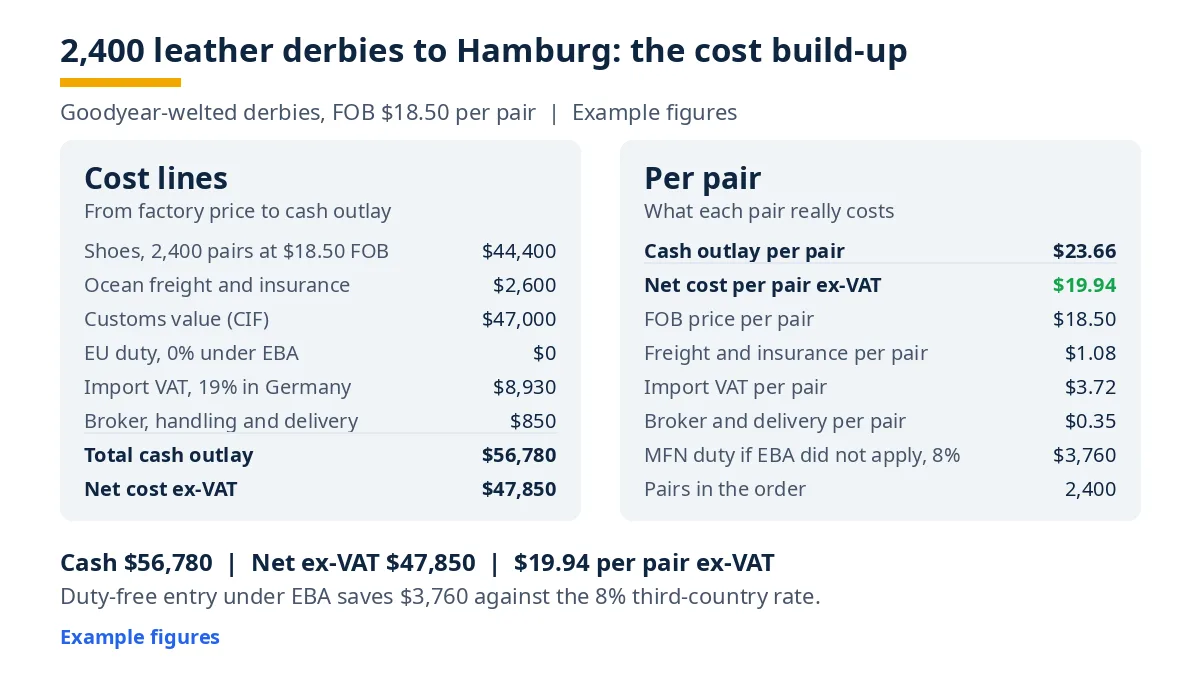
A buyer in Germany orders 2,400 pairs of Blake-stitched derbies from a Gazipur factory, at an agreed FOB price of 18.50 dollars per pair. The figures below are example figures.
The goods cost 44,400 dollars at FOB. Ocean freight and insurance add 2,600 dollars, giving a CIF customs value of 47,000 dollars. Duty is zero, because the shipment qualifies for tariff-free entry under Everything But Arms once origin is proven.8 German import VAT at 19 percent applies to the CIF value, adding 8,930 dollars. Brokerage, handling and delivery add 850 dollars.
Total cash outlay is 56,780 dollars, and the net cost excluding VAT is 47,850 dollars. That is 23.66 dollars per pair in cash terms and 19.94 dollars per pair excluding VAT.
What documents travel with the shipment?
Four documents carry most shoe shipments, and a missing one delays the container at the destination port. The commercial invoice states the style, quantity, unit price and total value. The packing list states the pairs per carton, the carton count and the size breakdown. The certificate or statement of origin supports the tariff-free claim under Everything But Arms.8 The inspection report, with the flex and chromium VI results for the bulk lot, supports the quality claim and the REACH position.5
Which mistakes cost shoe buyers the most?
The expensive mistakes in shoe importing are fitting mistakes, not price mistakes. Ordering by the size number instead of by foot length in millimetres produces a size run that fits nobody well. Approving a sample in one leather and accepting bulk in another produces a vamp that cracks at the crease. Accepting a cemented shoe for daily wear produces a sole that separates while the upper still looks presentable. Skipping the chromium VI report on the bulk lot produces a shipment that cannot be sold in the EU.5 Agreeing a price without the landed cost produces an order that loses money on the VAT line alone.
Each of these is avoidable at the sample stage, which is the cheapest stage to fix a shoe. Order the sample in the bulk leather, on the bulk last, in the bulk construction, and wear-test it for a full week before you approve bulk. Our footwear sourcing guide covers the wider supplier search.
Next steps on Exportain
Start by comparing factories on Exportain: read our leather shoes manufacturers guide and footwear sourcing guide, then post an RFQ with the shoe type, construction, last measurements and size run in the requirement. A factory that answers with its last code, its test reports and its size-run pricing is the factory to take to sample stage.
Sources
- Goodyear Welt vs Cemented Soles: The Construction Detail That Decides Shoe Lifespan. Wardrobe Loft, (accessed )
- Walking Shoe Sizing & Fit Guide 2026 (US/UK/EU/JP). FitVille (accessed )
- ISO 17694:2016 - Footwear - Test methods for uppers and lining - Flex resistance. International Organization for Standardization, (accessed )
- ISO 17707:2005 - Footwear - Test methods for outsoles - Flex resistance. International Organization for Standardization, (accessed )
- Commission Regulation (EU) No 301/2014 amending Annex XVII to Regulation (EC) No 1907/2006 as regards chromium VI compounds. EUR-Lex, (accessed )
- Certification - Leather Working Group. Leather Working Group (accessed )
- Customs tariff number 64031900 - Sports footwear, with outer soles of rubber, plastics, leather or composition leather and uppers of leather. TariffNumber (accessed )
- EU trade relations with Bangladesh. European Commission, (accessed )
- Leather sector spots 'hope' despite old troubles. bdnews24, (accessed )
- Bangladesh's leather industry: A vanguard role of Apex Footwear Limited. Global Bangladesh (accessed )
About the author
Sourcing from Bangladesh?
Post a request for quotation and suppliers on Exportain can send you their quotes directly.
Post an RFQ