Typical MOQ for Leather Shoes in Bangladesh (and How to Negotiate It Down)
A leather shoe minimum is counted per last, color, leather lot, and size curve, not per order total. Diagnose the binding constraint first, then change it.
Short answer
There is no single typical MOQ for leather shoes from Bangladesh. Each supplier counts the minimum per last, color, leather lot, sole build, and size curve, and the binding item sets the smallest order. Diagnose which item binds first, settle the last, lot, color, curve, and build in writing, and negotiate by changing that item, using stocked leather, or phasing the order.
On this page
Key takeaways
A leather shoe minimum is counted per last, color, leather lot, sole build, and size curve, and the binding item sets the smallest order.
The last decides fit: a sample approved on one last does not prove fit on another, and grading needs its own last for each size.
In the worked example, 180 pairs per last-and-color combination across two colors mean 360 pairs, with a size curve adding to 180 per combination.
Negotiate by changing the binding item, accepting stocked leather, dropping a colorway, standardizing the sole, or phasing by last, always in writing.
A buyer receives a minimum of 360 pairs for one leather shoe style and asks why the number is so high. The supplier is often not defending a single number. The supplier is defending a setup: one last, one leather lot, one sole build, and one size curve, each of which must reach a workable quantity before production starts. Until the buyer knows which setup item binds, any discussion of the number stays guesswork.
This guide is for buyers sourcing leather shoes from Bangladesh for the USA, UK, EU, or UAE. It treats the minimum as a diagnosis first and a negotiation second. This guide states no typical minimum, price, or lead time as fact, and every calculation number is labeled "Example figures" with checked arithmetic.
Diagnose the constraint before you discuss the number
Name the item that sets the floor. Five items can bind, each pointing to a different fix, so ask about all five before asking for a smaller number.
Binding item | Question that exposes it | What changes if it binds |
|---|---|---|
Last and fit | Which last, in which sizes, will this order use | A new last, or a new size range |
Leather lot and color | One dye lot or several, and which colors are stocked | Shade agreement, stocked leather, or fewer colors |
Sole build and outsole | Welted or cemented, and which outsole material | Tooling, operations, and resoling promise |
Size curve | How many pairs in each size inside the total | The split of pairs, not only the total |
Trims and packing | Which labels, boxes, and cartons are custom | A separate minimum for each custom item |
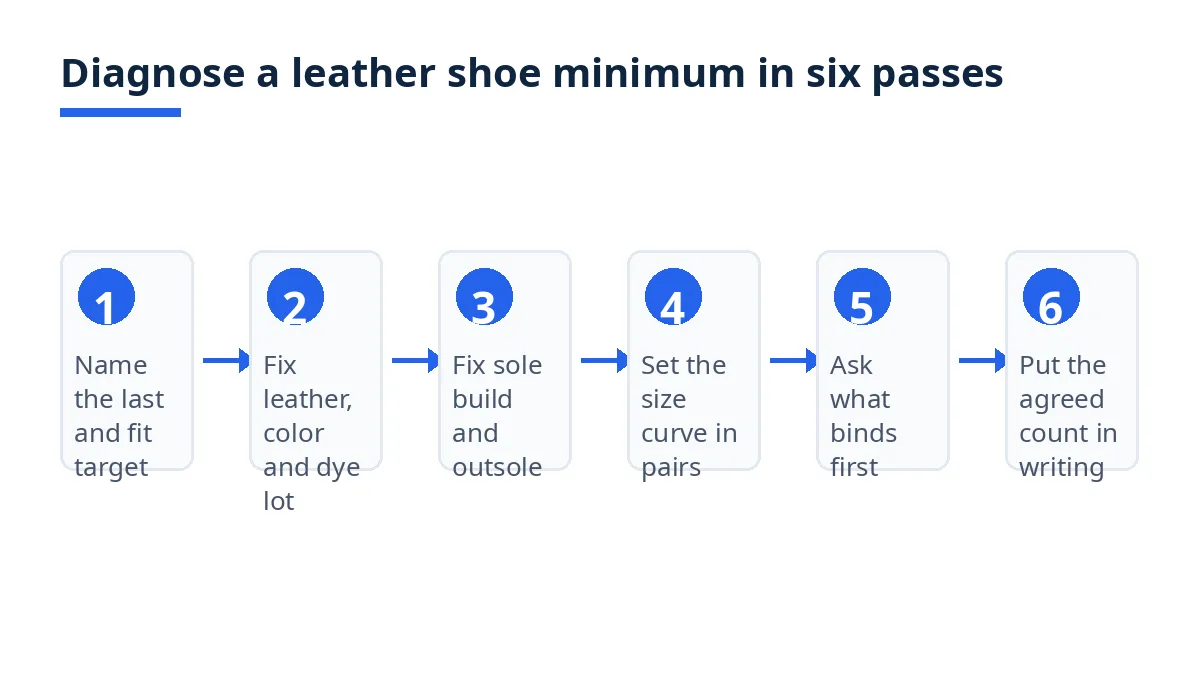
Work through the six passes below in order, so the quotation can be read against a fixed specification.
Name the last and the fit target for the wearer.
Fix the leather, the color, and the dye lot.
Fix the sole build and the outsole material.
Set the size curve in pairs, size by size.
Ask what binds first, and what would release it.
Put the agreed count, unit, and specification in writing.
The last decides the fit, and the last decides the minimum
A last is the foot-shaped form over which the upper is shaped. Last assessment checks a last for critical dimensions and shape against its marked size, and a last with the wrong shape or marking will produce footwear that does not fit well.1
Ask for the last chart for the exact last in the quotation, showing the marked size, heel pitch, and key girth and length dimensions in the size system the buyer sells in. A last marked as one size can match a different standard size, so the marked size alone is not proof of fit.1
Grading turns one last into a range, with its own last for each size, and small errors near the base size grow as grading steps accumulate. Ask whether the quotation covers the full range or only the base size. Never move a style to a different last without a fresh fit check: changing the last changes the product, even when leather and color stay the same.
Leather, lining, and sole: three separate minimums inside one pair
One pair carries three material decisions, each able to restart a minimum. Name all three separately: a supplier can agree on the upper while the lining or sole still carries its own floor.
Name the upper leather by animal, grain treatment, finish, and color with its shade standard. Full-grain leather keeps the original grain visible under a thin transparent finish, while corrected grain is sanded and covered with an opaque coating.2 Split leather comes from a lower layer, and suede is the buffed flesh side.2
The dye lot binds color: hides from different lots rarely match in shade. State whether the order draws on one lot or several, name the light for judging shade, and ask for the lot identity and laboratory report by named method. Stock leather in a running color can remove a custom dye-lot floor, but the lot still needs its test record.
Name the lining and insole separately from the upper: in welted construction the insole is load-bearing, because the upper and welt are stitched to its edge.3 In Goodyear welted construction, the welt is sewn to the upper and insole and the outsole is stitched to the welt, so the sole can later be replaced without pulling the upper apart.4 Cemented construction bonds the outsole with adhesive, which is faster and cheaper, while removing a bonded sole can damage the upper.3 State the build, outsole material, and resoling terms.
How a size curve turns one style into several orders
A size curve is the split of pairs across sizes inside one total. A total without a curve hides the real commitment. Example figures only: a supplier states a minimum of 180 pairs per last-and-color combination, for one last in two colors.
Last-and-color combination | Example figures | Smallest order |
|---|---|---|
One color | 180 pairs | 180 pairs |
Two colors | 180 pairs per combination, two combinations | 360 pairs |
Inside each 180-pair combination, the curve must add up. Example figures: sizes 40 to 45 at 20, 30, 40, 40, 30, and 20 pairs total 180 pairs (20 + 30 + 40 + 40 + 30 + 20 = 180). Dropping one color takes the smallest order from 360 pairs back to 180 pairs, because the combinations fall from two to one.
Check price breaks on both sides before ordering up. Example figures, in index units: 300 pairs at 100 cost 30,000 (300 x 100 = 30,000), while 360 pairs at 92 cost 33,120 (360 x 92 = 33,120). Ordering up costs 3,120 more and leaves 60 extra pairs, so a lower unit price does not always mean a lower total. The agreed price is the one in the accepted quotation.5
What a lower minimum trades away, and what it must never trade
A smaller order usually costs more per unit, because fixed costs such as leather, trims, line planning, checks, and paperwork spread across fewer pairs.5 Treat each move below as a question with a trade attached, and record agreed changes on a new quotation version.
Move to ask about | What it trades away | Keep in writing |
|---|---|---|
Share an existing last | A fit target the buyer did not choose | Last chart, sizes, and fit trial result |
Accept stocked leather in a running color | A custom color or finish | Lot identity, shade standard, and test record |
Drop a colorway | Range breadth at launch | Colors kept, and repeat terms for dropped colors |
Standardize the sole and outsole | A distinctive sole or heel build | Build, outsole material, and resoling terms |
Phase by last, with the repeat in writing | One shipment becomes two production slots | Repeat price, repeat minimum, and lot continuity |
Do not trade away the sample, test record, or inspection plan for a lower minimum. Approve the sample pair, and for a new style a pre-production sample, before bulk starts. No sampling figure is stated here as a universal rule: the values are those written into the purchase order for that lot.
Costs, documents, and timing that sit beside the minimum
A minimum is not a landed cost. Price basis, freight and insurance, duty at destination, and shipment documents each sit beside the pair count.
Under Incoterms® 2020, the sea and inland-waterway-only rules are four in number: FAS, FOB, CFR, and CIF. CPT is an any-mode rule, DPU is an any-mode rule, and DDP is an any-mode rule under which the seller clears import customs and pays duty.6 The other seven rules say nothing about the mode of transport. The four sea rules were written for port-to-port movement, and their current form does not cover a container travelling onward by road or rail.6 Under DDP the buyer still unloads, so unloading cost needs a clear contract line.6 Name the rule, place or port, and Incoterms® year in every quotation.
Heading 6403 covers leather-upper footwear whose outer soles are made from rubber, plastics, leather, or composition leather, splitting by sports footwear, footwear with a protective metal toe-cap, and other footwear.7 The upper material is the constituent material with the greatest external surface area, ignoring accessories such as ankle patches.7 Treat 6403 as indicative only and check the full national line against the destination tariff schedule. No duty rate is stated here: confirm it with a customs broker.
Documents should name the same last, leather lot, color, and size curve as the approved sample pair, and the packing list should state pairs per carton and how mixed sizes are marked. Timing follows the setup items, not the order total. Agree timing stage by stage in writing, tied to the last and lot it covers, instead of accepting one standard lead time.
Bangladesh reading: Savar leather, factory evidence, and the checks that are not inspections
Bangladesh leather starts close to the shoe factory. Footwear is the most prominent leather segment, with annual production exceeding 400 million pairs, according to LFMEAB data reported in 2024, and more than 200 tanneries are concentrated in the Savar Tannery Industrial Estate.8 The estate's central effluent treatment plant was still not fully functional eight years after tanneries moved there, and factories there could not obtain the Leather Working Group certification some brands require.8 Ask for the tannery name and lot identity separately from the shoe maker's own evidence, and ask what effluent evidence covers the lot offered.
The Leather Working Group audits tanneries, not shoe factories. Its protocol runs to 17 sections, and water and energy use, chemical handling, waste and effluent, and worker health and safety are among the areas it covers. Gold needs 85 percent, Silver 75, Bronze 65, and Audited 50, with the final rating set by the lowest category, and certification is valid for 24 months.9 An LWG rating does not guarantee that a final product will pass a restricted-substance test, and it does not replace legal compliance checks.9 Where a rating matters, ask for the certificate, check the site and products it covers, and confirm it with the issuing body.
On Exportain, badges record a document and photo review by Exportain staff, covering identity, phone and email, business registration, export registration, and facility photos. A badge is not a factory inspection, not a database check, and not a promise about capacity, quality, or delivery.10 Membership plans buy listing capacity and search placement and never grant a badge.10 Use the badge list to shorten a shortlist, then check the export registration and trade license yourself, approve samples, agree inspection before shipment, and put the Incoterm, payment, inspection, and shipment terms in writing before paying.10 Exportain stays outside the sale itself: it does not check the goods, arrange the freight, or handle customs clearance.10
Shoe-order mistakes that reopen the minimum
Agreeing a pair total without the unit. A total of 360 pairs means little until the record states per last, per color, per size curve, or per order total.
Approving a sample on a different last. Fit approval belongs to the last that will make the bulk pairs.
Changing color after the dye lot is agreed. A new color can mean a new lot, a new shade agreement, and a new count.
Mixing sole builds in one count. A welted build and a cemented build use different operations and tooling, so count each build separately.
Treating a listing minimum as the contract figure. What binds both sides is the accepted quotation.5
Agree these lines before bulk starts
Use this list as a sign-off sheet. If a line is blank, the minimum attached to it is not settled, however firm the total sounds.
Line | Record it exactly |
|---|---|
Last and fit | Last identifier, size range, width, fit trial result |
Upper leather | Animal, grain treatment, finish, color, shade standard and light |
Leather lot | Lot identity, dye lot count, laboratory report by named method |
Lining and insole | Material for each, named separately from the upper |
Sole build | Welted or cemented, outsole material, heel build, resoling terms |
Size curve | Pairs per size, adding to the total, per last-and-color combination |
Trims and packing | Custom and standard items, pairs per carton, carton marking |
Price basis and rule | Unit price, Incoterm with named place and year, validity, payment terms |
Sample and inspection | Approved sample pair identity, inspection plan, and who inspects |
What should I settle first about a leather shoe MOQ in Bangladesh?
Settle the binding constraint first: the last, the leather lot and color, the sole build, the size curve, and the trims. A minimum counted per last-and-color combination behaves differently from a minimum counted per order total, so state the unit in writing before comparing quotations.5
What do leather shoe costs and timelines look like beside the minimum?
Costs beside the pair count include the price basis, freight and insurance, duty on the exact national line, and inspection and paperwork. Timelines follow dye-lot scheduling, sample approval, laboratory turnaround, and inspection booking, so agree the time per stage in writing.
Which documents must match the approved shoe sample?
The quotation, sample approval record, packing list, and transport document should all name the same last, leather lot, color, size curve, and sole build as the approved sample pair. Where origin evidence is required, agree which document carries it before shipment.
What mistakes most often reopen a leather shoe minimum?
The most common mistakes are agreeing a total without its unit, approving a sample on a different last, changing color after the dye lot is agreed, mixing sole builds in one count, and treating a listing minimum as the contract figure. Each one moves a specification item after the count was set, so the count must be reopened and agreed again in writing.
Next steps on Exportain
Send each supplier the last, lot, color, curve, and build in one message, so the reply can settle the minimum instead of restating it. Test every quotation against its unit with the minimum-counting guide, and check supplier badges explained before shortlisting anyone from the supplier directory.
Sources
- Digital last assessment. SATRA (accessed )
- Leather Basics. Total Shoe Concept (accessed )
- Goodyear Welted Construction Explained | Men's Leather Shoes. Yangjiang Hengxin Shoes Co., Ltd., (accessed )
- Goodyear Welted Footwear. Coats (accessed )
- MOQ Meaning (Minimum Order Quantity). Exportain (accessed )
- Insider thoughts: Bob Ronai on Incoterms 2020 Rules; What are they about?. International Chamber of Commerce (accessed )
- HS Nomenclature 2007, Chapter 64: Footwear, gaiters and the like; parts of such articles. World Customs Organization (accessed )
- From rawhide to finished products: The self-sufficiency of Bangladesh's leather industry. The Business Standard, (accessed )
- Certification - Leather Working Group. Leather Working Group (accessed )
- How Supplier Verification Works on Exportain. Exportain, (accessed )
About the author
Sourcing from Bangladesh?
Post a request for quotation and suppliers on Exportain can send you their quotes directly.
Post an RFQ