Top Leather Shoes Manufacturers in Bangladesh: How to Find and Verify Them
Seven confirms for sourcing leather shoes from Bangladesh: last and fit, leather grade and finish, sole construction, stitching and flex, size curve, finishing and inspection, and capacity with compliance evidence.
Short answer
Find leather shoes manufacturers in Bangladesh by confirming the last and fit, the leather layer and finish per part, the sole construction and adhesion, stitching and flex behaviour, consistency across the size curve, finishing and inspection, and capacity through a trial lot with tannery, classification, and identity evidence read for what each proves. Order only when every confirm is closed.
On this page
Key takeaways
Settle the last first: fit decides the size system, the width fittings, and the wear trial the sample must pass.
Name leather layer, surface treatment, and finish separately for every upper part, in writing.
Name the sole construction and test sole adhesion; a decorative stitch is not a welt.
Hold bulk lots to a sealed sample pair, end-of-curve samples, and a trial record on the same last and construction.
A leather shoe is judged on a moving foot, after hours of wear, not as a still image. A last that pinches, a sole that parts, or a vamp that cracks can each make a style unsellable. The supplier who matters made the sample pair, on a last and construction the buyer can test, to a specification written before any price was agreed.
No company is named here, and no supplier is ranked. Seven confirms follow: last and fit, leather grade and finish, sole construction, stitching and flex points, size curve, finishing and inspection, and capacity with compliance evidence. Names, capacities, prices, and certificates are not asserted as facts anywhere below. Numbers showing a calculation are marked "Example figures".
How to use the seven confirms
Work through the confirms in order, keeping a written record for each. A confirm closes only when the supplier states the point in writing, the sample pair shows it, and the quotation carries the same wording. A new last, leather, sole, or size curve reopens the earlier confirm.
Confirm 1: Settle the last and the fit target for the wearer
Pin down. The last for each style, the size system, the width fittings offered, and the foot the shoe is shaped for. Fit is primarily about the dimensional properties that accommodate the shape and size of the foot, and foot surveys measure foot length, joint and instep girth, heel and joint width, and toe positions and depths.1 Ask which target population the last was shaped for.
Why it counts. The shape and size of a shoe last is fundamental to ensuring that a product has the appropriate shape to fit its intended customer profile, and lasts should be graded to achieve optimum population fit.1 Materials and manufacturing processes can shift the final dimensions away from the last dimensions, and incorrect footwear length and incorrect quarter and back part heights can be a direct cause of discomfort.1
Close it with. Last measurements for the sample size, an internal size check on the finished shoe, and a wear trial in the sample size. For men's lasts, SATRA TM252:2020 describes the measurement of the effective dimensions of lasts used in the routine assessment of their fitting qualities.2 Record the last identifier with the style. Judge fit on a pair worn and walked in.
Confirm 2: Name the leather layer, the surface treatment, and the finish separately
Pin down. For each upper part, the hide layer used, what was done to its surface, and the finish on top. Full-grain leather keeps the entire grain layer, with nothing sanded off, while top-grain includes the outer grain layer, and corrected-grain leather has flaws buffed or sanded away before dyeing and embossing.3 Split leather comes from the fibrous layer under the grain, and "genuine leather" is not a grade.3
Why it counts. Grade names describe which layer is used and how the surface was treated, so the label alone does not show finish or construction.3 A uniform surface can be an applied finish over a heavily buffed grain, while natural marks may remain on a full-grain surface.3 The finish decides how the shoe ages, so ordering by grade name alone can bring the right label on the wrong shoe.
Close it with. A written statement per part: vamp, quarters, heel counter, tongue, and any trim, each naming layer, surface treatment, and finish. Ask for close-up photographs of the actual leather and a swatch for each color, and check bonded leather wording where it applies: in the United States, the Federal Trade Commission guides say the percentages of leather fibers and non-leather substances should be disclosed when the term bonded leather is used.3 Record the finish name apart from the grade name, and re-check both whenever the leather source changes.
Confirm 3: Name the sole construction and the outsole material
Pin down. The outsole material, the heel build, and the method joining sole to upper: a Goodyear welt, a Blake stitch, or an adhesive, cemented build. In a Goodyear welted shoe, the welt, a strip of leather around the edge, is joined by two seams: the welt seam sews welt and upper to the insole assembly, and the sole stitch sews the outsole to the welt.4 In a Blake-stitched shoe, one seam runs through insole, upper, and outsole, while a cemented shoe is glued.4
Why it counts. Construction decides whether a sole can be replaced, how the shoe breaks in, and how it behaves in wet wear. A Goodyear welted shoe can have its sole cut off and replaced without disturbing the rest of the shoe, because the outsole is never stitched to the upper.4 Stitching around the sole edge proves nothing on its own, because plenty of glued shoes carry a decorative stitch.4
Close it with. The construction named in the specification sheet and a sole adhesion record for stuck-on and moulded soles. SATRA TM404:2020 determines the strength of the bond between the sole and upper at the toe and heel area of the lasted margin of completed footwear, and is mainly applicable to stuck-on or moulded-on constructions with an extended sole edge.2 The SATRA STD 185 tester measures the strength of adhesion of stuck-on and moulded soles at toe and heel, and a pass load can be applied to check that the sole does not part from the upper assembly.5 Agree the pass load and the point of measurement before production, and apply the same check to production pairs, not only to the sample.
Confirm 4: Inspect the stitching, the welt seam, and the flex points
Pin down. The seam map: stitch rows, seam positions, reinforcement at vamp and quarter joins, eyelet rows, and the heel seam, plus the welt seam where the shoe is welted. State stitch density and thread per seam as specification values.
Why it counts. The vamp crease is where an upper fails first in wear. SATRA TM25:2020, the vamp flex test, is primarily intended to determine the propensity for materials to crack or otherwise fail at flexing creases, and the method applies to flexible materials used for outers and linings of footwear uppers, such as leathers, coated fabrics, and textiles.2 A seam that looks even on a flat sample can open at the crease once the shoe is lasted and walked in.
Close it with. A wear trial flexing the sample pair, inspection of the vamp crease and welt seam under low-angle light, and a flex report naming material, method, and result where required.2 Check inside for the insole seam on a Blake-stitched pair.4 Retest whenever leather, lining, or construction changes.
Confirm 5: Prove the size curve, pair by pair, across the full range
Pin down. The full size curve and width curve offered, the grading rule from the sample size to each end of the curve, the measurement points for each size, and the quantity per size and per width. Each size must keep the sample proportions, including toe shape, heel width, and instep height.
Why it counts. A sample in the middle size proves the middle size only. Foot size surveys exist to determine the size, shape, and size distribution for a population, so that lasts can be developed appropriate to the size and style of the required shoe for the target market.1 If grading is uneven, the end sizes will fit differently from the sample.
Close it with. Sample pairs at the smallest, middle, and final sizes in the curve, each measured against its own size chart, and pair matching checked left against right in every size sampled. State quantity per size and width in the quotation, and read the minimum with its counting unit: it can be counted per order, per style, or per color, and combined with a minimum order value.6 Example figures: a minimum of 200 pairs per size across six sizes means 1,200 pairs, not 200.6
Confirm 6: Hold the finish, the shade, and the inspection record to the sample pair
Pin down. The finish standard for each style and color, the shade standard and the light it is judged under, the defect list, the inspection plan, and the packing instruction, agreed before bulk production. Finishing covers the sole edge, the heel, the welt trim, the eyelets, and the upper surface: edge paint or burnish even and complete, no loose thread ends, and no glue marks on the upper.
Why it counts. Bulk lots diverge from samples in shade and finish, and left and right must match in size, color, grain, and finish. A shade judged under different lights at factory and buyer will be judged twice with two answers.
Close it with. One sealed sample pair per style and color, a written sampling plan, and inspection of the finished, packed lot against that record. Agree the sampling basis and acceptable quality level in writing before paying.7 Test each finish change as a new sample, and re-inspect after rework before shipment.
Confirm 7: Test capacity through a trial lot and read the compliance evidence for what it is
Pin down. The producing site, whether the seller makes the shoes or trades them, the trial lot record, the lead-time stages from approved sample to finished lot, and the tannery that supplied the upper leather. Test capacity with a trial lot on the same last, leather, construction, and size curve as the bulk order. Ask whether the order will run in one run or several, since each run needs its own sample approval.
Why it counts. A claimed capacity number proves nothing without a batch behind it, and a tannery audit proves something narrower than a finished shoe. First launched in 2005, the Leather Working Group audit examines the way a tannery tracks, manages, and reports manufacturing impact, section by section across 17 sections.8 Each section carries its own floor. Gold needs 85 percent. Silver needs 75 percent. Bronze needs 65 percent. Audited needs 50 percent. The lowest section rating sets the final medal.8 A manufacturing facility certificate runs 24 months, while a part-processed material trader certificate runs 12 months, and certified traders carry the rating Approved.8 Certification is no promise that a finished product passes every restricted-substance test, and the audit does not judge legal compliance or grant an operating permit.8 Treat LWG evidence as tannery evidence only: it must name the audited site, the rating, and the expiry date.
Close it with. The trial record, the site address checked against quotation and invoice, and classification and identity papers together. Footwear with outer soles of rubber, plastics, leather, or composition leather and uppers of leather falls under heading 6403, with sports footwear under 6403.19 and footwear incorporating a protective metal toe-cap under 6403.40.9 Confirm the full national code with a broker. Ask for the trade licence and Export Registration Certificate, then match the name and address on each against the quotation and the invoice.7 On Exportain, the five badge names are Exportain Verified and Export Verified, then Factory Verified and Trading Company Verified, with Trusted Trader completing the set; read what each name records before relying on it.7 A badge rests on staff review of documents and photographs. It is not a visit to the factory. It does not search a government database. It does not promise capacity, quality, or delivery.7 Check the quotation for validity, payment terms, Incoterm, lead time, MOQ, and unit price, with the MOQ counting unit matching the size and color breakdown.6 Paying cash in advance leaves the buyer least protected; under a letter of credit, payment turns on documents showing shipment as agreed.7
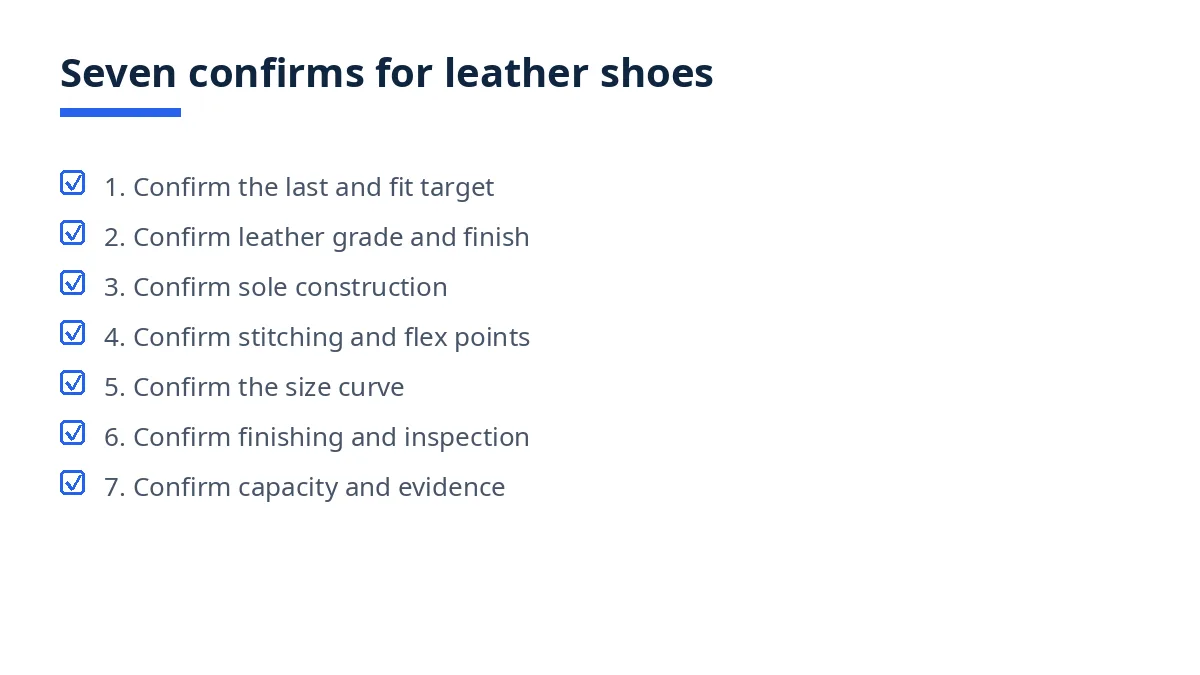
Seven confirms at a glance: evidence before an order
Confirm | Evidence to hold | Walk-away signal |
|---|---|---|
1. Last and fit | Last identifier, size system, wear trial | One size judged, no target population |
2. Leather grade | Layer, treatment, finish per part | Grade name only |
3. Sole construction | Construction named, adhesion record | Decorative stitch as a welt |
4. Stitching and flex | Seam map, flex report | Crease unchecked, no retest |
5. Size curve | End-of-curve samples, quantity per size | Middle size only |
6. Finish and inspection | Sealed pair, shade standard, sampling plan | No agreed light, inspection after shipment |
7. Capacity and evidence | Trial record, site, tannery evidence, licence and ERC | Tannery evidence read as shoe evidence |
Order only when all confirms close.
What is the most costly mistake when sourcing leather shoes in Bangladesh?
Ordering from a photograph or a headline price before fixing the last, the leather, and the construction. A photograph cannot show fit, grain, or whether the sole is stitched or glued. Fix the last, the leather, and the construction first, then judge the sample pair on the foot.1 3 4
How can I avoid a bulk lot of leather shoes that does not match the approved sample pair?
Keep a sealed pair for every style, color, and size range. Put the sampling plan, defect classes, shade standard, and size chart in writing first, then judge bulk pairs against that sealed record, including pairs from both ends of the curve. Any change of last, leather, lining, or construction calls for fresh tests, with reports that name material and method.2 5
Who is responsible for verifying a leather shoes supplier?
The decision rests with the buyer. Documents and the sample pair come from the supplier, certificate confirmation comes from the issuing body, classification comes from a broker, and sample, flex, and sole adhesion work comes from an inspector or laboratory. A badge records only what its own wording records.7
Where can I get help verifying a leather shoes supplier on Exportain?
Start with the supplier verification guide and the trust and verification checklist on each profile.7 Use the MOQ guide to read each minimum with its counting unit, and ask a broker where classification is borderline.6 9
Next steps on Exportain
Start by posting a free RFQ that states your last and fit target, the leather grade and finish for each part, the sole construction, and the size curve with quantities per size. Before you shortlist, read the MOQ guide and how supplier verification works, and open the trust and verification checklist on every Bangladeshi supplier profile you consider.
Post a free RFQ on Exportain and get quotes from verified Bangladeshi suppliers.
Sources
- Equipment used for comfort testing – part 1. SATRA (accessed )
- SATRA releases revised test methods. SATRA (accessed )
- Full-Grain vs Top-Grain Leather: What the Names Mean. Leather Collection, (accessed )
- Goodyear Welted Shoes Explained: How the Welt Works and Who Needs It. Hispotion (accessed )
- The SATRA STD 185 sole adhesion tester. SATRA (accessed )
- MOQ Meaning (Minimum Order Quantity). Exportain (accessed )
- How Supplier Verification Works on Exportain. Exportain, (accessed )
- Certification - Leather Working Group. Leather Working Group (accessed )
- HTS Codes of heading 6403. FindHS Codes (accessed )
About the author
Sourcing from Bangladesh?
Post a request for quotation and suppliers on Exportain can send you their quotes directly.
Post an RFQ