Wholesale Leather Shoes From Bangladesh: Prices, MOQ and Reliable Suppliers
Buy wholesale leather shoes from Bangladesh last first and lot first: fix the last, upper leather, construction and size curve, count the minimum per combination, and approve sample pairs before bulk.
Short answer
Buy wholesale leather shoes from Bangladesh by settling the last and the lot before the price. Name the last, upper leather grade, finish, build, sole unit, and size curve in the specification, work out the minimum for each last and color combination, and keep sealed sample pairs from the offered lot. Check the size curve pair by pair, keep lot lab evidence apart from tannery audit evidence, and compare quotations only when they share one specification.
On this page
Key takeaways
Settle last and lot before price: last, grade term, finish, build, and size chart with tolerances belong in the specification first.
Minimums multiply per combination. Example figures: 100 pairs per last and color combination, 3 lasts in 2 colors, give 600 pairs.
Check the curve pair by pair against the supplier chart: length, width, heel height, toe box, and shade under one agreed light.
Tannery audit evidence and lot lab evidence are separate documents; the first covers the tannery, the second covers the ordered leather.
Heading 6403 splits by sports use, strap uppers, metal toecap, ankle coverage, and sole; the full national code still needs the destination tariff.
Buying leather shoes wholesale from Bangladesh means buying pairs, not pieces, and judging a whole lot, not one sample. A single lot can mix shades, upper thicknesses, toe shapes, and heel heights. This guide sets out a last-first, lot-first way to order: settle the last, the upper leather, the build, and the size curve; work out what the minimum really counts; and approve sample pairs from the offered lot before bulk. Every number in this guide is an illustration. No market price, factory capacity, or standard minimum is presented as fact.
Start from the last: one shape decides the pair
Shoes are made in pairs, and the pair takes its form from a last. During lasting, a finished upper, built from flat leather or synthetic parts, is forced over the last, and that step produces the shoe's final shape and the room inside it that governs fit.1 Shape at the end depends on several things together: the last's shape, the upper material, how the upper is built, how the upper was conditioned, and how lasting itself was carried out.1
After the last comes out, an upper does not keep all of its lasted shape. Lasting distorts the upper permanently in part, but leaves part of it elastic, so the upper drifts back toward flatness over time.1 Heat setting counters that drift: controlled heat and moisture relax the upper fibers and raise the proportion of set that survives.1 In the era before heat setting, makers limited shape loss by keeping the last inside the shoe for a considerable time, typically 14 days.1 Fit should therefore be judged on a finished pair, on the production last, after setting.
Faults in shoes sit where flat goods have no equivalent failure. The sole bond can part, the heel can rock, and the toe box can pinch when lasting used the wrong shape.2 A pair must be judged as a pair: a clear left-right difference can leave it unsellable even if each shoe, viewed alone, carries no major fault.2 The specification should name the last by number or name, and add the size range, width fitting, toe shape, heel height, and heel pitch.
One lot means one upper, one last, and one build
Treat one lot as one combination: a single upper leather, grade, finish, color, last, width, and build, lasted across one size curve. Put the animal and skin, grade term, finish, tannage, color, lining, closure, sole unit, heel, and construction into a single specification, and ask each quotation to respond to that specification line by line.
Grade words name a layer and a surface treatment, not a finished shoe.3 A hide's grain layer may be kept whole, kept only at its outer part, or buffed and sanded to remove flaws before dye and emboss; the fibrous layer below the grain gives split leather, and ground fibers give bonded leather.3 "Genuine leather" labels none of those grades.3 Where a mark falls matters as much as what it is: hides carry scars, insect holes, and wrinkles by nature, and inspection scores them according to where they sit and how large they are, holding visible areas to a stricter standard.2
Grade term | Layer used | Surface treatment | Ask for in writing |
|---|---|---|---|
Full-grain | Entire grain layer | Left intact | Finish named; natural marks accepted |
Corrected grain | Grain side | Flaws buffed out, dyed, embossed at times | Emboss pattern; coating named |
Top-grain | Outer grain layer | Depends on the finish | Finish and coating named |
Split | Fibrous layer below the grain | Varies; often suede | Coating and end use named |
Bonded | Leather fibers, ground | Mixed with other substances | Fiber share; backing named |
Beyond the upper leather, the parts around the foot matter. Linings should sit flat without tears or bunching and should stay in place at the collar and tongue rather than pulling out or rolling.2 Insoles should cover the footbed, lie flat, and show no wrinkles or raised edges.2 The vamp, quarters, toe cap, heel counter, collar, and tongue each carry stress differently, so the specification should also name the lining, the insole, and whether the insole comes out.
How the sole joins the upper is part of the same lot decision. One opened maker page names six builds, described here in its own terms.4
Build | Sole attachment | Buyer note |
|---|---|---|
Goodyear welted | Welt stitched to upper and insole ridge; outsole stitched through welt, midsole, and sole | Strong and sturdy; water kept from the upper; resoled repeatedly4 |
Blake stitched | Upper sewn to the outsole from the inside; no welt used | Slimmer, more elegant profile for formal shoes4 |
Bologna | Upper sewn to a soft leather sock like a glove, then Blake stitched | Slim profile; comfortable formal shoe4 |
Cupsole | Upper lasted onto a soft insole; cupsole stitched around its rim | Practical and refined in appearance4 |
Moccasin | Leather drawn under the foot and sewn to the top apron | No insole board; flexible and comfortable4 |
Norwegian welted | Added visible stitch row; welt sewn from outside through upper and insole ridge | Lip guards the upper-to-sole join; sturdy outdoor shoes4 |
Bonding with adhesive is different again. The shoe checklist inspects bonding on its own: an outsole should be bonded around its full perimeter, with no opening at the toe, waist, or heel seat and no lifted edge, and failures trace to surface preparation, adhesive choice, curing, or control.2 A quotation for a welted shoe and a quotation for a bonded shoe describe different products, and the build and attachment method should be named before prices are compared.
Build the size curve on the supplier last chart
No size number means the same thing on every last. Foot length, width, and toe shape behind one number change when the last changes, and another brand's conversion chart cannot settle a different maker's sizes. Grading should use the supplier's chart for the last in question, showing how sizes were measured, which width fittings apply, and what tolerances hold. That chart should arrive in writing before quotations, and each quotation should state which size system it follows, size by size.
Measurement points need agreement before inspection: shoe length, insole length, outsole length and width, heel height, and opening circumference, with matching size marks on the shoe, its label, its box, and its carton.2 Example figures: 50 pairs in EU 41, 100 in EU 42, 160 in EU 43, 140 in EU 44, 80 in EU 45, and 50 in EU 46 add to 580 pairs. A total filled from the easy sizes while the middle sizes run short has not met the curve. Check each size against the chart and against its pair: heel heights matching on both shoes, the pair level on a flat surface with no rocking, and the toe box keeping shape under light pressure.2
A width fitting belongs inside the curve. Change the width and, for grading, the last has changed. Record the width fitting for each size and the allowed variation in heel height and length, and, where an order covers several markets, record the size system for each destination in the same document.
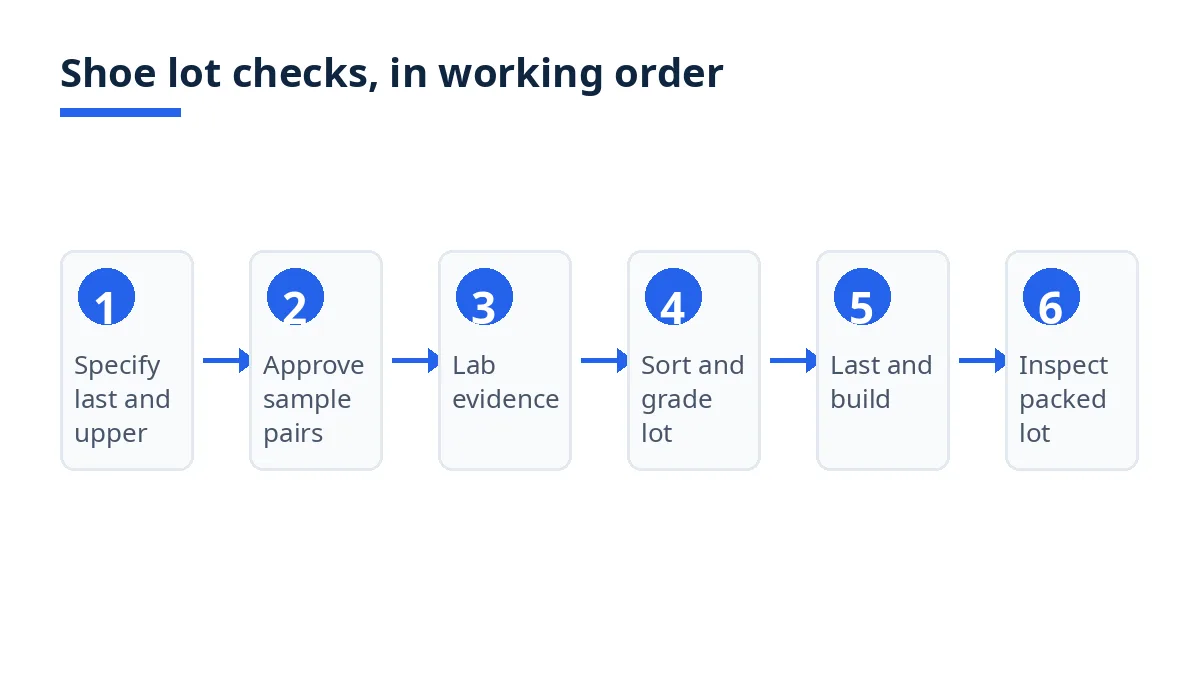
Eight checks that settle a shoe lot, in working order
Write the lot down. Set out the last, grade, finish, tannage, color, lining, closure, sole unit, heel, build, size chart and tolerances, grade rules by position, and packing. Give the lot one identity: one upper, one last, one width, one build, one color, one size curve.
Seal the sample pairs. Keep approved sample pairs sealed, one for each last and color combination, showing grain, shade, lining, closure, heel, and fit on the production last. Note the lot each sample pair came from, since a pair from another lot approves another lot.
Ask for method-named lab evidence. Where testing is specified, the report should name its method and give the result against the specification. The shoe checklist names ISO 17075 for colorfastness to rubbing, and states no grade or pass mark; the buyer specification supplies that.2
Band the shade and grade the marks. Under the agreed light, sort shade into bands, hold bands outside the agreed standard, and grade natural marks by position and size.2 Confirm each sole is centered on its upper rather than skewed.2
Watch the lasting and the build. Confirm the upper keeps its lasted shape, the stitching stays tight and even, seams stay closed when the shoe flexes, and the heel stays firm with no rocking and no gap at the heel seat.2
Run inspection on packed goods. Use the agreed sampling plan on finished, mostly packed goods, photograph defects, and mark their positions. Try every closure, and feel inside each shoe for protrusions and sharp edges.2
Match labels to the measured pair. Labels should carry correct size, material, origin, and care information, with the size label agreeing with the measured pair.2 Counts, size-curve totals, and the packing list should reconcile.
Pack to hold the shape. Where specified, pack each pair with a shoe tree, tissue, or form so the toe box and heel hold shape, and make the assortment in each carton match the order.2
Count the minimum once per last, color, and size set
Minimum order quantity means the smallest quantity a supplier accepts on normal terms. Suppliers count it per order, per style, or per color, and sometimes add a minimum order value alongside it.5 With shoes, the counting question is a lot question: does the figure apply per last, per color, per width, per size set, or per combination of those? One number means a different commitment under each reading, and more than one basis can apply at once.5
Example figures: at 100 pairs per last and color combination, 3 lasts in 2 colors give a smallest order of 600 pairs, not 100. One last in one color gives 100 pairs. The size curve splits that total across sizes; it does not increase it. Before planning a range, ask in the quotation whether a color may share a dye lot, whether width forms a separate combination, and whether two lasts sharing an upper leather count together.
Minimums are driven by three things: material bought for one buyer, trims and packaging with minimums of their own, and the planning and changeovers added by each extra color, last, or finish.5 Dyed upper leather, lining, and sole units are the custom material here; eyelets, laces, buckles, labels, and boxes are the trims. Options to raise as questions, with no outcome assured, include stock colors and lasts, a narrower range, standard trims and packing, a surcharge, sharing a lot, or an honest trial order.5
Pair-price parts: upper, build, sole, and lot size
This guide quotes no standard wholesale price for leather shoes, because none is stated in the sources opened for it. Price structure is what a buyer can still use. Example figures only: picture a unit price as an index of 100, split as upper leather 40, cutting, lasting, and stitching 22, sole, heel, and closures 15, testing, inspection, and packing 11, and price basis and margin 12. Real lots will split differently.
The upper leather and its grade govern material and yield. Last and build govern the work under the foot: welted work involves more operations than bonded work, and a new last means new grading across every size. Lot size per combination spreads changeovers, dye lots, and sole-unit runs; spreading them across the whole order total instead would understate their effect.
Quotations should be compared only when they share one specification and the same fields: unit price, minimum, lead time, Incoterm, payment terms, and validity.5 Always check both sides of a price break. Example figures: 1,100 pairs at USD 11.40 come to USD 12,540, while 1,200 pairs at USD 10.30 come to USD 12,360, so the larger order at the break can cost less overall. FOB covers goods to loading at the named port; freight past the port sits outside that unit price.5 Lead time has no standard value: settle dye-lot scheduling, last preparation, sample approval, lab turnaround, and inspection booking stage by stage, in writing.
Which 6403 line fits the shoe in front of you
The heading text for 6403 is footwear with outer soles of rubber, plastics, leather or composition leather and uppers of leather.6 International sharing stops at six digits; the code entered at the border is the destination country's national code.7
Deciding whether 6403 applies at all turns on two surface tests. For the upper, the governing material is the one covering the greatest external surface area, with accessories and reinforcements such as ankle patches, edging, ornamentation, buckles, tabs, and eyelet stays left out of the measure.7 A textile outer upper does not become a leather upper because its lining is leather, since lining does not count as upper material.7 For the outer sole, the governing material is the one with the greatest area touching the ground.7
Within 6403, the splits follow sports use, strap uppers, a protective metal toecap, ankle coverage, and sole material: 6403.12 and 6403.19 cover sports footwear, 6403.20 covers strap footwear, 6403.40 covers metal-toecap footwear, 6403.51 and 6403.59 cover other footwear with outer soles of leather, and 6403.91 and 6403.99 cover other footwear.7 Uppers, insoles, and other footwear parts sit apart from footwear itself, under heading 6406, the parts heading in Chapter 64.7 Footwear with outer soles and uppers of rubber or plastics falls under 6402, footwear with textile uppers under 6404, and footwear fitting none of 6401 to 6404 under 6405.7
Countries then extend the six digits in their own ways. The United States runs to a 10-digit import number, with extra lines inside 6403.59 for wood-based or platform footwear, turn or turned footwear, welt footwear, and footwear for men, youths and boys.7 The European Union adds two digits in the Combined Nomenclature and more in TARIC, reaching a 10-digit declaration code, with lines divided by insole length and wearer.7 The United Kingdom also uses 10 digits, and its tariff gives commodity code 6403200000 to strap footwear alone, not to leather shoes generally.7 Re-check every national line in the destination tariff for the entry date, confirm the six-digit line and the full national code for the exact shoe, keep shoe types on separate shipment lines, and seek a formal ruling before shipping where a binding decision is needed.7 No duty rate is stated in this guide.
Savar leather and shoe evidence: what to ask in Bangladesh
Tanning in Bangladesh centers on the Savar Tannery Industrial Estate, where tanneries moved from Hazaribagh in Dhaka. In May 2026 the Savar central effluent treatment plant (CETP) was reported able to handle 14,000 to 18,000 cubic meters of waste daily, while roughly 45,000 cubic meters daily was needed at the peak after Eid-ul-Azha.8 The Leather Working Group audit records that CETP performance can move a tannery's audit outcome, and that CETP evidence from a third party is part of the audit.9 Ask what effluent evidence covers the leather in the lot offered.
Buyers most often misread the tannery audit. It measures, controls, and reports how a tannery's manufacturing operations affect the environment, across 17 sections.9 Ratings run from 50 percent for Audited, through 65 percent for Bronze and 75 percent for Silver, to 85 percent for Gold, with each section needing the threshold and the final medal set by the lowest-scoring category.9 Manufacturing facilities hold certification for 24 months, while part-processed material traders hold it for 12 months.9 The audit is about the tannery, not the finished shoe: it does not guarantee an absence of restricted-substance failures in a final product, and traceability carries a separate percentage rating.9 Chromium VI below 3 mg/kg is required for Gold and Silver, and a higher level fails the audit automatically.9 Keep audit evidence and lot evidence apart: one names the tannery, standard, scope, and expiry; the other is the lab report, method, and result for the ordered leather.
The Leathergoods and Footwear Manufacturers and Exporters Association of Bangladesh (LFMEAB) speaks for Bangladesh makers and exporters across leather products, footwear, synthetics, and allied factories.10 Membership alone proves only membership. Badges should be read for the checks recorded behind them: reviewed factory photos sit behind Factory Verified, reviewed office or warehouse photos behind Trading Company Verified, and a checked Export Registration Certificate behind Export Verified.11 Staff review of documents and photos is what verification is; it is not a factory visit, and a badge does not guarantee production capacity, product quality, or delivery.11 Request the Export Registration Certificate and trade license directly, match the firm's name and address on the quotation and invoice, and ask where lasting and finishing take place, since no source opened for this guide locates shoe factories.
Where a shoe order goes wrong before bulk
Grade words alone. "Genuine leather" reveals almost nothing about layer or surface.3 Put skin, layer, treatment, finish, and lining into the written specification.
A shoe approved with no last named. Fit, toe shape, and internal space all trace to the last.1 Record the last, width, and size chart before production starts.
A tannery medal read as a shoe certificate. The medal rates tannery operations, and certification leaves open the possibility of restricted-substance failures in a final product.9 Hold the audit evidence and the lot lab report as separate documents.
One shoe taken for the pair. Shade, thickness, and heel height shift across a lot.2 Approve pairs per combination, sort the lot, and inspect packed goods.
Shade judged by eye from memory. Stable light and an agreed color datum are what shade judgments rest on.2 Lay the set out together under the agreed light and band it.
A minimum counted a single time. Per last and color, the same figure multiplies across the range.5 Get the counting basis into the quotation.
One code filed for unlike shoes. Surface area of the upper, sole material, ankle coverage, and toecap each shift the line within 6403.7 Settle the code shoe type by shoe type.
A badge read as an inspection. Document and photo review is the limit of verification, and no badge guarantees an order.11 Samples, inspection, and payment terms remain the buyer's work.
Sign-off list before bulk production starts
Put the full specification in writing: last, grade, finish, tannage, color, lining, closure, sole unit, heel, build, size chart and tolerances, grade rules, and packing.
Give the lot one identity on every document: one upper, one last, one width, one build, one color, one size curve.
Keep sealed sample pairs for each last and color combination, made on the production last, with their lot recorded.
Work out the minimum for each last, color, and width combination, confirm how it is counted in the quotation, and fit the size curve inside that total.
Line quotations up on a single specification, with matching fields for price, minimum, lead time, Incoterm, payment terms, and validity.
Ask for lot lab evidence by named method and limit, apart from any tannery audit evidence.
Band the shade under the agreed light, grade pairs by position and size, examine sole position, heel, toe box, stitching, lining, and closure, and hold out-of-standard bands.
Settle classification shoe type by shoe type: upper surface area, sole material, ankle coverage, toecap, and full national code.
Read badges for their recorded checks, and check the firm's name and address as shown on the trade license, as shown on the Export Registration Certificate, and as shown on the quotation and invoice.11
Run inspection on the finished, packed lot under the agreed sampling plan, check shape-holding packing, and reconcile counts and size-curve totals with the packing list.
What should I know first about wholesale leather shoes?
Start with the last, the upper leather, the build, and the size curve, and leave price until those are fixed. A shoe's shape and fit come from the last it is forced over in lasting, together with its material, construction, conditioning, and the lasting process itself.1 Fix the last, grade term, finish, lining, sole unit, and size chart with tolerances in writing, work out the minimum for each last and color combination, and approve sample pairs from the lot offered.
What do wholesale leather shoes cost, and how long does an order take?
No typical cost or timeline can be quoted for wholesale leather shoes. Upper leather and grade, last and build, sole unit and heel, and lot size per combination all move cost, and comparison is only sound across quotations sharing one specification.5 Example figures only: use an index split for the unit price, multiply the minimum across every combination, test both sides of each price break, and settle the time for each stage in writing. A quotation missing its minimum, lead time, Incoterm, payment terms, or validity is incomplete.5
Which documents travel with a wholesale leather shoe order?
Settle the document set before production, and describe the shoe the same way in each document: specification with last and size chart, quotation with its counting basis, sample approvals, lab reports naming their methods, inspection plan and decision, invoice and packing list giving pair count, size-curve totals, color, and last, and the transport document. File classification with the shipment: confirmed code per shoe type, any formal ruling, and origin evidence.7 Request the Export Registration Certificate and trade license directly, and match name and address to the quotation and invoice.11 Check any certificate with its issuing body.9
What mistakes waste a wholesale leather shoe order most often?
Grade words taken at face value, a shoe approved with no last named, a tannery medal read as a shoe certificate, one shoe taken for the pair, shade judged by eye, a minimum counted a single time, one code filed for unlike shoes, and a badge read as an inspection. Each mistake above is answered in the sections before this one, in writing, before production.
Next steps on Exportain
Open Bangladeshi suppliers and, before shortlisting, read what each profile's badges actually record.
While drafting the specification, keep the quality control checklist for leather shoes and the HS code guide for leather shoes beside the size chart. For the commercial side, read the supplier-verification explainer, and keep it beside the MOQ guide when counting combinations.
Then post a free RFQ on Exportain and get quotes from verified Bangladeshi suppliers, giving the last, upper leather, construction, colors, quantities for each combination, size curve, destination, and delivery term.
Sources
- Ensuring correct heat setting for lasted footwear. SATRA (accessed )
- Quality Control Checklist for Leather Shoes From Bangladesh. Exportain, (accessed )
- Full-Grain vs Top-Grain Leather: What the Names Mean. Leather Collection, (accessed )
- Shoe Constructions | Goodyear Welted, Blake Stitched & More. Oliver Sweeney (accessed )
- MOQ Meaning (Minimum Order Quantity). Exportain (accessed )
- HS, 2017 - Code 6403. United Nations Statistics Division (accessed )
- HS Code for Leather Shoes: Classification Guide for Importers. Exportain, (accessed )
- Govt to fix Savar CETP's deficiencies, back tanneries' own ETPs: Commerce minister. The Daily Star, (accessed )
- Certification - Leather Working Group. Leather Working Group (accessed )
- President's Message - LFMEAB. Leathergoods and Footwear Manufacturers and Exporters Association of Bangladesh (LFMEAB) (accessed )
- How Supplier Verification Works on Exportain. Exportain, (accessed )
About the author
Sourcing from Bangladesh?
Post a request for quotation and suppliers on Exportain can send you their quotes directly.
Post an RFQ