USA LED Bulb Imports From Bangladesh: Step-by-Step Guide
LED bulbs from Bangladesh to the USA pass through safety, radio, efficiency and California gates before price matters. This guide sets the file in that order, with duty on 8539.52 and a worked landed-cost example.
Short answer
To import LED bulbs from Bangladesh to the USA, fix the lamp in writing: base, wattage, lumens, colour temperature, dimming and any radio. Before ordering, hold evidence for the USA gates: UL 1993 and UL 8750 evaluation, FCC Part 15 or Part 18 radio limits as the lab determines, ENERGY STAR or DLC listing, and California Title 20 listing for California sales. Classify under 8539.52, confirm duty and any Chapter 99 addition with the broker, and price on landed cost.
On this page
Key takeaways
Hold UL 1993 and UL 8750 evaluation evidence and an FCC test report stating Part 15 or Part 18 and the limits applied, for the exact model, before ordering.
ENERGY STAR and DLC are separate programs: ENERGY STAR for consumer-market bulbs, DLC for commercial and industrial lighting; check the exact model on the list the buyer needs.
California Title 20 requires MAEDbS listing before state-regulated LED lamps may be sold in California, including online sales into the state; Title 24 JA8 certification is separate.
Subheading 8539.52.00 shows a General rate of 2 percent ad valorem in the schedule opened for this guide; the broker must confirm the suffix, rate and any Chapter 99 addition for the entry date.
Agree specification, trial order, inspection scope and Incoterms rule in writing, and price on a worked landed cost reworked with broker-confirmed figures.
An LED bulb looks simple until it reaches the United States, where it is an electrical product, a radio-frequency device and, in California, a regulated appliance at once. This guide puts those USA gates first and treats price, quantity and shipping as decisions that follow them. Every duty rate and standard named here comes from a source opened for this guide.
Set the USA gates before discussing price
Four checks decide whether a bulb may be placed on the USA market as intended: electrical safety evaluation against the UL standards for the lamp and its LED equipment; radio-frequency compliance, with the laboratory stating which FCC part and limits were applied; efficiency and listing, where ENERGY STAR, the DesignLights Consortium (DLC) and California rules each answer a different question; and the customs file, with classification, origin, valuation and any Chapter 99 addition confirmed by the broker.
Hold answers in writing before paying a deposit. A statement that a bulb "meets USA standards" is not an answer. Ask for the standard number, model tested, laboratory or certification body named, and evidence date, and check the model on the evidence is the model on the order.
What the bulb is on paper: lamp, module or smart device
The tariff schedule draws a line to copy into the specification: an LED module has no cap designed for easy installation or replacement in a luminaire, while an LED lamp has such a cap for mechanical and electrical contact in a lampholder.1 A screw-base bulb sold for household sockets sits on the lamp side of that line. A bare module supplied for incorporation into another product sits on the other side, and the safety and listing evidence that fits one may not fit the other.
Name the product in the same words everywhere: lamp or module, base type, shape, and whether the driver is integral. The statistical suffixes under 8539.52.00 turn on ANSI lamp shapes, with separate suffixes for the A/BT/P/PS/T, B/BA/C/CA/DC/F/G/ST, R/BR/PAR, and MR11/MR16/MRX16 groups.1 Put shape and base in the purchase order so the broker can settle the suffix.
A bulb with a radio function adds a transmitting function to a product otherwise judged only on emissions while operating. Require a separate written laboratory statement on the radio function, route and any identifier required, kept with the file for the exact model.
Safety evaluation and radio limits: the two files to hold first
Electrical safety for a self-ballasted lamp is evaluated against UL 1993, the tri-national Standard for Self-Ballasted Lamps and Lamp Adapters, which UL Solutions applies to line-connected LED lamps in its self-ballasted LED lamp category.2 LED equipment inside the product is covered by UL 8750, the Standard for LED Equipment for Use in Lighting Products, covering LED drivers, arrays and related control interfaces.3 UL Listed products are complete end products evaluated for field installation, while UL Recognized Components are evaluated for use inside end products under conditions of acceptability, and "UL Approved" is not a formal designation.3 Ask which mark applies to the exact product, and read the listing entry rather than a mark printed on a carton.
Part 15 sets the regulations for operating an intentional, unintentional or incidental radiator without an individual licence, and states that operation or marketing of a non-compliant radiator, including prior authorization as appropriate, is prohibited.4 Under section 15.101, unintentional radiators must be authorized before marketing through certification or SDoC, and "all other devices" are eligible for either route.4 An unintentional radiator generates radio-frequency energy for use within the device or sends it by conduction, without intending to emit it by radiation or induction.4 Hold the test report and SDoC information for the exact model.
Some lighting equipment is instead judged under Part 18, which sets field strength and conduction limits for radio-frequency lighting devices, with separate limits for consumer and non-consumer equipment.5 Do not guess which part governs a given bulb. Instruct the laboratory to state in writing, for the exact model and modes, whether Part 15 or Part 18 was applied, which limits were used, and whether dimmed operation and every mode were covered.
Efficiency listings, labels and California: three separate questions
ENERGY STAR and DLC answer different questions: the DLC program focuses on commercial and industrial lighting, while ENERGY STAR remains consumer-market-focused, and the two are separate programs with their own requirements.6 A household bulb for retail is judged, where a listing is needed, on the ENERGY STAR side. The requirements for integral LED lamps define the covered product as a lamp with LEDs, an integrated LED driver and an ANSI standardized base for connection through an ANSI standardized lampholder.7 Before the mark is used, written certification must come from an EPA-recognized Certification Body, with testing in an EPA-recognized laboratory, and the mark must be used only on qualified products.7 Check the model on the Certified Products List and keep a dated copy.
DLC listing belongs to a different buying decision. The DLC maintains Qualified Products Lists, and products are added after independent testing and documentation validating performance against DLC technical requirements, including LM-79 photometric testing and LM-80/TM-21 lumen maintenance methods.6 That route fits commercial and industrial lighting. Do not use DLC listing as a substitute for ENERGY STAR qualification for household retail bulbs, or an ENERGY STAR claim as a substitute for a DLC listing where a project or rebate program names the DLC list. Name the list actually needed, and hold the listing entry for the exact model.
The FTC Lighting Facts label lists brightness in lumens, estimated energy cost and life span, warm or cool light, wattage, and mercury content, and package fronts emphasize brightness in lumens instead of watts.8 Lumens, not watts, tell a shopper how bright a bulb is.8 Agree who supplies label artwork and who checks each figure against test reports. A label built from catalogue figures will fail the first serious check by a retailer or regulator.
State-regulated LED lamps are white-light bulbs and retrofit kits with E12, E17, E26 or GU-24 bases, and any such lamp manufactured on or after January 1, 2018 must comply with Title 20 before sale or offer for sale in California, with Tier 2 standards effective July 1, 2019.9 Lamps must be certified to the California Energy Commission's MAEDbS before sale, and importers, retailers and contractors share responsibility for ensuring regulated products are listed.9 Online and mail sales from out of state to a California end user must also meet Title 20 and be listed in MAEDbS.9 Title 24 is separate: its JA8 high-efficacy requirements for residential lamps and luminaires differ from Title 20 and require separate MAEDbS certification.9 Hold both answers where both apply, each for the exact model.
Judge a supplier on the USA file, not on the catalogue
A supplier file has four parts, and a gap in any one is a reason to pause: identity, with legal name, address, export registration and signatory, consistent across quotation, invoice and certificates; product evidence, with UL, FCC, ENERGY STAR or DLC, and California MAEDbS entries for the exact model; performance evidence, with the photometric report behind every label figure; and production control, covering how a tested model is kept unchanged, what triggers fresh testing, and how changes are communicated before shipment.
Ask for references the buyer can check. A reference that cannot be contacted, or one for a different product, does not support the order. Ask whether the supplier will run a trial lot on full paperwork, what remedy it offers for failures on arrival, and how quickly it replaces a failed lot.
Fix the specification so every number traces to a report
Write one specification and use it for the quotation, sample, purchase order, inspection and label. Fix base type and shape, rated wattage and voltage, lumen output, colour temperature, colour rendering, dimming behaviour and compatible dimmers where dimming is claimed, rated life basis, and operating modes covered by testing. E26 is the screw base named in the California scope and in the CBP ruling on screw-cap LED lamps, so where a USA household screw base is needed, write E26 and do not accept a substitute without a fresh check of every file.10 9
The DLC guide names LM-79 for photometric and electrical testing and LM-80 with TM-21 for lumen maintenance, giving the buyer precise terms for asking for evidence.6 Ask for the LM-79 report, and lumen maintenance evidence where a life claim will be printed. Do not print a life, lumen or efficacy figure with no report behind it. Where a supplier quotes a figure "for the range", ask for the report for the model on the order, or remove the figure until the report arrives.
Samples must match the specification, not merely resemble it. Order the exact model, base and colour temperature to be sold, in the retail packaging. Test function, dimming, colour and marking against the specification and reports.
Agree quantity, price basis and a trial order in writing
No typical minimum is stated here, because no such figure was opened in a USA or supplier source. Agree the minimum per supplier and shipment in writing, in units and cartons, with a short-count tolerance and pricing rule. Agree price the same way: currency, price per unit, price basis, and what else the price covers to an agreed point. Write the Incoterms rule, named place and version into the contract.
Run a trial order using full-order documents, the same specification, the same packaging and the same inspection scope. Tie each payment to a checkable document: signed specification and test reports before production, inspection report before shipment, and matching shipping documents. Exportain is not a party to the contract for goods and does not inspect goods, book freight or clear customs.
Inspect the shipment against the specification, not against a photograph
Inspect identity, function and marking at three points. Before packing, check model, base, shape, colour temperature and packaging against the specification, and bulb and carton markings against the documents. At handover, check count and carton marks against the packing list and photograph cartons, labels and pallet marks. On arrival, check the count, test a sample from each carton group for function and dimming, and record failures by model, carton and count.
Agree the inspection scope in writing before production, and name who inspects. A third-party firm can provide an independent check, but the buyer must still write the scope: clauses to check, sample size and selection, tests to run, and pass and fail rules. Where inspection finds a mismatch in model, base, marking or label, hold the lot until it is corrected and rechecked.
Shipping and delivery terms: choose a rule that fits container freight
Incoterms 2020 allocate delivery, risk, cost and customs duties, and the choice must fit how the goods move. Seven rules say nothing about mode of transport and can be used for any mode. The ICC article warns that FAS, FOB, CFR and CIF were written for port-to-port movement and do not fit container shipments in their current form.11 LED bulbs will normally move in containers, so work with the any-mode rules and write the rule, named place and version into the contract.
For container freight, FCA, CIP and DAP are the working choices. FCA puts delivery to the carrier on the seller. CIP adds a carriage contract and insurance for the buyer's risk. DAP places delivery at the named destination, ready for unloading, with risk to that point on the seller.11 Only CIP and CIF oblige the seller to provide insurance for the buyer's risk.11 In all but EXW the seller carries out export formalities, and in all but DDP the buyer carries out import formalities.11 A DDP price that leaves the USA customs file with the seller leaves the buyer dependent on another party for classification, duty and listing evidence. Prefer FCA or CIP for first orders, with DAP where the seller can credibly deliver to the named place, and keep the import file with the buyer's broker.
No transit figure is stated here. Time depends on sailing or flight, routing, port handling, and broker and partner agency time at the port. Ask the carrier for routing and scheduled times in writing, and the broker what advance filings and port checks apply to the mode chosen. CBP notes that specific requirements may apply to a commodity, such as those set by partner government agencies.12 Ask the broker before shipment whether any such requirement touches the exact product.
Duty, fees and documents at the USA border
Subheading 8539.52.00 covers LED lamps at a General rate of 2 percent ad valorem, with a Special rate shown as Free for listed programs, while 8539.51.00 covers LED modules at a Free General rate and 8539.90.00 covers parts at 2.6 percent.1 The schedule is Revision 15 (2026), so the broker must confirm line, suffix and rate for the entry date. A CBP ruling on E26/E27 screw-cap LED lamps applied 8539.52.0030 at 2 percent for the merchandise described, warning the holding applies only to that factual situation.10 Use it as a guide, not as a ruling on the buyer's lamp; where the lamp differs, ask the broker whether a binding ruling should be sought before the first commercial shipment.
The General rate is not the whole answer. The same ruling records additional Chapter 99 duties that applied to China and to all countries under reciprocal measures in early 2025, and warns the schedule is subject to amendment and reasonable care should be exercised in monitoring the applicable Chapter 99 subheading.10 Do not carry those 2025 additions into a Bangladesh entry as settled. Instruct the broker to confirm in writing, for Bangladesh origin and the entry date, whether any Chapter 99 addition, trade remedy duty or special program rate applies, with the lines relied on.
Documents should describe one consignment consistently: invoice, packing list, bill of lading or air waybill, and entry documents, with model, base, shape, quantity, price, currency and origin matching. Keep test reports, listings, the MAEDbS listing where applicable, and SDoC information with the entry file. CBP and the importing community share responsibility for compliance, and CBP states goods entering the USA marketplace should be genuine, safe and lawfully sourced.12 The buyer carries that responsibility even where a broker files the entry.
Landed cost example in US dollars
Every figure in this section is illustrative. The numbers show how the calculation works; they do not forecast a price. Replace each line with figures the broker has confirmed. Duty is at the 2 percent General rate from the schedule opened for this guide, on the example customs value stated, with no Chapter 99 addition included, pending broker confirmation.
Cost line | Example (USD) | Basis |
|---|---|---|
Goods, 5,000 bulbs at USD 1.80 per bulb | 9,000.00 | Example |
International freight and insurance to the USA port | 1,450.00 | Example |
Customs duty at 2 percent on the example customs value of USD 9,000.00 | 180.00 | Schedule General rate |
Broker and processing fees | 350.00 | Example |
Inland freight to the warehouse | 620.00 | Example |
Total cash outlay | 11,600.00 | Sum above |
Cost per bulb, 5,000 bulbs | 2.32 | Total / quantity |
The arithmetic is: 9,000.00 plus 1,450.00 plus 180.00 plus 350.00 plus 620.00 gives 11,600.00, and 11,600.00 divided by 5,000 bulbs gives 2.32 per bulb. If the broker confirms a Chapter 99 addition, a different customs value, or further CBP fees, add those lines and rework the total before quoting a selling price.
The USA import run, in order
Work this run in order, and do not start a later step until the written evidence for the earlier step is in the file. The diagram puts the whole run on one page.
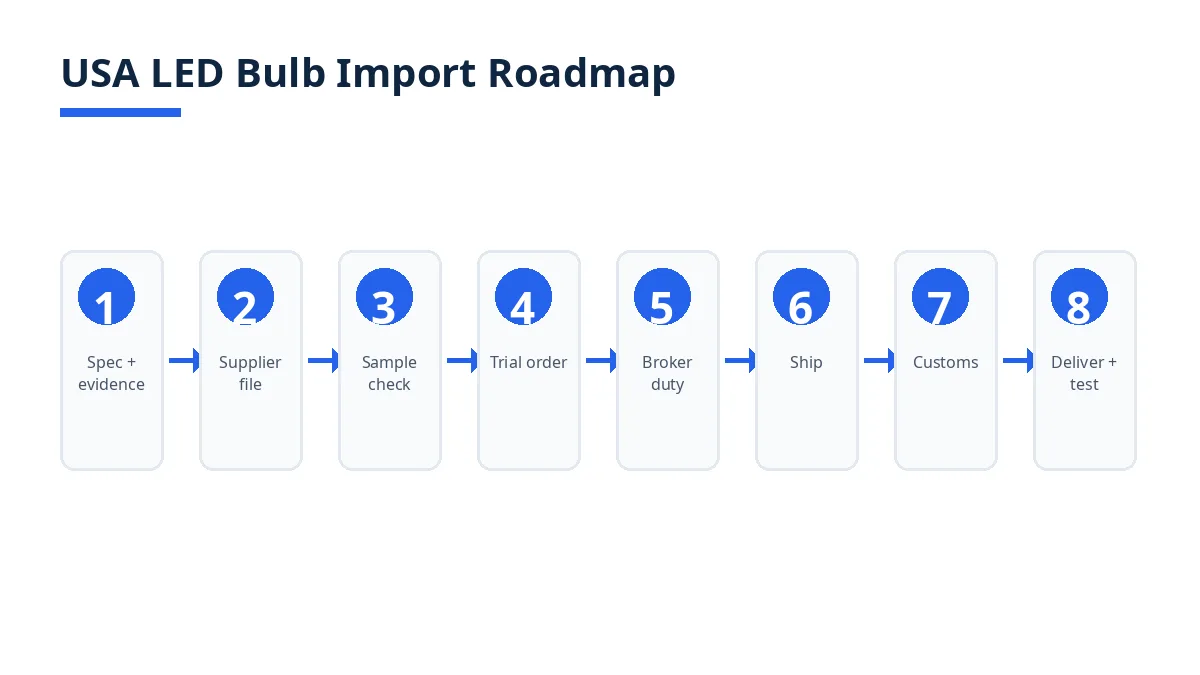
Set the specification in one document: lamp or module, base, shape, wattage, lumens, colour temperature, colour rendering, dimming, radio function and packaging.
Hold safety and radio evidence for the exact model: UL evaluation and listing, FCC test report with part and limits stated, and the separate radio statement where the bulb transmits.
Hold listing and label evidence: ENERGY STAR or DLC entry where applicable, Lighting Facts artwork checked against test reports, and the California MAEDbS listing for California sales.
Shortlist suppliers against that file and record each answer.
Agree quantity, price basis, trial order, payment triggers, inspection scope and failure remedy in writing, with the Incoterms rule, named place and version stated.
Check samples of the exact model and packaging against the specification and reports.
Run the trial order on full paperwork, inspect before packing and at handover, and test on arrival.
Confirm classification, duty and any Chapter 99 addition with the broker, and rework the landed cost on confirmed figures.
Book the carrier under the agreed Incoterms rule, confirm the broker's advance filings for the mode chosen, and ship with consistent documents.
Clear the entry, check count and function on arrival, file the entry documents with the evidence, and record what the next order must change.
What is the typical MOQ for LED bulbs from Bangladesh?
A typical minimum cannot be quoted here. No minimum figure was opened in a USA or supplier source for this product. Agree the minimum per supplier and shipment in writing, in units and cartons, with a short-count tolerance and pricing rule. Run a trial order first on full paperwork.
How long does shipping take?
There is no transit figure here. Time depends on sailing or flight, routing, port handling and checks at the USA port. Ask the carrier for routing and scheduled times in writing, and the broker how long entry and partner agency checks may add. Plan around the longest realistic time.
What import duty applies?
The schedule shows 8539.52.00 at 2 percent General, Free Special for listed programs, with modules at Free and parts at 2.6 percent.1 Have the broker confirm line, suffix, rate and any Chapter 99 addition for the exact consignment and entry date, and any special program rate for Bangladesh origin.10 Duty is separate from broker fees, freight and other CBP fees, listed separately in the landed cost.
How do I verify a supplier?
Judge a supplier on the USA file, not a price list. Check identity, safety and radio evidence for the exact model, listing and label evidence, test reports behind every printed figure, production control, and checkable references. Require written notice before any change to model, driver, base or a component affecting a test result or listing. Run a trial order on full paperwork and test on arrival.
Next steps on Exportain
Work through the step-by-step import guide for Bangladesh before you contact suppliers, and rebuild your own landed-cost worksheet built from your own broker rates from broker-confirmed rates rather than the illustrative figures in this guide. Screen makers through the supplier directory and follow the buying walkthrough when you send RFQs with the specification enclosed.
Post a free RFQ on Exportain and get quotes from verified Bangladeshi suppliers.
Sources
- Harmonized Tariff Schedule of the United States, Chapter 85: Electrical machinery and equipment and parts thereof (Revision 15, 2026). United States International Trade Commission (accessed )
- UL Announces Certification Options for New ANSI T-LED Fit System. UL Solutions (accessed )
- Lighting Standards and Certification. UL Solutions (accessed )
- Part 15 - Radio Frequency Devices. Federal Communications Commission (accessed )
- Part 18, Subpart C - Technical Standards. Federal Communications Commission (accessed )
- DesignLights Consortium Manufacturer's Guide. DesignLights Consortium (accessed )
- ENERGY STAR Program Requirements for Integral LED Lamps, Version 1.4. U.S. Environmental Protection Agency (accessed )
- FTC Materials Will Help Shoppers Understand New Light Bulb Labels Coming in 2012. U.S. Federal Trade Commission (accessed )
- State-Regulated LED and Small Diameter Directional Lamps Frequently Asked Questions. California Energy Commission (accessed )
- Ruling N349718: Tariff classification of LED lamps (E26 and E27 screw cap). U.S. Customs and Border Protection (accessed )
- Insider thoughts: Bob Ronai on Incoterms 2020 Rules; What are they about?. International Chamber of Commerce (accessed )
- Basic Importing and Exporting. U.S. Customs and Border Protection (accessed )
About the author
Sourcing from Bangladesh?
Post a request for quotation and suppliers on Exportain can send you their quotes directly.
Post an RFQ