UK LED Bulb Imports From Bangladesh: Costs, Duties and Suppliers
UK buyers importing LED bulbs from Bangladesh: clear the UKCA, RoHS, ecodesign, energy-labelling and WEEE gates for the exact lamp, confirm duty and preference with a broker, and price the landed cost on example figures reworked with confirmed numbers.
Short answer
To import LED bulbs from Bangladesh to the UK, clear the Great Britain gates for the exact lamp before ordering: UKCA or CE marking, electrical safety, electromagnetic compatibility, RoHS, ecodesign and energy labelling, and WEEE producer registration. Have the broker confirm the tariff code, the duty rate and any Developing Countries Trading Scheme preference, then agree the specification, sample, inspection and delivery term in writing, and price the landed cost on broker-confirmed figures.

On this page
Key takeaways
Great Britain accepts UKCA or CE marking under continued recognition for 21 regulations, but the declaration of conformity and test file for the exact lamp must be held before shipment.
No duty rate is stated for LED lamps: the 0.00 percent line covers LED modules under code 8539.51 only, so the broker must confirm the lamp code, rate and preference.
WEEE producer registration applies to commercial importers of LED bulbs, with direct registration under 5 tonnes and a producer compliance scheme over 5 tonnes.
Price the landed cost on labelled example figures only, and rework every line with broker-confirmed duty, VAT and origin proof before ordering.
A single LED bulb carries three identities at the United Kingdom border: electrical product, regulated light source and electronic equipment. A buyer who starts with price and works backward to compliance usually finds the problem after the goods have shipped. This guide reverses that order: the United Kingdom gates first, then suppliers, pricing and shipping. No typical price, minimum order quantity, transit time or duty rate is stated as fact here: no such figure appears in a United Kingdom source opened for this product.
The UK gate comes before the supplier search
Great Britain is England, Scotland and Wales. Northern Ireland follows different product rules, so this guide covers the Great Britain market only, and a buyer selling into Northern Ireland must confirm the Northern Ireland position separately.1 A product is placed on the market when it is first made available for distribution, consumption or use on the Great Britain market as part of a commercial activity, and placing on the market can take place before the physical handover of the product.2 The compliance file must therefore be ready when the product is first made available, not when the last carton clears the warehouse.
The United Kingdom government has laid legislation to continue recognition of current European Union requirements, including CE marking, indefinitely for a range of product regulations, so businesses have the flexibility to use either the UKCA marking or the CE marking to sell products in Great Britain.2 Continued recognition applies to 21 product regulations.2 The government marking table lists electrical equipment, electromagnetic compatibility, restriction of hazardous substances and ecodesign for energy-related products as UKCA or CE for the Great Britain market, and CE, or UKNI and CE, for the Northern Ireland market.1 Confirm which regulations apply to the exact bulb. You will still need to take action to comply with importer responsibilities if you are placing a product on the Great Britain market from outside the United Kingdom.2 Agree, before production, who acts as importer, whose details appear where, and who holds the conformity file.
Lamp, module or luminaire: name the product before you classify it
Classification and conformity both turn on what the product is, so fix the description before anyone quotes a code or a test. The tariff chapter note for heading 8539 draws the line between the two LED products buyers most often confuse. An LED module has no cap designed to allow easy installation or replacement in a luminaire and to ensure mechanical and electrical contact, while a lamp carries such a cap.3 A screw-cap or bayonet-cap bulb that a householder can fit and replace is, on that test, a lamp. A bare board that only works inside a fitting the buyer builds, and a finished fitting containing LED sources, are different products again. Ask the broker which heading fits the goods in front of you, and do not let a supplier code or a catalogue heading settle the question.
A bulb with a wireless control, an app or a sensor may raise a further regime. The Department for Business and Trade list of regulations in scope of continued recognition includes the Radio Equipment Regulations 2017 alongside the electrical equipment and electromagnetic compatibility regulations.2 If the bulb can be controlled wirelessly, ask in writing whether radio equipment rules apply to that model.
Marking and safety: the mark is the last step, not the first
The Electrical Equipment (Safety) Regulations 2016, numbered 2016/1101 and owned by the Department for Business and Trade, are the current legislation for the electrical equipment sector.1 Low voltage electrical equipment appears in the list of areas the placing-on-the-market guidance covers.2 For the Great Britain market, businesses have the flexibility to choose UKCA or CE marking for electrical equipment.1 The choice of mark is a consequence of the conformity work, not a substitute for it. A mark on the bulb or its packaging proves nothing on its own. What proves the position is the file behind it: the conformity assessment, the test reports that support it, and the declaration of conformity recording which legislation and standards were applied.
Under the fast-track provision described in the government guidance, a manufacturer can place products on the Great Britain market where they meet the European Union essential requirements and, where required, have been conformity assessed by a European Union-recognised body, provided it affixes the UKCA marking as allowed and draws up the United Kingdom declaration of conformity listing compliance with the relevant European Union legislation.2 Where products fall within multiple regulations, a mixture of UKCA and CE procedures can be used.2 Ask for the declaration for the exact model, check that it names the bulb you are buying, and hold the file before shipment: the declaration, the test reports, the specification the reports were run against, and the label and packaging artwork. If the supplier cannot produce the declaration for the exact model, that is a failed gate, whatever the price.
EMC, RoHS, ecodesign and the energy label: one test file, four checks
Electromagnetic compatibility is a separate regime from electrical safety. The Electromagnetic Compatibility Regulations 2016, numbered 2016/1091 and owned by the Department for Business and Trade, are the current legislation for that sector, and the marking table lists electromagnetic compatibility as UKCA or CE for the Great Britain market.1 An LED bulb contains a driver that switches power, and that driver is the part most likely to raise an electromagnetic compatibility question. This guide states no emission or immunity limit, because no limit was opened in a United Kingdom source for this product. Ask whether the model has been assessed, what evidence supports the assessment, and whether the declaration covers the electromagnetic compatibility regulations for this model, tied to the exact driver. Re-check when the driver changes.
Restriction of hazardous substances is the second check. The Restriction of the Use of Certain Hazardous Substances in Electrical and Electronic Equipment Regulations 2012 restrict substances in electrical and electronic equipment placed on the market, subject to the maximum concentration values and exempted applications in the schedules.4 Schedule A1 lists the restricted substances and the maximum concentration values tolerated by weight in homogeneous materials: lead, mercury, cadmium, hexavalent chromium, polybrominated biphenyls, polybrominated diphenyl ethers, and four phthalates, DEHP, BBP, DBP and DIBP.4 Schedule A2 sets out exempted applications, including lighting entries that deal mainly with mercury in fluorescent lamps.4 Do not let a fluorescent-lamp exemption answer a question about an LED lamp. Ask whether any exemption is claimed for the exact application, and if so, for the entry it relies on and its expiry position.
Ecodesign and energy labelling are the third and fourth checks. The Ecodesign for Energy-Related Products and Energy Information (Lighting Products) Regulations 2021 set ecodesign and energy labelling rules for light sources and separate control gears.5 The ecodesign requirements sit in Schedule 3 under regulation 4, with conformity assessment under regulation 7 and exemptions in Schedules 4 and 6.5 This guide states no efficacy, lifetime or other performance threshold, because no threshold was opened from Schedule 3. Ask whether the model has been assessed against the Schedule 3 requirements that apply to it, and whether the technical documentation supports the declared values. For labelling, the energy information guidance states that the supplier who first places a regulated product on the Great Britain market, or puts it into service, is responsible for compliance, and that suppliers must produce energy labels and product information sheets, known as fiches, with supporting technical documentation allowing their accuracy to be assessed.6 Suppliers must provide labels to dealers promptly and for free, include the fiche with each product, and make the technical documentation available to the Office for Product Safety and Standards if requested, retaining it for 15 years after manufacturing has stopped.6 The rescaled energy label was introduced for light sources from 1 October 2021, and suppliers must print rescaled labels onto the packaging for light sources placed on the market from that date.6 From 1 January 2021, the energy label for products placed on the Great Britain market must also include the United Kingdom flag, English language text, and a QR code where applicable.6 Ask for the label artwork, fiche and technical documentation for the exact model, and check that the class and values match the ecodesign file.
WEEE: the duty that starts when the bulbs land
Waste electrical and electronic equipment rules create a producer duty that many first-time importers miss, because it arises from placing equipment on the market rather than from selling it at retail. The regulations cover electrical and electronic equipment defined in 15 broad categories, and they do not apply to filament bulbs apart from LED filament bulbs, to which the regulations do apply.7 A commercial importer of LED bulbs is therefore inside the scope of the rules: producers who import on a commercial basis bear the obligation, and private individuals importing products are not liable.7
Producer obligations start with annual registration. How a producer registers depends on tonnage placed on the United Kingdom market: under 5 tonnes, it can register directly with its environmental regulator as a small producer, and over 5 tonnes, it must join a producer compliance scheme, which finances collection, treatment, recovery and disposal of household waste equipment.7 The producer must ensure the crossed-out wheeled bin symbol, of appropriate size as per the BSI EN 50419 standard, is displayed on the product, must make information on reprocessing of components and materials available within one year of placing new equipment on the market, and must retain all relevant documentation for at least four years.7 Settle the producer question before the first shipment: who registers, who joins a scheme if the tonnage requires it, who pays, and who holds the evidence. If you sell under your own brand, check with your adviser whether the producer duty moves to you: the guidance treats a business that buys equipment, changes it and resells it under its own brand as a producer, subject to the brand-appearance rule it states.7
Judge a supplier on the UK file, not the catalogue
A catalogue proves that a supplier can photograph a bulb. It does not prove that the bulb in the photograph is the bulb in the file. Judge a supplier by whether it can build the United Kingdom file for the exact model, and by whether the names, numbers and artwork in that file agree with each other. Ask for the legal name and registered address of the entity that will sign the export documents, and check that the same name appears on the quotation, the invoice, the declaration of conformity and the origin proof. If the test reports name a different company, ask why, and hold the explanation in writing. Ask how the supplier controls change: driver, LED package, cap, housing and packaging can all change without the model name changing, so ask what triggers a new test, declaration or label, and ask to be told before any such change ships. If a supplier answers a document request with a brochure or a promise that paperwork follows later, treat the file as incomplete.
Fix the specification and inspect against it, lot by lot
Write the specification as a table in which every claimed value has a source. Fix the cap type, the rated voltage, the claimed wattage, the claimed lumen output, the colour temperature, any lifetime claim, the driver type and whether it is integrated or separate, dimming behaviour if dimming is claimed, and any outdoor or ingress protection claim. For each field, record the value, the test method or standard the supplier says was used, and the report that proves it. If a value has no report, write it as unproven and do not use it in pricing, labelling or advertising until the report exists. State the counting and packing rules in the same document: per bulb or per carton, bulbs per carton and master carton, carton markings, and what happens to a short carton. Require packaging artwork for approval before printing, and a photograph of the sample marking before bulk ships. Agree the failure rule too: what happens if a lot fails, who re-tests, who pays, and what evidence closes the failure. Inspect each lot against this specification before shipment: count, cap and marking, label and fiche data, carton markings, declaration model number, pack condition, and report coverage for the lot and model. A visual check cannot confirm a lumen, lifetime or efficacy value.
MOQ, price structure and the sample that earns a bulk order
This guide states no typical minimum order quantity or price, because no such figure appears in a United Kingdom source opened for LED bulbs from Bangladesh. Settle every commercial figure with each supplier for each shipment, in writing, and place a sample order first. A minimum counted per model, per cap type, per colour temperature and per packaging variant is a different commitment from a minimum counted across a mixed order, so state the counting basis in the order. Break the price into parts before comparing quotations: bulb, packaging, test and file costs, transport and insurance under the agreed delivery term, and charges for labels, artwork or inspection. Compare quotations on the same delivery term and the same file. State the currency, the price basis, whether the price follows quantity shipped or quantity usable on arrival, and who bears the loss for unusable bulbs. Order the sample on the same paperwork as bulk, with the same specification, marking, label and packaging.
Delivery terms for containers: pick the rule that fits the move
The Incoterms 2020 set decides who delivers, who bears risk, who pays which costs and who handles customs duties, so the rule chosen must match how the goods actually move. EXW, FCA, CPT, CIP, DAP, DPU and DDP work for any mode or combination of modes. FAS, FOB, CFR and CIF work only for sea and inland waterway transport.8 CPT, DPU and DDP belong to the any-mode set, not the sea-only set. For containerised LED bulbs, the ICC Academy guidance notes that FCA is typically a better choice than FOB even for maritime transport, because delivery and risk under FCA can occur when the goods are handed to the carrier rather than only when they are on board the vessel.8 Under CPT and CIP, the seller pays for transport to the named destination, but risk passes when the goods are handed to the carrier, and CIP adds insurance.8 Under DAP, DPU and DDP, delivery and risk transfer occur at the named destination, with DPU differing because the seller unloads, and DDP because the seller must clear the goods for import.8
Settle two points separately, in writing: the conformity failure plan, because no delivery term allocates the cost of a border refusal caused by a failed United Kingdom file; and the import clearance plan, because under DDP the seller clears the goods for import, while under other rules the buyer arranges its own clearance. This guide states no transit time, because no transit figure was opened for this route. Get the routing and scheduled times from the carrier in writing, and get the broker's view of how long customs and any inspection may add at the border.
Duty, VAT and the documents at the UK border
Classification comes first, and the broker must confirm the line for the exact lamp. The tariff heading is 8539, and the chapter note distinguishes LED modules from LED lamps by the cap.3 The commodity page opened for this guide covers LED modules under code 8539.51, showing a third-country duty rate of 0.00 percent and import VAT at the standard rate of 20.00 percent, with a supplementary unit of items.9 That modules line must not be read across to lamps. No duty rate is stated in this guide for LED lamps, because the lamps commodity page was not opened. Have the broker confirm the current 10-digit commodity code for the exact lamp, the duty rate on that line on the date of import, and the supplementary unit for the declaration. Price duty only on the broker confirmed line.
Preference may change the duty answer, but only if origin and proof are in order. The Developing Countries Trading Scheme replaced the Generalised Scheme of Preferences, and its Comprehensive Preferences tier covers least developed countries.10 Bangladesh is listed among the Comprehensive Preferences countries in the scheme annex.10 Least developed countries continue to benefit from duty-free, quota-free trade on everything but arms under the scheme.10 To claim preference, a business needs a valid proof of origin, either a Form A or an origin declaration, and businesses can self-certify without an official stamp from the exporting country.10 Whether preference applies turns on the origin rules for the exact goods, so have the broker confirm origin and proof before pricing duty at zero.
Import VAT is charged separately from duty. The tariff pages show import VAT at the standard rate of 20.00 percent.9 Confirm with your broker and accountant what value the VAT is charged on and how it is accounted for in your VAT position. The customs steps published by the government start with a GB EORI number for imports into England, Wales or Scotland, systems and software for declarations, any licences and labelling checks, inspection, the declaration itself, payment of VAT and duty, and release if goods are held up.11 Goods may be held at the border if the right amount of duty or VAT has not been paid, the right licences are missing, or the goods did not pass inspection.11 The documents that should describe one consignment are the commercial invoice, the packing list, the transport document, the origin proof if preference is claimed, the declaration of conformity and test file for the model, the energy label and fiche data, and the producer registration evidence for the waste equipment file.
Landed cost example in pounds sterling
Every figure below is an example figure, chosen to show how the arithmetic works, not to predict a price. Replace each line with a broker-confirmed figure before ordering. Duty is shown at 0.00 pounds as an example figure only, on the assumption the broker confirms a zero rate for the confirmed code with qualifying origin proof.
Cost line | Example figure (GBP) | Basis |
|---|---|---|
Goods, 8,000 bulbs at 1.65 pounds per bulb | 13,200.00 | Example figure |
International freight and insurance | 1,850.00 | Example figure |
Customs duty, shown as 0.00 example figure only | 0.00 | Broker to confirm code and origin proof |
Customs value for VAT, goods plus freight and insurance | 15,050.00 | Adding the lines above |
Import VAT at 20 percent, working figure only | 3,010.00 | 20 percent of the customs value shown |
Broker and handling | 420.00 | Example figure, outside the VAT value in this example |
Total cash outlay | 18,480.00 | Adding the lines above |
Cost per bulb shipped, 8,000 bulbs | 2.31 | Total over shipped quantity, exact |
Cost per usable bulb, 7,680 bulbs at an assumed 4 percent loss | 2.41 | Total over usable quantity, rounded |
The arithmetic is shown in the table: 13,200.00 plus 1,850.00 plus 0.00 gives 15,050.00; twenty percent of that is 3,010.00; adding 420.00 gives 18,480.00, or 2.31 pounds per bulb shipped and 2.41 pounds per usable bulb at the assumed 4 percent loss. Confirm with the broker whether broker and handling charges fall inside or outside the VAT value for the actual consignment.
The UK import run, in order
Follow this run in order. The diagram below sets out the run in a single view.
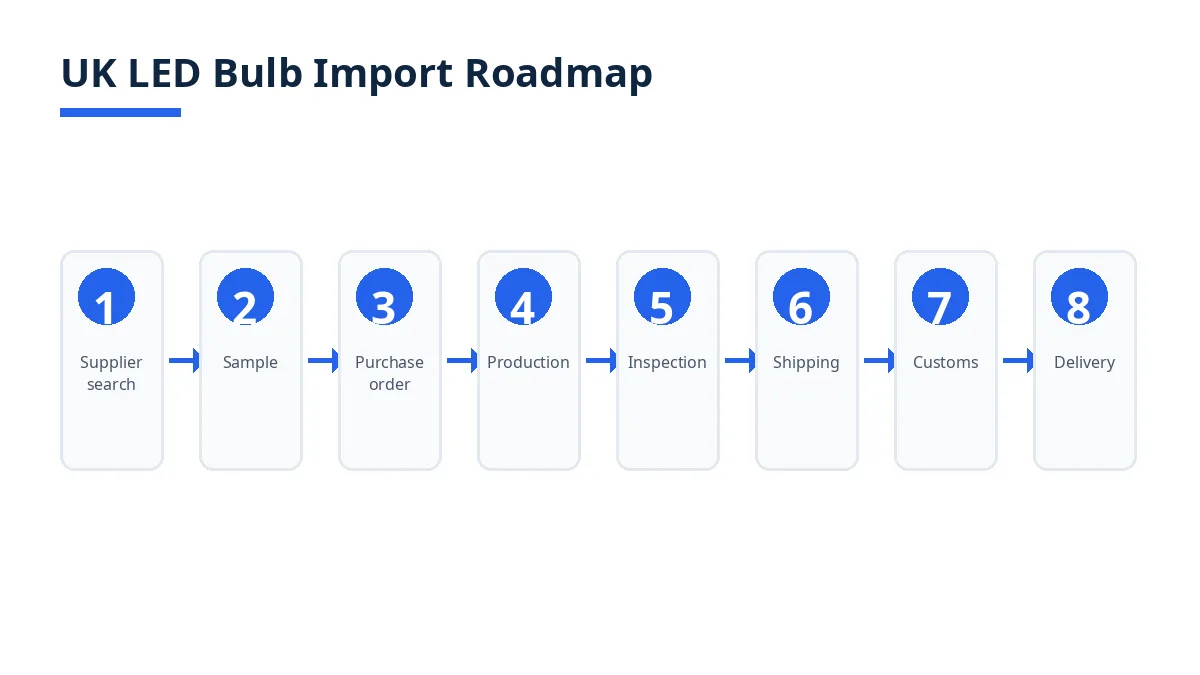
Settle the product description: lamp or module, cap type, features, and whether any wireless control is present.
Confirm the Great Britain gates for that product: marking route, safety, electromagnetic compatibility, RoHS, ecodesign, energy labelling and WEEE.
Confirm the tariff code, the duty line and the preference and origin position with the broker, before pricing.
Shortlist suppliers against the United Kingdom file, and record each answer.
Agree the specification, counting basis, price parts, sample, inspection points and failure rule in writing.
Order the sample on bulk paperwork, check it against the specification and the file, and photograph the marking and label.
Agree the delivery term, named places, import clearance plan and conformity failure plan, in writing.
Approve packaging artwork, including the energy label and fiche data, before printing.
Produce, inspect lot by lot, and ship with invoice, packing list, transport document, origin proof and conformity file for the same consignment.
Declare, pay duty and VAT as confirmed, present for inspection, count and check on arrival, and keep the declaration, payment records and lot file together.
What is the typical MOQ for LED bulbs shipped from Bangladesh to the UK?
This guide quotes no typical minimum, because no minimum figure was opened in a United Kingdom source for this product. Agree the minimum with each supplier and for each variant in writing, stating whether it counts per model, cap type, colour temperature or packaging variant, and place a sample order, on full paperwork, before bulk.
How long does shipping LED bulbs from Bangladesh to the UK take?
This guide gives no transit time, because none was opened for this route. The span from loading to release depends on routing, carrier schedules, the delivery term, customs and any inspection. Get the routing and scheduled times from the carrier in writing, and get the broker's view of how long customs and inspection may add at the border.
What import duty applies to LED bulbs entering the UK?
No duty rate is stated in this guide for LED lamps, because the lamps commodity page was not opened. The modules line under code 8539.51 shows a third-country duty rate of 0.00 percent, but that line covers modules, not lamps, and must not be read across.9 Have the broker confirm the current commodity code for the exact lamp, the duty rate on that line, and whether a Developing Countries Trading Scheme preference applies with qualifying origin and valid proof of origin.10 Price duty only on the broker confirmed answer.
How do I verify an LED bulb supplier for the UK market?
Check the file, not the catalogue. Ask for the legal name and address, the declaration of conformity and test reports for the exact model, the energy label artwork and fiche, the origin proof position, and the producer registration position for waste equipment. Check that names and model numbers agree across quotation, invoice, declaration, reports and packaging, and that the sample carries the same marking and label as bulk will carry.
Next steps on Exportain
Begin with the general how to import from Bangladesh guide, then search Bangladeshi suppliers with the specification and file questions from this guide in hand. Read how to buy before placing an order, and check the example table against the landed cost guide using broker-confirmed figures. Post a free RFQ on Exportain and get quotes from verified Bangladeshi suppliers
Sources
- Product regulations by sector and current approaches to product marking: UKCA and CE regimes. GOV.UK (accessed )
- Placing manufactured products on the market in Great Britain. GOV.UK (accessed )
- Electric filament or discharge lamps, including sealed beam lamp units and ultraviolet or infra-red lamps; arc lamps - UK Integrated Online Tariff - GOV.UK. GOV.UK (accessed )
- The Restriction of the Use of Certain Hazardous Substances in Electrical and Electronic Equipment Regulations 2012. legislation.gov.uk (accessed )
- The Ecodesign for Energy-Related Products and Energy Information (Lighting Products) Regulations 2021. legislation.gov.uk (accessed )
- Regulations: energy information. GOV.UK (accessed )
- Regulations: Waste Electrical and Electronic Equipment (WEEE). GOV.UK (accessed )
- Place of delivery & risk transfer in trade contracts. ICC Academy (accessed )
- Commodity code 8539510000: Light-emitting diode (LED) modules – UK Integrated Online Tariff. GOV.UK, HM Revenue and Customs (accessed )
- What is DCTS and why is it important for international trade?. GOV.UK (accessed )
- Get UK customs clearance when importing goods into the UK: step by step. GOV.UK (accessed )
About the author
Sourcing from Bangladesh?
Post a request for quotation and suppliers on Exportain can send you their quotes directly.
Post an RFQ