Can You Use DDP for Air Freight? Rules, Alternatives and Examples
DDP can be used for air freight when the seller can clear the goods for import at the destination airport. This guide follows the air journey, compares DAP, CPT and CIP, and lists the checks to run before booking.
Short answer
Yes. DDP works for air freight and courier shipments because it is an any-mode Incoterms 2020 rule, not a sea-only rule. The seller must arrange air carriage, complete import clearance at destination, and pay duty and taxes, delivering at the named place ready for unloading. Use DDP only when the seller can name the destination broker and the duty basis; otherwise DAP or CPT fits the flight better.
On this page
Key takeaways
DDP is an any-mode Incoterms 2020 rule, so it works for air freight and courier shipments; only FAS, FOB, CFR, and CIF are limited to sea and inland waterway transport.
Under DDP the seller arranges air carriage, completes import clearance, and pays duty and taxes, with delivery complete at the named destination, import-cleared and ready for unloading.
A carrier billing option that charges import costs to the shipper is not an Incoterms rule; the sale term, the billing selection, and the declarant must all be confirmed.
Use DAP when the buyer will clear the goods, and CPT or CIP when the seller pays carriage but risk passes at handover to the first carrier; never use CIF for a flight.
Yes, DDP can be used for air freight. The term is not tied to ships, ports, or a bill of lading. Under Incoterms® 2020, DDP belongs to the group of rules that work for any mode of transport. A seller who agrees to it must arrange carriage by air where air is the mode chosen, complete import clearance at destination, and pay the duty and taxes that import brings. The question that decides most air shipments is narrower: can this seller, for this destination airport, stand behind the import clearance the term requires? If not, DAP or CPT will usually fit the same flight better.
DDP on a flight: the answer in full
Delivered Duty Paid means delivery is complete when the goods arrive at the named destination, import-cleared and ready to be unloaded from the arriving transport.1 The seller carries and pays for export clearance, carriage to the named place, any transit formalities, and import clearance, including duty and taxes.1 The buyer takes delivery by unloading the goods, at the buyer's risk and usually at the buyer's cost, and must help the seller obtain documents the import authorities require, although the seller stays responsible for the clearance.1
That definition contains no mention of a vessel. The seller's carriage contract may use road, rail, air, sea, or inland waterway transport, alone or combined.1 Air changes none of the DDP obligations. It changes the paperwork and the speed at which a missing document becomes a missed flight. Write the full address or terminal point into the contract, with Incoterms® 2020 stated.
Only four Incoterms® 2020 rules are limited to sea and inland waterway transport: FAS, FOB, CFR, and CIF. DDP sits outside that group. Incoterms® 2020 is the most recent version of the eleven three-letter trade terms, and it entered into force on 1 January 2020.2 Under CIF, risk moves to the buyer at loading on board the vessel in the shipment port.3 There is no vessel in an air movement, so CIF cannot describe an air shipment correctly. The air equivalents that keep the seller paying carriage are CPT and CIP.
Why flying the goods changes the DDP decision
Air movement puts pressure on a DDP agreement in three ways. First, the goods arrive quickly, so import paperwork must be ready before departure. An entry summary declaration for the European Union must be lodged for short-haul flights by the actual time of take-off, and for long-haul flights at least four hours before arrival at the first airport in the customs territory.4 Second, goods that do not clear sit in a terminal the buyer does not control, so the seller's import appointment must exist before departure. Third, duty and broker charges may be assessed more than once if an order is split across flights, so ask whether the price covers one consignment or each flight separately.
Air cargo and courier: two DDP journeys on the same aircraft
Air cargo and courier shipments can travel on the same aircraft and still follow different clearance paths. In an air cargo movement, the seller or the seller's forwarder books space with an airline, the goods move under an air waybill, and a broker the seller appoints files the import declaration. In a courier or express movement, the courier carries the parcel, presents its own shipment data, and often clears the goods through its own brokerage channel, billing duty and taxes under the billing arrangement the shipper selected. The sale term and the carrier billing choice are separate decisions: a billing option that charges import costs to the shipper is a billing arrangement, not an Incoterms® rule.5 Confirm the contract term, the billing selection, and who files the declaration.
The steps below follow an air cargo DDP shipment. Courier steps run in the same order, with the courier performing several middle steps under its own account.
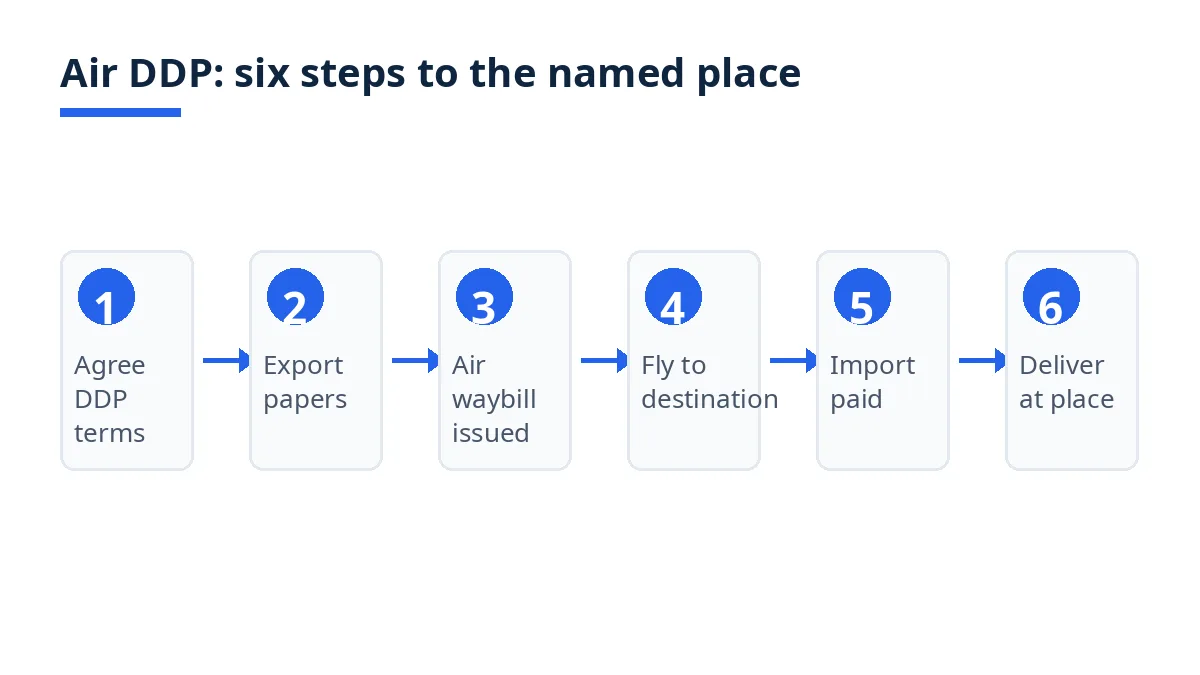
Agree the term and the named place. Record DDP, the full named place, and Incoterms® 2020 in the sale contract.
Complete export clearance. The seller files the export declaration and obtains approval before loading.
Hand the goods to the carrier under an air waybill. The air waybill is the contract of carriage between shipper and carrier, and every shipment must be accompanied by one.6 An electronic air waybill is the electronic form of that contract.6
Fly the goods and lodge advance cargo information within the deadlines for the flight.4
Clear the goods for import. The seller's broker files the import declaration, duty and taxes are settled on the seller's account, and the goods are released.
Deliver at the named place, ready for unloading. Delivery happens when the goods stand at the buyer's disposal there.1 The buyer unloads and arranges onward transport beyond the named place.
For a courier shipment, ask who files the declaration and whose account takes the charges.
The airport handover: air waybill, clearance, and the named place
Check three air waybill fields before departure: the consignee, the goods description against the invoice, and the declared value against the invoice value. A mismatch is a clearance question waiting at arrival.
At arrival, customs reviews the invoice, waybill, and other documents, checking description, value, HS code, and origin, then assesses duties and taxes, and the goods are released once charges are settled.5 Clear descriptions and correct values from the outset reduce the risk of delay.5 Under DDP, the seller pays the assessed charges, while the buyer must assist with documents the authorities require.1
Name the terminal or the exact delivery point. Under DAP and DDP, the seller pays unloading charges at destination only where the carriage contract says the seller bears them; otherwise they fall to the buyer.3
When to switch: DAP, CPT, and CIP beside DDP
Choose before the sale contract is signed. The deciding question is who can clear the goods for import at the destination airport, and who should carry the risk while the aircraft is in the air.
Term | Seller pays carriage to the named place | Risk passes to the buyer | Import clearance and duty | When it fits an air shipment |
|---|---|---|---|---|
DDP | Yes | At the named place, cleared for import, ready for unloading | Seller | Seller can clear at destination |
DAP | Yes | At the named place, ready for unloading | Buyer | Buyer has a broker at the arrival airport |
DPU | Yes | At the named place, after the seller unloads | Buyer | Buyer wants the seller to unload as well |
CPT | Yes, to the named destination | When handed to the first carrier | Buyer | Seller pays freight; buyer takes risk at handover |
CIP | Yes, to the named destination, plus insurance for the buyer | When handed to the first carrier | Buyer | As CPT, plus insurance the buyer can claim on |
CIF | Yes, by sea to the destination port, plus minimum insurance | When loaded on board the vessel | Buyer | Does not fit air freight: a sea and inland waterway rule only |
Under the "C" rules, delivery and destination differ: risk transfers where the seller hands the goods to the carrier, while the seller still pays carriage to the named destination.3 For the "D" rules, the delivery point and the destination are one and the same: the named place.3
Switch from DDP to DAP when the seller cannot clear the goods for import, when local rules require the local importer to clear them, or when the buyer wants control of the import declaration. Where the destination's customs authorities require the local importer itself to file the import clearance, DDP is not available and DAP should be used instead.1 Do not switch to CIF for an air shipment.
What an air DDP price is built from, and what time it takes
A DDP air price is a build-up, and each line should be visible before signing: goods and packing, inland transport, export clearance, air freight, transit formalities, import clearance and the broker's fee, duty and taxes, terminal handling, and onward carriage beyond the airport. Insurance is not an obligation under DDP.3 Agree it separately, in writing.
No rate or broker fee is stated here, because none is fixed. Duty and tax amounts depend on the declared value, the HS code, the country of origin, and the type of goods, and each country has its own rules.5 Ask the seller for the duty basis.
Worked example: cotton scarves by air to a London warehouse
Example figures only: 400 handloom cotton scarves in 8 cartons, DDP to a London warehouse, as one air consignment. The duty line is illustrative, not a schedule rate.
Cost line | Example figure (USD) |
|---|---|
Goods value, 400 scarves | 6,000 |
Air freight, Dhaka to London | 940 |
Export handling and export clearance | 85 |
Import duty, illustrative broker figure | 312 |
Broker fee for import clearance | 120 |
Insurance arranged by the seller for its own risk | 60 |
Total DDP price | 7,517 |
6,000 + 940 + 85 + 312 + 120 + 60 = 7,517. Per scarf, that is 7,517 divided by 400, or 18.79 rounded to cents. No import tax figure is shown. Onward carriage is inside the total only because the named place is the warehouse.
Bangladesh departure: export papers before the aircraft leaves
Before anything is loaded, the seller's export declaration must be approved by Customs. That declaration, the Bill of Export or Shipping Bill, identifies the goods and their value, the exporter, the overseas buyer, and the carrier.7 Enclosed with it are the commercial invoice and packing list, the certificate of origin, the EXP form certified by an authorised dealer, the VAT registration certificate, the taxpayer identification number, and the export letter of credit or, failing that, an approved export contract, purchase order, or guarantee.7 An ERC applies for jute, jute goods, and tea.7 Approval follows a documentary check and physical verification; loading may then begin, and export is complete once the airline leaves the port.7 Ask the destination broker to check the invoice and packing list against the import declaration before departure.
Four destination checks: USA, UK, EU, and UAE
No duty or tax rate is stated below. Confirm each point with a licensed broker for that destination, in writing, before signing. The ICC Academy's United States example has a Dhaka seller completing and paying for the import formalities in Beaverton, Oregon, with United States Customs. A seller with no United States entity or presence may have to register as a Foreign Importer of Record.3 For imports into England, Wales, and Scotland, the EORI number must begin with GB. Movements involving Northern Ireland may call for one beginning with XI.8 Ask whose EORI number the declaration will carry and who pays VAT and duty. In the European Union, third-country operators are registered by the first Member State in which they wish to lodge a customs declaration.9 Ask who lodges the declaration and whose EORI number it carries. For the United Arab Emirates, no customs procedure is stated here, because no UAE customs source was opened for this guide. Ask a UAE-licensed broker to confirm the filing and calculation route in writing.
Signs the DDP offer will stall at the airport
Watch for five signs: one total with no build-up; no destination broker named; a named place that is only a city or airport name; no answer on who stands as declarant; and a sea-only term such as CIF quoted for a flight. Any one sign calls for a written correction before booking.
Before you book: the air DDP check
The contract states DDP, the full named place, and Incoterms® 2020.
The seller names the destination broker and states who stands as declarant.
The duty basis is shown: HS code, customs value, and the broker's calculation route.
The build-up separates freight, clearance, duty, tax, and onward carriage.
The air waybill fields match the invoice and packing list.
The courier billing selection matches the DDP term.
Insurance is agreed separately, stating who insures and who claims.
The document cut-off and flight are named.
Can a courier deliver DDP without a broker at destination?
A courier can carry the goods, but DDP still requires clearance on the seller's side. The seller must show who files the declaration and whose account takes the charges. A carrier billing option that charges import costs to the shipper is a billing arrangement, not an Incoterms® rule.5 If no clearance route is named, the movement is a DAP movement in practice.
What does DDP cost on an air shipment, and how long does clearance take?
DDP on air costs the sum of the stages in the build-up above. No single figure here states that sum, because duty follows the destination schedule for the HS code and customs value, and air freight follows weight, volume, route, and season.5 Clearance time follows the same stages: documents ready before departure, advance cargo information lodged within the flight deadlines, and the import declaration assessed after landing.4 5
Which papers travel with an air DDP shipment?
The export set is the declaration, invoice, packing list, EXP form, certificate of origin, and product certificates.7 The transport document is the air waybill.6 The import set is the broker's declaration with the invoice, packing list, air waybill, and any licence or certificate required, checked before departure.
What goes wrong most often with DDP by air?
The most common failure is an import appointment that does not exist: no destination broker, no declarant, and no duty basis. Others are a named place that means two different points, a sea-only term quoted for a flight, and a courier billing selection that does not match the sale term.
Next steps on Exportain
Compare the DDP quotation with the DAP alternative in the table above, and ask the seller for the broker name, duty basis, and build-up in writing. See Incoterms rules, CIF, landed cost, and how to buy first.
Post a free RFQ on Exportain and get quotes from verified Bangladeshi suppliers.
Sources
- DAP & DDP Incoterms 2020 explained: Key differences. ICC Academy (accessed )
- Incoterms® rules. International Chamber of Commerce (ICC) (accessed )
- Incoterms® 2020 C rules vs D rules: Risk transfer explained. ICC Academy (accessed )
- Customs clearance documents and procedures. European Commission (accessed )
- Your Guide to What Duties & Taxes Mean in Shipping. DHL, (accessed )
- News Brief: Moving the Electronic Air Waybill Forward. International Air Transport Association (accessed )
- Customs Clearance Procedures for Export. Bangladesh Customs, National Board of Revenue (accessed )
- Get UK customs clearance when importing goods into the UK: step by step. GOV.UK (accessed )
- Using the EORI number. German Customs (Zoll) (accessed )
About the author
Sourcing from Bangladesh?
Post a request for quotation and suppliers on Exportain can send you their quotes directly.
Post an RFQ