

Quality Control Checklist for Leather Shoes From Bangladesh
Leather shoes quality control checklist for Bangladesh orders: sole bonding, heel attachment, toe-box shape, pair matching, measurements, stitching, closures, lab evidence, and shape-holding packing, with a numbered checklist, failure fixes, and a summary table.
Short answer
This leather shoes quality control checklist covers sole bonding and heel attachment, toe-box shape, upper leather grading, measurements, pair matching, stitching and edge finishing, lace and closure function, insole condition, labels, lab evidence by named method, and shape-holding packing, with a numbered checklist, failure fixes, and a summary table.
On this page
Why this checklist matters
A shoe fails where a flat leather good cannot. A sole can part from the upper, a heel can rock, and a toe box can pinch when lasted over the wrong shape. A buyer who checks only the leather surface passes pairs that return as complaints, because the faults that matter most sit in the bond, heel, and pair fit.
Footwear guides put sole attachment, adhesive, heel attachment, toe shape, and pair symmetry at the center, alongside stitching, edges, eyelets, laces, and insoles.1 Pairs are checked together, because a visible left-right difference can make a pair unsellable even when neither shoe carries a major fault alone.1 Leather grading differs: scars, insect holes, and wrinkles are inherent to hides, so inspection grades by position and size.2
Before you start
Assemble the reference set before any carton is opened: approved sample pair, signed specification, size chart, defect list, sampling plan, and packing specification. A staged shoe plan starts by freezing that file — last, sample, material list, size range, packaging, labels — because an inspector on a different version may pass the wrong shoe.3 Check construction before boxing, since stitching, lasting, bonding, and pair matching get harder to isolate once shoes are packed.3
Agree measurement rules in advance: which points, in what condition, and with what tool. Footwear checks typically cover shoe length, insole length, outsole length and width, heel height, and opening circumference, and size markings on shoe, label, box, and carton must correspond.1 Judge color under one agreed light, since leather color difference is judged against a stable light source and color datum.2 Agree defect classes and the sampling plan in writing, including standard, level, buyer-specified AQL values per class, and the action on a fail. Every AQL figure here is a buyer-specified value or a published table figure only, never a universal rule for leather shoes.
The full checklist (numbered, printable)
Work through the list in order, pair by pair, marking each item pass, fail, or not applicable, and record measurements where numbers are involved.
Sole attachment, full perimeter. The outsole is bonded all the way around, with no gap at toe, waist, or heel seat and no edge lifting.1
Bonding quality and glue control. No open bonding, excess glue, insufficient adhesive, or poor edge bonding.1 Faults can come from poor surface preparation, wrong adhesive, insufficient curing, or weak control.1
Sole position and shape. Each sole sits centered on its upper, not skewed, and neither sole is deformed or mispositioned.1
Heel attachment. The heel is firmly attached, with no rocking, looseness, or gap at the heel seat.1
Heel height and pair balance. Heel height matches the chart on both shoes, and the pair stands level on a flat surface without rocking.1
Heel top piece. The top piece is fully attached, even, and free of chipping or partial detachment.
Toe-box shape and reinforcement. Toe shape matches the sample, the toe box holds shape under light pressure, and specified reinforcement is even on both shoes.1
Toe spring and twist. Neither shoe shows excessive toe spring or twisting, and neither is misshapen against the sample.
Upper leather type and grain. Leather type, grain, and finish match the sample, with consistent grain within each pair.4
Natural marks, graded by position and size. Scars, insect holes, veins, loose grain, cracking, and wrinkles are graded by position and size, visible-area marks more strictly.2
Color and shade. Color is even within each pair and across the lot against the sample, with no shade split between left and right shoes.1 4
Upper surface. The upper is free of scratches, stains, glue marks, dents, and uneven finishing outside the agreed defect list.1 4
Length and outsole dimensions. Shoe length, insole length, outsole length, and outsole width match the chart at the agreed points.1
Opening and fit dimensions. Opening circumference, and strap length where fitted, match the chart.1
Left-right pair matching. The two shoes match in size, shape, color, stitching, sole position, and component placement, checked side by side and sole to sole.1
Upper stitching. Stitching is tight and even, with no skipped, broken, or loose stitches and no loose threads at stress points.1 3
Edge finishing. Edges are clean and finished, with no rough, frayed, or unfinished edge on the upper, collar, or tongue.1
Seam behavior on flexing. When flexed by hand, seams do not gape, pull, or split, and the upper shows no abnormal deformation.1
Lace and eyelet function. Laces are the specified length and condition, eyelets are paired, evenly spaced, sharp-free, and firmly set, and lacing closes evenly.1
Other closures. A zipper, buckle, strap, or hook-and-loop fastener operates repeatedly without catching or slipping, and adjustable straps hold their setting.1
Lining condition and attachment. The lining lies flat, is free of tears and bunching, and does not pull out or roll at the collar or tongue.1
Insole condition and fit. The insole sits flat, covers the footbed, is free of wrinkles and raised edges, and a removable insole reseats cleanly.1
Outsole tread and surface. Tread pattern matches the sample, with no deformation, surface damage, or separation at the tread edge.1
Internal finish. Inside each shoe is free of protrusions, rough areas, exposed nails or staples, and sharp edges that could affect wear.1
Odor, dampness, and mold. Check for strong chemical odor, dampness, and mold, especially inside the shoe and packing, and set aside and photograph affected pairs.4
Labels and markings. Size, material, origin, and care information are correct in content and spelling, in the agreed position, and the size label matches the measured pair.1
Hangtags and barcodes. Hangtags are correct and correctly placed, and barcodes scan where scanning is required.1
Lab evidence by named method. Where the buyer specification requires lab testing, record method and result per test. Colorfastness to rubbing is covered by ISO 17075; sole bond, flex, and abrasion are recorded the same way.4 No grade, threshold, or pass mark is stated here; the buyer specification sets it.
Shoe-tree and box packing that holds shape. Each pair is packed with its shoe tree, tissue, or form where specified, so toe box and heel keep shape and the pair is not crushed.1
Carton assortment and marks. Size and color assortment per carton matches the order, carton marks match the packing list, and quantities are counted.1
Sampling decision on the finished, packed lot. Apply the agreed plan to the finished, packed lot. As a published-table example only, a lot of 500,001 pairs or more at General Inspection Level II gives code letter Q and a sample of 1,250, with acceptance and rejection numbers of 21 and 22 for major defects at a buyer-specified AQL 2.5, and 0 and 1 for critical defects.5 For the largest lots, the minor pair resolves by the arrow rule in the master table, so confirm it there or via the inspection company's calculator.5 Your lot uses your purchase-order values.
Common failures and how to fix them
Sole edge lifting at the toe. Cause: poor surface preparation, wrong adhesive, or insufficient curing. Fix: isolate the batch and size run, re-bond affected pairs, and re-check the perimeter after curing.
Heel rocking or loose. Cause: unlevel heel seat, missed fixing, or adhesive failure. Fix: reset on a level seat, refit the fixing, and stand-test every remade pair.
Toe box collapsing or pinching. Cause: wrong lasting shape, missing reinforcement, or crushing in packing. Fix: re-last over the correct shape with specified reinforcement, and correct the packing form.
Shade split inside a pair. Cause: left and right shoes cut from different skins or dye lots. Fix: sort back into matched pairs under the agreed light, and remake unmatched pairs.
Stitching wandering or skipping near the sole. Cause: feed fault, or stitching pulled during lasting. Fix: re-stitch the seam, then flex-check the remade pair and the run.
Pair mixed in the box. Cause: packing station change or mixed size run. Fix: open affected cartons, re-pair by size, shade, and shape, and add a pair-matching check before sealing next time.
Downloadable template / summary table
No file download is offered with this article. Copy the summary table below into your inspection sheet, add your purchase-order values, and record one row per group.
Checklist group | Items | Record |
|---|---|---|
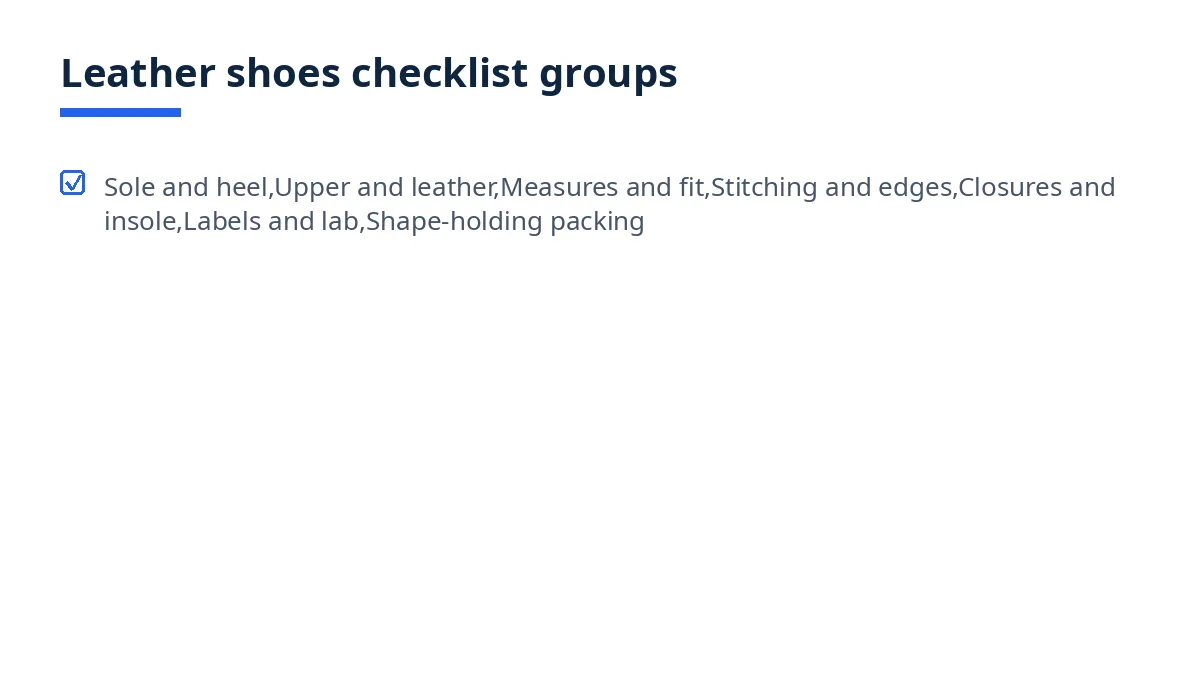
Sole and heel | 1–7 | Bond, heel, toe shape |
Leather and color | 9–12 | Grain, marks, shade, surface |
Measures and pair match | 13–15 | Length, width, left-right match |
Stitching, edges, flex | 16–18 | Stitch, edge, flex |
Closures and inside | 19–24 | Laces, closures, lining, insole |
Labels, lab, packing | 25–30 | Odor, labels, lab, packing, carton marks |
Sampling decision | 31 | Standard, level, code, sample, Ac/Re, result |
AQL figures here are buyer-specified values and published table figures only. The sampling decision is taken on the finished, packed lot, not on unpacked pairs.
How Exportain helps
Buyers can post a requirement describing the shoe and inspection scope, and arrange inspection directly with a provider. The inspection services category page currently states No services published in this category yet, so treat that page as a category notice, not a listing, and agree the inspection contract directly with the provider you choose. A pre-shipment inspection samples finished, mostly packed goods; it is not a check of every piece and not a guarantee, so the written checklist and sampling plan still decide the result.6
FAQs
When should this checklist be used?
Use it on the pre-production sample, during production while bonding and lasting can still be corrected, and at final inspection on the finished, packed lot.
Who should complete it?
The buyer's inspector or an appointed third-party inspector completes it against the buyer's specification, using the approved sample pair and the signed defect list. Supplier checks run in parallel but do not replace it.
What are the most common failures?
Sole edge lifting, loose heels, collapsing toe boxes, shade splits in a pair, wandering stitching near the sole, and mixed pairs in the box. Each is listed above with its fix.
Can a third party do it?
Yes. A third-party inspector can run the full checklist and sampling decision, provided the buyer supplies the specification, approved sample pair, defect list, and written sampling plan first. The contract is between buyer and provider.
Next steps on Exportain
Read the AQL Acceptance Quality Limit guide to set the standard, level, and Ac/Re values in your purchase order, and the Pre-Shipment Inspection guide for how final inspection is booked and run.
Sources
- Footwear Inspection: Complete Guide to Quality Control and Inspection Standards. ECQA (accessed )
- Genuine Leather Inspection | Grading and Defects. NITR (accessed )
- Shoe Quality Control: Step-by-Step Guide. TradeAider (accessed )
- Leather Goods Inspection and Quality Control in Asia & China. V-Trust (accessed )
- AQL Meaning: Acceptance Quality Limit, Tables. Exportain (accessed )
- Pre-Shipment Inspection (PSI). Exportain (accessed )
About the author
Sourcing from Bangladesh?
Post a request for quotation and suppliers on Exportain can send you their quotes directly.
Post an RFQ


