HS Code for Leather Shoes: Classification Guide for Importers
Indicative HS heading 6403 for leather shoes: how the heading is chosen, what decides the subheading, and how US, EU and UK national codes extend it - with a verify-before-you-ship check.
Short answer
Leather shoes are indicatively classified under HS heading 6403, which covers footwear with uppers of leather, but that heading alone is not a complete code. The exact six-digit subheading depends on the shoe type, sole material and ankle coverage, and each destination country adds its own digits after the sixth. Confirm the full national code in the destination tariff before shipping.
On this page
Leather shoes do not have one universal code that can be copied from a supplier catalogue onto every customs entry. The heading most often used as a starting point is 6403, which the Harmonized Tariff Schedule of the United States describes as footwear with outer soles of rubber, plastics, leather or composition leather and uppers of leather.1 That heading is indicative only: the correct code depends on the shoe itself, and the full code on the entry is the national code of the destination country, confirmed in that country's tariff for the date of entry.
Verify note: before you use any code in this guide on a real shipment, confirm the subheading and the full national code in the destination tariff, and check it with a customs broker or the customs authority where the goods will enter. Tariff texts change, national extensions differ, and a code that fits one shoe style does not automatically fit the next style in the same order.
Quick answer: indicative HS heading (with verify note)
The indicative heading for leather shoes is 6403. It covers footwear whose uppers are leather and whose outer soles are rubber, plastics, leather or composition leather.1
Two tests decide whether 6403 is even the right heading. The first is the upper: its material is taken to be the constituent material with the greatest external surface area, ignoring accessories and reinforcements such as ankle patches, edging, ornamentation, buckles, tabs and eyelet stays. United Kingdom guidance states the same test plainly: where the material with the most external area of the upper is leather, the footwear is classified under heading 6403, and where it is textile, it is classified under heading 6404.2 The second test is the outer sole, whose material is the material with the greatest surface area in contact with the ground.
How HS codes are structured (2-4-6 digits)
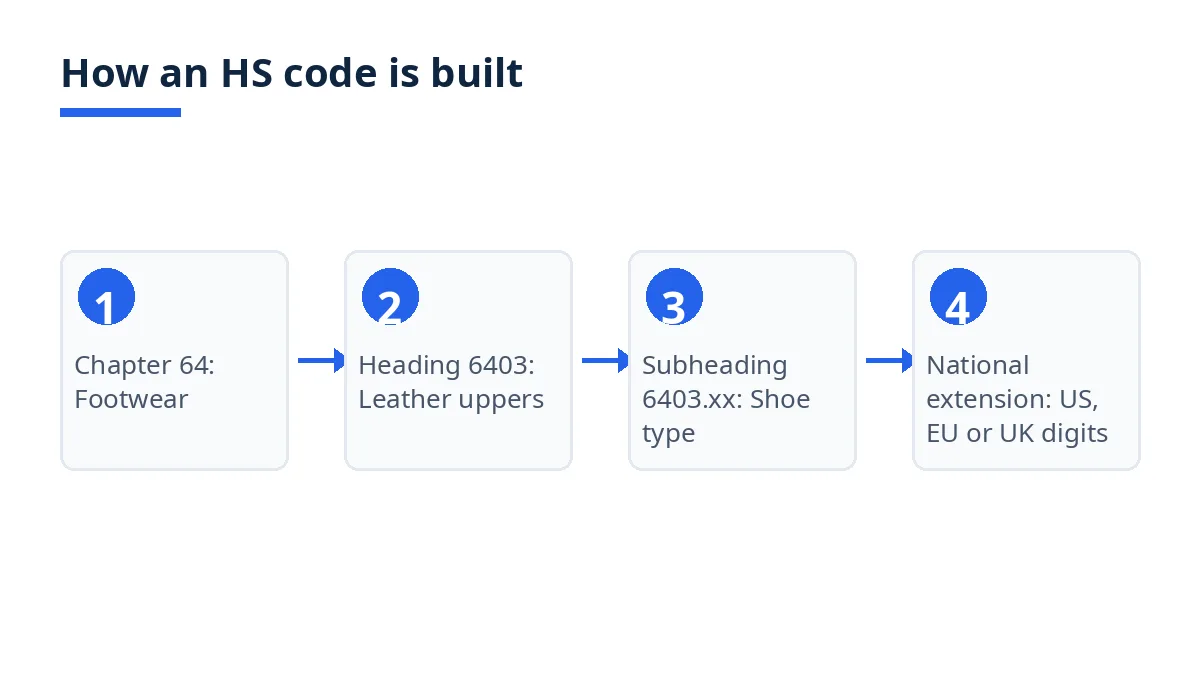
The Harmonized System narrows from broad to specific. The first two digits are the chapter, the next two digits make the four-digit heading, and the final two digits of the six-digit code make the subheading. Chapter 64 covers footwear, gaiters and the like, and parts of such articles. Heading 6403 sits inside that chapter, and the six-digit subheadings inside 6403 describe particular kinds of leather-upper footwear.
Only the first six digits are shared internationally. Beyond the sixth digit, each country adds its own digits for its own tariff and statistical purposes, so the same shoe can carry a different full code in different destinations even though the first six digits match. The United States uses a 10-digit import number, European import declarations generally use 10 digits, and the United Kingdom uses its own 10-digit commodity code.3
The diagram below shows the build-up from chapter to national code.
Factors that decide the code for leather shoes
The deciding factors are the materials, the construction and the shape of the shoe, checked in that order. Start with the upper material, judged by the greatest external surface area test. A mixed-material upper is common: leather panels combined with textile inserts, mesh sections or synthetic overlays. Ask the supplier to state which material covers the greatest external surface area of the upper, excluding accessories and reinforcements. Lining material is not counted as an upper material, so a leather-lined shoe with a textile outer upper is not a leather-upper shoe on the strength of its lining.
Next, check the outer sole material by the ground-contact test, and note whether the sole is rubber, plastics, leather or composition leather, since heading 6403 accepts each of those sole materials. Then check the shape and function of the shoe: whether it covers the ankle, whether it is sports footwear, whether it has a protective metal toecap, whether it is made on a base or platform of wood, and whether its upper consists of leather straps across the instep and around the big toe. Each feature maps to a different subheading inside 6403, so one order containing ankle boots, low shoes and strap sandals will normally need more than one code.
Sports footwear is split inside 6403 between ski boots, cross-country ski footwear and snowboard boots on one side and other sports footwear on the other.1 Separate uppers, insoles and other parts of footwear are not footwear at all: they fall under heading 6406, the parts heading of Chapter 64.
National codes: US HTS, EU CN/TARIC, UK commodity code
In the United States, the Harmonized Tariff Schedule extends the six-digit subheading to a 10-digit import number. Inside heading 6403, the current United States schedule lists, among others, subheading 6403.59 for other footwear with outer soles of leather that does not cover the ankle, with further lines for footwear made on a base or platform of wood, turn or turned footwear, welt footwear, footwear for men, youths and boys, and footwear for other persons.1 Each of those lines is a United States line: it describes how the United States breaks down the shared subheading, and it must not be quoted as the code for a European entry.
In the European Union, the Combined Nomenclature adds two digits to the six-digit subheading to make an eight-digit code, and TARIC adds further digits for EU measures, giving a 10-digit code for import declarations. The EU schedule keeps the same 6403 subheading structure: sports footwear, strap footwear, footwear with a protective metal toecap, footwear with outer soles of leather covering the ankle, and other footwear with outer soles of leather.4 The EU descriptions also split the ankle-covering and other lines by insole length and by wearer, for example a line for footwear covering the ankle with insoles of less than 24 cm and separate lines for men and for women where the insole is 24 cm or more.4
In the United Kingdom, the commodity code is also 10 digits. The United Kingdom tariff lists commodity code 6403200000 for footwear with outer soles of leather and uppers consisting of leather straps across the instep and around the big toe.5 That code is a United Kingdom code for that specific strap-footwear description; it is not a code for leather shoes in general, and a low leather shoe or a leather ankle boot needs a different United Kingdom line even though both sit under heading 6403.
How to confirm the code officially
Start with the text of the destination tariff, not with a search result or a supplier invoice. Open the current chapter for footwear in the destination schedule, read the heading text for 6403, read the chapter notes, and then work down through the subheadings until the description matches the shoe in front of you. Classification under the United States schedule is governed by the General Rules of Interpretation, and the first rule provides that classification is determined according to the terms of the headings and any relative section or chapter notes.6
Next, test the shoe against the chapter notes and the surface-area rules for the upper and the outer sole, using the supplier's material breakdown and, where the upper is mixed, measurements of external surface area by material. Where the answer is still doubtful, ask a customs broker to confirm it in writing, or seek a formal ruling from the customs authority of the destination country. A ruling on a comparable shoe is useful background, but it describes the shoe that was put before the authority, so check that its materials, construction and measurements match your shoe before relying on it.
Common classification mistakes
The most common mistake is stopping at the heading. Writing 6403 on an entry, or on a commercial invoice, and treating it as a complete code leaves the subheading and the national extension undecided, and a customs system that requires a full national code will not accept a heading as an entry.
A second group of mistakes comes from judging the shoe by its most visible material instead of the surface-area tests. A shoe with leather trims, a leather heel counter or a leather toe cap is not necessarily a leather-upper shoe if textile covers the greatest external surface area of the upper. Equally, a leather upper with a textile lining is not misclassified by the lining, because lining is not an upper material.
A third mistake is mixing up neighbouring headings. Waterproof footwear with outer soles and uppers of rubber or plastics, where the uppers are neither fixed to the sole nor assembled by stitching, riveting, nailing, screwing, plugging or similar processes, belongs under heading 6401, not 6403.7 Other footwear with outer soles and uppers of rubber or plastics belongs under 6402, footwear with textile uppers belongs under 6404, and footwear that fits none of 6401 to 6404 belongs under 6405.7
Related duties and documents
The HS code does not by itself state what an importer will pay. The code points to the duty treatment in the destination tariff, and the amount that applies depends on the full national code, the origin of the goods, any preference or trade measure that applies on the entry date, and the customs value. Ask your broker for the treatment that applies to your full national code, origin and entry date, and keep that answer with the entry file.
The documents that normally travel with a footwear shipment are the commercial invoice, the packing list, the bill of lading or airwaybill, and the certificate of origin where a preference or a buyer requirement calls for one. The invoice description should match the classification: it should name the shoe type, the upper material, the outer sole material, whether the shoe covers the ankle, and the quantity and unit, so that the code on the entry can be checked against the goods.
FAQs
What is the HS code for leather shoes?
The indicative heading is 6403, which covers footwear with outer soles of rubber, plastics, leather or composition leather and uppers of leather.1 There is no single complete code for all leather shoes: the six-digit subheading depends on the shoe type, sole and ankle coverage, and the full code adds the destination country's own digits.
Is the HS code the same in every country?
Only the first six digits are shared. The chapter, heading and subheading are the same internationally, but each country adds its own digits after the sixth digit for its tariff and statistical purposes.3 The United States uses a 10-digit import number, the European Union builds on an 8-digit Combined Nomenclature code with TARIC extensions, and the United Kingdom uses its own 10-digit commodity code.
How do I confirm the correct code?
Read the destination tariff text for Chapter 64, apply the heading text and the chapter notes, and test the upper and outer sole by the surface-area rules, using the supplier's material breakdown.2 Then ask a customs broker to confirm the full national code in writing, or seek a formal ruling from the destination customs authority for a doubtful case.
What happens if I use the wrong code?
A wrong code can delay clearance while customs re-examines the goods, and it can change the duty treatment that applies to the entry. It can also create a mismatch between the entry, the invoice description and any origin or preference claim, which then needs to be explained and corrected. The correction route and any penalty depend on the destination country's rules and on whether the error is found by the importer or by customs.
Next steps on Exportain
For background on how the system works, read HS Code: Harmonized System Explained and HS Codes: How to Classify Your Product. When you are ready to source, browse suppliers on Exportain and compare product specifications, including upper and sole materials, before you ask for a quotation. To start a sourcing request with the specification your broker will need, Post a free RFQ on Exportain.
Sources
- Harmonized Tariff Schedule of the United States, Revision 18 (2026), Chapter 64. U.S. International Trade Commission (accessed )
- Classifying footwear for import and export. GOV.UK (accessed )
- What is a harmonized or HS code?. FedEx (accessed )
- Combined Nomenclature, Chapter 64 (Council Regulation (EEC) No 2658/87, Annex I, as amended). legislation.gov.uk (accessed )
- Commodity code 6403200000: Footwear with outer soles of leather, and uppers which consist of leather straps across the instep and around the big toe. UK Trade Tariff, GOV.UK (accessed )
- Headquarters Ruling H333417: Classification of women's boots. U.S. Customs and Border Protection (accessed )
- Section XII, Chapter 64: Footwear, gaiters and the like (HS 2022). European Commission, Taxation and Customs Union (accessed )
About the author
Sourcing from Bangladesh?
Post a request for quotation and suppliers on Exportain can send you their quotes directly.
Post an RFQ