Leather Shoes Price in Bangladesh: FOB Cost Breakdown for Buyers
Read a leather shoe FOB quotation per pair: fix the last, upper leather, build and size curve, then rank the pair-cost groups and the port lines on one specification.
Short answer
A leather shoe FOB price is a per-pair figure that ends when the shoes are loaded on board at a named port. Read it group by group: upper leather per pair, cutting and closing, lasting and sole attachment, sole unit and heel, lining and trims, pair inspection, shape-holding packing, and the port lines. Fix the last, upper leather, build and size curve first, because each one moves the pair figure before any discussion of totals.
On this page
Key takeaways
Read the price per pair, not per dozen or per carton, and restate every competing quotation to one pair before ranking.
Upper leather is priced by what one pair consumes: animal, layer, finish, grade rules, and the sealed sample that sets grain and shade.
The build sets the labor: a welted shoe and a cemented shoe are different products, and fit is judged on finished pairs from the production last.
A combination minimum multiplies per last, color, and width combination. Example figures: a 180-pair minimum for each last-and-color pair, two lasts in three colors, sets the smallest order at 1,080 pairs.
Tannery audit evidence and lot lab evidence are separate documents; the first covers the tannery, the second covers the ordered leather.
A leather shoe quotation that arrives as one total hides the decisions that set it. Two totals for the same shoe can differ by several dollars a pair while both sellers price honestly, because the totals rest on different lasts, different upper leather, different builds, or different ports. This guide reads the figure the way a shoe is made and checked: pair by pair, group by group, up to the point where the shoes go on board.
The pair is the unit a shoe price stands on
Shoes are sold, checked, and packed as pairs, and a price that is not stated per pair cannot be compared with one that is. A per-dozen figure, a per-carton figure, and a per-pair figure describe the same order only after each is restated to one pair. Settle the unit in the first line of every quotation, and restate every competing figure to that unit before any ranking.
A pair is also the unit of judgment. The faults that matter most in a shoe sit in the bond between sole and upper, in the heel, and in how the two shoes match, and a visible difference between the left shoe and the right shoe can leave a pair unsellable even when neither shoe carries a major fault on its own.1 Inspection therefore runs pair by pair, with the sole bonded around its full perimeter, the heel firm with no rocking, the toe box holding shape, and the two shoes matching in size, shape, color, stitching, and sole position.1
The pair unit also governs shade. Hides arrive with scars, insect holes, and wrinkles, and graders score each mark by its place on the hide and its size, with the strictest view reserved for areas the wearer sees.1 Color is judged against one agreed light and one agreed color datum, because a pair cut from two dye lots can split in shade.1 Name the shade standard, the light, and the pair-matching rule in the specification, before the price discussion starts.
Eight pair-cost groups inside an FOB shoe quotation
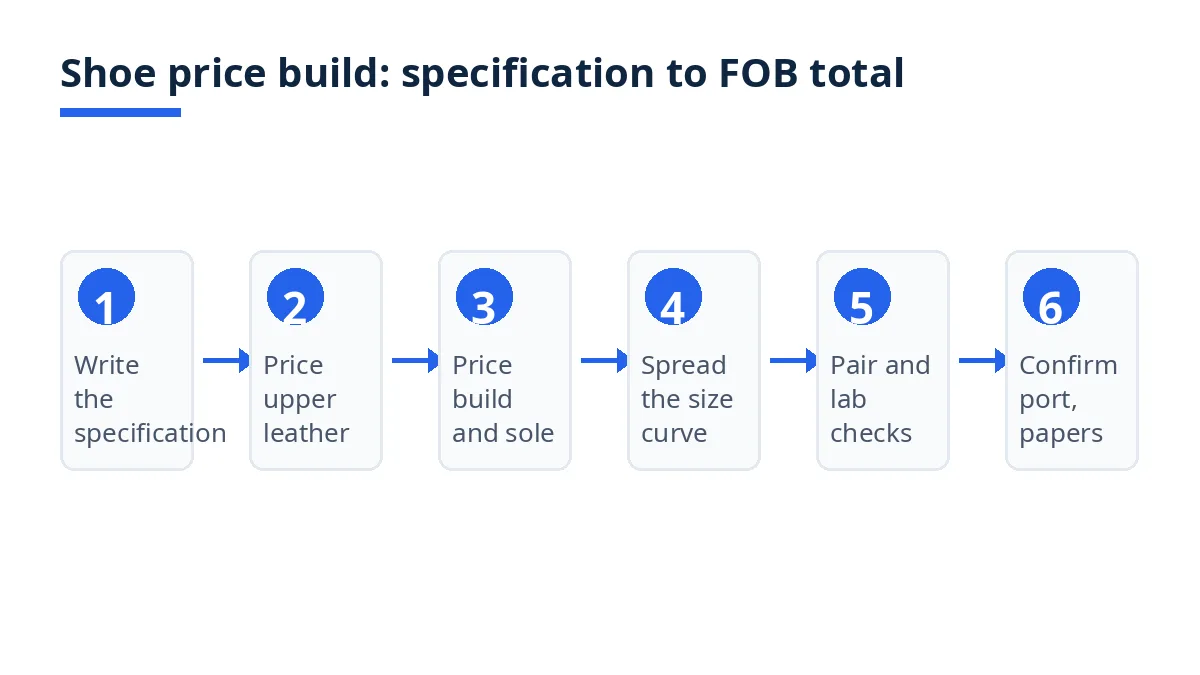
An FOB quotation for leather shoes breaks into eight groups. The first five follow the shoe through the factory, the sixth and seventh follow the finished pair to the carton, and the last group carries the carton to the ship. No group in this guide carries a market figure. Treat every number below as an illustration; a live figure turns on the specification, the combination, and the date.
Group | Priced per | What settles the group |
|---|---|---|
1. Upper leather | Pair | Animal, layer, finish, cutting yield |
2. Cutting and closing | Pair | Pattern pieces, stitching, edge work |
3. Lasting and sole attachment | Pair | Last, heat setting, build |
4. Sole unit, heel, and closures | Pair | Sole material, heel, fastening |
5. Lining, insole, and trims | Pair | Lining, insole, labels, boxes |
6. Pair inspection and lot lab evidence | Pair | Sampling plan, named test methods |
7. Shape-holding packing | Pair | Shoe trees, tissue, cartons, marks |
8. Port lines | Pair or shipment | Named port, route, papers, loading |
Group 1: upper leather, priced by what one pair consumes
The upper leather group is usually the heaviest share of a leather shoe price, and it is priced by consumption, not by the area bought. A grade word points to a hide layer and a surface treatment; it does not describe a finished shoe on its own: full-grain leather keeps the entire grain layer with nothing sanded from the surface, top-grain leather uses the outer grain layer, corrected grain has its flaws buffed or sanded away before dyeing and embossing, split leather comes from the fibrous layer below the grain, and the label genuine leather names no grade at all.2 Each grade behaves differently when cut, and each one leaves a different share of bought area unusable after natural marks, thin areas, and edges are set aside.
Ask the seller to state the animal, the layer, the surface treatment, the finish, and the tannage, and to state how much bought leather one pair consumes on the agreed pattern. A quotation that names only a grade word cannot be tested, since two sellers can quote the same grade word for leather that yields differently per pair.
Group 2: cutting and closing the upper
Cutting turns bought leather into pattern pieces, and closing stitches those pieces into an upper. The pattern decides how many pieces one pair needs, and the piece count decides both the leather consumed and the stitching time. A plain upper with few pieces and a brogue upper with many pieces and decorative perforations are different cutting and closing jobs even when both use the same leather, and the quotation should say which pattern, piece count, and stitching standard it prices.
Edge work sits in this group too. Edges on the upper, collar, and tongue should come clean and finished, with no rough or frayed edge, and seams should stay closed when the shoe flexes by hand.1 Where a design adds piping, overlays, or perforation, name those operations in the specification so the seller prices them in this group rather than discovering them at sample stage.
Group 3: lasting, heat setting, and sole attachment
Lasting gives the shoe its shape. A finished upper, built from flat leather parts, is forced over a last, and that step produces the final shape and the room inside the shoe that governs fit.3 Fit should be judged on a finished pair, made on the production last, after setting, because an upper partly springs back toward flatness once the last comes out.3
Heat setting is the step that holds the shape. Controlled heat and moisture relax the upper fibers and raise the share of set that survives, and before heat setting existed makers limited shape loss by leaving each last in place for a long hold, commonly two weeks.3 Ask whether heat setting is part of the build priced here, and judge the result on finished pairs, not on uppers still on the last.
Sole attachment is priced in this group because the build decides the work. In a Goodyear welted shoe the upper is stitched to a ridge on the insole and to a welt, and the outer sole is then stitched through the welt, midsole, and sole, a construction that can be resoled many times.4 In a Blake stitched shoe the upper is stitched to the outsole from inside, with no welt, giving a slimmer profile.4 Bologna, cupsole, moccasin, and Norwegian welt builds vary the same join again, each with its own stitching and labor.4 Cemented bonding is different again: the outsole should be joined to the upper along the whole edge, closed at toe, waist, and heel seat alike, and failures trace to surface preparation, adhesive choice, curing, or control.1 Name the build before comparing prices, because a welted shoe and a cemented shoe are different products with different labor in this group.
Group 4: sole unit, heel, and closures
The sole unit group covers the outsole, any midsole, the heel, the heel top piece, and the closure that holds the shoe on the foot. Each sole sits centered on its upper rather than skewed, neither sole deformed, and the heel firmly attached with no rocking, looseness, or gap at the heel seat.1 Heel height must match the chart on both shoes, and the pair must stand level on a flat surface without rocking.1
Sole material moves this group first. Heading 6403, the indicative heading for leather shoes, covers leather-upper footwear whose outer soles are rubber, plastics, leather, or composition leather, and the sole material that governs is the one with the greatest area in contact with the ground.5 Closures move it second: laces need eyelets that are paired, evenly spaced, free of sharp edges, and firmly set, while a zipper, buckle, strap, or hook-and-loop fastener must operate repeatedly without catching or slipping.1 State the sole material, the heel construction, and the closure in the specification, and ask the seller to price each one inside this group.
Group 5: lining, insole, and trims
The lining, insole, and trims group is small per pair and easy to leave vague, which is why it causes disputes. The lining should lie flat without tears or bunching and remain fixed at the collar and tongue, without slipping out or curling, and the insole should span the whole footbed, stay flat, and stay free of creases and lifted rims.1 The specification should name the lining material, the insole type, and whether the insole comes out.
Trims in this group are the labels, hangtags, and boxes that travel with the pair. Size, material, origin, and care information must be correct in content and spelling, in the agreed position, with the size label agreeing with the measured pair, and barcodes must scan where scanning is required.1 Ask which trims are standard and which are custom, and price the custom ones here in writing.
Group 6: pair inspection and lot lab evidence
Inspection is priced per pair because it is done pair by pair, on finished and mostly packed goods, under a sampling plan agreed in writing. The plan names the standard, the level, the buyer-specified acceptance values per defect class, and the action on a failed lot, and every value in it is a buyer-specified value or a published table figure, never a universal rule for leather shoes.1
Lab evidence belongs in this group too, and it must describe the lot offered. Where the specification requires testing, each report should carry the method name and the result measured against the specification; colorfastness to rubbing is covered by ISO 17075, and the buyer specification supplies the grade or pass mark, since the checklist states none.1 Keep that lot evidence apart from tannery audit evidence. The Leather Working Group audit looks at a tannery's own measurement, control, and reporting of its manufacturing impact, spread over seventeen sections, and it does not guarantee that a finished product passes restricted-substance testing.6 A tannery certificate names the tannery, the rating, and the validity dates; a lab report names the lot, the method, and the result.
Group 7: shape-holding packing
Packing for shoes holds a shape, not just a count. Each pair is packed with a shoe tree, tissue, or form where specified, so the toe box and heel keep shape and the pair is not crushed, and the size and color assortment in each carton must match the order, with carton marks matching the packing list and quantities counted.1 A crushed toe box or a collapsed heel is a packing fault that reads as a lasting fault at the destination, so the packing method, the form used, the pairs per carton, and the carton marks belong in the quotation, priced in this group.
A carton that holds mixed sizes to fill space is cheaper to pack and harder to receive, because the assortment no longer matches the order line by line. Settle the assortment rule per carton in the specification: which sizes and colors share a carton, how many pairs each carton holds, and what each carton mark carries.
Group 8: port lines to the named port of shipment
The port lines carry the packed cartons from the factory to the ship, and they can only be tested when the port is named. FOB names a delivery point on board a ship the buyer names, at a port the contract names: the seller takes the goods to the port, loads them, and finishes the export paperwork, while the buyer books the carrier, pays for the voyage, and takes care of import paperwork.7 Without a named port, the inland freight and the loading charges cannot be tested, and two quotations priced to different ports cannot be ranked.
Inland freight, terminal handling, export clearance, and loading sit in this group, and the boundary between them should be written down, since terminal handling can sit inside the freight line, inside the clearance line, or split between them. For the clearance line, the export declaration — the Bill of Export or shipping bill — must reach Customs and be approved before goods are loaded or stuffed for export. Its enclosures run from payment evidence (the export letter of credit or contract) through goods evidence (the commercial invoice and the packing list) to identity evidence (the EXP form certified by an authorized dealer, the origin certificate, the VAT certificate, and the taxpayer identification number).8 Confirm the papers and the charges item by item, plus the storage terms if the nominated vessel is delayed.7 Where cartons are handed to a container terminal days before loading rather than placed directly on board, ask whether the delivery rule still fits, since the ICC Academy notes FCA as the more appropriate rule for containerized handover at a terminal.7
Two shoes, two FOB totals: worked example figures
Example figures throughout this section. The two examples price different shoes, different pair counts, and different destinations, so neither total is a market figure. Both use FOB Chattogram as the port, per pair, in US dollars.
Example A is a cemented casual shoe with a rubber sole unit, 900 pairs, for a buyer in the United Kingdom.
Pair-cost group, Example A | Per pair, USD |
|---|---|
1. Upper leather | 7.20 |
2. Cutting and closing | 3.10 |
3. Lasting and sole attachment | 2.85 |
4. Sole unit, heel, and closures | 2.40 |
5. Lining, insole, and trims | 1.15 |
6. Pair inspection and lot lab evidence | 0.62 |
7. Shape-holding packing | 0.58 |
8. Port lines | 1.85 |
FOB total per pair | 19.75 |
Example figures: 900 pairs at USD 19.75 come to USD 17,775, or USD 237.00 per dozen pairs. The upper leather group is the heaviest single group, and the port lines are a small share of the pair total at this pair count.
Example B is a Goodyear welted ankle boot with a leather sole unit, 1,500 pairs, for a buyer in the United States.
Pair-cost group, Example B | Per pair, USD |
|---|---|
1. Upper leather | 9.80 |
2. Cutting and closing | 4.20 |
3. Lasting and sole attachment | 5.65 |
4. Sole unit, heel, and closures | 3.90 |
5. Lining, insole, and trims | 1.85 |
6. Pair inspection and lot lab evidence | 0.88 |
7. Shape-holding packing | 0.74 |
8. Port lines | 1.48 |
FOB total per pair | 28.50 |
Example figures: 1,500 pairs at USD 28.50 come to USD 42,750. The gap between the two totals sits mostly in the upper leather, the build, and the sole unit groups, not in the port lines, which are lower per pair in Example B because the same shipment charges spread across more pairs. Read the groups, not the totals, when two quotations differ.
Always test both sides of a price break before choosing a quantity. Example figures: 950 pairs at USD 21.00 come to USD 19,950, while 1,000 pairs at USD 19.50 come to USD 19,500, so the larger order costs USD 450 less overall even though it buys 50 more pairs. The break only helps if the extra pairs can be sold or stored, and only when both quotations share one specification, one port, and the same eight groups.
The size curve spreads the price across sizes
A shoe order is spread across a size curve, and the curve changes what each pair costs to make even when the pair total looks flat. Grading from a base size to the ends of the range runs from the maker's own chart for that last: the measuring points, the width fittings on offer, and the tolerances allowed, and no size number means the same thing on every last.1 Get that chart in writing ahead of any quotation, and have each quotation name the sizing system it uses for every size.
Example figures: an order of 1,080 pairs spread as 120 pairs in EU 41, 200 in EU 42, 280 in EU 43, 240 in EU 44, 160 in EU 45, and 80 in EU 46 totals 1,080 pairs, with the middle sizes carrying the bulk of the order. The ends of the curve cost more per pair to serve, since fewer pairs absorb the same grading, last preparation, and size-change work. Ask how the seller spreads grading and changeover work across the curve, and whether the pair total holds for every size or only for the middle of the range.
The curve also interacts with the combination minimum. A minimum order quantity is the smallest quantity a supplier accepts on normal terms, and it can be counted per order, per style, or per color, sometimes with a minimum order value alongside it.9 With shoes, the counting basis is a combination question: does the figure apply per last, per color, per width, or per combination of those. Example figures: with a 180-pair minimum for each last-and-color pair, two lasts in three colors set the smallest order at 1,080 pairs, not 180. The size curve splits that total across sizes; it does not reduce it. Before planning a range, ask whether two lasts sharing an upper leather count as one combination, whether a dye lot can be shared across colors, and whether width counts separately, and get the answers into the quotation.9
What sits outside FOB, and the four sea rules
Everything past loading on board sits outside an FOB price and belongs in the landed cost file: ocean freight and marine insurance fall to the buyer, who books the carrier and pays the carriage, plus import duty and taxes, destination charges, and onward transport.7 This guide states no duty rate. The code points to the treatment in the destination tariff, and the amount depends on the full national code, the origin, any preference that applies on the entry date, and the customs value, so ask a broker to confirm the treatment for your code, origin, and entry date; a rate found for one line does not transfer to another.5
Only four Incoterms 2020 rules are limited to sea and inland waterway transport: FAS, FOB, CFR, and CIF. CPT works for any mode of transport, DPU works for any mode, and DDP works for any mode; under DDP the seller also clears the goods for import and pays any duty, while the buyer unloads the goods.10 Under the C rules, delivery and risk transfer happen at origin, at handover to the carrier or loading on board, while the seller still arranges and pays transport to the named destination; under the D rules, delivery and risk transfer happen at the named destination.10 Only CIF and CIP put cargo insurance on the seller, so an FOB quotation carries no seller-arranged voyage insurance unless the contract adds it.10 A CIF total and an FOB total are never like for like, and an FOB price quoted for air freight applies a sea rule to a journey it was not written for.
Timelines are quotation terms, not standard periods. A quotation carries its own unit price, minimum, lead time, delivery rule, payment terms, and validity, and the lead time, shipment window, and validity date should be agreed in writing.9 Agree the stages one by one: dye-lot scheduling, last preparation, sample sign-off, lab turnaround, and inspection booking.
Bangladesh evidence that belongs beside a shoe price
The Savar estate outside Dhaka is where Bangladesh's export tanning is concentrated, after the move out of the capital's Hazaribagh quarter, and in May 2026 the estate's central treatment plant was reported to handle fourteen to eighteen thousand cubic meters a day, while the post-Eid-ul-Azha peak calls for about forty-five thousand.11 Outside evidence of how the plant performs forms part of the Leather Working Group audit, since plant performance can move a tannery's audit outcome.6 Ask what effluent evidence covers the leather in the lot offered, and ask how a peak-period order is scheduled.
Read the tannery audit for what it is. A tannery needs fifty percent for Audited, sixty-five for Bronze, seventy-five for Silver, and eighty-five for Gold, and the weakest section fixes the medal; a manufacturing certificate runs two years, and a trader of part-processed material gets one year.6 Gold and Silver both demand chromium VI under three milligrams per kilogram; anything higher is an automatic fail.6 The audit covers the tannery, not the finished shoe: it cannot promise that a finished shoe is free of restricted-substance failures, and traceability is scored on its own as a percentage.6 Keep audit evidence and lot evidence apart, as group 6 requires.
A badge on Exportain spells out the checks that sit behind it. One badge covers identity, phone, and email together with business registration; a second covers the Export Registration Certificate; the facility badges rest on reviewed photos of the factory, office, or warehouse; and no membership plan buys any badge.12 Staff review documents and photographs for these checks. That review is not a visit to the factory, and it is not a search of a government database, and a badge on a profile promises nothing about output, quality, or on-time delivery.12 Ask the seller for its Export Registration Certificate and trade license yourself, check that the company name and address agree across quotation and invoice, and ask where the lasting and finishing work happens: no source opened for this guide places shoe factories, and a badge does not settle the question.12
Price traps that make a cheap quote dear
Ranking totals that end at different points. An FOB total ends on board at the named port, a CIF total carries freight and insurance, and a DDP total carries delivery to destination with import clearance and duty paid by the seller.7 10 Restate every quotation to one rule, one port, and the same eight groups before ranking.
Comparing a welted shoe with a cemented shoe on one line. The builds carry different labor, different sole work, and different resoling prospects.4 Compare builds separately, or restate the specification to one build.
Reading a grade word as a yield. Full-grain, top-grain, corrected grain, split, and genuine leather name layers and surface treatments, and none of them states how much bought leather one pair consumes.2 Compare consumption per pair and grade rules, not grade words.
Judging shade from one sample pair. Shade varies across a lot.1 Judge the lot laid out together under the agreed light, banded against the agreed datum.
Treating a tannery medal as lot evidence. The medal rates the tannery across seventeen sections, and a medal does not prove the lot itself is free of restricted substances.6 Hold the audit certificate and the lot lab report as separate documents.
Leaving the port, the rule, or the counting basis unnamed. Without a named port the port lines cannot be tested, without a matching rule the totals cannot be ranked, and without a counting basis the combination minimum multiplies silently.9 7 Put all three in the quotation.
Accepting a listing tier price as the agreed price. A tiered listing shows an opening price for a quantity band; the price that binds is the one in the quotation both sides accepted, with its quantity, delivery rule, payment terms, and validity.9 Rank accepted quotations, not listing pages.
Quotation file: the lines to hold before you rank
Pair specification in writing: last, grade term, finish, tannage, color, lining, closure, sole unit, heel, build, size chart with tolerances, grade rules by position and size, and packing.
Eight pair-cost groups itemized per pair, in one currency, with the port lines separated from the factory groups and the named port stated.
Consumption per pair for the upper leather, with the pattern, piece count, and sealed sample that sets grain and shade.
Build named in full, with heat setting and sole attachment stated, and fit judged on finished pairs from the production last.
Combination minimum counted per last, color, and width combination, with the size curve totals reconciled to the combination total.
Pair inspection and lab evidence agreed: sampling plan, named test methods, lot marking on every report, and the action on a failed lot, apart from tannery audit evidence.
Shape-holding packing, carton assortment, and carton marks agreed, with counts reconciled to the packing list.
Classification settled shoe type by shoe type: the indicative heading is 6403, the upper test is greatest external surface area, the sole test is greatest ground-contact area, and the full national code is checked in the destination tariff, with a broker, ahead of shipping.13 5
Badge meanings read from the checks recorded behind each badge, with the Export Registration Certificate and trade license asked for directly and checked against the quotation and invoice.12
Commercial terms in writing: validity date, lead time by stage, shipment window, payment terms, and the storage rule if the nominated vessel is delayed.9 7
What should I settle before I ask for a leather shoe price?
Settle the pair before the figure: the last, the upper leather layer and finish, the build, the sole unit and heel, the lining and closure, and the size curve with its width fittings. Name the named port of shipment and the delivery rule that fits the transport, and ask each seller to answer the same specification group by group.
What costs and timelines sit inside an FOB leather shoe quotation?
Inside FOB sit the eight pair-cost groups in this guide, ending with loading on board at the named port: upper leather, cutting and closing, lasting and sole attachment, sole unit and heel, lining and trims, pair inspection and lab evidence, shape-holding packing, and the port lines.7 Outside FOB sit ocean freight, voyage insurance, import duty and taxes, and destination charges. Timelines have no standard length: lead time, shipment window, and validity have to be settled in writing, stage by stage.9
Which documents travel with an FOB leather shoe shipment?
Agree the list with the forwarder and broker before shipment: the Bill of Export with its enclosures, the commercial invoice and packing list, the bill of lading, the specification with the last and size chart, the confirmed classification code for each shoe type, and origin evidence where a preference or buyer requirement calls for it.8 5 Export paperwork sits with the seller under FOB; import paperwork sits with the buyer.7 The invoice description should match the classification: shoe type, upper material, outer sole material, ankle coverage, quantity, and unit, so the code on the entry can be checked against the goods.5
What mistakes most often distort a leather shoe price comparison?
Ranking totals that end at different points, comparing a welted shoe with a cemented shoe on one line, reading a grade word as a yield, judging shade from one sample pair, treating a tannery medal as lot evidence, leaving the port, rule, or counting basis unnamed, and accepting a listing tier price as the agreed price. Each mistake is answered in the sections before this one, in writing, before bulk production.
Next steps on Exportain
Open Bangladeshi supplier profiles and read what each profile's badges actually record before shortlisting, then read what each badge records beside how a minimum is counted when the combination total is worked out. Keep the pair checks in the shoe checklist beside the size chart, and settle the code from the indicative heading for the shoe with a broker before shipping.
Post a free RFQ on Exportain and get quotes from verified Bangladeshi suppliers → https://exportain.com/rfqs
Sources
- Quality Control Checklist for Leather Shoes From Bangladesh. Exportain, (accessed )
- Full-Grain vs Top-Grain Leather: What the Names Mean. Leather Collection, (accessed )
- Ensuring correct heat setting for lasted footwear. SATRA (accessed )
- Shoe Constructions | Goodyear Welted, Blake Stitched & More. Oliver Sweeney (accessed )
- HS Code for Leather Shoes: Classification Guide for Importers. Exportain, (accessed )
- Certification - Leather Working Group. Leather Working Group (accessed )
- FOB & FAS Incoterms® 2020 explained: Key differences. ICC Academy (accessed )
- Customs Clearance Procedures for Export. Bangladesh Customs, National Board of Revenue (accessed )
- MOQ Meaning (Minimum Order Quantity). Exportain (accessed )
- Incoterms® 2020 C rules vs D rules: Risk transfer explained. ICC Academy (accessed )
- Govt to fix Savar CETP's deficiencies, back tanneries' own ETPs: Commerce minister. The Daily Star, (accessed )
- How Supplier Verification Works on Exportain. Exportain, (accessed )
- HS, 2017 - Code 6403. United Nations Statistics Division (accessed )
About the author
Sourcing from Bangladesh?
Post a request for quotation and suppliers on Exportain can send you their quotes directly.
Post an RFQ