DAP vs DDP: Key Differences, Costs and Which One to Choose
DAP and DDP differ at one point only: import clearance. Compare who files the US entry, who pays duty, what a DDP seller must be able to do, and a worked 9,000-pair denim jeans order to Chicago.
Short answer
Under DAP the seller delivers to your named place and carries the risk until arrival, but you clear import and pay duty. Under DDP the seller also clears import and pays duty, the maximum obligation of any Incoterms rule. In the United States, with no import VAT, DDP costs the duty plus the seller importer charge; accept it only from a seller that can name its importer of record and broker.
On this page
Key takeaways
DAP and DDP share everything except import clearance: under DAP the buyer clears import and pays duty, under DDP the seller does.
Under DDP the seller takes the maximum obligation of any Incoterms rule, yet the rule requires no cargo insurance at all.
A Dhaka seller can act as a non-resident importer in the United States with an importer number, a resident agent and a bond, or through a broker.
In the worked example the totals differ by $650, the seller's importer service and bond charge; the duty is the same money under either rule.
A buyer in Chicago asks a Dhaka supplier for 9,000 pairs of men's denim jeans and gets two prices for the same order, one marked DAP and one marked DDP, both to the Chicago warehouse. The gap between the two prices is the border: who files the United States entry, who pays the duty and who carries the cost if the duty figure moves.
What is the single difference between DAP and DDP?
DAP (Delivered at Place) and DDP (Delivered Duty Paid) sit among the eleven Incoterms 2020 rules, the edition in force since 1 January 2020.1 Under both, the seller arranges and pays for transport to the place you name, clears the goods for export, and carries the risk of loss or damage until the goods arrive there on the arriving vehicle, ready for unloading.2 Under both, the buyer unloads the goods at the named place.
The rules part at exactly one point: import clearance. Under DAP the buyer handles import clearance and pays the duty and taxes. Under DDP the seller handles import clearance and pays the duty and taxes.2 Nothing else in the delivery changes, yet the two quotations can leave you with very different jobs.
Question | DAP | DDP |
|---|---|---|
Seller delivers the goods at | Your named place, ready for unloading | Your named place, ready for unloading |
Risk passes to you | On arrival at the named place | On arrival at the named place |
Main carriage paid by | The seller | The seller |
Export clearance handled by | The seller | The seller |
Import clearance handled by | You | The seller |
Import duty and fees paid by | You | The seller |
Importer of record | You | The seller, or its appointed agent |
Unloading at the named place | You | You |
Cargo insurance the rule requires | None under either rule | None under either rule |
A container lost at sea is the seller's loss under DAP as well as under DDP, because risk passes only when the goods arrive at your warehouse. Our CPT vs DAP guide looks at the same border question from a rule where risk passes much earlier, at handover to the first carrier.
What does DAP ask of you at the United States border?
Under DAP you are the importer of record. That is the party United States Customs and Border Protection (CBP) holds responsible for the entry: the classification, the declared value, the country of origin and the duty.3 In the United States the importer of record must be the owner or purchaser of the goods, or a licensed customs broker designated by one of them, and the duty is a personal debt of the importer even when a broker pays it on the importer's behalf.3
You, or a broker acting for you, file the entry and the entry summary, CBP Forms 3461 and 7501, and for ocean cargo the Importer Security Filing must reach CBP at least 24 hours before the container is loaded at the foreign port.4 Shipments over $2,500 need a formal entry, and a formal entry needs a customs bond, either a single-transaction bond for the one shipment or a continuous bond of at least $50,000 for a year of entries.3
United States duty is charged on the customs value, which excludes international freight and insurance.3 On top of the duty, CBP collects a Merchandise Processing Fee of 0.3464 percent of the entered value and a Harbor Maintenance Fee of 0.125 percent on sea cargo.3 Since 29 August 2025 the $800 de minimis exemption has been suspended for all countries, so even a low-value commercial shipment now needs an entry and pays duty.3 The buyer also bears the risks of loss or damage during the import clearance process, so a container held at the port while your entry is sorted is your problem, including storage charges.2
What does DDP ask the seller to take on?
Under DDP the seller takes the maximum obligation of any Incoterms rule: export clearance, carriage, import clearance, duty and taxes, with risk held until arrival at your named place.1 The buyer must assist with documents the import authorities need, but the seller stays responsible for the import clearance process.2
For a Dhaka seller, that responsibility has three concrete parts in the United States. First, the seller must be able to stand as importer of record, or appoint a party that can. A foreign seller can act as a non-resident importer with an importer number through CBP Form 5106, a resident agent and a bond with a resident corporate surety.3 Second, the seller must price the duty before the goods move and absorb the difference if the figure changes. Third, the seller must keep the entry records, for five years from entry, and answer for the classification and value declared.3
Tariff rates for garments move, and the seller quotes weeks before the entry is filed. If the rate rises in between, the seller pays the higher duty, not you, which is why a careful seller adds a margin for that exposure or refuses DDP on a high-duty line. Where local rules require the local importer to clear the goods itself, DDP cannot be used and DAP is the appropriate rule.2
Why does the United States change the maths?
In the United Kingdom and the European Union, the decision often turns on import VAT. The United Kingdom charges import VAT at 20 percent and Germany at 19 percent, and a seller that is not registered for VAT where the goods land usually cannot reclaim the import VAT it pays, so the amount stays inside the DDP price.1
The United States has no import VAT, so that whole argument drops away. The decision turns on duty alone, plus the smaller fees and the cost of acting as importer, with no VAT line to reclaim under either rule.3 The United States is Bangladesh's single largest export market, taking more than $7.74 billion of ready-made garments in fiscal 2025-26, according to Export Promotion Bureau data.5
Worked example: 9,000 denim jeans from Chattogram to Chicago
Example figures. A buyer in Chicago orders 9,000 pairs of men's denim jeans from a Dhaka supplier, goods valued at $42,000, shipped from Chattogram to Los Angeles and then by rail and road to the Chicago warehouse. The duty rate is an example rate of 12 percent of the $42,000 goods value.3 The Merchandise Processing Fee uses the fiscal year 2027 rate of 0.3464 percent.3
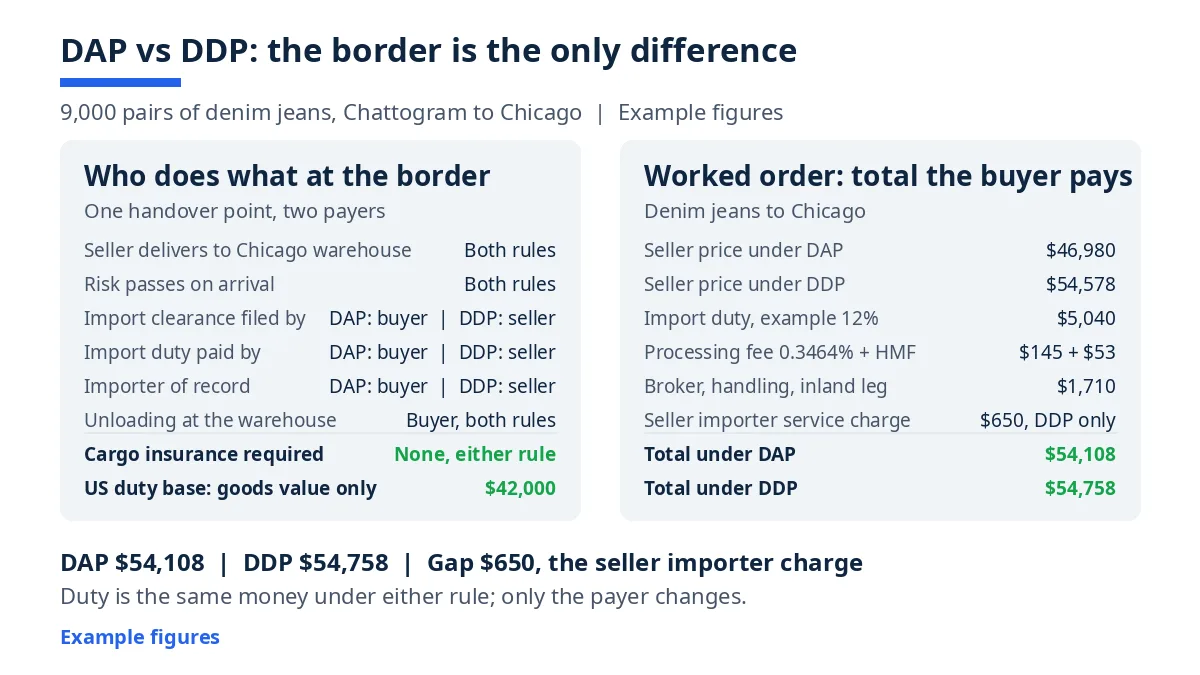
Cost line | Under DAP | Under DDP |
|---|---|---|
Goods, packing and export clearance | $42,000, in the seller price | $42,000, in the seller price |
Ocean freight, Chattogram to Los Angeles | $4,600, in the seller price | $4,600, in the seller price |
Cargo insurance, seller's own cover | $380, in the seller price | $380, in the seller price |
Seller price | $46,980 | $54,578 |
Import duty, example 12% of $42,000 | $5,040, paid by the buyer | $5,040, in the seller price |
Merchandise Processing Fee, 0.3464% of $42,000 | $145, paid by the buyer | $145, in the seller price |
Harbor Maintenance Fee, 0.125% of $42,000 | $53, paid by the buyer | $53, in the seller price |
Broker and clearance fees | $220, paid by the buyer | $220, in the seller price |
Port handling at Los Angeles | $340, paid by the buyer | $340, in the seller price |
Rail and road leg to Chicago | $1,150, paid by the buyer | $1,150, in the seller price |
Seller's importer service and bond charge | $0 | $650, in the seller price |
Unloading at the Chicago warehouse | $180, paid by the buyer | $180, paid by the buyer |
Total the buyer pays | $54,108 | $54,758 |
Landed cost per pair | $6.01 | $6.08 |
Duty is 12 percent of $42,000, which is $5,040. The Merchandise Processing Fee is 0.3464 percent of $42,000, which is $145.49, rounded to $145, and the Harbor Maintenance Fee is 0.125 percent, $52.50, rounded to $53.3 Under DAP the buyer-side lines add to $7,128, so $46,980 plus $7,128 gives $54,108. Under DDP $54,578 plus the $180 unloading charge gives $54,758.
The gap between the two totals is $650, exactly the seller's importer service and bond charge. Every other line is the same money paid by a different party. If a DDP quotation is higher by far more than the duty, fees and a service charge, ask for the lines. Our DDP price guide shows how to read each line of a DDP quotation, and our DAP customs clearance guide walks through the buyer-side steps.
When should a buyer accept DDP?
Accept DDP when the border work is worth more to you than the seller's service charge. That is usually the case on a first order into the United States, when you have no broker, no bond and no entry history, and a $650 service charge is cheaper than setting all three up for one shipment.
When should a buyer insist on DAP?
Insist on DAP when you already hold the border machinery yourself. A buyer with a continuous bond, a broker on retainer and regular entries pays the duty and fees at cost and keeps control of the classification and the entry records. For that buyer the seller's $650 service charge buys nothing.
Insist on DAP as well when the duty line is large or uncertain. Keeping the entry yourself also keeps the refund: if CBP later agrees the duty was overpaid, the refund goes to the importer of record, which under DAP is you.3 If the seller has no United States importer setup and no broker willing to file for it, DDP is not available in practice, whatever the quotation says.
Four checks before you sign either quotation
Name the importer of record. Under DAP it is you. Under DDP ask for the name, the importer number and the broker, in writing.
Get the duty line on its own. Ask for the tariff code, the goods value and the rate applied.3
Price the fees separately. The Merchandise Processing Fee and the Harbor Maintenance Fee belong in the quotation, not discovered at the port.3
Write the named place in full. Put the warehouse address, not just the city, after the rule, with the edition, Incoterms 2020.2
Questions buyers ask about DAP and DDP
Can a Dhaka seller act as importer of record in the United States?
Yes, as a non-resident importer, with an importer number through CBP Form 5106, a resident agent and a bond with a resident corporate surety.3 Most Dhaka sellers do it through a United States broker rather than directly.
Does DDP cost more than DAP in the end?
In the worked example DDP costs $650 more on a $54,108 order, the seller's importer service and bond charge. The duty, fees, freight and handling are the same money under either rule.
Who pays if United States duty rises between quotation and arrival?
Under DDP the seller pays, because the seller is the importer of record and the duty is its debt to CBP.3 Under DAP you pay, because you are the importer.
Do I still need insurance under DAP or DDP?
Neither rule requires a policy, but the seller carries the transit risk under both and usually insures it.2 After delivery the risk is yours, so your own cover should start at the warehouse door.
Next steps on Exportain
Price the order twice, once on each term, to the same warehouse address, with the duty, fees, broker and service lines shown separately, then compare the totals rather than the seller prices. You can look for Bangladeshi suppliers and open a new RFQ that states the term, the place and the edition. Our Incoterms guide runs through all eleven rules.
Sources
- DDP Delivered Duty Paid: Definition, Responsibilities. DHL (accessed )
- DAP & DDP Incoterms 2020 explained: Key differences. ICC Academy (accessed )
- DDP vs DAP: Which Incoterm to Use When Selling Abroad. Triplicate (accessed )
- US Customs Clearance Guide for Importers (2026). Freightos (accessed )
- RMG exports to US jump 26% in Aug after first-half decline. The Business Standard, (accessed )
About the author
Sourcing from Bangladesh?
Post a request for quotation and suppliers on Exportain can send you their quotes directly.
Post an RFQ