

DAP Customs Clearance: Export vs Import Explained
Under DAP, export clearance stays with the seller and import clearance stays with the buyer. This guide splits every customs filing, the broker authority, and what happens when clearance is not ready.
Short answer
Under DAP, the seller clears export customs in Bangladesh and any transit formalities on the way, and the buyer clears import customs at destination and pays the duty and taxes. The buyer appoints the broker, gives written authority for the broker to act, and must be ready to clear before the goods arrive. If import clearance is not ready, the buyer bears the risk while the goods sit in customs control. Only DDP moves import clearance to the seller.
On this page
Key takeaways
Under DAP the seller clears export customs and transit formalities, and the buyer clears import customs and pays duty and taxes; delivery happens at the named place, ready for unloading.
The buyer appoints the broker and gives written authority before departure; in the USA the broker must obtain a valid power of attorney before transacting customs business.
If import clearance is not ready, the buyer bears the risk while the goods sit in customs control, and the seller cannot deliver as contracted.
The seller must assist the buyer with import documents at the buyer's cost, and the buyer must assist the seller with export documents at the seller's cost; assistance does not move either filing.
DDP is the only rule where the seller clears import customs and pays duty; FCA matches DAP on the customs split but differs on carriage and risk.
A DAP shipment can reach the named place on time and still not be delivered: the goods arrive ready for unloading, and the buyer must first clear import customs. That pause is where most DAP customs problems happen.
This guide is for buyers importing from Bangladesh into the USA, the UK, the EU and the UAE. It states no duty rate, broker fee or transit time; confirm every figure with the destination broker.
The customs split in one table
Under DAP, delivery and destination are the same place: the goods are delivered when placed at the buyer's disposal at the named place, ready for unloading, and risk passes at that arrival moment.1 2 Incoterms® 2020 provides 11 rules with a clear allocation of cost, risk and obligations, and presents DPU after DAP to mark the single unloading difference: under DAP the seller does not unload, while under DPU the seller does.3 The rule gives export and transit formalities to the seller and import clearance to the buyer.1 2 The diagram below follows the split in filing order.
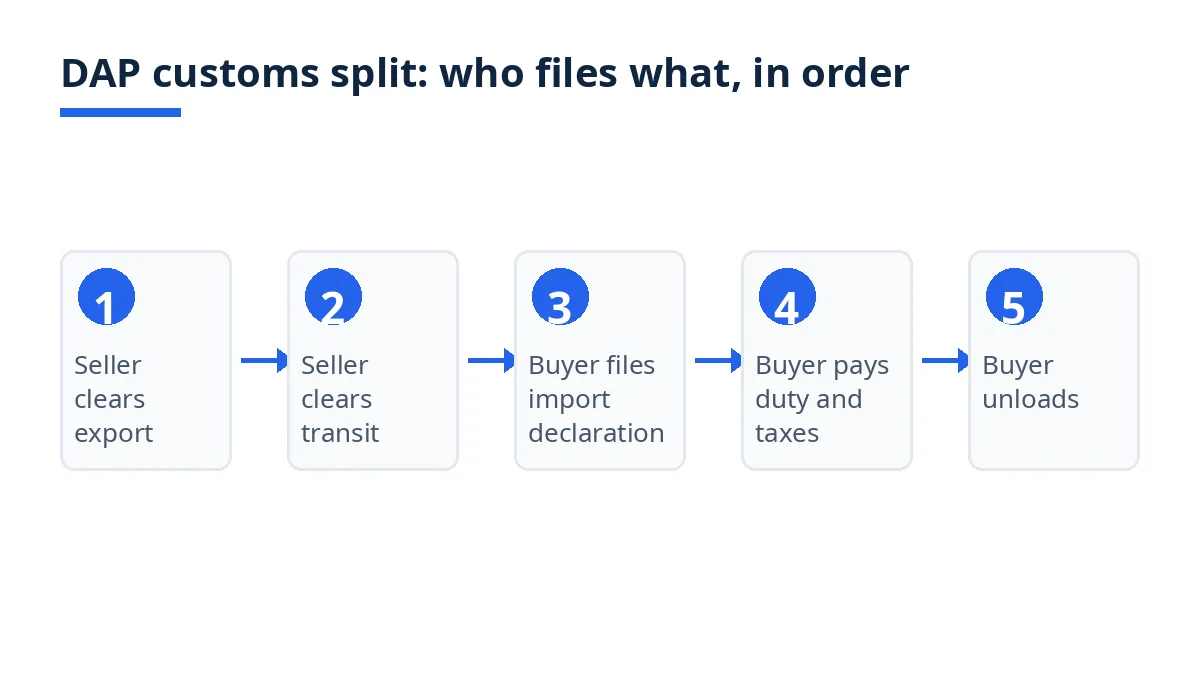
Formality | Handled by | Paid by |
|---|---|---|
Export clearance in Bangladesh | Seller | Seller |
Transit formalities before delivery | Seller | Seller |
Import licences, permits, security clearance and pre-shipment inspection | Buyer | Buyer |
Import clearance and the import declaration | Buyer | Buyer |
Duties, taxes and other import clearance costs | Buyer | Buyer |
Unloading | Buyer, unless the carriage contract includes it | Buyer |
Each side must assist the other, at the requester's cost, with documents for the other's formalities, but assistance does not move either filing.4
Export clearance: what the seller files in Bangladesh
The seller must carry out, at its own risk and cost, all export clearance formalities required by Bangladesh, and any formalities required by a transit country before delivery.4 Section 131 of the Customs Act, 1969 requires customs clearance for export, and goods must not be loaded or stuffed in containers for export unless a Bill of Export, also called a shipping bill, has been submitted to Customs in the prescribed format and approved.5
The enclosures are the export letter of credit or, where there is none, the export contract, purchase order or export guarantee approved by the negotiating bank; the signed commercial invoice; the packing list; the EXP form certified by Authorized Dealer banks; the certificate of origin, issued by the Export Promotion Bureau (EPB) or a Chamber of Commerce and Industry; the VAT registration certificate; and the Taxpayer Identification Number (TIN).5 Product-specific papers sit on top of that set where they apply, including an Export Registration Certificate for jute, jute goods and tea, and a consignment-wise export permit from the Bangladesh Tea Board for tea.5
The buyer's work on the export side is checking, not filing. Check the invoice and packing list before handover against the contract. A difference found before loading can be corrected at the source document; at destination it becomes a query on the import declaration.
Transit formalities: the leg buyers forget
Transit formalities are the seller's work under DAP. The seller must handle export clearance and any necessary customs formalities for countries through which the goods transit.1 That differs from the C rules, where the buyer must complete import formalities and any transit customs procedures, even though the seller pays the carriage.2 Ask the seller, in writing, which transit filings it will make.
Where clearance must happen at a destination airport, the buyer clears the goods there, and the seller's carrier must then receive the paperwork to move the cargo onward.4 Agree the sequence before departure. The buyer should not be the consignee on any air waybill or bill of lading, because it is the seller who has to arrange for its forwarder to take possession of the goods and arrange local inland transport.4 Name the seller as consignee and the buyer or broker as notify party.
Import clearance: what the buyer files at destination
The buyer must carry out and pay for all formalities required by the country of import, including licences and permits required for import, import clearance, security clearance for import, pre-shipment inspection, and any other official authorisations and approvals.4 The seller files nothing at destination and pays no import duty or tax.
Destination | Registration and authority | Before arrival | Release |
|---|---|---|---|
United Kingdom | EORI starting with GB for England, Wales and Scotland; XI may be needed for Northern Ireland 6 | Licence, labelling and inspection checks; declaration set up 6 | Declaration filed; VAT and duty paid; held if duty or VAT is unpaid, a licence is missing, or inspection failed 6 |
European Union | Established in the EU with an EORI valid throughout the EU; a non-EU resident needs an EU-established person to act for it 7 | Entry Summary Declaration before first entry; clearance by the importer or its customs representative, on the Single Administrative Document 7 | Temporary storage under customs supervision for no longer than 90 days; single tariff due at the place of entry; VAT usually paid by the importer 7 |
United States | Broker power of attorney obtained before transacting customs business, retained by the broker, not filed with Customs and Border Protection 8 | Confirm entry, classification, valuation and payment route with the licensed broker | No filing system, valuation basis or duty rate is stated in this guide |
United Arab Emirates | No filing step, system or rate is stated in this guide | Confirm importer registration, declaration route and licence position with the destination broker | Confirm the payment method with the broker; the split still applies |
Who appoints the broker, and what the written authority must say
The buyer appoints the broker, because import clearance is the buyer's filing. Carriage and clearance are separate jobs: naming a forwarder does not appoint a broker. Appoint the broker at the order stage, not on arrival.
Written authority must be settled before the first filing. In the USA it takes the form of a power of attorney, which the broker must obtain before transacting customs business in the importer's name and must retain rather than file.8 In the EU the clearance may be lodged by a customs representative appointed by the importer.7 In the UK the business must be set up for import declarations, with the right registration, systems and software, or use an agent to declare.6 Agree in writing: scope, duration and revocation; who pays the broker, duty and taxes, and through which account; the documents the broker needs and when each will arrive; and the notice method for arrival, queries and release.
Appointing a broker does not transfer the obligation. The buyer remains the party that must carry out and pay for import formalities under DAP.4 Keep the filed declaration, duty payment evidence and release notice in the shipment file.
When import clearance is not ready
When import clearance is not ready, the goods wait in customs control, and the seller's carrier cannot move them onward until the buyer has cleared them.4 The risk also moves: the buyer bears all risks of loss or damage during the import clearance process, and if the buyer fails to obtain a necessary import permit, the buyer bears the risk from the agreed delivery date or period.4 The ICC Academy states the same rule as article B3(a).1 If the buyer cannot import-clear promptly, it may itself be in breach of contract if the seller cannot deliver as contracted.4
Paying duty early does not cure a failed delivery: if goods are damaged or lost before the final destination, the seller may be in breach of contract, and the buyer will have already paid import duties and VAT or GST.4 Confirm in writing, before shipment, who bears storage where clearance is slow. The fix is timing: broker appointed, authority signed, licences checked and duty estimated before departure, and documents with the broker in transit.4
DAP beside DDP, DPU and FCA on the customs point only
Only the customs point is compared here. DPU shares the DAP customs split exactly, and differs only on unloading.
Rule | Export clearance | Transit formalities | Import clearance and duty |
|---|---|---|---|
DAP | Seller | Seller | Buyer |
DPU | Seller | Seller | Buyer |
DDP | Seller | Seller | Seller, including duty and taxes |
FCA | Seller | Buyer, with the carriage it arranges | Buyer |
Under the D rules, the seller carries out export formalities and any transit customs under DAP and DPU, while under DDP the seller carries out all customs formalities, export, import and any transit.2 DDP is the only rule where the seller clears import customs and pays import duty.9 It is not always available: some import customs authorities impose legal restrictions requiring the local importer to carry out import clearance itself, in which case DDP cannot be used and DAP is the appropriate rule.1 2 Under FCA the seller completes export formalities and the buyer arranges transport and import formalities, so FCA matches DAP on customs and differs on carriage and risk, which pass at handover to the buyer's carrier.10 EXW is the outlier: under EXW the buyer handles export clearance, which can lead to complications where goods cross a border, and traders are encouraged to consider FCA instead.10
Costs and timelines: gates, not typical figures
DAP fixes who pays, not how much. No DAP rule sets a freight rate, a premium, a duty rate, a broker fee or a transit time, and this guide states none of them. The seller pays export clearance, transit formalities and carriage to the named place; the buyer pays the broker, the import declaration work, the duty and taxes assessed, unloading, and onward transport. Confirm each figure with the broker against the live schedule and the destination valuation basis. The CIF guide explains the CIF-value basis and why the USA values goods differently.11 Work the buyer-side lines into the landed cost guide with the broker's written estimate, and compare quotations only on the same basis, as the DAP price guide sets out.
Timelines are gates: Bill of Export approval before loading or stuffing,5 broker appointment and written authority before departure, EU Entry Summary Declaration before arrival at the first point of entry with temporary storage for no longer than 90 days,7 and UK declaration, VAT and duty payment before release.6
Mistakes that leave goods uncleared
Appointing the broker after arrival. The declaration, licence check and duty estimate need the transit window.
No written authority, or authority for the wrong port. A broker that cannot act for the buyer cannot file. Check scope, duration and revocation before departure.8
Naming the buyer as consignee where the seller must move the goods onward. The seller's forwarder cannot take possession from the carrier, and the onward leg stalls after clearance.4
Accepting a city as the named place. A city name leaves the clearance point and delivery point open. The seller may select the point that suits its purpose, usually the cheapest option, such as a cargo terminal.4 Name the full address, dock, gate or terminal.
Treating a DAP price as duty-paid. DAP excludes import clearance, duty and taxes. Only DDP moves them to the seller, and only where the seller can lawfully act as importer.1 2
Leaving licence and permit checks until arrival. A missing permit puts the risk on the buyer from the agreed delivery date or period.4
Customs-split checklist before booking
Work through this list before the goods are booked, in order.
The contract reads "DAP [named place in full, with dock, gate or terminal], Incoterms 2020", and the import clearance point is named separately where it differs from the named place.
The seller has confirmed the Bill of Export route, the enclosures it will file, and any product-specific permit, with approval before loading.5
The buyer has appointed the destination broker, the written authority is signed, and the broker holds the seller's documents, or a dated plan to receive each one in transit.
Licences, permits, security clearance and pre-shipment inspection have been checked, and the duty estimate comes from the live schedule. No rate has been assumed.
The transport document names the seller as consignee and the buyer or broker as notify party, where the seller must move the goods onward after clearance.4
Arrival notice and the storage position for a slow clearance are agreed in writing.
What should I know first about DAP customs clearance?
Know the split: the seller clears export customs and transit formalities, and the buyer clears import customs and pays duty and taxes.1 2 Import clearance may have to happen before the onward leg.4 Appoint the broker and sign the written authority before departure.
What are the typical costs and timelines for DAP customs clearance?
There are none under DAP, because the rule fixes who pays, not how much or how long. The seller pays export and transit formalities and carriage; the buyer pays the broker, import clearance, duty and taxes, unloading and onward transport.4 Timelines are gates: Bill of Export approval, broker authority, EU pre-arrival notification, and declaration and payment.5 7 6
Which documents are needed for DAP customs clearance?
On the export side, the seller files the Bill of Export with its enclosures: the export letter of credit or contract, signed commercial invoice, packing list, EXP form certified by Authorized Dealer banks, certificate of origin, VAT certificate and TIN, plus any product-specific permit.5 On the import side, the buyer files the import declaration, holds any import licence or permit, and keeps the duty payment evidence with the declaration.4 The broker needs the written authority to act.8
What are the most common mistakes with DAP customs clearance?
Appointing the broker after arrival, filing without written authority, naming the buyer as consignee where the seller must move the goods onward, accepting a city as the named place, treating a DAP price as duty-paid, and leaving licence checks until the goods are in customs control. Each one leaves the goods waiting while the buyer bears the risk during import clearance.1 4
Next steps on Exportain
Read the Incoterms guide for shipments from Bangladesh to check the DAP split against the other ten rules, and use the DAP documents checklist to confirm who prepares each paper before you book.9 When the named place, clearance point, broker and duty estimate are fixed, post a free RFQ on Exportain stating the DAP term, the named place in full and the Incoterms 2020 edition, and check the how to buy guide for the buying steps.12 Exportain is a B2B marketplace where buyers find Bangladeshi suppliers and post requests for quotation. It is not a party to the contract for the goods, and it does not inspect goods, book freight or clear customs.
Sources
- DAP & DDP Incoterms 2020 explained: Key differences. ICC Academy (accessed )
- Incoterms® 2020 C rules vs D rules: Risk transfer explained. ICC Academy (accessed )
- Incoterms® 2020. International Chamber of Commerce (ICC) (accessed )
- Delivered at Place (DAP) – Incoterms® 2020 Rules. Trade Finance Global (accessed )
- Customs Clearance Procedures for Export. Bangladesh Customs, National Board of Revenue (accessed )
- Get UK customs clearance when importing goods into the UK: step by step. GOV.UK (accessed )
- Guide to import goods. European Commission, Access2Markets (accessed )
- 19 CFR § 141.46 - Power of attorney retained by customhouse broker. Cornell Law Institute (LII) (accessed )
- Incoterms for Shipments From Bangladesh. Exportain (accessed )
- FCA & EXW Incoterms® 2020 explained: Key differences. ICC Academy (accessed )
- CIF Meaning (Cost, Insurance & Freight). Exportain (accessed )
- How to source and buy from Bangladesh. Exportain (accessed )
About the author
Sourcing from Bangladesh?
Post a request for quotation and suppliers on Exportain can send you their quotes directly.
Post an RFQ


