What Does a DDP Price Include? Cost Breakdown With a Real Example
Definition
A DDP price covers goods delivered to a named place, cleared for import, with duty and taxes paid by the seller. The seller pays for export packing and clearance, carriage to the named place, import clearance, and duty and taxes, and bears the risk until the goods arrive ready for unloading. The buyer unloads the goods and pays for onward transport after the named place. DDP imposes no duty to insure the goods for the buyer.
By Naim Islam
Published 7 min read
On this page
Key takeaways
A DDP price covers goods, export packing and clearance, carriage, import clearance, and duty and taxes, delivered ready for unloading at the named place.
DDP is an any-mode rule. Only FAS, FOB, CFR and CIF are limited to sea and inland waterway transport.
The seller has no duty to insure for the buyer, and unloading cost depends on the carriage contract. Agree both in writing.
The seller must be able to clear the goods for import in the destination country. Where it cannot, DAP is the more suitable rule.
A DDP quote looks simple: one price, and the goods arrive. That holds only when every line behind the number is named. This breakdown names each line, with one Bangladesh shipment worked to a total.
What a DDP price promises, in one paragraph
A DDP price is the cost of goods delivered to a named place, cleared for import, with duty and taxes paid by the seller. The seller carries the cost and risk of the journey, completes export and import formalities, and delivers the goods ready for unloading. The buyer unloads the goods and pays for transport after the named place.
The named place does most of the work. A DDP price to a port, a terminal, or a warehouse are three different prices. Name a full address or terminal and point, not a city alone.
DDP in plain English: the seller takes the import job
DDP stands for Delivered Duty Paid. It is one of the eleven Incoterms® 2020 rules published by the International Chamber of Commerce (ICC), and it places the greatest share of cost and risk on the seller.1 2 The seller arranges and pays for carriage to the named place, completes export formalities, then completes import formalities and pays duty and taxes at destination.1 Delivery happens when the goods are placed at your disposal, ready for unloading, and risk passes at that point.1
DDP works for any mode, including multimodal shipments.3 The sea-only rules are only four: FAS, FOB, CFR and CIF.4 CPT, CIP, DAP, DPU and DDP are not limited to sea or inland waterway transport.4
The buyer keeps two jobs: unloading the goods, and assisting the seller with documents the import authorities require.1 The seller remains responsible for import clearance. Test that point before you agree DDP: some import authorities require the local importer to clear the goods, and a foreign seller may face barriers or an outright prohibition.3 In an ICC Academy example, a Dhaka seller delivering to Oregon may need to be a Foreign Importer of Record where it has no presence there.3
Insurance needs a separate line. DDP imposes no obligation on the seller to arrange insurance for the buyer.3 The seller may insure the goods to protect its own position, since it bears the risk up to the named place.3 If you want cover that pays you directly, agree it in writing.
From the factory gate to your premises: how a DDP shipment runs
The difference from DAP is paperwork and payment at the border.
The seller packs the goods, prepares the invoice and packing list, and completes export clearance in Bangladesh, which requires an approved Bill of Export.5
The seller books carriage to the named place and hands the goods to the carrier.
The goods travel to the destination country, by sea, air, road, or a combination.
The seller, directly or through a broker, completes import clearance and pays duty and taxes.1
The seller delivers the goods to the named place, ready for unloading, and gives notice so you can receive them.1
You unload the goods, bear the risk of unloading, and arrange onward transport after the named place.
Inside the quote and outside it: reading each DDP line
Ask the supplier to confirm each line in writing.
Cost line | In a DDP price | Who pays |
|---|---|---|
Goods | Yes | Seller |
Export packing | Yes | Seller |
Export clearance | Yes | Seller |
Carriage to the named place | Yes | Seller |
Import clearance | Yes | Seller |
Duty and taxes at import | Yes | Seller |
Insurance for the buyer | No duty to insure | Agree separately |
Unloading | Check the carriage contract | Buyer, unless the contract says seller |
Onward transport | No | Buyer |
Under DDP, the seller pays unloading charges only where the contract of carriage stipulates that those charges are the seller's responsibility; otherwise they fall to the buyer.3 Ask the seller to state, in the quotation, whether unloading is included.1
Duty is destination-specific and classification-specific, so no supplier can state a correct duty figure without the exact goods, their classification, their value, and the destination schedule. A quotation should show the duty amount allowed, and its basis, for your broker to check.
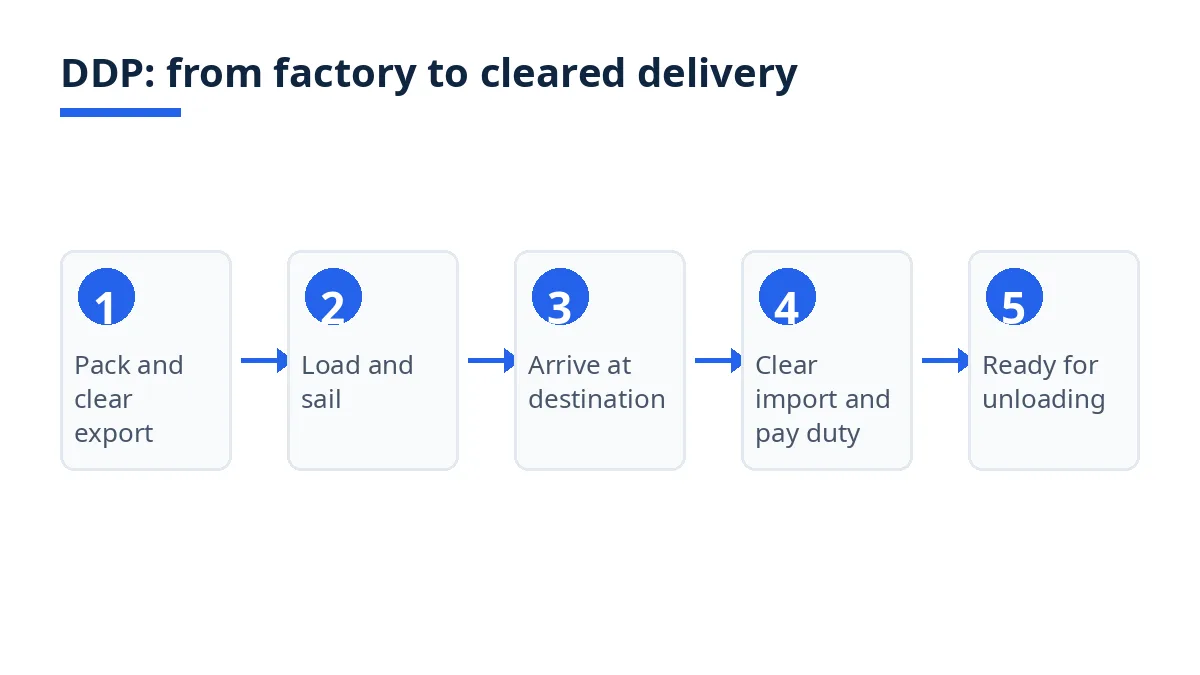
The diagram follows the DDP boundary, ending when the goods stand ready for unloading.
Worked example: polo shirts from Chattogram to Felixstowe
All figures here are example figures, chosen to show the arithmetic, not market costs. No duty rate is stated as fact: duty depends on destination and classification, and a broker must confirm it. The shipment is 5,000 cotton polo shirts from Bangladesh to a warehouse in Felixstowe, United Kingdom, on DDP terms.
Line | Example figures |
|---|---|
Goods: 5,000 shirts at $4.20 | $21,000 |
Export packing | $450 |
Export clearance | $180 |
Inland transport and port handling | $620 |
Ocean freight, Chattogram to Felixstowe | $2,850 |
Insurance for the seller's own risk | $210 |
Import clearance and broker fee | $340 |
Duty and import taxes allowed | $2,960 |
DDP price | $28,610 |
$21,000 + $450 + $180 + $620 + $2,850 + $210 = $25,310 before import, and $25,310 + $340 + $2,960 = $28,610, or $5.72 per shirt. Insurance is included only because this seller chose to insure its own risk; DDP does not oblige the seller to insure for the buyer.3
The buyer still pays for unloading unless the carriage contract includes it: allow $180 outside the $28,610. There is no onward transport cost, because the named place is the warehouse.
DDP beside DAP, DPU and CIF: the import line is the difference
The Incoterms guide for shipments from Bangladesh sets out all eleven rules.
Term | Delivery | Import clearance and duty | Unloading | Mode |
|---|---|---|---|---|
DAP | Named place, ready for unloading | Buyer | Buyer | Any mode |
DPU | Named place, after unloading | Buyer | Seller | Any mode |
DDP | Named place, ready for unloading | Seller | Buyer | Any mode |
CIF | On board at the port of shipment | Buyer | Buyer | Sea and inland waterway only |
DAP and DDP share the delivery point, and the seller bears the journey risk in both.1 The single difference is import clearance: under DAP the buyer clears the goods and pays duty and taxes, and under DDP the seller does.1 DPU differs on unloading: the seller delivers the goods unloaded, bearing its risk and cost, while the buyer still clears the goods for import.4 Read the DPU price guide and the DAP price guide when a supplier offers a choice between the three D rules.
CIF sits in a different family. Under CIF the seller delivers by loading the goods on board, and risk passes there, even though the seller pays freight and minimum insurance to the destination port.4 The CIF cost, insurance and freight guide explains that insurance, which DDP does not require. If a supplier cannot clear goods for import in your country, DAP is the more suitable D rule.1
Five traps that turn one DDP price into two bills
Naming a city instead of a place. Name the terminal, warehouse, or address.
Assuming unloading is included. Get the position in writing before the goods sail.1
Assuming insurance is included. DDP creates no insurance duty for the buyer. Agree cover in the contract.3
Accepting DDP without an import plan. Ask who files the import declaration. Where the seller cannot complete import clearance, choose DAP instead.1
Comparing DDP and DAP totals. Separate the import clearance, duty, and tax lines first.
What is DDP?
DDP stands for Delivered Duty Paid. Under this Incoterms® 2020 rule, the seller delivers goods to a named place, cleared for import, with duty and taxes paid, and bears the cost and risk of the journey.1 The buyer unloads the goods and pays for transport after the named place.
How does DDP work in practice?
The seller packs the goods, completes export clearance, arranges carriage, completes import clearance, and pays duty and taxes.1 The seller gives notice on arrival so the buyer can receive the goods.1 The buyer assists with import documents, unloads the goods, and bears the unloading risk.1
Is DDP used for shipments from Bangladesh?
Yes. The ICC Academy gives a DDP example of a seller in Dhaka delivering two containers of apparel to a named address in Beaverton, Oregon, completing export and import formalities and delivering the goods ready for unloading.3 Whether DDP suits a shipment depends on the seller being able to complete import clearance in the destination country.3
What are common mistakes with DDP?
The common mistakes are naming only a city, assuming unloading and insurance are included, accepting DDP with no import plan, and comparing DDP and DAP totals without separating duty and tax. Put the named place, unloading, insurance, and duty basis in writing before shipment.
Next steps on Exportain
Ask suppliers to quote DDP with the import lines shown separately, and check them with a broker before you accept. Post a free RFQ stating the goods, quantity, named place, and DDP terms through post a free RFQ, and read the how to buy guide.
Sources
- DAP & DDP Incoterms 2020 explained: Key differences. ICC Academy (accessed )
- Incoterms® 2020. International Chamber of Commerce (ICC) (accessed )
- Incoterms® 2020 C rules vs D rules: Risk transfer explained. ICC Academy (accessed )
- Place of delivery & risk transfer in trade contracts. ICC Academy (accessed )
- Customs Clearance Procedures for Export. Bangladesh Customs, National Board of Revenue (accessed )
Reviewed by Nourin Tabassum
About the author
Sourcing from Bangladesh?
Post a request for quotation and suppliers on Exportain can send you their quotes directly.
Post an RFQ