When Does Risk Transfer Under EXW? A Visual Guide for Importers
Under EXW, risk passes when goods are placed at your disposal at the named place — not at collection or at the port. This visual guide follows that moment through a Bangladesh shipment, with a worked cost example and claim scenarios.
Short answer
Under EXW (Ex Works), risk transfers to the buyer at the named place when the seller places the goods at the buyer's disposal, ready for collection, and notifies the buyer. From that moment, loss or damage is the buyer's risk, even if the goods are still inside the seller's premises. Insurance should therefore start at the named place, not at the port of loading.
On this page
Key takeaways
Under EXW, risk passes when goods are placed at the buyer's disposal at the named place and the buyer is notified — before collection, not at the port.
Loading, export clearance, carriage, insurance, and import clearance are the buyer's tasks under default EXW; the seller assists only as asked, at the buyer's risk and cost.
Insurance must start at the named place: a policy starting at the port leaves the factory-to-port leg and loading uncovered.
A vague named place, a collection-based insurance start, and confusing risk with ownership or payment are the timing mistakes that cause most EXW claim disputes.
A forklift drops a carton during loading at a Narayanganj factory. The cartons have not left the factory. Under EXW, timing decides who pays: risk had already passed when the seller placed the goods at disposal and notified the buyer they were ready.
Quick answer
Under EXW (Ex Works), risk transfers to the buyer at the named place when the seller places the goods at the buyer's disposal, ready for collection, and notifies the buyer. From that moment, loss or damage is the buyer's risk, even if the goods are still inside the seller's premises.
What EXW means in plain English
EXW is one of the 11 rules in Incoterms 2020, published by the International Chamber of Commerce (ICC), with a clear allocation of cost, risk, and obligations.1 Under EXW, the seller delivers by placing the goods at the disposal of the buyer at the seller's premises or another named place, such as a factory or warehouse.2 The seller is not required to load the goods onto a collecting vehicle, or to clear the goods for export.2
"At the buyer's disposal" is a practical test: the goods must be ready, identified as the contract goods, and available for collection at the agreed place and time. Write the full address, rule, and edition together, for example "EXW [factory address, Narayanganj, Bangladesh], Incoterms 2020".2
Risk is not ownership, payment, or conformity: the rule does not say when ownership passes, set the price, or decide liability for non-conforming goods. See the EXW meaning guide for the general definition and price breakdown.
How it works step by step
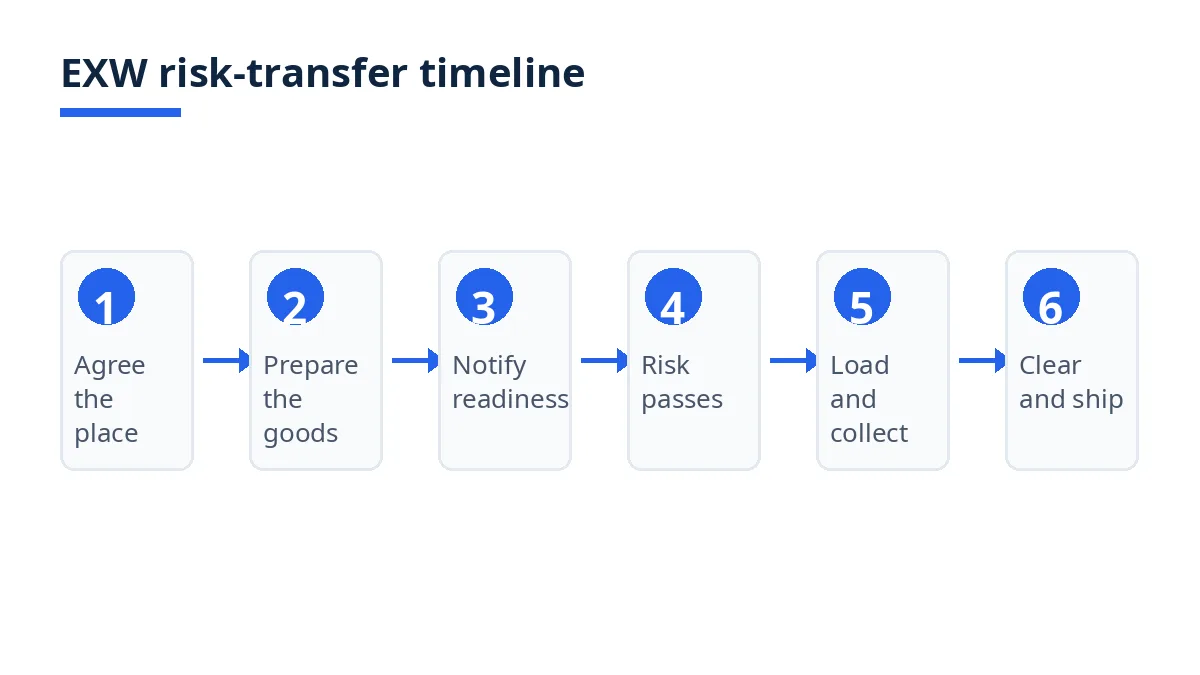
Agree the named place and edition. State the full factory address, the rule, and "Incoterms 2020". A city name alone leaves the disposal point open to argument.
The seller prepares and identifies the goods. The seller makes the contract goods ready at the named place, in the agreed packaging, for identification.
The seller notifies readiness. That notice triggers collection. Without it, the parties may dispute when the moment arrived.
Risk passes at disposal. Once the goods are at disposal and the buyer has been notified, delivery is complete and risk passes, even if the goods are still in the warehouse.
The buyer loads and collects. Loading is the buyer's task under default EXW, at the buyer's risk and cost, unless another arrangement was agreed in writing.
The buyer clears export, ships, and clears import. The buyer arranges and pays for export clearance, carriage, insurance, import clearance, and final delivery. The seller assists only as asked, at the buyer's risk and cost.2
In Bangladesh, goods may not be loaded for export unless an export declaration, the Bill of Export or Shipping Bill, is submitted to Customs and approved.3 That step sits after the risk moment, so settle a forwarder route before agreeing EXW.
Who is responsible for what
Stage | Seller | Buyer |
|---|---|---|
Before disposal | Produce, pack, identify, and ready the goods | Agree the place, collection window, and insurance start date |
At disposal | Place the goods at disposal; notify the buyer | Take the risk, even before collection |
After disposal | Assist only as asked, at the buyer's risk and cost2 | Load, collect, clear export, carry, insure, clear import, deliver onward |
Insurance | No insurance duty under EXW2 | Buy cover from the named place |
Later damage | Not the risk bearer, unless the contract says otherwise | Claim under the buyer's insurer or carrier |
Under every Incoterms 2020 rule, the transfer of risk coincides with delivery, so the delivery point is also the risk point.4
Worked example with numbers (Bangladesh shipment)
Example figures: every figure below is illustrative, not a real price or charge for any product, route, or country. Duty is left for the buyer to complete from the destination tariff.
A buyer orders 4,000 cotton towels from a Narayanganj factory, on terms "EXW [factory address, Narayanganj, Bangladesh], Incoterms 2020", for a Hamburg warehouse. Readiness is notified on a Monday, so risk passes that day; the carrier collects on Wednesday.
Line | Example figures (USD) |
|---|---|
Product cost: 4,000 towels at 3.00 EXW | 12,000.00 |
Loading | 120.00 |
Inland transport to Chattogram | 450.00 |
Export handling | 180.00 |
Ocean freight | 1,100.00 |
Cargo insurance | 95.00 |
Destination handling | 300.00 |
Inland delivery, Hamburg | 260.00 |
Total before import duty | 14,505.00 |
Import duty | Your tariff figure |
Landed cost per towel before duty | 3.63 |
The total is 12,000 + 120 + 450 + 180 + 1,100 + 95 + 300 + 260 = 14,505, and 14,505 divided by 4,000 is 3.63 per towel.
Scenario A: damage during loading. The carrier drops 80 towels on Wednesday. Example value: 80 multiplied by 3.00 equals 240. Loading is the buyer's task and risk passed on Monday, so the buyer claims under its own insurance or carrier arrangement.
Scenario B: water damage in transit. A further 150 towels are water-damaged on the ocean leg. Example value: 150 multiplied by 3.00 equals 450. No insurance duty sits on the seller under EXW, so the buyer claims under the cover arranged from the named place. A policy starting only at the port would leave the factory-to-port leg uncovered.
Scenario C: goods that do not match the specification. On arrival, the towels weigh less than the agreed specification. That is a conformity question for the sales contract, not one the risk moment answers.
EXW vs related terms
Term | Risk passes to the buyer | In practice |
|---|---|---|
EXW | At disposal at the named place | Earliest transfer; buyer carries loading, export, and transit risk |
FCA | On delivery to the buyer's carrier | Seller loads and clears export; risk moves at handover |
FOB | On board the vessel at the port of shipment | Seller carries risk until loading on board; sea only |
DAP | On arrival at the destination, ready for unloading | Seller carries transit risk; buyer unloads and clears import |
For the full set of 11 rules, see the Incoterms guide for shipments from Bangladesh.4 Under every rule, the delivery point there is also the risk point.4
Common mistakes to avoid
Insuring from the port, not the named place. If cover starts at Chattogram while risk passed at Narayanganj, the inland leg and loading are uninsured. Match the insurance start to the disposal moment, in writing.
Treating collection as the risk moment. A buyer who plans from the collection date has already missed the transfer. Plan from the readiness notice.
Naming a city, not a place. "EXW Bangladesh" or "EXW Narayanganj" does not identify the warehouse, gate, or loading point. Use the full address.
Assuming loading help shifts the risk. If the seller's staff help load as a favour, default EXW still leaves loading with the buyer. If the seller is to load, write who loads, who pays, and who bears loading risk into the contract first.
Confusing risk with ownership or payment. Paying before collection does not move the moment earlier, and paying after does not move it later.
How Exportain helps
On Exportain, state the Incoterm and the full named place in the request for quotation, so each supplier quotes against the same disposal point and risk moment. The how to buy guide sets out the steps from catalogue search to comparing quotations and arranging freight and inspection.5 Ask each reply to confirm the named place, the readiness notice method, and whether loading help is included or excluded.
Read badges for what they record. Exportain verification is a document and photo review, not a factory inspection, and a badge is not a guarantee of capacity, quality, or delivery. Exportain is not a party to the goods contract.
FAQs
What is EXW?
EXW means Ex Works. It is an Incoterms 2020 rule under which the seller delivers by placing the goods at the buyer's disposal at a named place, usually the seller's premises, and the buyer arranges and pays for collection, export, transport, insurance, and import from that point.2
How does EXW work in practice?
The seller prepares the goods at the named place and notifies the buyer they are ready. Risk passes at that moment, before collection. The buyer then loads, collects, clears export, ships, insures, clears import, and delivers onward.2
Is EXW used for shipments from Bangladesh?
EXW is used for shipments from Bangladesh, but it suits a buyer with a forwarder or agent in Bangladesh for collection and export clearance. Without that local route, consider FCA, under which the seller clears export.2 Bangladesh still requires an approved Bill of Export before goods are loaded for export.3
What are common mistakes with EXW?
The common mistakes are timing mistakes: insuring from the port rather than the named place, treating collection as the risk moment, naming a city instead of a full address, assuming loading help shifts the risk, and confusing risk with ownership or payment.
Next steps on Exportain
Post a request for quotation stating the full named place and "EXW, Incoterms 2020", then compare replies using the how to buy guide. Before you sign, re-read the Incoterms guide for shipments from Bangladesh for your term's risk point, and price every quote to your warehouse with the landed cost guide.
Sources
- Incoterms® 2020. International Chamber of Commerce (ICC) (accessed )
- DDP & EXW Incoterms® 2020 explained: Key differences. ICC Academy (accessed )
- Customs Clearance Procedures for Export. Bangladesh Customs, National Board of Revenue (accessed )
- Incoterms for Shipments From Bangladesh. Exportain (accessed )
- How to source and buy from Bangladesh. Exportain (accessed )
About the author
Sourcing from Bangladesh?
Post a request for quotation and suppliers on Exportain can send you their quotes directly.
Post an RFQ