

How to Compare FCA Quotations From Bangladeshi Suppliers
Compare FCA quotations from Bangladeshi suppliers like for like: normalise the named place and delivery form, split each FCA price, add the same onward costs, and rank by landed cost per unit.
Short answer
To compare FCA quotations from Bangladeshi suppliers, fix one specification, write each named place in full with its delivery form — seller's premises loaded, or another place ready for unloading — split each FCA price into its lines, then add the same onward costs from each delivery point to one warehouse and rank by landed cost per unit. The lowest headline FCA price often loses once the longer onward leg is added.
On this page
Key takeaways
An FCA comparison starts with the named place and the delivery form, not the headline price: seller's premises loaded, or another named place ready for unloading.
Split each FCA price into goods, packing, marking, loading or inland transport, and export clearance, so an included leg is never set beside a separate leg.
Add the same onward costs from each delivery point to one warehouse, then rank by landed cost per unit, not by headline FCA price.
Duty and taxes always come from the schedule for your confirmed code, confirmed with your broker, never copied from another product, supplier, or destination.
Two FCA quotations for the same goods can carry the same three letters and still price different work. One supplier may quote FCA at its own factory, where it loads the buyer's collecting vehicle, while another quotes FCA at a forwarder depot or a container terminal, where the goods arrive ready for unloading. The unit prices look comparable, but the delivery points are not, and the onward journey for the buyer starts from a different place in each case.
This guide removes that mismatch before any ranking: it rewrites every quotation onto the same lines, normalises the named place and delivery form, adds the same onward costs to one warehouse destination, and ranks by landed cost per unit.
Under Incoterms 2020, FCA means that the seller delivers the goods and transfers the risk of loss or damage to the buyer at the agreed place and point, upon handing them over to the carrier or the buyer's designated person.1 The seller carries out export clearance, and the buyer arranges transport and import formalities.1 FCA suits any mode of transport, including multimodal shipments.1 Landed cost is the total expense of a product after arrival at its final destination, including product cost, shipping, duties, taxes, insurance, handling and other charges.2
Why this matters for buyers and sellers
For a buyer, the risk is paying twice for one leg, or paying nothing for a leg that still has to be bought. A quotation that already includes inland transport to a terminal cannot be set beside a factory-gate quotation as if both start at the same point. The buyer who ranks on the lower headline price may then buy the longer onward leg at a higher cost, and the apparent saving disappears before the goods reach the warehouse.
For a seller, a request that names the delivery form in full is easier to answer accurately. When the buyer states the named place, the point inside it, the packing, and the carrier deadline, the seller does not have to guess whether loading, inland transport, or a terminal charge sits inside the price.
The delivery form is where FCA comparisons most often go wrong. DHL explains the split: at the seller's premises, delivery occurs once goods are loaded onto the buyer's collecting vehicle; at any other location, delivery occurs when goods arrive ready for unloading, and the seller does not unload them.3 A sheet that records only "FCA" has left out the line that decides who loads and where onward costs begin.
Step-by-step: how it works
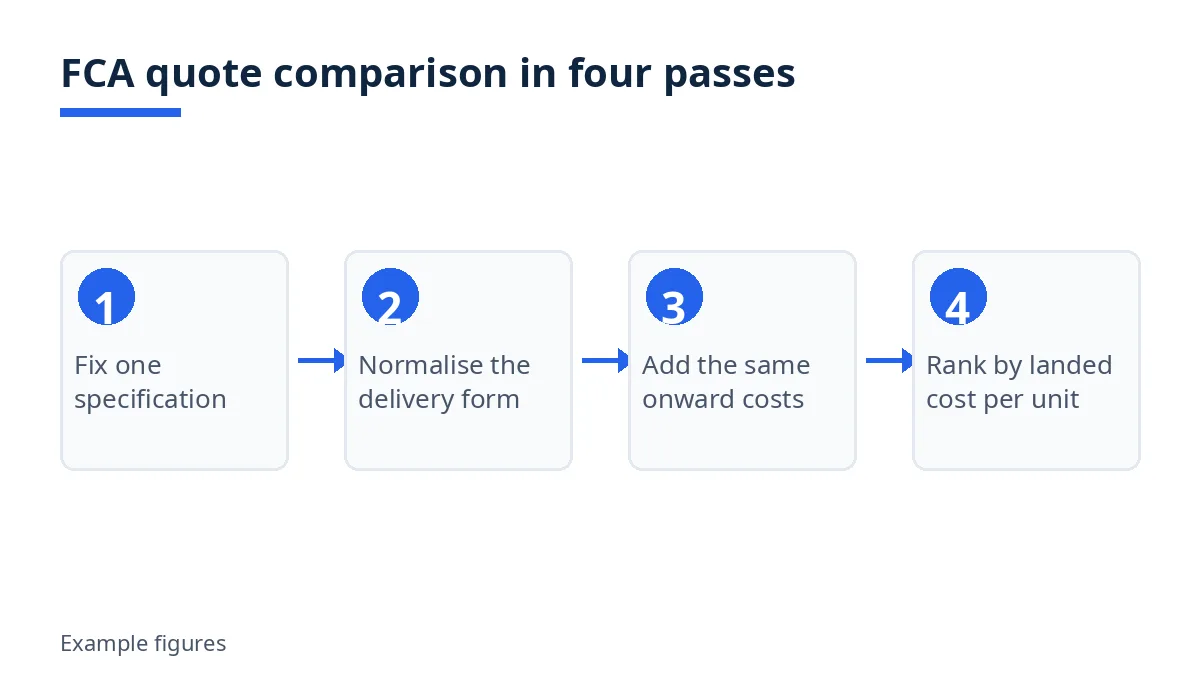
Keep one sheet for all suppliers; do not rank any quotation until every line is filled or marked not applicable, with the reason noted.
Fix one specification. Send the same product, material, size, colour, quantity, packing, marking, and inspection requirement to every supplier in identical words. A supplier answering a different specification is not comparable.
Write the named place in full, with the delivery form beside it. Record the full address and the point inside the place, such as a gate, bay, depot, or terminal. Write either "seller's premises, loaded" or "other named place, ready for unloading." Under FCA, the seller delivers and transfers risk at the agreed place and point upon handover to the carrier or the buyer's designated person.1
Split the FCA price into its lines. Ask for the goods price, packing, marking, loading where the place is the seller's premises, inland transport where the place is elsewhere, and export clearance, each on its own line. FCA costs include the goods, their packaging, and, where delivery occurs at the seller's premises, loading onto the collecting vehicle, plus export formalities, while transport beyond the delivery point remains the buyer's cost.1
Record validity, readiness, and carrier nomination together. Note the price expiry date, the ready date, the collection window, the carrier nomination deadline, the payment method and timing, the currency, and who bears bank charges. A quotation that expires before the decision date is not yet comparable.
Add the same onward costs from each delivery point to one warehouse. Use one forwarder basis for main carriage, insurance, destination handling, duty and taxes from your confirmed code's schedule, broker fees, and warehouse delivery, to the same destination warehouse for every supplier, so a difference in onward cost reflects a difference in delivery point or route.
Rank by landed cost per unit, then check the winner again. Divide each total by the units that will actually arrive, after any agreed tolerance. Before accepting, re-check the winning quotation for validity, readiness, and delivery form.
Confirm the winning terms in writing. Repeat the specification, named place and delivery form, price lines, validity, payment terms, and carrier details to the winning supplier. Keep the other quotations on file, so a later price change can be checked on the same sheet.
Costs, timelines and documents
What are the typical costs and timelines?
There are no typical costs or timelines that hold for every FCA order, because the named place, the route, the transport mode, and the destination duty schedule all change the total. The structure is stable. Landed cost is product cost plus shipping plus duties plus taxes plus insurance plus handling plus other charges.2 Build the total as: FCA price, packing and marking if excluded, loading or inland transport, then main carriage, insurance, destination handling, duty and taxes, broker fees, and warehouse delivery.
For timelines, ask for separate dates rather than a single delivery promise: price expiry, production finish, readiness at the named place, collection window, carrier nomination deadline, and expected warehouse arrival. DHL notes that if the buyer's carrier fails to collect on time, the buyer bears the risk from the end of the agreed delivery period, even though the goods have not moved.3
The table below uses example figures only. Replace every onward line with a forwarder or broker figure for your shipment, and replace the duty line with the amount from the schedule for your confirmed code.
Example figures, 2,400 cotton cushion covers | Quote 1 | Quote 2 | Quote 3 |
|---|---|---|---|
Named place and form | Seller's premises, Gazipur, loaded | Forwarder depot, Dhaka, ready for unloading | Container terminal, Chattogram, ready for unloading |
FCA price per unit | $2.90 | $2.70 | $3.00 |
FCA total | $6,960 | $6,480 | $7,200 |
Onward transport and handling | $850 | $1,450 | $620 |
Insurance | $110 | $110 | $110 |
Duty and taxes, schedule amount | $530 | $510 | $540 |
Broker and handling | $240 | $240 | $240 |
Total landed cost | $8,690 | $8,790 | $8,710 |
Landed cost per unit | $3.62 | $3.66 | $3.63 |
Quote 2 carries the lowest FCA price, but its depot delivery point leaves the longest onward leg, so it lands as the most expensive of the three. Quote 1, with a higher FCA price, lands cheapest on the chosen route, and Quote 3 sits between the two. Change any onward line and the ranking can change again, which is why the sheet must show its working.
Which documents are needed?
Ask each supplier, at quotation stage, which papers it will supply and which you or your forwarder must obtain. At a minimum, confirm the commercial invoice, the packing list, the product code for your destination schedule, and the carrier's transport document. The seller must give sufficient notice that goods have been delivered, and must provide proof of handover once goods have been handed over.3 A quotation that leaves the proof of handover unnamed should not be ranked yet, because the handover is the moment risk passes.
Confirm who supplies any certificate of origin your schedule requires, and the export clearance papers the seller will complete, since export clearance sits with the seller under FCA.1 If a letter of credit requires a bill of lading with an on-board notation, agree that mechanism in advance: DHL notes it applies only where explicitly agreed, and is not an automatic right under FCA.3 Insurance also needs a line on the sheet, although it is not part of the FCA price: DHL notes that neither party is obligated to arrange insurance under FCA, while buyers are strongly advised to take out cover from the point of delivery.3
Bangladesh-specific rules and tips
The named place carries extra weight in Bangladesh because suppliers sit at different distances from inland depots and from the port, and that distance feeds directly into the onward transport line. Compare a supplier near the terminal with an inland supplier on the same forwarder basis and the same port, or the inland supplier will look dearer for a route reason, not a factory price reason. In the worked example above, the depot quote is not the dearest factory, it is the quote with the longest remaining leg.
Confirm the collection point inside the named place in writing, not only the town. A factory site, a depot, and a terminal each have gates, bays, and hours, and a carrier sent to the wrong gate loses the collection window. Ask for the collection point and hours, who loads and unloads under the stated form, and the notice given when goods are ready.
Use one destination schedule for every quote, and check the code with your broker rather than copying a code from a supplier catalogue, since a wrong code can change the duty payable.2 Keep the code, the schedule amount, and the broker's note on the sheet.
Mistakes and red flags
What are the most common mistakes?
Comparing a premises-loaded quote with an other-place-unloaded quote as if they were the same. The two forms place loading and unloading on different sides of the handover. Normalise the form first, then compare.
Accepting a vague named place. A quotation that says only a city, a district, or "FCA Bangladesh" leaves the delivery point, the loading duty, and the onward route undefined. DHL warns that a vague or wrong named place can lead to disputes over loading costs, confusion about when risk passes, and delays if the carrier arrives at the wrong location.3
Treating packing, marking, or inland transport as included without a line. One supplier may include export packing in the FCA price, while another prices standard packing and charges separately for export packing. The unit prices differ, but the goods do not.
Ranking on an expired quotation or an unconfirmed carrier. A price that expires before the decision date, a ready date that has passed, or a carrier nominated after the seller's deadline all make the ranking stale. Re-confirm validity, readiness, and carrier details for the top-ranked quote before accepting it.
Assuming the carrier will issue an on-board bill of lading. Under FCA, that document follows an explicit agreement between buyer and seller, not the term alone.3 If a letter of credit requires it, agree the mechanism in writing before the goods move.
Checklist
Before you confirm, every line should be answered in writing.
One specification sent in identical words to every supplier, including packing, marking, and inspection.
Named place in full, with the point inside the place, for every quotation.
Delivery form recorded for every quotation: premises loaded, or other place ready for unloading.
FCA price split into goods, packing, marking, loading or inland transport, and export clearance lines.
Validity, ready date, collection window, carrier deadline, payment method, timing, currency, and bank charges confirmed for every quotation.
Same onward costs added from each delivery point to one warehouse, on one forwarder basis.
Duty and taxes taken from the schedule for your confirmed code, with the broker's note on file.
Insurance recorded for every leg from the delivery point onward, with no uncovered leg.
Documents confirmed: invoice, packing list, product code, transport document, proof of handover, and any certificate of origin required.
Winning terms confirmed in writing, including specification, named place and form, price lines, and payment.
How Exportain helps
Exportain lets buyers browse supplier listings and post a request for quotation that carries the same specification to more than one supplier. Use that request to state the product, quantity, packing, and marking once, and ask every supplier for the same lines: named place in full, delivery form, split FCA price, validity, ready date, and payment terms. When replies arrive on different forms, the comparison sheet in this guide rewrites them onto common lines before ranking.
Exportain is not a party to the goods contract, and it does not book freight, clear customs, or inspect goods. The delivery form, carrier nomination, insurance, and duty schedule therefore remain matters for the buyer, the seller, and their forwarder or broker to settle in writing.
FAQs
What should I know first about FCA?
Know first that FCA is a handover rule, not a delivered-price rule. The seller delivers the goods to the carrier or person nominated by the buyer at the agreed place and point, completes export clearance, and transfers risk at that handover, while the buyer then arranges main carriage and import formalities.1 Before comparing prices, settle the named place and the delivery form. See the Incoterms for shipments from Bangladesh guide and the FCA contract clause guide.
What are the typical costs and timelines?
There are no typical FCA costs or timelines that apply to every order. The FCA price covers the goods, packaging, loading at the seller's premises where that is the delivery form, and export formalities, while transport beyond the delivery point is the buyer's cost.1 Add main carriage, insurance, destination handling, duty and taxes from your confirmed code's schedule, broker fees, and warehouse delivery to reach landed cost per unit, using the formula in the landed cost for imports from Bangladesh guide.2 Ask for price expiry, ready date, and carrier deadline separately.
Which documents are needed?
Confirm the commercial invoice, packing list, product code, carrier transport document, and proof of handover, plus any certificate of origin your schedule requires. The seller completes export clearance under FCA,1 and must provide proof of handover and sufficient notice of delivery.3 If a letter of credit requires a bill of lading with an on-board notation, agree that mechanism explicitly in the sales contract, since it is not an automatic right under FCA.3
What are the most common mistakes?
The most common mistakes are comparing a premises-loaded quotation with an other-place-unloaded quotation as if they were the same, accepting a vague named place, ranking on an expired quotation, and leaving insurance or duty out of the landed total. Each error survives a headline-price ranking. The delivery-form column, the full named place, and the landed cost per unit are the checks that catch them before acceptance.
Next steps on Exportain
Browse suppliers on Exportain suppliers, post one specification to several suppliers through Exportain RFQs, and read the Incoterms for shipments from Bangladesh guide before you send the request.
Sources
- FCA & EXW Incoterms® 2020 explained: Key differences. ICC Academy (accessed )
- What is Landed Cost? Definition, Components, Formula, Strategies, FAQs. SimpleGlobal (accessed )
- FCA Incoterms Explained: Free Carrier Meaning. DHL (accessed )
About the author
Sourcing from Bangladesh?
Post a request for quotation and suppliers on Exportain can send you their quotes directly.
Post an RFQ


