

When Does Risk Transfer Under FCA? A Visual Guide for Importers
When risk passes under FCA, in one place: the named-place handover, the two delivery variants, and what happens when goods are damaged before, at, or after transfer, with a worked Gazipur example.
Short answer
Under FCA (Free Carrier), risk passes from seller to buyer at the named place when goods are delivered to the carrier nominated by the buyer. At the seller's premises, that is when goods are loaded onto the buyer's vehicle; elsewhere, it is when the seller's vehicle arrives with goods ready for unloading. From that moment, loss or damage during main carriage is the buyer's risk, even if the buyer has not yet arranged insurance.
On this page
Key takeaways
Under FCA, risk passes at the named place when goods are delivered to the buyer's nominated carrier, not at the destination or on board a vessel.
At the seller's premises, risk passes once loading onto the buyer's vehicle is complete; at another named place, it passes when the seller's vehicle arrives with goods ready for unloading.
If the buyer's carrier fails to collect, the buyer bears the risk from the end of the agreed delivery period, even though the goods have not moved.
FCA places no insurance duty on either party, so the buyer should arrange cover starting at the named-place handover, not at vessel loading.
Risk is not conformity, ownership, or payment: damage in transit, wrong goods on arrival, and unpaid invoices are three different claims.
You have agreed FCA terms with a Bangladeshi supplier, and a carton is damaged on the way to the port. Whether the seller or you carry that loss turns on one question: had risk moved?
Quick answer: the moment risk moves
Under FCA (Free Carrier), risk passes to the buyer at the named place, when the goods are delivered to the carrier nominated by the buyer.1 At the seller's premises, that is when the goods are loaded onto the buyer's vehicle. Elsewhere, it is when the seller's vehicle arrives with the goods ready for unloading.
The FCA risk-transfer timeline
Risk under FCA does not move at the destination or when goods go on board a vessel. It moves early, at the handover. Under all 11 Incoterms 2020 rules, the transfer of risk coincides with delivery.2
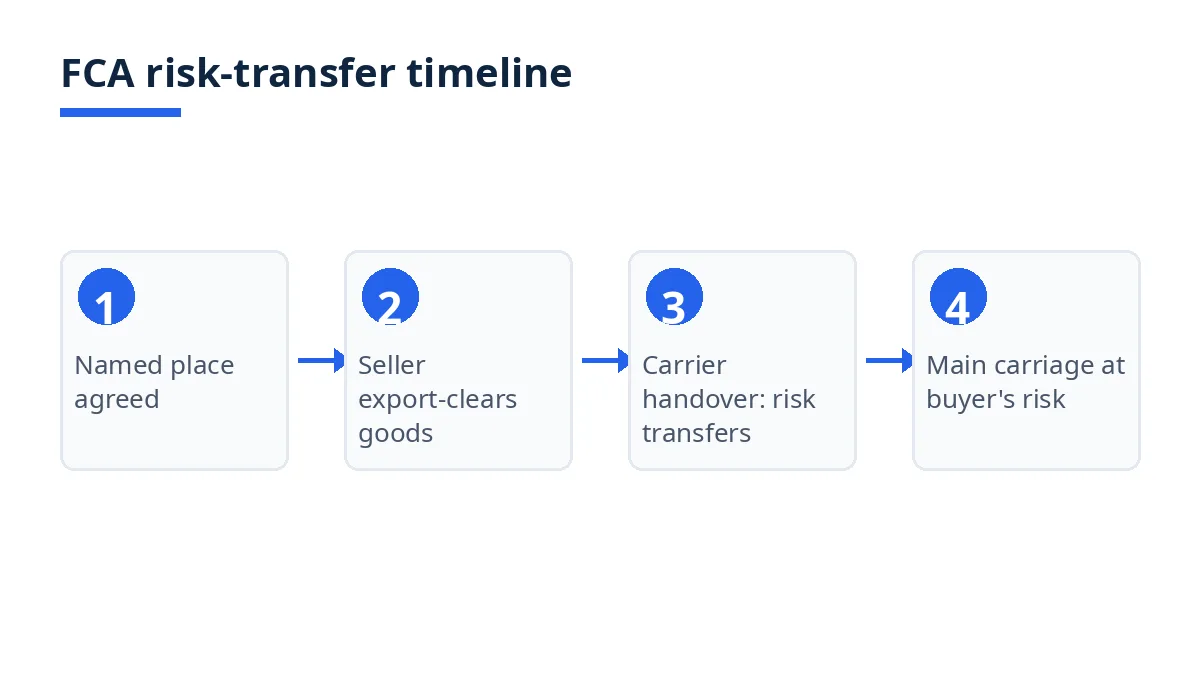
Agree the named place in full: "FCA [factory address, Gazipur, Bangladesh], Incoterms 2020".
Seller prepares and export-clears the goods for the buyer's carrier.1
Handover. At the seller's premises, delivery happens on loading onto the buyer's vehicle. At another named place, it happens when the seller's vehicle arrives with the goods ready for unloading.2
Main carriage at the buyer's risk from the named place onward.
FCA works for any mode of transport, including multimodal shipments.1
Two named places, two transfer moments
Seller's premises. The seller loads the goods onto the buyer's transport. Delivery, and risk transfer, happen once loading is complete.3
Another named place. The seller carries the goods to a container terminal, for example. Delivery, and risk transfer, happen when the goods arrive there, ready for unloading.2 3 Damage during unloading there is already the buyer's risk.
Named place | Risk passes when | Who loads or unloads |
|---|---|---|
Seller's premises | Goods loaded onto the buyer's vehicle | Seller loads |
Another named place | Seller's vehicle arrives, goods ready for unloading | Carrier unloads |
A contract that says only "FCA Bangladesh" does not say which variant applies.2
Claim scenarios: before, at, and after transfer
Before the transfer. A forklift damages cartons during loading onto the buyer's truck, before loading is complete. Risk has not yet passed, so the loss sits with the seller.
At the other named place. The seller's truck arrives at the terminal with the goods ready for unloading, and a carton is dropped as it comes off the truck. Risk already passed on arrival, so the loss is the buyer's risk.
During main carriage. Goods are damaged on the ocean leg or the road to the destination. That is the buyer's risk, because the buyer contracted the carriage and took the risk at the named place.1 A policy starting only at vessel loading leaves the earlier leg uncovered.
The carrier does not turn up. If the buyer's carrier fails to collect at the agreed time and place, the buyer bears the risk from the end of the agreed delivery period, though the goods have not moved.3
Goods that do not match the order. On arrival, the goods are the wrong size or fabric. That is a question about conformity to the sales contract, not one the risk moment answers.
Worked example: a Gazipur shipment to the UK
Example figures: every figure below is illustrative, not a real price or charge.
A UK buyer orders 3,000 knit polo shirts from a Gazipur factory on "FCA [factory address, Gazipur, Bangladesh], Incoterms 2020", with the named place being the seller's premises. Example unit value: 4.20 USD per shirt, so the order value is 3,000 x 4.20 = 12,600 USD.
Event | Example value | Risk bearer |
|---|---|---|
120 shirts damaged while loading, before loading finishes | 120 x 4.20 = 504 USD | Seller |
200 shirts damaged in a truck incident after handover | 200 x 4.20 = 840 USD | Buyer |
Goods damaged in storage after the agreed delivery period ends, carrier not collected | Value of the damaged shirts | Buyer3 |
Shirts arrive in the wrong size | Not a damage value | Sales contract question |
On the other variant, the transfer would happen on arrival at the terminal, ready for unloading.2
Who is responsible for what
Stage | Seller | Buyer |
|---|---|---|
Before handover | Prepare and pack the goods; clear them for export1 | Nominate the carrier; give collection details in good time |
At handover | Load at own premises, or deliver ready for unloading3 | Take the risk from the handover moment |
After handover | Give proof of delivery3 | Pay for main carriage; clear import; pay duties and taxes |
Insurance | No insurance duty under FCA3 | Arrange cover starting at the handover |
Later damage | Not the risk bearer, unless the contract says otherwise | Claim under own insurance or carrier arrangement |
Neither party must arrange insurance under FCA, but the buyer is advised to take out cover from the point of delivery.3 An on-board bill of lading notation is an agreed option, not an automatic right.4
What FCA means in plain English
FCA stands for Free Carrier. It is one of the 11 Incoterms 2020 rules published by the International Chamber of Commerce (ICC), which allocate cost, risk, and obligations between seller and buyer.4 In plain terms, the seller gets export-cleared goods to the carrier you named, at the place you named, and you take over from there.
Ownership is not set by the Incoterms rule, and payment timing does not move the transfer moment.
FCA vs related terms
Compare terms by their risk point alone.
Term | Risk passes to the buyer | Difference on risk |
|---|---|---|
EXW | At disposal, before loading | Earlier than FCA; buyer also handles export clearance1 |
FCA | At carrier handover at the named place | Seller loads at own premises and clears export |
FOB | On board the vessel at the port of shipment | Sea only; for containerised cargo, FCA is typically better2 |
CIF | On board the vessel at the port of shipment | Same risk point as FOB, plus seller-arranged carriage and insurance; see the CIF guide |
CPT | On handover to the carrier contracted by the seller | Resembles FCA, but the seller contracts the carriage2 |
DAP | At destination, ready for unloading | Seller carries transit risk much further than FCA2 |
For all 11 rules, see the Incoterms guide for shipments from Bangladesh.2
Common mistakes to avoid
Insuring from the port, not the named place. If cover starts at vessel loading, while risk passed earlier at a factory or terminal, the gap is uninsured. Start cover at the handover.
Naming a city, not a place. "FCA Gazipur" does not identify the factory or terminal, or which variant applies. Use the full address.
Treating collection as the risk moment. If the carrier collects late, risk may already have passed at the end of the agreed delivery period.3 Plan from the delivery period, not the collection date.
Assuming the seller insures the main journey. FCA places no insurance duty on either party.3 If no one arranges cover, the main journey runs uninsured.
Assuming loading help shifts the risk. At another named place, the seller's duty ends on arrival, ready for unloading.3 Help with unloading does not rewrite the transfer moment unless the contract says so.
Confusing risk with conformity, ownership, or payment. Damage in transit, wrong goods on arrival, and unpaid invoices are three different claims, against different parties.
How Exportain helps
On Exportain, state the Incoterm and the full named place in the request for quotation, so each supplier quotes against the same handover and risk moment. Ask each reply to confirm the named place, the variant, the collection window, and the proof of delivery at handover. The how to buy guide covers comparing quotations.
Exportain verification is a document and photo review, not a factory inspection, and a badge is not a guarantee. Exportain is not a party to the goods contract.
FAQs
What is FCA?
FCA means Free Carrier. It is an Incoterms 2020 rule under which the seller delivers export-cleared goods to the carrier nominated by the buyer at a named place, and risk passes at that handover.1
How does FCA work in practice?
The buyer nominates a carrier and gives the seller the carrier details and collection time. The seller prepares and export-clears the goods, then delivers them at the named place.2 Risk passes then, and the buyer arranges main carriage and import clearance.
Is FCA used for shipments from Bangladesh?
FCA is used for shipments from Bangladesh, and it suits a buyer who wants to control main carriage while leaving export clearance with the seller. Traders are encouraged to consider FCA instead of EXW where goods cross a border, because EXW export duties sit with the buyer.1
What are common mistakes with FCA?
The common mistakes are insuring from the port rather than the handover, naming a city instead of a full address, treating late collection as the risk moment, assuming the seller insures the main journey, and confusing risk with conformity, ownership, or payment.
Next steps on Exportain
Browse suppliers, then post a request for quotation on the RFQ board stating "FCA, Incoterms 2020" and the full named place. Before you sign, re-read the Incoterms guide for shipments from Bangladesh for the other rules' risk points.
Sources
- FCA & EXW Incoterms® 2020 explained: Key differences. ICC Academy (accessed )
- Place of delivery & risk transfer in trade contracts. ICC Academy (accessed )
- FCA Incoterms Explained: Free Carrier Meaning. DHL (accessed )
- Incoterms® 2020. International Chamber of Commerce (ICC) (accessed )
About the author
Sourcing from Bangladesh?
Post a request for quotation and suppliers on Exportain can send you their quotes directly.
Post an RFQ


