

7 Costly FCA Mistakes Importers Make (and How to Avoid Them)
Seven FCA mistakes importers make when buying from Bangladesh, what each one costs, and the contract fix for each, from the named place and loading to insurance, clearance and delivery proof.
Short answer
Under FCA, the seller delivers goods cleared for export to a carrier the buyer nominates at a named place, and risk passes at handover. The costly mistakes are naming that place vaguely, expecting the seller to load off-premises, assuming the seller insures or clears import, treating the FCA price as a landed cost, choosing the wrong term, and agreeing no delivery proof.
On this page
Key takeaways
Name the full delivery place, with the Incoterms version, in identical wording in the quotation, contract and transport booking: risk and costs split at that point.
At a place other than the seller's premises, the seller delivers ready for unloading; loading there, insurance and import clearance are the buyer's to arrange.
FCA imposes no insurance duty on either party, and only CIF and CIP oblige the seller to insure, so buyers must buy cover that starts at the named place.
Never compare an FCA price with a CIF or DDP price as if they covered the same journey: build a landed-cost sheet that adds carriage, insurance, duty and inland delivery.
Name the delivery document in the contract, and agree any on-board bill of lading instruction before loading, since it only issues if agreed in advance.
FCA common mistakes are expensive because they are usually discovered after the goods have moved. FCA, or Free Carrier, is an Incoterms 2020 rule under which the seller delivers the goods, cleared for export, to a carrier nominated by the buyer at a named place. Risk passes to the buyer when the goods are handed over at that place. If the named place is the seller's premises, the seller loads the goods onto the buyer's vehicle; at any other named place, the seller delivers the goods ready for unloading.1 The seller clears the goods for export, while the buyer arranges and pays for the main carriage, clears the goods for import, and carries the risk from handover onward.2 Every mistake below is a version of getting one part of that split wrong, and each one is fixable in the contract before the shipment starts.
The list: FCA common mistakes importers make
The seven mistakes below follow the same pattern: what happens, why it costs money, and how to fix it. Work through them against your contract before you confirm an FCA order.
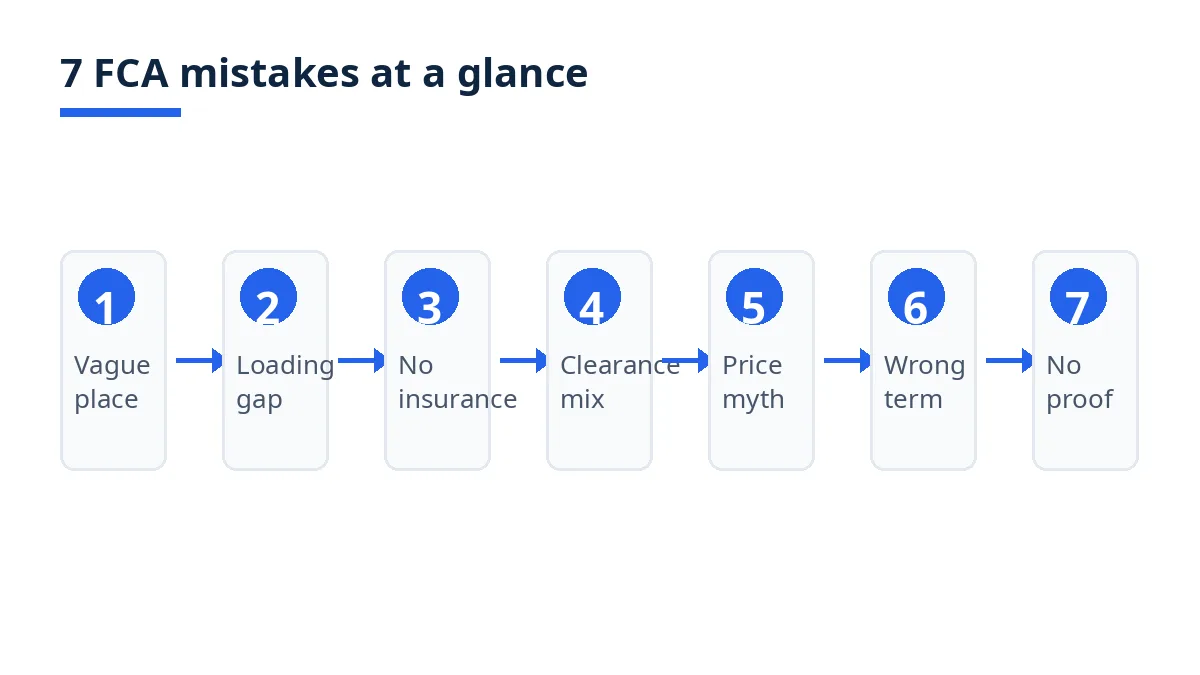
1. Naming the place too vaguely
What happens. The contract says "FCA Bangladesh", "FCA Dhaka" or "FCA Chittagong" with no address, terminal, container freight station or warehouse named. The seller, the buyer and the carrier each picture a different handover point.
Why it costs you. The named place decides when risk passes and who pays for local haulage, storage and terminal handling after that point. A vague place invites a dispute over whether delivery happened at all, and a carrier sent to the wrong gate can rack up waiting time and missed cut-off charges while the parties argue.
How to fix it. Write the full named place into every document, in identical wording: "FCA [seller's premises address, city], Incoterms 2020" or "FCA [named terminal or freight station, city], Incoterms 2020". Confirm before booking that your nominated carrier actually collects from that place, and use the same wording in the request for quotation, the quotation, the contract and the transport booking.
2. Expecting the seller to load at a place other than its premises
What happens. The buyer assumes the seller will load the goods onto the truck or into the container at a terminal, freight station or port, because the seller loaded the vehicle when the named place was the seller's factory on a previous order.
Why it costs you. Under FCA the loading duty changes with the place. At the seller's premises the seller loads the goods onto the buyer's vehicle, but at any other named place the seller delivers the goods ready for unloading, and unloading is the carrier's job.1 A carrier crew that arrives expecting loaded goods, or a seller waiting for a forklift that is not its duty to provide, can miss a sailing or a flight cut-off.
How to fix it. State in the contract who unloads at a non-premises place and who pays any terminal handling charge. Instruct your carrier in writing, and if you genuinely need the seller to load at the terminal, agree that service and its price separately instead of assuming it is inside the FCA price.
3. Assuming the seller insures the cargo
What happens. The buyer reads an FCA quotation, assumes transit insurance is included, and never buys cover. The goods travel from the named place onward with no cargo policy in the buyer's name.
Why it costs you. FCA imposes no obligation on either party to insure the goods. Only the CIF and CIP rules oblige the seller to arrange insurance; under FCA the buyer must arrange its own cover for the legs that run at its risk.3 4 If the cargo is damaged or lost after handover, an uninsured buyer absorbs the loss, even though the seller did nothing wrong.
How to fix it. Buy cargo insurance that starts at the named place, not at the port of loading, and covers the full journey to your door. Write the insurance responsibility into the contract so there is no gap between the seller's cover ending and yours beginning. The Exportain guide to FCA insurance sets out who covers which leg in more detail.
4. Mixing up export and import clearance
What happens. The buyer assumes the seller will clear the goods for import as well as export, or, coming from an EXW habit, assumes the buyer must clear the goods for export too. In some orders nobody confirms who files the export declaration at all.
Why it costs you. Under FCA the seller clears the goods for export and the buyer clears them for import, paying any duties and taxes at destination.2 Goods with unfiled export formalities sit at origin, while goods arriving without an import broker face storage charges and clearance delays at destination.
How to fix it. Put one sentence in the contract for each side of the border: the seller clears the goods for export, and the buyer clears them for import. Confirm the seller is able to complete the export formalities for your goods, and appoint your import broker before the shipment sails. The Exportain guide to FCA customs clearance explains the split in full.
5. Treating the FCA price as an all-in landed cost
What happens. The buyer compares an FCA quotation against a CIF or DDP quotation as if the two prices covered the same journey, or builds a retail margin on the FCA price alone.
Why it costs you. The FCA price ends at handover to the carrier. Main carriage, insurance, terminal and documentation charges, import duty and taxes, and inland delivery to your warehouse are all still to come, and all fall on the buyer.2 A budget built on the FCA figure alone understates the landed cost and can wipe out the margin on the order.
How to fix it. Build a landed-cost sheet for every FCA quote: FCA price, plus main carriage, plus insurance, plus import duty and taxes, plus inland delivery. Compare quotations only on the same delivery term, and question any FCA quote that looks far below the rest, since it may exclude a local charge the others include.
6. Using FCA where another term fits better
What happens. The buyer uses FCA by habit for a deal that needs something else: FOB for containerised sea freight, where the risk point on board the vessel does not match the reality of containers handed over at a terminal, or FCA where the buyer really wants the seller to carry the goods to the destination and bear that leg.
Why it costs you. The wrong term puts risk transfer at a point neither party controls, or leaves a leg of the journey unpriced and unassigned. It also creates document mismatches, since the transport document the buyer's bank or broker expects may not match the term in the contract.
How to fix it. Match the term to the journey: FCA for containerised and multimodal shipments where the buyer controls the main carriage, CPT or DAP where the seller is to carry the goods to the destination, and CIP or CIF where the seller is also to insure.5 Always write the version after the term, as in "FCA, Incoterms 2020", since an unversioned term invites an argument about which edition applies. For the wider choice, read the guide to Incoterms for shipments from Bangladesh.
7. Not agreeing delivery proof in advance
What happens. The contract names no delivery document. The seller hands the goods to the carrier, no signed receipt is specified, and, on a letter-of-credit shipment, nobody has arranged for a bill of lading with an on-board notation.
Why it costs you. Without agreed proof of delivery, a payment or damage dispute turns into an argument about what was handed to whom and when. On letter-of-credit terms the problem is sharper: under Incoterms 2020, the FCA rule allows the parties to agree that the buyer will instruct the carrier to issue an on-board bill of lading to the seller, but that only happens if it was agreed in advance, at the buyer's cost and risk.5 1 Left unagreed, the seller may be unable to present the document its bank requires.
How to fix it. Name the delivery document in the contract: a signed carrier receipt, a forwarder's certificate, or a bill of lading or air waybill as the mode requires. For letter-of-credit shipments, agree the on-board notation instruction before loading, put it in the carrier instructions, and confirm who pays for it.
Summary table
Mistake | What goes wrong | Fix in one line |
|---|---|---|
Vague named place | Dispute over where delivery happened | Write the full address or terminal, identically, in every document |
Seller expected to load off-premises | Missed cut-off while parties wait on loading | Agree unloading and terminal handling in writing |
No insurance arranged | Loss after handover falls on the buyer | Buy cover starting at the named place |
Clearance mixed up | Goods stuck at origin or at destination | Seller clears export, buyer clears import, in the contract |
FCA price treated as landed cost | Margin wiped out by unbudgeted legs | Build a full landed-cost sheet per quote |
Wrong term for the journey | Risk transfers at an uncontrolled point | Match the term to the journey and state Incoterms 2020 |
No delivery proof agreed | Payment and damage disputes with no evidence | Name the delivery document, and the on-board instruction for credit shipments |
How Exportain helps
Exportain is a B2B marketplace for sourcing from Bangladesh, and its buying flow is built around written terms: buyers search published products by keyword and category, review supplier profiles, and post a request for quotation stating quantity, target price, destination, Incoterm, required certifications and deadline, with suppliers in that category quoting against it.6 Use that flow to fix the mistakes above before you order. State the full named place and the Incoterms version in the request for quotation, ask each quoting supplier to confirm loading, insurance and clearance responsibilities in its quotation, and name the delivery document you require. Quotations on the platform are versioned, showing unit price, MOQ, lead time, Incoterm, payment terms and validity for each version, so you can compare suppliers on the same fields.6
Treat profile badges as a starting filter, not a conclusion. Badges record document and photo checks reviewed by the Exportain team; they are not factory inspections or quality guarantees, so run your own checks on the shortlist and keep the agreed terms in the quotation thread. Exportain is a marketplace and is not a party to your goods contract, and it does not book freight or clear customs for you, so the carrier, broker and insurer you appoint remain your responsibility.6 Post a free request for quotation at Exportain RFQs with your named place, Incoterm and delivery-document requirements written in, and compare the versioned quotations that come back.
FAQs
What is the biggest mistake?
Leaving the named place vague. The named place decides when risk passes from seller to buyer, who pays for each local charge, and which delivery document proves the handover. Every other mistake in this list becomes harder to fix when the delivery point itself is unclear, so settle the full place name, with the Incoterms version, before anything else.
How can I avoid it?
Write the delivery term out in full in the contract: the term, the full named place, and "Incoterms 2020". Add one line each for loading at a non-premises place, insurance, export clearance, import clearance and the delivery document. Send the same wording to the seller, the carrier and your broker so all three work from one version of the deal.
Who is responsible?
The seller is responsible for supplying goods that conform to the contract, clearing them for export, delivering them to the carrier at the named place, and providing proof of delivery. The buyer is responsible for nominating the carrier, paying for the main carriage, clearing the goods for import and paying duties and taxes there, and arranging insurance for the legs that run at its risk. Risk passes from seller to buyer at handover at the named place.1 2
Where can I get help?
Start with the professionals for each leg: a freight forwarder for the main carriage, a customs broker for import clearance, and a cargo insurer for cover from the named place. On Exportain, read how to buy from Bangladesh for the eight buying steps, then post a request for quotation that states your named place, Incoterm and delivery-document requirements so suppliers quote against the same terms.6
Next steps on Exportain
Before you confirm an FCA order, read the guide to Incoterms for shipments from Bangladesh to check your term choice against the alternatives, and the guide to CIF cost, insurance and freight if you are weighing a seller-insured term instead. Then read how to buy from Bangladesh and post your request for quotation with the full named place, the Incoterms version, and your delivery-document requirement written in.
Sources
- FCA (Free Carrier). Flexport (accessed )
- FCA Shipping Terms: A Comprehensive Guide to Free Carrier Agreements. Vipu Logistics (accessed )
- FCA Incoterm: Understanding Free Carrier and Its Impact on Global Trade. FreightAmigo (accessed )
- Incoterms 2020: All You Need To Know. Mondaq (accessed )
- Incoterms® 2020. International Chamber of Commerce (accessed )
- How to source and buy from Bangladesh. Exportain (accessed )
- Incoterms
- export documents
- cargo insurance
- Incoterms 2020
- buyer guide
- customs clearance
- Bangladesh sourcing
About the author
Sourcing from Bangladesh?
Post a request for quotation and suppliers on Exportain can send you their quotes directly.
Post an RFQ


