Electrical Products Sourcing Guide: Electronics and Solar From Bangladesh
Use this guide to source electronics, electrical products and solar equipment from Bangladesh: EPB market data, product families, supplier verification, MOQ, pricing, lead times, BSTI, CE, RoHS, CB testing and duties.
Short answer
Use this electrical products sourcing guide to buy electronics, electrical goods and solar products from Bangladesh: start from the latest EPB export data, match each product family to a producing site, verify test reports and certificates for your exact model and rating, agree MOQ, price and lead time in writing, and confirm CE, RoHS and duty requirements for your market before you order.
On this page
Key takeaways
Electrical product exports from Bangladesh rose 23.82 percent to a record $206.19 million in fiscal 2025-26, the largest engineering export earner, according to EPB data.
There is no single typical MOQ, price or lead time: each is quoted per model, rating and label version against a written specification.
CE marking is the manufacturer declaration of conformity, not an EU approval: the file is the conformity assessment, technical documentation and signed EU declaration of conformity.
RoHS limits apply per homogeneous material: cadmium at 0.01 percent and nine other substances at 0.1 percent, with documentation kept for 10 years.
A CB test report can support national certification in more than 50 CB Scheme member countries without full repeat testing.
This electrical products sourcing guide is for buyers in the United States, the United Kingdom, the European Union and the United Arab Emirates who buy electronics, electrical goods and solar products from Bangladesh. It covers what the country exports, the product families behind the figures, how to find and verify suppliers, and how minimum order quantity, price and lead time are set where a wrong rating or a missing test report can stop a consignment at the border.
Electrical buying differs from most categories in one respect: the product must perform to a stated rating, and you must prove it with documents naming your exact model, voltage and producing site. This guide treats specification, testing and certification as parts of one buying decision.
Market overview with latest data
According to data from the Export Promotion Bureau (EPB), exports of electrical products rose 23.82 percent to a record $206.19 million in fiscal year 2025-26, up from $166.52 million a year earlier, and the category became the largest earner among engineering products.1 Engineering exports overall rose 21.77 percent to $652.15 million in the same year.1 The Bangladesh export data summaries track the wider trade picture.
The export basket shows the breadth: televisions, refrigerators, freezers and air conditioners, plus power transformers, electric cables and insulated wires, switches, sockets, circuit breakers and LED lighting, and rechargeable batteries, transistors and semiconductor devices.1 Those families use different machinery, bought-in components and test regimes, so there is no single Bangladesh electrical supplier. A supplier strong in one family may assemble another from bought-in parts: workable when disclosed, a problem when hidden.
Growth is arriving with tighter proof requirements. The European Union Ecodesign for Sustainable Products Regulation (ESPR) entered into force in July 2024, introducing Digital Product Passport requirements through product-specific delegated acts; where they apply, manufacturers must provide information on materials, components, environmental characteristics, durability and repairability.1 The sector still lacks adequate testing infrastructure for European and other Western-market standards, and dependence on imported components makes traceability harder to evidence.1
Solar demand at home
Solar is both a family you can source and a domestic demand base for modules, inverters, cable and batteries. The Sustainable and Renewable Energy Development Authority (SREDA) reports 1,871.5 megawatts (MW) of renewable generation capacity, of which 1,578.415 MW comes from solar, split between 1,200.94 MW on-grid and 377.47 MW off-grid.2 The stated target is at least 20 percent of electricity from renewable sources by 2030 and 30 percent by 2040.2
Main products and production clusters
Fix the product family first: each family is judged on different measurements, and your specification and inspection plan should follow the family.
Cables and conductors. Building wire, power cable, control cable, solar cable and overhead conductors sit behind the export lines for electric cables and insulated wires.1 Judge them on conductor material, cross-section and resistance, insulation thickness, voltage rating and flame behavior. Under-size conductors waste energy as heat for the whole service life, so measured conductor resistance is both a quality fact and an operating-cost fact.
Switchgear and distribution equipment. Switches, sockets and circuit breakers are established export lines, alongside power transformers.1 Judge this family on rated current, breaking capacity and trip characteristics for breakers, contact and housing materials for switches and sockets, and rating, losses and routine test results for transformers. Ask which parts are bought in: the bought-in contact set or trip unit decides much of the field performance.
Lighting. LED lighting is part of the export basket.1 Judge it on measured lumens, color temperature, power factor and driver life, and ask whether the driver can be replaced without discarding the luminaire. The United Kingdom tariff notes for heading 8539 draw a line worth copying into your specification: LED modules are light sources based on light-emitting diodes without a cap designed for easy installation or replacement in a luminaire, while LED lamps have such a cap.3 Module, lamp and luminaire are different products with different price points.
Fans, motors, appliances and consumer electronics. Televisions, refrigerators, freezers and air conditioners anchor this family in the export data.1 Energy use in service is the dominant lifetime cost, so the rating plate, test report and energy label class for your exact model and voltage matter more than any general factory claim.
Solar and storage. Photovoltaic modules, inverters, charge controllers, mounting structures, solar home systems and rooftop kits, with rechargeable batteries in the established export basket.1 Judge a module on wattage and tolerance, an inverter on efficiency and protection functions, and a battery on capacity and cycle life at stated discharge conditions. The United Kingdom tariff notes state that electric accumulators in heading 8507 include accumulators presented with ancillary components such as connectors, temperature control devices and circuit protection devices.3 Price the complete kit list, including mounting, cable and controller.
Treat the headings as indicative: the full national code in your destination tariff decides duty and controls.
Product family | Indicative heading | What decides the exact line |
|---|---|---|
Insulated cables and conductors | 8544 | Voltage rating and connector fit; United Kingdom tariff line 8544 49 99 covers other conductors for a voltage not exceeding 1,000 V3 |
Electric accumulators and batteries | 8507 | Chemistry, and whether the unit is presented with ancillary components such as connectors or protection devices3 |
LED light sources | 8539 | Module or lamp: lamps carry a cap for installation in a luminaire, modules do not3 |
Transformers and static converters | 8504 | Rating, type, and whether the unit is complete or a part |
Production clusters follow the producing site, not a single district story. The electrical products industry in Bangladesh overview maps the sector and its clusters in full. Your task is narrower: match your specification to the site that actually makes your family, record which stages are bought in, and compare the exporter profiles for electrical equipment, industrial electronics and trade lighting.
How to find and verify suppliers
Start from a rated specification, not from a supplier list. A useful enquiry states the product family, the standard you are buying to, rated voltage and frequency, current or power rating, materials and restricted-substance limits, dimensions, plug and labeling requirements, energy targets where they apply, quantities per model, packing, and the test evidence required with the quotation. Without those fields, no two suppliers are pricing the same product. The RFQ guide and the guide to finding suppliers in Bangladesh set out the enquiry fields and the wider search process.
Build a longlist from several channels: the sector association, trade data showing which exporters ship your family to your market, referrals, and curated marketplaces. The Bangladesh Electrical Merchandise Manufacturers Association (Bemma), the sector association, is preparing members for export requirements through workshops covering product origin, warranties, after-sales service, repairability and documentation.1 Membership is a first identity reference, not proof that a factory can run your product. On Exportain, browse the suppliers directory against your specification, then post one structured request so suppliers answer the same requirements.
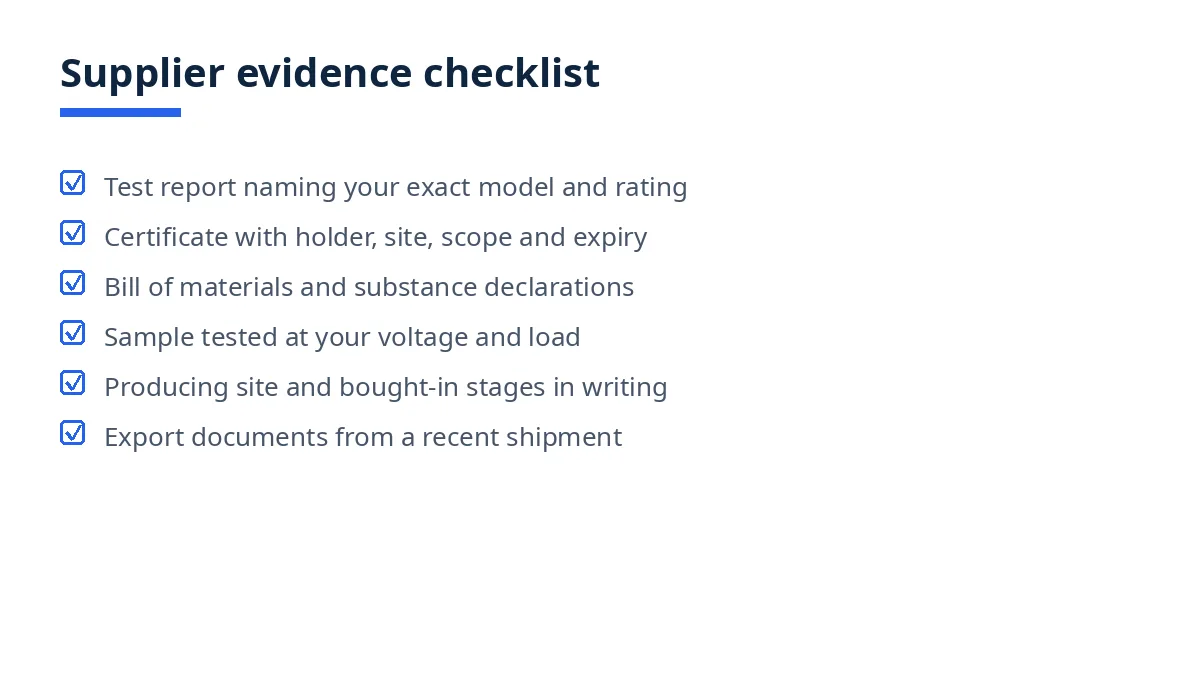
The diagram lists the evidence to request with the quotation, not after a deposit.
Identity. Match the legal name, trade license details and factory address across the supplier documents and its online presence, and resolve any inconsistency in writing before you discuss price.
Producing site. Record which plant makes your product and which stages are bought in, from rod and compound for cable to compressors and boards for appliances. Imported components are normal in this sector and are why traceability needs documents rather than assurances.1
Test evidence and material file. Ask for test reports and certificates that name your model, rating and producing site; a certificate for a different voltage, housing or site is background only. Ask for the bill of materials at the level your market requires, plus supplier declarations for restricted substances covering solder, cable compounds, plastics, batteries and finishes.
Domestic license position. Ask whether your product sits on the Bangladesh Standards and Testing Institution (BSTI) mandatory certification list and, if it does, for the license covering your factory and model. BSTI added power transformers to the list in one expansion round4 and later added 37 more products, including uninterruptible power systems (UPS) and lead-acid traction batteries, taking the list to 239 products at that time.5
Export readiness. Ask which markets the supplier ships this family to, and compare its routine export documents with the export documents checklist and the ERC guide.
Samples under load. Order samples in your exact specification and test them as your market will: run the appliance at your voltage, measure cable resistance and drum length, and charge and discharge the battery at the stated rate. A sample that is only photographed has not been tested.
Payment discipline. Confirm bank details through a second channel before paying, and treat any late change of bank details as a reason to pause and re-verify.
Warning signs include a quote far below every comparable offer for the same rated specification, refusal to send samples or test reports, pressure to pay quickly into a personal account, reluctance to identify the producing factory, and certificates naming a different company, site, model or rating. Add one specific to this category: a compliance claim with no file behind it.
MOQ, pricing and lead times
Buyers regularly ask for the typical minimum order quantity (MOQ), the typical price and the typical lead time, and for this category there is no single standard figure for any of the three. What can be set out clearly is what drives each number. The MOQ guide explains how minimums are set.
What is the typical MOQ?
MOQ is set by the smallest workable lot at each production stage, not by a trade-wide rule. For cable it is rod, compound and drum economics; for lighting and electronics, component reels and driver batches; for modules, cell lots; for appliances, compressor lots. Private labeling adds its own floor through label and carton print runs. Compliance requirements change the minimum: a compliant compound or a replaceable driver can turn a standard domestic model into a separate export run with its own minimum. Expect minimums per model, per rating and per label version.
What does the price consist of?
The main cost components are bought-in components and materials, conversion and assembly, testing and certification, packing, inland transport and export handling, plus freight and insurance where your delivery term puts them on the seller. Metal and component prices move quotations, so export quotes carry validity periods. Price the compliance file as part of the product: accredited testing and take-back contributions where a producer responsibility scheme applies cost money, and a quote that omits them is not cheaper, it is incomplete. Compare quotations only on an identical specification sheet and the same delivery term. Example figures: two lighting makers quote for the same batten specification, one at $4.80 per unit EXW with a standard fixed driver and no test file, and one at $5.15 per unit FOB with a replaceable driver and a test report naming the model. Adding inland transport, export handling and loading of $0.19 per unit to the EXW quote gives a like-for-like FOB cost of $4.99 per unit, so the gap for the tested, repairable version is $0.16 per unit, not the $0.35 the headline prices suggest. Use the same adjustment with the landed cost guide.
How long is the lead time?
Lead time is a chain: component purchase, production, testing, packing and transport to port. Imported components are usually the long stage, because a line can stand ready while the order waits for cells, drivers, chips or compressor parts. Testing adds its own queue, and the reported shortage of testing facilities for European and other Western-market standards means laboratory time should be booked and confirmed, not assumed.1 Confirm the production slot, component position and laboratory booking in the purchase order, stage by stage.
Quality, certifications and compliance
Electrical goods fail in ways that carry safety and cost consequences: cable with under-size conductors that runs hot, breakers that do not trip at the stated fault level, luminaires whose output falls short of the carton claim, and batteries whose capacity fades long before the stated cycle life. Quality control here is measurements agreed before production and checked before shipment.
Specify measurable quality, family by family. For cable: conductor material, cross-section and resistance, insulation thickness, voltage rating and routine tests per drum. For switchgear: rated current, breaking capacity and trip curve. For lighting: measured lumens, color temperature, power factor and driver replacement method. For appliances: energy consumption at the stated test condition and label class. For solar: module wattage tolerance and battery capacity at a stated discharge rate.
What does BSTI require in Bangladesh?
BSTI operates the national certification mark system, and its mandatory list has grown in published rounds. One round added 43 products, including power transformers.4 A later round added 37 more, including UPS units and lead-acid traction batteries, taking the list to 239 products at that time.5 If your product is on the list, ask for the BSTI license for your factory and model, and check holder, site, scope and expiry before you rely on it. It does not replace your destination market approval, which follows the rules in the next section.
Which certifications matter for the European Union?
Three files do most of the work for the European Union and the wider European Economic Area (EEA), and they answer different questions.
CE marking answers whether the product may be sold. The manufacturer is responsible for the conformity assessment, the technical file, the EU declaration of conformity and affixing the CE marking.6 By affixing it, the manufacturer declares that the product meets all the legal requirements for CE marking and can be sold throughout the EEA, including products made in other countries and sold in the EEA.6 The European Commission states the limits plainly: the marking is not an approval of safety by the European Union or another authority, it does not indicate origin, and it is compulsory only for covered products and forbidden on others.6 Importers and distributors share the duty to help ensure that only compliant products bearing the marking are placed on the EEA market.6 Own-brand buyers should expect to be treated as the manufacturer for these duties.
RoHS answers what the product may contain. The Restriction of the Use of Certain Hazardous Substances (RoHS) regime controls levels of hazardous substances in electrical and electronic equipment (EEE).7 Great Britain guidance on the RoHS Regulations lists 10 restricted substances and groups with maximum concentration values per homogeneous material: cadmium at 0.01 percent, and lead, mercury, hexavalent chromium, polybrominated biphenyls, polybrominated diphenyl ethers and four phthalates (DEHP, BBP, DBP and DIBP) each at 0.1 percent.7 In practice this is a supply-chain file, not a single test: the manufacturer is responsible for the whole product including incorporated components, must determine component compliance through testing or supplier information, and must keep technical documentation and the declaration of conformity for 10 years after the last product in the line is placed on the market.7 One scope point matters for solar buyers: photovoltaic panels produced for permanent use at a specific location are excluded from the Great Britain RoHS Regulations, so check the scope position for your exact product and market.7
The CB Scheme answers how test evidence travels. The IECEE CB Scheme, run by the IEC System for Conformity Assessment Schemes for Electrotechnical Equipment and Components, is an international system for the mutual acceptance of product safety test reports and certificates for electrical and electronic equipment, based on internationally accepted product safety standards.8 CB testing laboratories test products to the applicable standards, and national certification bodies in member countries can then authorize market access without additional testing.8 There are more than 50 member countries, including European Union member states, the United States, China, India, Korea and Russia, and the scheme covers categories including household equipment, information technology equipment, lighting, switches and controls, and electromagnetic compatibility.8
How should you inspect before shipment?
Test at three stages: approve a pre-production sample in the correct rating and keep it sealed, require routine test records from production, then inspect the finished lot against the approved sample. Agree the sampling method and defect limits in the purchase order itself. ISO 2859-1 specifies an acceptance sampling system for inspection by attributes, indexed by the acceptance quality limit (AQL): it presses the supplier to maintain a process average at least as good as the AQL while limiting the consumer risk of accepting an occasional poor lot, and its schemes apply to end items, components and raw materials.9 Its switching rules move inspection between normal, tightened and reduced levels as quality history changes.9 Add functional testing on packed units: power a sample of luminaires, appliances and inverters at your voltage against the rating plate.
Shipping, Incoterms and duties
Electrical goods ship as cable on drums, appliances and lighting in palletized cartons, fragile module stacks and project lots in containers. Packing is part of the product decision: drums sealed against moisture, modules protected against stacking pressure, cartons marked with rating information matching the documents, and batteries packed and documented under the dangerous goods rules for their chemistry, confirmed with your forwarder before booking. Agree carton dimensions, drum lengths and packing materials before the price is fixed.
Choose the delivery term deliberately. The Incoterms rules published by the International Chamber of Commerce (ICC) are eleven three-letter trade terms, first published in 1936, with Incoterms 2020 the current version, in force from 1 January 2020, clarifying tasks, costs and risks between sellers and buyers.10 Under EXW, you arrange and pay for almost everything from the factory gate. Under FOB, the supplier delivers on board at the named Bangladeshi port and you control the main freight. Under CIF, the supplier also pays freight and minimum insurance to your destination port, while risk passes on loading. Under DAP, goods are brought to a named place in your country without import clearance; under DDP, duties and clearance sit with the seller. Name the port or place precisely in the purchase order. Read Incoterms for shipments from Bangladesh before comparing quotes on different terms.
Duty is where classification and origin meet money. Your product full HS classification sets the duty line in your destination market, and preferential schemes can reduce or remove duty where the goods qualify under the relevant rules of origin and you hold the correct proof of origin. Preferential positions differ between markets and change as trade policy develops, so this guide states no duty rate: a rate copied from a general guide can be wrong for your heading, market and shipment date. Confirm the current rate and origin requirements with your customs broker and official tariff before ordering, then build landed cost in full.
On the export side, Section 131 of the Customs Act 1969 requires customs clearance for export: goods may not be loaded for export unless a Bill of Export, also called a shipping bill, has been submitted to Customs in the prescribed format and approved, specifying the goods description, their value, the exporter, the foreign buyer and the transport operator.11 The documents enclosed with the Bill of Export include the export letter of credit, or where there is none, the export contract, purchase order or export guarantee approved by the negotiating bank, the commercial invoice, the packing list, the EXP form certified by an authorized dealer, the certificate of origin issued by the EPB or a chamber of commerce and industry, the VAT registration certificate and the taxpayer identification number.11 After approval following documentary check and physical verification, goods are loaded, and export is complete once the vessel leaves and the officer signs the shipping bill as shipped on board.11
Step-by-step buying process
Define the product precisely: family, standard, ratings, materials and substance limits, dimensions, plug and labeling, packing, destination and shipment window.
Build a longlist and send every candidate the identical specification, so quotations compare like for like.
Verify the shortlist in layers: identity, producing site and bought-in stages, test evidence for your exact model, substance file, domestic license position and export readiness.
Sample and test under load: run samples at your voltage, and measure the values your specification names.
Confirm commercial terms in a written purchase order: specification, price and delivery term, MOQ per model and rating, stage-by-stage lead time, and payment terms.
Manage production actively: confirm component position, production dates, laboratory booking and routine test records.
Inspect before shipment: sample packed units, verify ratings, measurements, packing and labeling against the sealed sample, and record functional test results.
Ship and clear: confirm the Bill of Export document set, transport documents and origin paperwork match your lot before the vessel sails.
Review the order after delivery: measured performance, failure rates, test results and customer feedback feed a tighter second order.
Related guides
Keep your market picture current with the electrical products industry in Bangladesh overview, and read the exporter-side profiles for electrical equipment exporters, industrial electronics suppliers and trade lighting suppliers.
FAQs
Is Bangladesh a good place to source electronics, electrical and solar products?
Yes, for buyers whose products match the country export strengths. Electrical product exports rose 23.82 percent to a record $206.19 million in fiscal 2025-26 and became the largest engineering export earner, across a basket from appliances to cables, transformers, switchgear, LED lighting and batteries.1 The fit is strongest for defined product families in standard ratings, and the result depends on matching your specification to a producing site with test evidence for your market, because testing capacity for Western-market standards remains a reported constraint.1
What is the typical MOQ?
There is no single typical MOQ for electrical products from Bangladesh. The minimum is set per supplier, per model and per rating by the smallest workable production lot: rod and compound lots for cable, component and driver batches for lighting and electronics, cell lots for modules, compressor lots for appliances, and print runs for private labels. Ask each shortlisted supplier to quote the minimum for your exact specification in writing.
How long is the lead time?
Lead time is a chain rather than a single number. Component purchase, production, compliance testing, packing and transport each add a stage, and a failed test adds a redesign and retest cycle. Imported components are usually the longest stage, and reported limits on testing capacity for European and other Western-market standards can extend the testing stage.1 Ask each supplier to quote lead time stage by stage against your required arrival date.
Which certifications matter?
The certifications that matter first are the legal controls for your market, not voluntary labels. For the European Union, the manufacturer must complete the conformity assessment, hold the technical file, issue the EU declaration of conformity and affix the CE marking, a declaration rather than an approval by the European Union.6 The product must also meet the RoHS substance limits, evidenced by a supply-chain file covering components and materials, with documentation kept for 10 years.7 In Bangladesh, hold the BSTI license for your factory and model where your product is on the mandatory list.4 5 A CB test report from the IECEE scheme can then carry safety test evidence into national certification in more than 50 member countries.8 For batteries, one dated duty is already fixed: an electronic battery passport will be mandatory from 18 February 2027 for electric-vehicle batteries, industrial batteries above 2 kilowatt-hours and light means of transport batteries placed on the European Union market.1
Next steps on Exportain
Start with the electrical products industry in Bangladesh overview, then read how to import from Bangladesh for the ordering and shipping steps. When your specification is ready, use finding suppliers in Bangladesh to build your longlist and send every candidate the same rated specification.
Sources
- Electrical, electronics exports hit record growth amid rising EU compliance hurdles. The Business Standard, (accessed )
- Solar power saves Tk 5-6 per unit against grid electricity, offers environmental benefits. OutLook Bangla, (accessed )
- Commodity code 8544499900: For a voltage of 1 000 v. GOV.UK, UK Integrated Online Tariff (accessed )
- BSTI includes 43 new products under mandatory quality certificate. The Financial Express, (accessed )
- BSTI includes 37 more products under mandatory quality certificate. Samakal (accessed )
- CE marking. European Commission, (accessed )
- RoHS Regulations 2012 (as amended): Great Britain. GOV.UK (accessed )
- CB Scheme Certification. TÜV SÜD (accessed )
- SIST ISO 2859-1:2003 - Sampling procedures for inspection by attributes, Part 1: Sampling schemes indexed by acceptance quality limit (AQL). International Organization for Standardization, (accessed )
- Incoterms® rules. International Chamber of Commerce (accessed )
- Customs Clearance Procedures for Export. Bangladesh Customs, National Board of Revenue (accessed )
About the author
Sourcing from Bangladesh?
Post a request for quotation and suppliers on Exportain can send you their quotes directly.
Post an RFQ