Wholesale Jute Shopping Bags From Bangladesh: Prices and MOQ
A wholesale jute shopping bag price is set by bag type, fabric weight, print and quantity, not by a catalogue range. This guide gives example price bands by GSM, MOQ tiers, a line-by-line way to compare quotations, and a worked order of 6,000 laminated totes to New York.
Short answer
Wholesale jute shopping bags from Bangladesh are priced per bag by type, fabric weight, print and quantity, not from a catalogue range. As example figures, a plain 280 GSM hessian tote sits near $0.85 to $1.10 FOB Chattogram, a laminated 350 GSM tote near $1.45 to $1.85, and a dyed tote with woven handles near $2.60 to $3.40. Custom designs typically need 500 to 1,000 units, with bulk discounts from 5,000 units. Compare quotations on the same term.
On this page
Key takeaways
Example price bands run from $0.85 to $1.10 FOB per bag for a plain 280 GSM hessian tote to $2.60 to $3.40 for a dyed tote with woven handles and lining.
Custom designs typically need 500 to 1,000 units, smaller makers may accept from 300 pieces, and bulk discounts generally start at 5,000 units.
Most of the price fall as quantity rises is the set-up spread: a $150 screen set costs $0.30 a bag at 500 pieces and $0.0125 at 12,000.
Compare quotations line by line on the same delivery term, FOB Chattogram, with fabric GSM, print, handles, packing and validity shown separately.
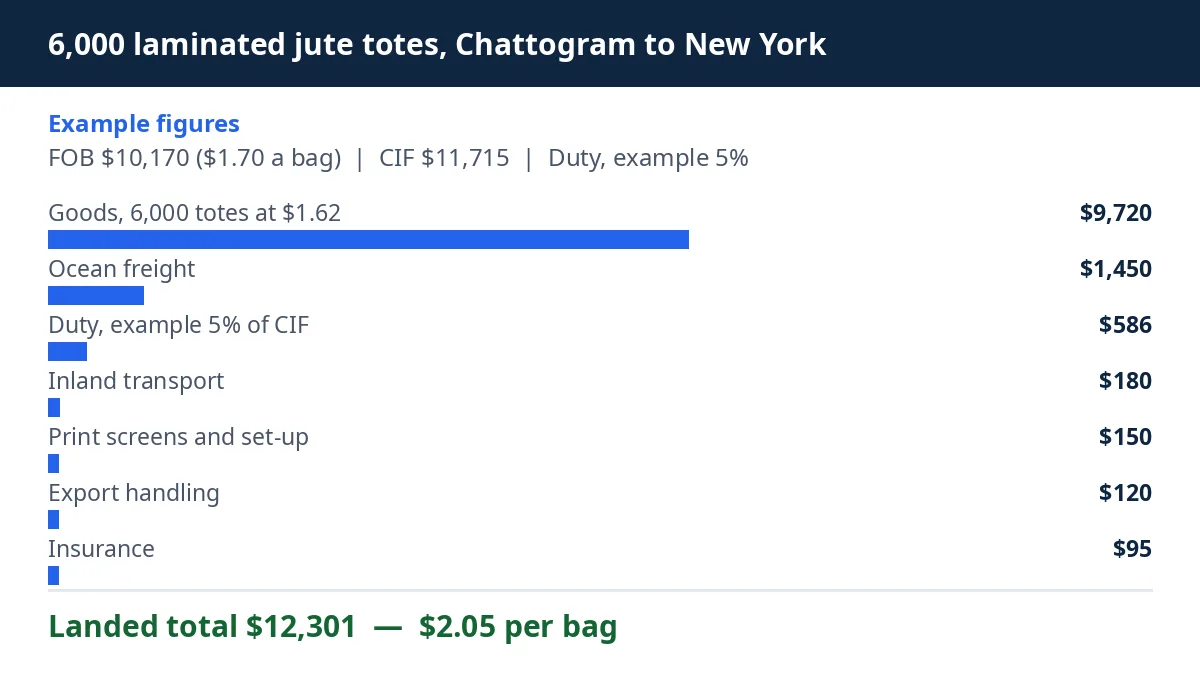
Example figures put 6,000 laminated totes to New York at $10,170 FOB and $12,301 landed, or $2.05 per bag.
A retail buyer in Manchester needs 6,000 jute shopping totes: laminated, one-colour print, webbing handles. Three Dhaka suppliers reply with three unit prices, and the spread between the cheapest and the dearest is more than 40 per cent. None of the three is wrong: each covers a different fabric weight, print setup and delivery term, and the unit price alone cannot tell the buyer which is which.
Demand is rising: the EU's Single-Use Plastics Directive requires member states to cut consumption of listed single-use plastic products by 2026 against a 2022 baseline, with reusable alternatives at the point of sale among them.1 Jute and jute goods earned $883.7 million in fiscal year 2025-26, with sacks and bags at $132.3 million.2 This guide gives example price bands, quantity tiers, quotation lines and a worked order of 6,000 laminated totes. Every price in it is an example figure.
Price bands by bag type and GSM
Example figures. The bands below are FOB Chattogram per bag, for orientation only: every supplier prices the bag you specified: its fabric weight, print, quantity and delivery term. A shopping tote differs from a packing sack, which has no handles and needs no retail finish.
Bag type | Fabric | Example FOB per bag |
|---|---|---|
Plain hessian tote | 280 GSM, unprinted | $0.85–$1.10 |
Laminated tote, 1 colour | 350 GSM, screen print | $1.45–$1.85 |
Laminated tote, 2 colours | 420 GSM, two-colour print | $1.75–$2.25 |
Juco tote, fine print | 320 GSM jute-cotton blend | $1.90–$2.50 |
Dyed tote, lined | Dyed fabric, cotton lining | $2.60–$3.40 |
GSM is grams per square metre, the weight of the cloth. Heavier cloth uses more fibre in each bag, so it costs more and makes a stronger bag: put the GSM on the quotation and check the sample against it. Lamination adds a film that gives the bag structure and resists water, and it adds a making step.
MOQ tiers: what each quantity buys
There is no single minimum order quantity: the minimum is fixed per bag type, per design and per production run, and it rises with the set-up the order needs. A plain tote needs almost no set-up, so its minimum can be low; a laminated tote with custom print and dyed fabric needs screens, dyed lots and a stitching set-up, so its minimum is higher. For custom designs, larger makers usually ask for 500 to 1,000 units, while smaller ones may start at 300 pieces, and volume discounts usually begin at 5,000 units and above.3
Example figures. FOB per bag for the same laminated tote, one-colour print:
Quantity | Example FOB per bag |
|---|---|
500 | $2.05 |
1,000 | $1.92 |
3,000 | $1.78 |
6,000 | $1.70 |
12,000 | $1.61 |
The fall from $2.05 to $1.61 is mostly the set-up spread. A $150 screen set costs $0.30 a bag at 500 pieces, $0.15 at 1,000, $0.05 at 3,000 and $0.0125 at 12,000. On a repeat order the screens already exist, so ask whether the price falls with them. See our MOQ guide for jute bags for the levers that bring a minimum down.
What moves the unit price
Fabric weight. The heaviest cost line, because the cloth is most of the bag: moving from 280 GSM to 420 GSM adds fibre to every bag, and the price follows.
Print. Each colour adds a screen and a press pass, so a four-colour design costs more than a one-colour design, and the gap is widest on small orders.
Handles, lining and dye. Cotton, webbing and woven jute handles are priced differently, and a long handle takes more material than a short one. A lining brings a second material and another making step.
Size. A larger bag uses more cloth, stitching and packing, and changes how many bags fit in a carton and a container. A standard size costs less than a custom size needing a new cutting layout.
Quantity. Fixed set-up spreads over more bags as the run grows. Fix the specification first, then change the quantity.
How to compare three quotations line by line
Ask for the price broken into its parts, and set quotations side by side only when every part is on the same basis. Under FOB (Free On Board) the seller's duty ends once the goods are placed on the vessel at the named port, cleared for export, and the risk moves to the buyer from that point; the buyer pays the sea freight and everything after.4 Under CIF the seller also pays the freight and a marine insurance policy to the destination port, while the risk still moves to the buyer as soon as the goods are on board at origin, and the cover is Institute Cargo Clauses (C), the minimum level, at 110 per cent of the contract value or more.4 5
Ask every supplier to quote FOB Chattogram and show each line separately:
Quotation line | What to check |
|---|---|
Fabric, GSM and grade | Weight and grade in writing |
Making, print and handles | Stitch density; cost per colour; handle material |
Lamination and packing | Film area; cartons or bales; bags per carton |
Freight and insurance | Only where the term includes them |
Validity | How long the price holds, and what can change it |
A supplier that itemises the price is opening up its real cost structure; one that refuses is asking you to accept a single total on trust. Our FOB cost breakdown for jute bags opens a quotation up line by line.
Worked example: 6,000 laminated totes to New York
Example figures. A buyer in New York orders 6,000 laminated jute shopping totes, 40 x 35 x 15 cm, 350 GSM laminated jute, one-colour print, webbing handles, FOB Chattogram. The numbers below show how a landed cost is built up.
Cost line | Amount |
|---|---|
Goods, 6,000 totes at $1.62 each | $9,720 |
Print screens and set-up | $150 |
Inland transport, Dhaka to Chattogram | $180 |
Export handling | $120 |
FOB total | $10,170 |
FOB per bag | $1.70 |
Ocean freight to New York | $1,450 |
Insurance | $95 |
CIF value | $11,715 |
Duty, example 5% of CIF value | $586 |
Total landed cost | $12,301 |
Landed cost per bag | $2.05 |
Goods plus set-up plus transport plus handling comes to $10,170, or $1.70 a bag. Adding freight and insurance gives a CIF value of $11,715; duty at the example rate of 5 per cent is $585.75, rounded to $586; and $12,301 divided by 6,000 bags is $2.05 per bag.
Sampling and payment terms
A specification error multiplies across every bag in the run, so the sample round is where a wholesale order is won or lost. Sampling takes 10 to 21 days depending on design complexity: standard logo applications take about 10 days, while custom woven handles or dyed fabrics extend the process to three weeks.3 Production-quality samples usually come at cost, with the buyer paying the shipping, and some suppliers drop the fee once a bulk order above 5,000 units is confirmed.3 Agree who pays and what happens if the sample is rejected, before it is made.
Ask for the sample made in the final fabric, handles, print and lamination, and sign it off in writing only when every point passes, keeping the approved bag sealed as the reference for the run. Payment terms belong in the order before production starts: the deposit share, the balance trigger, and the documents that release the balance, with what happens if the inspection fails and who pays for the re-inspection. Bangladesh Bank's cash assistance is paid subject to repatriation of export earnings within the specified period.6 For diversified jute products the rate is 10 per cent for shipments between 1 July 2026 and 30 June 2027; jute final products get 5 per cent and jute yarn 3 per cent.6
Checking the supplier behind the price
A low price from a supplier you cannot check is not a bargain. The Jute Diversification Promotion Centre, set up in 2002, counts 1,100 registered entrepreneurs across 282 diversified jute product types.7 The directory is a starting point, not a verdict: find out if each maker weaves its own fabric or buys it in. Ask every supplier to state in writing whether it manufactures, trades or acts as an agent. Our guide to jute shopping bag makers in Bangladesh sets out the factory checks, our exporter checklist for jute bags tests the registration, shipping record, bank and paperwork behind the firm, and our wholesale jute bags guide explains how supplier types shape the price.
Quality control on the bulk run
No bulk order can be inspected bag by bag on arrival, so agree the sampling plan before production starts: who inspects, what is checked, and what happens to rejected cartons. The plan follows ISO 2859-1: lot size and inspection level give a code letter, and the code letter with the acceptance quality limit (AQL) gives the sample size and the accept and reject numbers.8 Level II is the default; the usual setting gives critical defects AQL 0, major defects 2.5 and minor defects 4.0.8
For the worked order, a 6,000-bag lot at level II draws code letter L, so the inspector pulls 200 bags: at AQL 2.5 the lot passes with 10 or fewer major defects and fails at 11, and at AQL 4.0 it passes with 14 or fewer minor defects and fails at 15.8 Write the level, the AQL values and the re-inspection payer into the order. Our quality control checklist for jute shopping bags lists the inspection points for the sample and the bulk run. The IJO 98/01 standard sets guidelines for jute bags in food packaging.9
HS code and duty: the line buyers forget
Classification decides the duty, and the duty line in the worked example is $586. A handled shopping tote that resembles a handbag can fall under heading 4202, while a packing-oriented textile tote can fall under 6305.90, and jute sacks for packing fall under 6305.10.10 The first six digits of the Harmonized System are shared worldwide.10 The heading turns on what the bag is used for, so confirm it with your customs broker before the order ships. Our HS code guide covers the classification in full.
Mistakes that push the price up
Ordering before the artwork is frozen. Every change after the screens are made means new screens.
Judging quotations on the unit price alone. Two suppliers can price the same bag differently because one is using lighter fabric, fewer print colours or a different delivery term. Judge the landed cost per bag instead.
Accepting a quotation with no validity date. Raw jute prices move, so ask how long the price holds and get the answer in writing.
Questions buyers ask about wholesale jute shopping bags
How much does a wholesale jute shopping bag cost?
No single figure answers that, because the price follows the bag type, the fabric weight, the print and the quantity. A plain 280 GSM hessian tote sits near $0.85 to $1.10 FOB Chattogram, a laminated 350 GSM tote near $1.45 to $1.85, and a dyed tote with woven handles and lining near $2.60 to $3.40.
What is the usual MOQ for custom jute shopping bags?
Larger makers usually ask for 500 to 1,000 units on a custom design, smaller ones may start at 300 pieces, and volume discounts usually begin at 5,000 units and above.3
Next steps on Exportain
Start from the specification: bag type, fabric GSM and grade, size, print and quantity, priced on FOB Chattogram. Then find Bangladeshi suppliers, or post an RFQ attaching the specification, and ask every reply to price each line apart. Read how to buy before ordering.
Sources
- Single-Use Plastic Rules by Market: EU, Vietnam and Japan. Sunsho Trade (accessed )
- Jute exports rise 37 per cent as Bangladesh plans to double earnings by 2031. The Financial Express, (accessed )
- Jute Bags Wholesalers: Bulk Suppliers & Custom Options. Accio, (accessed )
- Incoterms 2020 Explained: Complete Guide (2026 Update). Inecta (accessed )
- Incoterms® 2020. International Chamber of Commerce (ICC) (accessed )
- FY27: BB retains cash incentive for exports of 43 sectors. Dhaka Tribune, (accessed )
- Jute Diversification Promotion Centre weaves success for 1,100 entrepreneurs. Daily Sun, (accessed )
- Textile Quality Control: AQL Sampling And Inspection Guide. TextileTuts (accessed )
- How Wigmore Trading is Revolutionizing Packaging Agriculture Products with Food Grade Jute Sacks. Wigmore Trading, (accessed )
- Bag HS Codes Guide: 6305 Breakdown for Importers. FreightAmigo, (accessed )
About the author
Sourcing from Bangladesh?
Post a request for quotation and suppliers on Exportain can send you their quotes directly.
Post an RFQ