How to Import Mangoes From Bangladesh in 2026: Complete Buyer Guide
A step-by-step guide to importing fresh mangoes from Bangladesh in 2026: varieties, season windows, ripening and cold chain, phytosanitary rules, documents and freight choices.
Short answer
To import mangoes from Bangladesh, buy mature-green fruit of a proven export variety such as Amrapali, Himsagar, Langra or Fazli during the May to September season, confirm hot water or vapour heat treatment and a phytosanitary certificate, pack in 4 kg cartons, hold the fruit near 13 degrees Celsius, and ship by air to your market.
On this page
Key takeaways
Bangladesh grows 2.4 to 2.5 million tonnes of mangoes a year but exported only 2,194 tonnes in 2025.
Amrapali accounts for about 80 percent of mango shipments; Himsagar, Langra and Fazli cover most of the rest.
Export mangoes are picked mature-green and held near 13 degrees Celsius, then ripened at 20 to 23 degrees at destination.
Fruit fly treatment and a phytosanitary certificate decide market access; the United States requires hot water treatment.
Air freight is the normal choice for a first order, with the common export pack a 4 kg carton of 7 or 8 mangoes.
Fresh mangoes from Bangladesh reach buyers in a short season, and the fruit does not wait for slow paperwork. Bangladesh grows 2.4 to 2.5 million tonnes of mangoes a year, yet shipped only 2,194 tonnes abroad in 2025.1 This guide covers choosing a variety, booking inside the season window, keeping the cold chain unbroken, clearing phytosanitary rules, and picking air or sea freight.
What does importing mangoes from Bangladesh involve?
Importing mangoes from Bangladesh means buying mature-green fruit from an exporter in Rajshahi or Chapainawabganj, treating it against fruit fly, packing it in ventilated cartons, and flying it to your market while it is still firm. Your exporter handles harvest, grading and treatment; you handle your market's import rules, the freight booking and the payment terms.
Bangladesh is the eighth largest mango producer in the world, growing more than 2 million tonnes a year across Chapainawabganj, Rajshahi, Dinajpur and Naogaon.2 Shipments reached 2,194 tonnes in 2025, up 66 percent on 2024, and went to 26 countries, led by the United Kingdom with 686 tonnes.1
Which mango varieties should you buy?
Choose the variety by your market and selling window, not by taste alone. Amrapali accounts for about 80 percent of Bangladesh's mango shipments, with Himsagar, Langra, BARI-4 and Fazli making up most of the rest.1 Amrapali suits volume retail, Himsagar suits premium retail, and Langra suits buyers serving South Asian communities in the United Kingdom.
Variety | Harvest window | Fruit and flavour | Best use for buyers |
|---|---|---|---|
Himsagar | First week of June through June | About 219 grams, thin skin, fragrant, soft orange flesh | Premium fresh retail and gift packs |
Langra | Mid-June to mid-July | 200 to 600 grams, thin skin, sweet with a light tang | Fresh eating for South Asian markets |
Amrapali | July to early September | Small fruit, smooth thin skin, orange flesh, no fibre | Volume retail, the main export variety |
Fazli | July to early September | 400 to 1,000 grams, large and flat, juicy and sweet | Late-season supply and processing |
The windows above come from the Bangladesh season calendar: early varieties ripen from the second week of May to mid-June, mid-season varieties from mid-June, and late varieties from July to the first week of September.3
When is the mango export season in Bangladesh?
The mango season in Bangladesh runs for about five months, from May to September, but most fruit is available from June to July.3 Treat June and July as the core window, with Gopalbhog and Himsagar opening the season and Fazli and Amrapali extending it into August and early September.
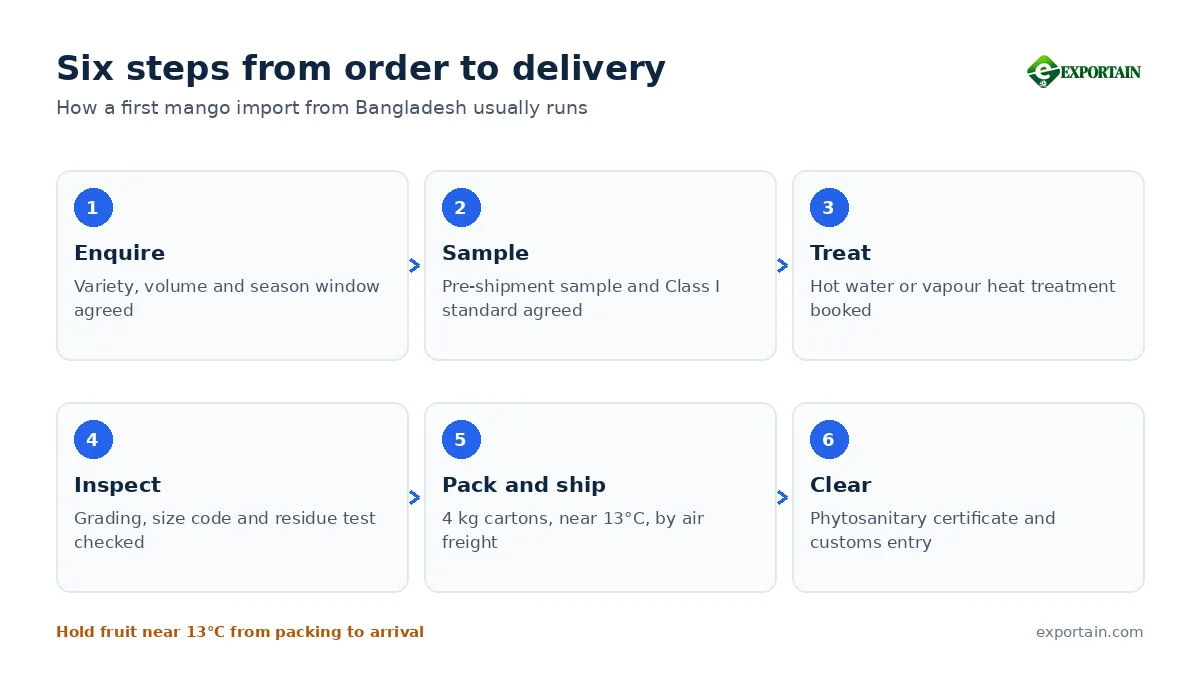
Start your enquiries in March or April. Exporters allocate orchard lots and treatment slots early, and the vapour heat treatment facility in Dhaka treats only around three tonnes of mangoes a day, so late orders compete for a narrow pipe.4 Confirm the harvest date in writing, then allow two days for harvest and packing, one day for treatment and certification, and the transit time to your airport or port.
How do you find and check a mango exporter?
Start with exporters who already ship fresh fruit abroad. Read the supplier verification badges so you know what each badge actually confirms, then ask for the exporter's recent mango shipments, the districts they source from, and the treatment plant they use.
Before you pay anything, ask for a pre-shipment sample of the exact variety and size you plan to order. Europe almost exclusively requires Class I mangoes, which must be of good quality, sound, clean and free from damage that affects the flesh, appearance or keeping quality.5 Use the quality control checklist for mangoes at inspection, and put the grade, size code, count per carton and tolerance for defects into the purchase order.
A letter of credit protects both sides when the documents must match the shipment exactly. Read the letter of credit guide for Bangladesh trade before you agree terms, and never pay the full balance before inspection on a first order.
How do ripening and the cold chain work for mangoes?
Mangoes for export are picked mature but green and ripened after arrival. Fruit picked before it is mature never develops full flavour and is more open to chilling injury and heat damage during fruit fly treatment, while fruit left on the tree until ripe often breaks down inside.6
Temperature decides how fast the fruit ripens and how long it keeps. Mature-green mangoes hold for 14 to 28 days at 10 to 13 degrees Celsius, and ripe mangoes hold for up to a week at the same range.6 The best storage and transport temperature is 13 degrees Celsius, because below that level the fruit risks chilling injury, and the best ripening range is 20 to 23 degrees Celsius.6 Your exporter should pre-cool the fruit to 10 to 12 degrees Celsius after harvest and hold it near 13 degrees through packing and transport.
Temperature-controlled transport stretches shelf life from 5 to 10 days to more than 15 days, but access to it is limited in Bangladesh, which is one reason post-harvest losses run high.2 Ask your exporter in writing where the fruit is pre-cooled and what temperature the truck or container holds.
What phytosanitary and treatment rules apply to mangoes?
Fruit fly is the pest that decides whether your mangoes can enter a market. Major markets will not accept fruit fly infested products, and a phytosanitary certificate is required to import mangoes into Europe.5 In Bangladesh, export growth has been held back by phytosanitary concerns, above all fruit fly infestation.4
Two heat treatments are used against fruit fly: hot water treatment, which dips the fruit in heated water, and vapour heat treatment, which exposes it to heated, humid air. Mango exports to the United States must be hot water treated, while the European Union does not yet require it.5 Bangladesh has only five hot water treatment units, and a vapour heat treatment facility was set up in Gabtoli, Dhaka.4 2 After vapour heat treatment the fruit is cooled and washed for about 30 minutes, and the process is reported to extend shelf life to about 8 to 10 days.4
For the European Union, the phytosanitary certificate must carry one of four statements from the national plant protection organisation: the fruit comes from a country or area recognised as free from non-European fruit fly, no signs of the fly were seen at the place of production since the start of the last vegetation cycle, or the fruit was given an effective treatment, with the treatment data shown on the certificate.5 Ask your exporter which statement will appear on yours.
Residue limits are the second gate: European law sets maximum residue levels for pesticides on mangoes, and buyers in several member states apply lower limits.5 Lead must stay below 0.10 mg/kg and cadmium below 0.050 mg/kg.5 Ask for the spray record and a residue test result for the shipment.
Which documents does a mango shipment need?
A mango shipment needs the standard export set plus the plant health paper that proves the fruit is fit to enter your market; confirm the exact list with your customs broker.
Document | What it proves | Who issues it |
|---|---|---|
Commercial invoice | Variety, quantity, price and payment terms | Exporter |
Packing list | Carton count, net and gross weight, size codes | Exporter |
Phytosanitary certificate | The fruit was inspected and meets plant health rules | Plant Quarantine Wing, Department of Agricultural Extension |
Certificate of origin | The fruit was grown in Bangladesh | Chamber of commerce |
Air waybill or bill of lading | The carrier received the goods for transport | Airline or shipping line |
Residue test report | Residues sit within the destination limit | Accredited laboratory |
The phytosanitary certificate is the document buyers most often get wrong, because it is consignment specific and must match the shipment exactly. Read the export documents guide for Bangladesh alongside this list, and check its number, variety, quantity and treatment statement against the invoice before the goods leave Dhaka.
Should you ship mangoes by air or by sea?
Air freight is the normal choice for Bangladeshi mangoes. High air freight charges already restrict export potential, and exporters reported freight costs rising two to three times above normal rates before the 2025 rebound.1 Air freight keeps the fruit in transit for days rather than weeks, which matters when shelf life after treatment is about 8 to 10 days.4
Factor | Air freight | Sea freight |
|---|---|---|
Transit time | Days, so the fruit arrives firm | Weeks, so the fruit must survive the voyage |
Cold chain | Airport cold rooms, short handling chain | Reefer container, must hold near 13 degrees Celsius throughout |
Best for | First orders and premium varieties | Large volumes once the route is proven |
Main risk | Freight cost and limited cargo space | Ripening in transit and a missed selling window |
If you try sea freight, ship mature-green fruit in a reefer container held near 13 degrees Celsius, agree the ripening plan with your buyer before loading, and run a small trial first.6 For most first-time buyers, air freight keeps the risk simpler. The CIF guide for air freight explains how cost, insurance and freight work when the goods fly rather than sail.
How much does a first mango order cost?
Price a first order from the carton up. The common export pack for mangoes is a 4 kg cardboard box, and the usual trading sizes are 7 or 8 mangoes per 4 kg box in the Netherlands, the United Kingdom and France.5
Example figures: a first trial order of 500 kg of Amrapali at an example free on board price of 2.20 US dollars per kg costs 1,100 US dollars for the fruit. At 4 kg per carton that is 125 cartons, and at 8 mangoes per carton it is about 1,000 pieces of fruit. If example air freight and handling add 1.90 US dollars per kg, the landed fruit cost before duty is about 2,050 US dollars, or about 4.10 US dollars per kg.
What mistakes do first-time mango buyers make?
The most common mistake is ordering ripe fruit. Ripe mangoes hold for up to a week at 10 to 13 degrees Celsius, while mature-green fruit holds for 14 to 28 days, so ripe fruit leaves almost no room for a delay.6 Order mature-green fruit and ripen it at destination. The second mistake is booking freight before the treatment slot is confirmed: with five hot water treatment units in the country and a vapour heat treatment plant treating about three tonnes a day, a booked flight without a slot is a wasted booking.4 2 The third mistake is accepting mixed sizes in one carton. Larger fruit takes two to four days longer to ripen than smaller fruit, so mixing sizes gives uneven ripening on the retail shelf.6 The fourth mistake is skipping the residue test to save time. A shipment held or destroyed at destination for a residue failure costs far more than the test, and one contaminated package can lead to the whole batch being destroyed.5
Next steps on Exportain
Start by asking mango exporters on Exportain for their variety list, harvest calendar and treatment plant, then compare two or three written quotes for the same size and pack. Post an RFQ for your order at /rfqs/new with the variety, size code, carton count and destination airport, and read how to buy on Exportain first. For classification and inspection detail, see the HS code guide for mangoes and the quality control checklist for mangoes.
Sources
- Bangladesh mango exports rise 66% in 2025. FreshPlaza (accessed )
- Advancing Mango Production & Forward Marketing in Bangladesh. LightCastle Partners, (accessed )
- Top Mango Varieties in Bangladesh. United News of Bangladesh (accessed )
- Bangladesh expands vapour heat treatment for mango exports. FreshPlaza (accessed )
- Entering the European market for mangoes. CBI, (accessed )
- Mango – Post-harvest & Processing. International Tropical Fruits Network (accessed )
- Cold chain
- Mangoes
- Air freight
- phytosanitary certificate
- mango import
- Bangladesh mangoes
- fresh fruit import
About the author
Sourcing from Bangladesh?
Post a request for quotation and suppliers on Exportain can send you their quotes directly.
Post an RFQ