Best Incoterm for Importing Light Engineering & Bicycles From Bangladesh
FCA suits most container shipments of bicycles and knocked-down kits from Bangladesh, FOB fits heavy steel parts loaded at Chattogram, and CIP beats CIF on insurance. This guide compares the terms by cargo shape, container size and landed cost.
Short answer
For most light engineering orders from Bangladesh, FCA is the best Incoterm: risk passes when the sealed container is handed to your carrier, and you control freight and insurance. Choose FOB for heavy steel parts loaded at Chattogram, CIP when you want the seller to arrange all-risks insurance, and DDP only for small first orders.
On this page
Key takeaways
FCA is the strongest default for containerised bicycles and SKD or CKD kits from Bangladesh.
FOB fits heavy steel parts loaded on board at Chattogram, not containers sealed at the factory.
CIF insurance is only minimum Clauses (C) cover; CIP requires all-risks Clauses (A) cover.
A 40-foot high cube holds about 76.3 cubic metres against 67.7 for a standard 40-foot container.
Compare quotes by landed cost per unit, not by the headline price, under FOB, CIF or DDP.
Light engineering goods from Bangladesh do not behave like garments in a container. Bicycles are light but bulky, steel parts are heavy but compact, and a knocked-down kit packs very differently from a finished bike. The Incoterm you choose decides who pays for freight, who carries the risk in transit, and who handles customs at each end.
Bangladesh earned USD 151.40 million from bicycle exports in FY 2025-26, up from USD 116.44 million in FY 2024-25 and USD 82.50 million in FY 2023-24, according to Export Promotion Bureau data reported by The Financial Express.1 The European Union remains the principal destination, and Bangladeshi bicycles now reach more than 40 countries.1
What do the 11 Incoterms 2020 rules actually decide?
Incoterms 2020 are the 11 standard trade terms published by the International Chamber of Commerce (ICC). They set out who pays for transport, where risk passes from seller to buyer, and who handles export and import clearance.2 The rules entered into force on 1 January 2020 and remain the current edition.2 Seven rules work for any mode of transport, and four, FAS, FOB, CFR and CIF, work only for sea and inland waterway transport.2
Two points matter most here. Under CFR and CIF, the seller pays freight to the destination port, but risk passes to the buyer when the goods go on board the vessel in Bangladesh. And FOB and CIF were written for goods loaded directly onto a vessel, not for containers sealed at a factory, so FCA usually matches a sealed container better than FOB.
Always write the term with the version and the named place, for example "FCA Dhaka, Bangladesh, Incoterms 2020". See our Incoterms guide for shipments from Bangladesh.
Which Incoterm fits a container of bicycles?
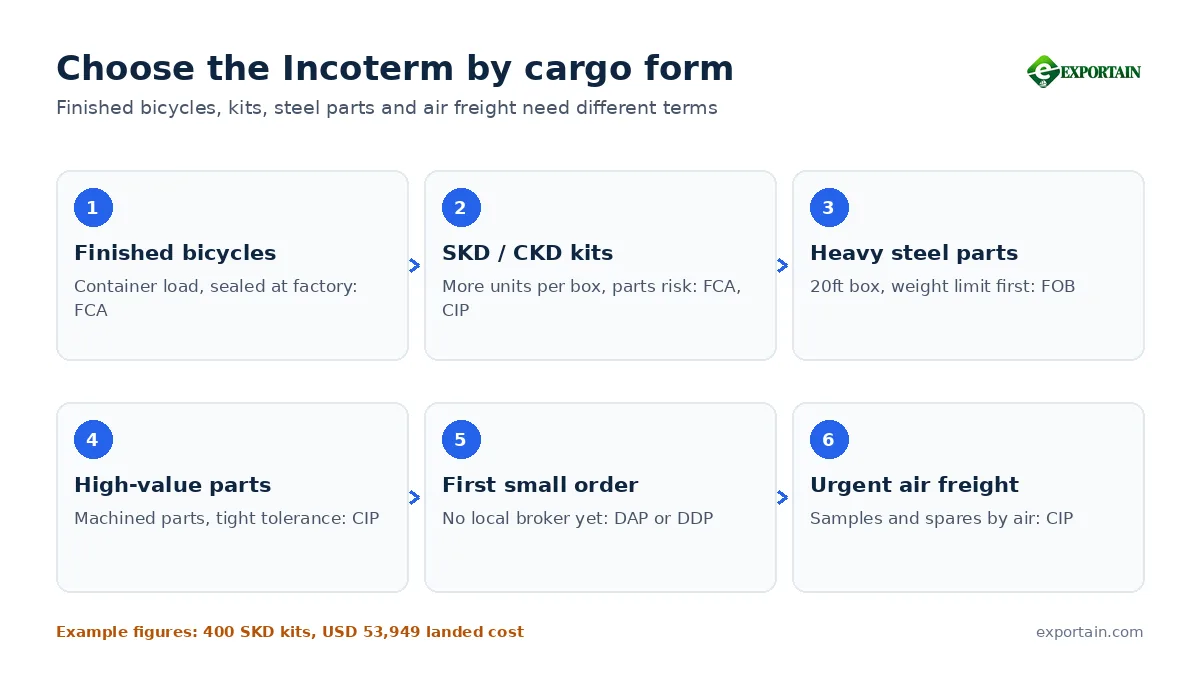
For a first or repeat order of finished bicycles, FCA is the strongest default. The seller clears the goods for export and hands the sealed container to the carrier you named, and risk passes at that handover. You then control the ocean freight, the insurance and the import clearance.
FOB still works when the goods are genuinely loaded on board at Chattogram. The risk is the gap between the factory gate and the vessel: if a container is damaged on the road to Chattogram, the buyer may already carry risk that passed earlier than expected.
CIF suits a buyer who wants one price covering goods, freight and minimum insurance to the destination port. The seller pays freight and buys insurance, but risk still passes on board the vessel, and the insurance is only the minimum level: Institute Cargo Clauses (C), which covers named major events such as fire, stranding and collision, but not theft, pilferage or ordinary handling damage.3
Under DAP the seller delivers to a named place ready for unloading, before import clearance. Under DDP the seller also clears the goods for import and pays the duty. Use DDP for a small first order, and move to FCA or CIF once you have a broker of your own.
How does CKD or SKD change the term you should choose?
Bicycles are often shipped as kits. A completely built up (CBU) bicycle is ready to ride. A semi-knocked-down (SKD) kit arrives as major sub-assemblies, such as a frame with wheels and handlebars detached, and needs only basic hand tools and 5 to 20 minutes of work at the destination.4 A completely knocked down (CKD) kit arrives as individual parts and needs a full assembly line.4 SKD kits pack roughly two to three times as tightly as finished bicycles.4
That change in volume changes the Incoterm logic. A finished-bicycle order fills a container by volume long before it reaches the weight limit, so freight per unit is high and the buyer gains by controlling freight under FCA or FOB. An SKD or CKD order fills the same container with far more units, so freight per unit falls.
For SKD and CKD shipments, FCA is again a sound default, because the buyer controls the carrier and can ask for a loading plan that keeps each kit complete in one carton. Under CIP, the seller also buys all-risks insurance, which covers handling damage and theft unless an exclusion applies.3
One customs point needs care. Under the World Customs Organization rules for classification, an unassembled article that has the essential character of the finished article can be classified as the finished article.4 If every part for a complete bicycle travels in one container under one bill of lading, customs may treat the kits as finished bicycles.
When should steel parts and heavy castings use a different term?
Steel parts, castings, forgings and fasteners are the opposite of bicycles: heavy, compact and hard to damage by crushing, but easy to overload. A 20-foot container holds about 33.2 cubic metres and a 40-foot container about 67.7 cubic metres, with maximum payloads of about 28,000 kg and 26,500 kg respectively.5 A steel shipment usually reaches the weight limit before the volume limit.5
For heavy steel goods, a 20-foot container is often the right box, because it carries a higher payload than a 40-foot container. FOB works well when the goods are loaded at Chattogram, because the handover on board is clear. FCA is the better choice when the container is stuffed at the factory.
Damage risk is lower for steel than for finished bicycles, but rust, moisture and poor packing still cause claims. Under CIP, the seller must buy all-risks cover, which responds to water damage and handling damage that the minimum CIF cover would not.3
Sea or air: how does the transport mode narrow the choice?
Most light engineering orders travel by sea. Chattogram handles around 90 percent of Bangladesh's seaborne trade, and sea freight from Chattogram to North Europe takes about 24 to 30 days, and to the United States about 28 to 35 days.6 Air freight from Dhaka reaches European and United States hubs in about a day or two.6
The four sea-only terms, FAS, FOB, CFR and CIF, cannot be used for air freight. If you fly samples, spare parts or an urgent restock, use FCA, CPT or CIP instead. CIP is the natural choice for an air shipment of high-value parts, because the seller arranges carriage and buys all-risks insurance.3 CPT is the same freight arrangement without the insurance duty, so the buyer arranges cover. For a mixed order, write a separate term for each leg.
What does insurance really cover under CIF and CIP?
Only two Incoterms put an insurance duty on the seller: CIF and CIP. Under Incoterms 2020, CIF requires minimum cover in line with Institute Cargo Clauses (C), and CIP requires cover in line with Institute Cargo Clauses (A).3 The insured amount must be at least 110 percent of the contract value.3
Clauses (C) covers only listed major events, such as fire, explosion, stranding, sinking, collision, general average and jettison.3 Clauses (A) covers all fortuitous physical loss or damage except the listed exclusions, so theft, pilferage, rain damage and handling damage are covered unless an exclusion applies.3 War and strikes need separate clauses in both cases.3 A scratched frame or water staining on a carton of parts will usually fall outside Clauses (C). If you buy on CIF, either agree a higher level of cover in the contract, or buy your own additional cover.
How do you compare landed cost under FOB, CIF and DDP?
The table below compares the main terms. It shows who pays for each step and where risk passes, so you can see why two quotes with different terms cannot be compared by price alone.
Incoterm | Mode | Risk passes to buyer | Seller pays | Best fit |
|---|---|---|---|---|
FCA | Any | Handover to buyer's carrier | Export clearance, delivery to carrier | Bicycles, SKD kits |
FOB | Sea only | On board the vessel | Export clearance, loading on board | Heavy steel parts at Chattogram |
CIF | Sea only | On board the vessel | Export clearance, freight, minimum insurance | One sea price to the port |
CIP | Any | Handover to first carrier | Export clearance, freight, all-risks insurance | High-value parts, CKD kits |
DAP | Any | At named place, ready for unloading | Export clearance, freight to destination | First orders |
DDP | Any | At named place, duty paid | Export clearance, freight, import clearance, duty | Small trial orders |
Example figures: a 40-foot high cube container of 400 SKD bicycle kits, FOB price USD 48,000, ocean freight USD 3,200, insurance USD 180, and import duty at 5 percent of the CIF value. A 40-foot high cube container holds about 76.3 cubic metres, against 67.7 cubic metres for a standard 40-foot container.5
Cost line | FOB | CIF | DDP |
|---|---|---|---|
Goods (FOB) | 48,000 | 48,000 | 48,000 |
Ocean freight | 3,200 | included | included |
Insurance | 180 | included | included |
Import duty at 5 percent of CIF value | 2,569 | 2,569 | included |
Total landed cost | 53,949 | 53,949 | 53,949 |
Cost per kit (400 kits) | 134.87 | 134.87 | 134.87 |
The difference is who arranges each step and who pays if freight or duty changes. Compare quotes by landed cost per unit, not by the headline price.
Which errors catch first-time buyers out?
The costliest error is using FOB for a container sealed at the factory. The goods are in a sealed box long before they reach the vessel, and the buyer may not know exactly when risk passed. The second mistake is buying on CIF and assuming the insurance covers everything. The CIF minimum is Clauses (C), the narrowest of the three levels.3 Read the certificate before the vessel sails.
The third mistake is naming the wrong place. "CIF Europe" does not name a place at all. Write the port or the warehouse, the city and the country, and agree who unloads. The fourth mistake is treating a CKD or SKD kit as a set of separate parts for customs purposes without checking the classification rules. An unassembled article with the essential character of the finished article can be classified as the finished article.4
Before you sign, confirm the assembly state, the container size, the insurance clause by name, and who books the freight. Read our HS code guide for bicycles and HS code guide for bicycle parts, and use our quality control checklist for bicycles to agree what is checked before the balance is paid.
How should you write the Incoterm into the contract?
Write the term in full in the sales contract, the proforma invoice and the purchase order, in the same words each time. A typical line reads: "FCA Dhaka, Bangladesh, Incoterms 2020." Add the delivery point in plain words, and add the insurance clause where the seller buys cover, for example "CIP Hamburg, Germany, Incoterms 2020, insurance under Institute Cargo Clauses (A) for 110 percent of the contract value."
Agree the documents at the same time: commercial invoice, packing list, bill of lading or airway bill, certificate of origin, and the insurance certificate where one is due. Under FCA for sea freight, the 2020 rules allow the parties to agree that the carrier will issue an on-board bill of lading to the seller once the goods are loaded, for presentation to the bank under a letter of credit.2
Next steps on Exportain
Compare suppliers for light engineering goods and bicycles on Exportain suppliers, then post a request for quotation at Exportain RFQs with the assembly state, the container size and the Incoterm you want quoted. Read the how to buy guide and our light engineering sourcing guide before you place a first order.
Sources
- Bicycle exports rebound, $151.4m earned in FY26. The Financial Express, (accessed )
- Incoterms® 2020. International Chamber of Commerce (ICC) (accessed )
- Institute Cargo Clauses A, B, C: Which Cover Do You Need?. SilenSea Trading, (accessed )
- What Is SKD Vs. CKD? Semi Knocked Down Manufacturing & Duty Optimization. Sourcing Pioneer (accessed )
- How Many CBM in a Shipping Container? (20ft, 40ft & 40HC). CBM Calculator, (accessed )
- Freight from Bangladesh — Europe, USA, Asia & Global. Canxansa Logistics (accessed )
About the author
Sourcing from Bangladesh?
Post a request for quotation and suppliers on Exportain can send you their quotes directly.
Post an RFQ