HS Code for Bicycles: Classification Guide for Importers
Non-motorised bicycles point indicatively to heading 8712, subheading 8712.00. This guide covers the motor test, complete vs unassembled shipments, parts vs complete cycles, and the US wheel-size, EU and UK ball-bearing national lines to confirm.
Short answer
Bicycles and other cycles that are not motorised point indicatively to heading 8712, at the single six-digit subheading 8712.00. The deciding tests are whether a motor is fitted, whether the goods are a complete cycle or parts, and the national splits that follow: wheel size in the United States and ball bearings in the EU and UK tariffs. Confirm the full 8-10 digit code in the destination tariff before filing.
On this page
Key takeaways
Non-motorised bicycles and other cycles point indicatively to heading 8712, at the single six-digit subheading 8712.00: unlike many headings, 8712 has no six-digit split by material, size, or use.
A cycle fitted with an auxiliary or electric motor is tested under heading 8711, not 8712, and parts shipped alone sit in heading 8714 unless the shipment has the essential character of a complete bicycle.
The United States splits heading 8712 by wheel diameter, at 8712.00.15 for both wheels not exceeding 63.5 cm and further lines for larger and mixed-wheel bicycles.
The EU and UK split at eight digits by ball bearings: 8712 00 30 for bicycles with ball bearings and 8712 00 70 for other cycles, extended to ten digits in the UK.
Heading 8712 includes all children's bicycles, while other children's cycles fall in heading 9503, so a child's bicycle is never moved to the toy headings on size alone.
If you import bicycles for retail, hire fleets, or distribution, the code on the customs entry decides how the shipment is treated at the border. This guide covers one product family only: non-motorised bicycles and other cycles, and the lines that sit next to them. Parts are dealt with here only where they change the answer for a complete cycle.
Quick answer: indicative HS heading (with verify note)
Non-motorised bicycles and other cycles point indicatively to heading 8712, at the single six-digit subheading 8712.00. The heading text reads "Bicycles and other cycles (including delivery tricycles), not motorised".1 That wording carries two limits: the cycle must not be motorised, and the heading covers cycles beyond the standard two-wheel bicycle, including delivery tricycles.1 Treat 8712.00 as indicative and confirm the full national code before filing.
Goods as presented | Indicative starting point |
|---|---|
Complete non-motorised bicycle | Heading 8712, subheading 8712.001 |
Delivery tricycle, non-motorised | Heading 8712, subheading 8712.001 |
Other non-motorised cycle, such as a unicycle | Heading 8712, subheading 8712.001 |
Cycle fitted with an auxiliary motor or an electric motor | Test heading 8711 first2 |
Bicycle parts shipped alone, not as a cycle | Heading 87142 |
Child's bicycle | Heading 8712, under Chapter 87 note 43 |
Other child's cycle, not a bicycle | Test heading 9503, under Chapter 87 note 43 |
Unlike many product headings, 8712 does not split at six digits by material, size, or use: there is one six-digit line, 8712.00, and every distinction that follows lives in the national digits.1
How HS codes are structured (2-4-6 digits)
The Harmonized System is a multipurpose international product nomenclature developed by the World Customs Organization (WCO), comprising more than 5,000 commodity groups, each identified by a six-digit code, and used by more than 200 countries and economies as a basis for their customs tariffs.4 The European Commission describes the same hierarchy: sections, chapters at two digits, headings at four digits, and subheadings at six digits, with countries subdividing the six-digit categories further for their own tariffs.5
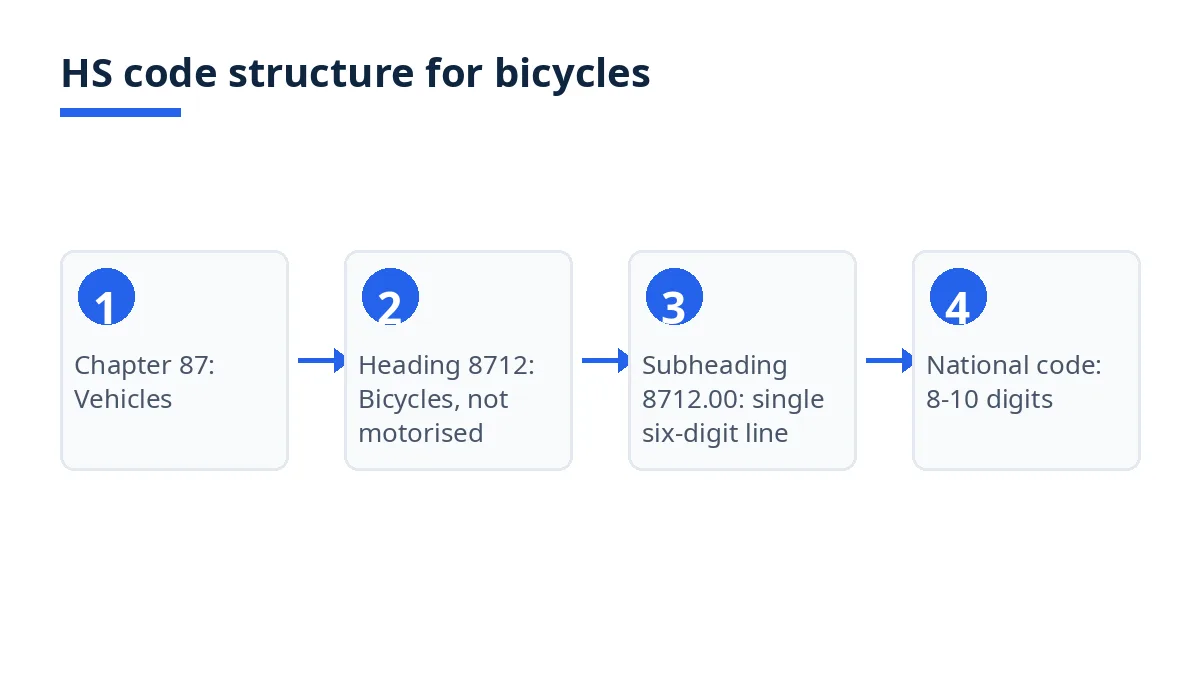
For bicycles, the build-up is short: chapter 87, heading 8712, and subheading 8712.00 as the only six-digit line under that heading.1 The EU Combined Nomenclature uses eight-digit codes,5 and the United States and the United Kingdom work to ten digits.
Read the HS code explainer for the full structure, and the step-by-step classification guide for the method used to reach a code.
Factors that decide the code for bicycles
Motorised or not is the first test. Heading 8712 covers cycles that are not motorised.1 A cycle fitted with an auxiliary motor is tested under heading 8711, which covers motorcycles and cycles fitted with an auxiliary motor; the United States schedule lists cycles with an electric motor for propulsion there, with a separate line for output not exceeding 250 W.2 Record motor type and output, and test the motorised line first whenever a motor is present.
Complete cycle or parts shipment. Parts of vehicles of headings 8711 to 8713 sit in heading 8714, with frames and forks at 8714.91 and other parts across 8714.92 to 8714.99.2 The exception is the unassembled or incomplete cycle: under General Rule of Interpretation 2(a), a reference to an article includes that article incomplete or unfinished, provided that, as presented, it has the essential character of the complete article, and includes a complete article presented unassembled or disassembled.3 A knocked-down bicycle that together makes a complete bicycle is therefore tested as a bicycle, while bulk parts with no complete-cycle character stay in heading 8714. Declare complete cycles and surplus parts on separate lines.
Wheel size decides the United States line. The United States schedule splits heading 8712 by wheel diameter, not by bicycle type. Bicycles with both wheels not exceeding 63.5 cm sit at 8712.00.15, with suffixes for both wheels not exceeding 50 cm, exceeding 50 cm but not exceeding 55 cm, and exceeding 55 cm but not exceeding 63.5 cm.2 Larger-wheel bicycles split at 8712.00.25 for a bicycle under 16.3 kg complete without accessories with tires not exceeding 4.13 cm in cross-section, 8712.00.35 for other larger-wheel bicycles, and 8712.00.44 for a mixed-wheel bicycle under the same limits valued at 200 dollars or more each.2 Other bicycles take 8712.00.48, and other cycles take 8712.00.50.2
Ball bearings decide the EU and UK eight-digit line. In the EU and UK tariffs, the eight-digit split inside 8712.00 turns on bearings, not wheel size: bicycles with ball bearings sit at 8712 00 30, and other cycles sit at 8712 00 70.3
Children's bicycles stay in 8712; other children's cycles do not. Chapter 87 note 4 states that heading 8712 includes all children's bicycles, while other children's cycles fall in heading 9503.3 A child's tricycle, scooter, or pedal car that is not a bicycle needs the heading 9503 test instead.
Frame material and bicycle type do not split the six-digit code. Steel, aluminium, and carbon frames, and road, mountain, city, folding, and cargo models, all start from the same subheading 8712.00.1 Record them anyway: they can matter in the national digits, for example the United States weight and tire limits.
National codes: US HTS, EU CN/TARIC, UK commodity code
United States: HTS, ten digits. Start from 8712.00 and read the wheel-diameter lines in full: the 8712.00.15 group for both wheels not exceeding 63.5 cm, split by the 50 cm and 55 cm bands; the larger-wheel lines at 8712.00.25, 8712.00.35, and the mixed-wheel line at 8712.00.44; other bicycles at 8712.00.48; and other cycles at 8712.00.50.2 A published ruling illustrates the small-wheel line: a boys bicycle with a 16 inch diameter wheel was classified at 8712.00.1510, within the suffix for both wheels not exceeding 50 cm in diameter.6
European Union: CN at eight digits, TARIC for measures. The Combined Nomenclature uses eight-digit codes, building on the six-digit HS subheading with EU subdivisions.5 For bicycles, the eight-digit lines are 8712 00 30 for bicycles with ball bearings and 8712 00 70 for other cycles, as shown in the UK tariff pages that share the same eight-digit structure.3 Read the confirmed line in TARIC for the entry date, and do not carry a United States wheel-diameter suffix into an EU entry.
United Kingdom: commodity code, ten digits. The UK tariff lists the same eight-digit lines and extends them to ten digits.3 Under 8712 00 30, the ten-digit lines split by consignment origin group, at 8712 00 30 10, 8712 00 30 20, and 8712 00 30 90.3 Under 8712 00 70, the ten-digit lines include 8712 00 70 10 for unicycles and 8712 00 70 91, 8712 00 70 92, and 8712 00 70 99 for other cycles by consignment origin group.3 Take the full code from the UK Trade Tariff for the goods and the entry date.
How to confirm the code officially
Write a precise description: complete or unassembled, motor type and output if any, both wheel diameters, weight complete without accessories, tire cross-sectional diameter, bearing type, and the count of complete cycles the shipment can build.
Start from the official tariff for the destination: the United States HTS, TARIC, or the UK Trade Tariff, and read the heading text and chapter notes first.
Check published rulings for similar cycles, such as the United States ruling for a 16 inch boys bicycle at 8712.00.1510.6 A ruling on a different wheel size is not a ruling on your bicycle.
For a borderline case, such as a knocked-down shipment where the essential-character test is arguable, apply for a binding decision before you ship. In the EU, a Binding Tariff Information application needs a separate application for each type of product and a detailed description of the goods.7 In the United Kingdom, a legally binding decision is generally valid for 3 years, through an Advance Tariff Ruling.8
Give your broker the description and the confirmed code for each model, and use the same codes throughout the entry. Re-check the code when the specification changes: a new motor, a different wheel size, or a change of bearing type can move the national line even when the first six digits stay at 8712.00.
Common classification mistakes
Filing a motor-assisted cycle under 8712. Heading 8712 covers cycles that are not motorised.1 A motor moves the test to heading 8711.2
Filing a parts shipment as bicycles. Parts of headings 8711 to 8713 sit in heading 8714.2 Only a shipment with the essential character of a complete bicycle is tested as a bicycle under General Rule 2(a).3
Filing a child's non-bicycle cycle under 8712. Heading 8712 includes all children's bicycles, but other children's cycles fall in heading 9503.3
Copying a national line across countries. The United States splits by wheel diameter, while the EU and UK split at eight digits by ball bearings.2 3
Inventing a six-digit split. There is one six-digit line under heading 8712, namely 8712.00.1
Using a ruling for a different model. The 16 inch boys bicycle ruling at 8712.00.1510 turns on its own wheel size.6 A 26 inch adult bicycle, a delivery tricycle, and a unicycle each need their own line from the tariff.
Related duties and documents
This guide states no duty rates: the code decides which duty line customs applies, and a line for a small-wheel bicycle does not carry to a larger-wheel, mixed-wheel, or other-cycle line. Read the rate beside your confirmed code for your origin and entry date, and check what proof of origin a preference claim requires.
Keep the specification sheet, the confirmed codes, any binding decision, and the origin evidence together in the shipment file, with each model as a separate invoice line. The sheet should carry, for each model: complete or unassembled state, motor details if any, both wheel diameters, weight complete without accessories, tire cross-sectional diameter, bearing type, the count of complete cycles, and the consignment origin where the UK ten-digit line requires it. List cycles and spare parts separately where a shipment mixes them.
FAQs
What is the HS code for bicycles?
Non-motorised bicycles point indicatively to heading 8712, at subheading 8712.00, which covers bicycles and other cycles, including delivery tricycles, that are not motorised.1 The full code runs to eight digits in the EU and ten digits in the United States and the United Kingdom.
Is the HS code the same in every country?
Only the first six digits are shared. Countries subdivide the six-digit categories into national subheadings.5 The United States splits heading 8712 by wheel diameter,2 while the EU and UK split at eight digits by ball bearings,3 so the full code is not the same in every country.
How do I confirm the correct code?
Describe each model precisely, read the heading text and chapter notes in the destination tariff, and check published rulings for similar cycles, such as the United States ruling for a 16 inch boys bicycle at 8712.00.1510.6 For a borderline case, apply for a binding decision before shipping: a Binding Tariff Information decision in the EU7 or an Advance Tariff Ruling in the United Kingdom, generally valid for 3 years.8
What happens if I use the wrong code?
Duty, licensing, and quota treatment are worked out from the code on the declaration, so a wrong code brings the wrong treatment. A legally binding decision helps you calculate the duties and restrictions that will apply in advance.8 If you find an error after filing, tell your broker promptly.
Next steps on Exportain
Browse Bangladeshi suppliers on Exportain and send your specification sheet, including wheel diameters, bearing type, and motor details where relevant, with your enquiry. The HS code explainer is the background read, and the step-by-step classification guide sets out the method for testing a code before you file. Exportain is not a party to the goods contract and does not inspect goods, book freight, or clear customs.
Sources
- HS, 2012 - Code 8712: Bicycles and other cycles, including delivery tricycles, not motorised. United Nations Statistics Division (accessed )
- Harmonized Tariff Schedule of the United States, Chapter 87. CustomsMobile (U.S. HTS Chapter 87) (accessed )
- Bicycles and other cycles (including delivery tricycles), not motorised - UK Integrated Online Tariff, heading 8712. GOV.UK, HM Revenue and Customs (accessed )
- What is the Harmonized System (HS)?. World Customs Organization (accessed )
- Harmonised System. European Commission (accessed )
- Customs Ruling NY N292674 - Classification of bicycles from Cambodia. U.S. Customs and Border Protection (accessed )
- European Binding Tariff Information (EBTI). European Commission, Taxation and Customs Union (accessed )
- Check what you'll need to get a legally binding decision on a commodity code. GOV.UK, HM Revenue and Customs (accessed )
About the author
Sourcing from Bangladesh?
Post a request for quotation and suppliers on Exportain can send you their quotes directly.
Post an RFQ